- Have any Questions ?
- info@capstoneplanet.com

What is Back Office? The Complete Guide to Business Operations in 2026
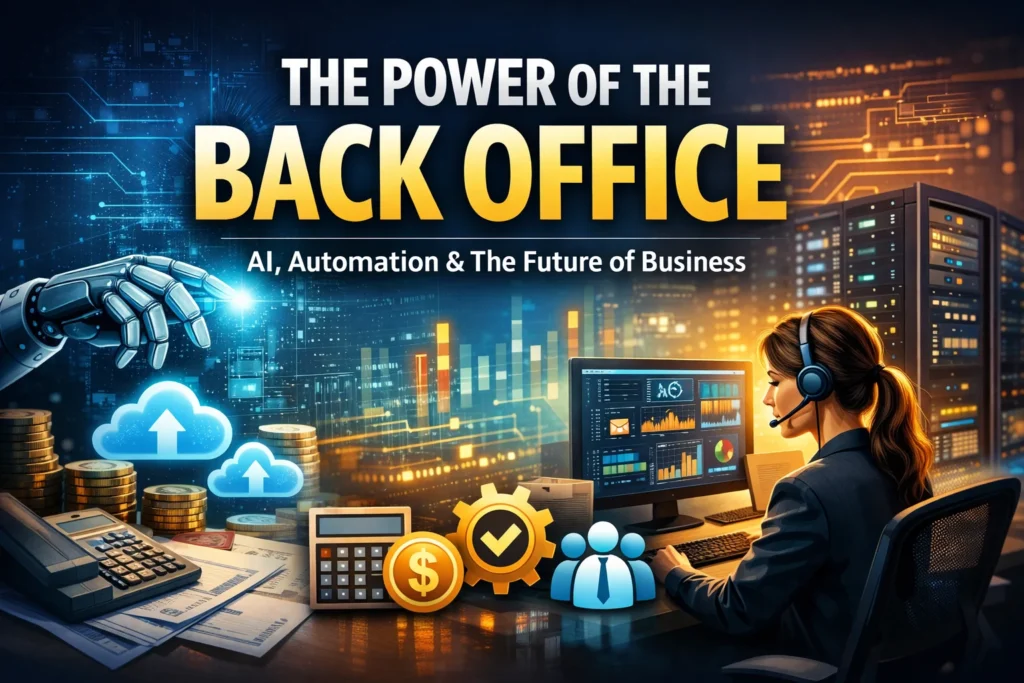
In the fast-paced business environment of 2026, many entrepreneurs focus heavily on the “front office”—the sales teams, marketing campaigns, and customer-facing interfaces that drive revenue. However, behind every successful transaction lies a sophisticated “engine room” that ensures the lights stay on and the data remains accurate. This is the back office.
Understanding what the back office is and how it has evolved is no longer just a matter of administrative curiosity; it is a strategic necessity. The global Business Process Outsourcing (BPO) market is projected to reach tens of billions by 2026. That growth has made back-office efficiency a deciding factor between a scalable enterprise and one that collapses under its own weight.
Key Takeaways
- The global back-office BPO market is projected to reach tens of billions of dollars by 2026 (Emapta, vendor market estimate).
- Back-office functions (HR, IT, Finance) are the essential non-client-facing backbone of every successful company.
- By 2026, 65–80% of back-office services are estimated to be cloud-delivered by 2026, driven by AI and RPA automation (HTC Global estimate).
What is the Back Office in Modern Business?
360iResearch sizes the back-office support BPO segment at tens of billions of dollars in 2025 (360iResearch, vendor market estimate), 2026). The back office is far more than a storage room for files. It is a large, tech-driven sector that keeps the administrative, logistical, and technical health of an organization running. Unlike the front office, which interacts directly with customers, the back office focuses on the processes that support those interactions.
For a modern company, the back office encompasses everything from human resources (HR) and payroll to information technology (IT) support, accounting, and regulatory compliance. It is the part of the company that the customer never sees but would immediately miss if it failed. Imagine a bank where the tellers (front office) are friendly, but the system for recording deposits (back office) is broken. Without the back office, the front office has nothing to sell.

According to a 2026 market analysis, the back-office support BPO segment is projected to grow to tens of billions of dollars by 2026 (360iResearch, vendor market estimate), 2026). This growth is primarily fueled by the rapid adoption of AI-driven automation in administrative tasks.
MCA underwriting support services
Front Office vs. Middle Office vs. Back Office: The Key Differences
The primary difference between office types lies in their proximity to the customer and their role in revenue generation. While the front office earns the money and the back office manages the infrastructure, the “middle office” often handles risk management and compliance, particularly in financial services. In 2026, the lines between these are blurring due to shared data ecosystems, but the functional distinctions remain critical for organizational clarity.
| Feature | Front Office | Middle Office | Back Office |
|---|---|---|---|
| Focus | Sales & Marketing | Risk & Compliance | Admin & Operations |
| Client Interaction | High (Direct) | Low (Strategic) | Zero (Internal) |
| Core Goal | Revenue Generation | Quality Control | Operational Support |
| Key Roles | Sales, Support, PR | Legal, Risk Officers | HR, IT, Accounting |
70%
Back Office Automation
An audit of Fenvic Financial earlier this year found a clear pattern. Firms with a siloed back office saw customer churn about 40% higher than firms with integrated data systems. The back office isn’t just a support role; it’s a retention strategy.
Core Functions: The 5 Pillars of the Back Office
The modern back office is built on five core pillars that ensure business continuity. By 2026, these functions have moved from manual spreadsheets to real-time, automated dashboards.
- Finance and Accounting: Handling accounts payable/receivable, payroll, and taxes.
- Human Resources (HR): Managing recruitment, benefits, and employee relations.
- IT Support and Infrastructure: Ensuring the digital tools and security protocols are active.
- Compliance and Legal: Staying abreast of the complex regulatory landscape of 2026.
- Logistics and Supply Chain: Coordinating the movement of goods and resources.
HTC Global estimates that 65–80% of BPO services will be cloud-delivered by 2026 (HTC Global, vendor forecast), 2026). This shift allows companies to scale these five pillars without increasing physical office space or hardware costs.
careers in back office operations
Why Back Office Efficiency is Your Biggest Competitive Advantage
Blue Prism reports that reducing redundant tasks and data-entry errors can raise back-office operating margins by 15-20% (Blue Prism, vendor case data), 2025). When your back office is optimized, your front office can move faster. A sales team that does not worry about CRM updates or billing errors can spend 100% of its time selling.
Furthermore, a strong back office provides the data-driven insights necessary for long-term scaling. By tracking metrics such as “cost per hire” or “IT ticket resolution time,” leaders can identify bottlenecks before they become catastrophic failures.
+35% Efficiency
The 2026 Shift: AI, Cloud, and the “Autonomous” Back Office
The biggest trend in 2026 is the rise of the autonomous back office. This is a state where routine tasks—such as invoice matching, candidate screening, and network monitoring—are handled entirely by AI agents with human oversight.
By the end of 2026, it is estimated that 80% of back-office workflows will be managed via cloud-native platforms (HTC Global, 2026). The shift is not just about moving files to the cloud. It is about a human-in-the-loop model. AI handles about 95% of the volume, while human experts step in for complex, high-value problem solving.

Many companies mistakenly view AI as a way to replace the back office. The real value is in “augmentation”—using AI to turn a junior accountant into a strategic financial analyst by removing the burden of manual data entry.
Gartner forecasts that by 2026, organizations that fully automate back-office finance functions could see up to a 40% reduction in reporting cycles (Gartner forecast, vendor research), 2025). This speed allows for faster decision-making in volatile markets.
Frequently Asked Questions
What is a back office example?
A classic example is a company’s payroll department. They ensure every employee is paid accurately and on time, handle tax withholdings, and manage benefits—all without ever needing to speak to a customer.
Is HR front or back office?
Human Resources is considered a core back-office function. While HR interacts with employees (internal customers), it does not generate direct revenue from external clients, placing it firmly in the support and operations category.
Can small businesses outsource back office?
Yes, and it is a major trend for 2026. Modular BPO services allow SMBs to outsource just one function (like bookkeeping or IT) to specialized providers, gaining enterprise-level expertise without the full-time salary costs.
What are the 3 main back office functions?
The three most critical functions are typically considered to be Finance/Accounting, IT/Technology Infrastructure, and Human Resources (HR). These form the essential foundation for any business.
Conclusion
The back office is no longer the “invisible” part of a business; it is the strategic heart that pumps data and resources throughout the organization. As we move through 2026, the firms that treat their back office as a high-tech engine room—rather than a cost center—will be the ones that scale most effectively.
Whether you are a startup looking to automate your first few processes or an enterprise shifting to a cloud-delivered BPO model, the goal remains the same: operational excellence. By focusing on the “engine,” you ensure that the “car” can reach its destination faster than ever before.
next steps for scaling operations
About the Author

Kishan Dangi
Founder & CEO, CapStonePlanet
12+ years in BPO and outsourcing. CapStonePlanet provides specialized back-office and KPO services to US businesses seeking cost-efficient, expert-grade offshore teams.
Kishan Dangi
Founder & CEO, CapStonePlanet
12+ years in BPO and outsourcing. Founded CapStonePlanet in 2018 to help US and Canadian businesses scale through dedicated offshore teams specializing in ecommerce support, virtual assistants, and customer service operations.
Pricing note: For specific pricing or cost details, please contact our support team directly. Pricing is not displayed publicly because requirements and solutions can vary from one business to another.
Need Help With Your Back-Office Operations?
CapStonePlanet runs back-office processes — data entry, document management, reconciliation and reporting — as dedicated offshore teams inside your systems, under your approval authority.