- Have any Questions ?
- info@capstoneplanet.com

AI Answering Systems vs. Human Receptionists: Choosing the Right Model (2026)
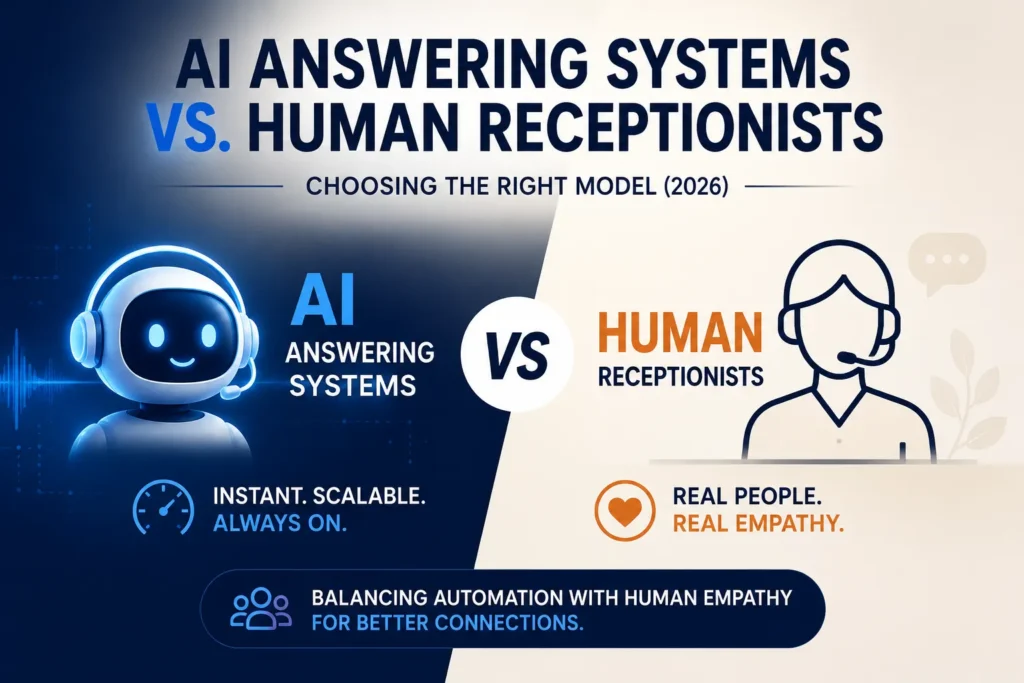
For small businesses and enterprise operations alike, the first point of contact—the inbound phone call—remains the most critical interaction. The choice is no longer a simple binary between “a machine or a person.” It is about strategically balancing operational efficiency with emotional intelligence.
Traditional answering services rely entirely on human call centers, which are subject to shift schedules, high turnover, and scaling limitations. Modern solutions deploy AI virtual receptionists capable of handling natural language conversations, scheduling appointments, and qualifying leads with near-human fluency. But applying AI to every interaction often creates unnecessary friction.
The objective is to deploy automation where it drives speed, and reserve human capital for moments that require nuanced empathy.
The Evolution of the Virtual Receptionist
In the past, automated answering systems were little more than interactive voice response (IVR) menus: “Press 1 for Sales, Press 2 for Support.” These systems frustrated callers and often led to immediate hangups.
Today’s AI answering systems operate on natural language processing. They can detect intent, parse complex multi-part questions, and integrate directly with CRM systems to book calendar slots or trigger email workflows autonomously. However, they still lack genuine human empathy.
Head-to-Head Comparison: Efficiency vs. Empathy
Comparing First-Contact Architectures
| Feature | AI Answering System | Human Virtual Receptionist |
|---|---|---|
| Availability | 24/7/365 (Zero downtime) | Scheduled shifts (Overtime/Premium costs) |
| Concurrency Capacity | Infinite (Zero hold times during spikes) | Strictly limited by active agent count |
| Empathy & Tone | High but simulated | Genuine, natural, and adaptable |
| Problem Complexity | Best for routine tasks (scheduling, FAQs) | Best for nuanced, emotionally charged issues |
| Cost Structure | Fixed or Subscription-based | Hourly or Per-minute billing |
| Data Accuracy | 100% on CRM data entry (no typos) | Variable based on agent fatigue |
The 4-Layer Hybrid Call Routing Framework
To maximize ROI, businesses are adopting a hybrid model.
The 4-Layer Hybrid Call Framework
- Layer 1: The AI Frontline – All incoming calls hit the AI system first for immediate greeting, zero hold times, and basic intent capture.
- Layer 2: Routine Resolution – The AI autonomously handles scheduling, business hours inquiries, and basic lead qualification.
- Layer 3: Sentiment Escalation – If the AI detects frustration, urgency, or complex medical/legal inquiries, it instantly routes the call to a human.
- Layer 4: Human Closure – The human agent receives the call along with a real-time transcript of what the AI already collected, avoiding repetitive questions.
Real Operational Examples
We see clear dividing lines where AI wins on efficiency and where humans win on trust.
High Volume, Low Complexity
A local dental clinic receives 40 calls a day asking for their location or attempting to reschedule routine cleanings. An AI answering system handles these simultaneously, entering the data directly into the scheduling software. The clinic saves the cost of a full-time desk worker.
Lead Capture at 3:00 AM
A plumbing company runs 24/7 emergency ads. A lead calls at 3:00 AM. A human answering service might take 5 minutes to answer, causing the lead to hang up and call a competitor. The AI answers instantly, qualifies the emergency, and pages the on-call plumber immediately.
Complex Judgment Calls
A law firm receives a call from a distressed individual involved in an accident. An AI cannot provide the necessary emotional reassurance. Here, a human receptionist excels by navigating the gray areas, understanding the context, and building immediate trust with the caller.
Friction & Industry Reality: The Limits of AI
Implementing an AI answering system is not without friction. Many businesses mistakenly deploy AI without a human fallback, leading to disastrous customer experiences when the AI encounters a novel problem. Furthermore, AI systems struggle with heavy accents, poor audio quality, and highly technical jargon unless specifically trained.
Internal resistance is also common. Sales teams often worry that AI will mishandle high-value leads. Without a seamless “warm transfer” protocol to a human agent, the AI can become a barrier rather than an assistant.
Hard Statistics: 2026 Frontline Benchmarks
- Cost Reduction: AI answering systems can reduce frontline operational costs by up to 65% compared to fully staffed 24/7 human centers.
- Abandonment Rates: Deploying AI as the first line of defense reduces call abandonment rates to near zero, as callers are greeted instantly.
- Lead Conversion: Businesses using 24/7 AI lead capture report a 22% increase in captured after-hours leads.
The 5-Level First-Contact Maturity Model
- Level 1: Voicemail. Calls go to a static recording after hours.
- Level 2: Basic IVR. “Press 1 for Sales.” Frustrating but functional.
- Level 3: Human Answering Service. Outsourced humans take messages but cannot resolve complex CRM tasks.
- Level 4: Autonomous AI. AI handles calls end-to-end but struggles with complex escalations.
- Level 5: The Hybrid Engine. AI handles routine volume and data entry, seamlessly escalating complex or emotional calls to human specialists with full transcripts.
Frequently Asked Questions
What is the main advantage of an AI answering system?
The primary advantage is infinite scalability and immediate response. AI can handle 100 calls simultaneously without placing anyone on hold, ensuring zero missed leads and 24/7 availability at a fraction of the cost of human staff.
Can an AI receptionist schedule appointments directly?
Yes. Modern AI systems integrate directly with calendar and CRM software (like Calendly, Salesforce, or industry-specific tools) to check availability and book appointments in real-time.
When should a business use a human answering service instead?
Human receptionists are essential for industries dealing with high-stress, sensitive, or complex situations—such as legal defense, specialized healthcare, or high-ticket B2B sales—where genuine empathy and nuanced judgment are critical.
How does a hybrid answering model work?
In a hybrid model, an AI answers every call instantly to eliminate hold times and handle basic tasks. If the caller has a complex issue or requests a human, the AI seamlessly transfers the call (and the transcript) to a live human agent.
Are AI answering systems expensive to implement?
No. They are highly cost-effective. Most operate on a fixed monthly subscription or per-minute usage model, which is significantly cheaper than the salary, benefits, and overtime costs associated with hiring 24/7 human staff.
Executive Summary
The debate between AI and human receptionists is no longer an “either/or” proposition. The most competitive businesses in 2026 are deploying hybrid models. By leveraging AI answering systems to handle routine, high-volume tasks and utilizing human agents for complex, high-value interactions, operations can maximize efficiency without sacrificing customer trust.
Written by the CapStonePlanet Operations Team
We specialize in designing intelligent frontline solutions, integrating advanced AI receptionists with elite human support to optimize your inbound strategy.
About the Author

Kishan Dangi (KK Patel)
Founder & CEO, CapStonePlanet
12+ years in BPO and outsourcing. Founded CapStonePlanet in 2018 to help US and Canadian businesses scale through dedicated offshore teams specializing in ecommerce support, virtual assistants, and customer service operations.
Pricing Notice: Pricing and savings vary depending on volume, scope, workflow requirements, and service configuration. Contact our team for detailed pricing and a customized estimate.