- Have any Questions ?
- info@capstoneplanet.com

Agentic AI in Customer Experience: Beyond Chatbots to Autonomous Service (2026)
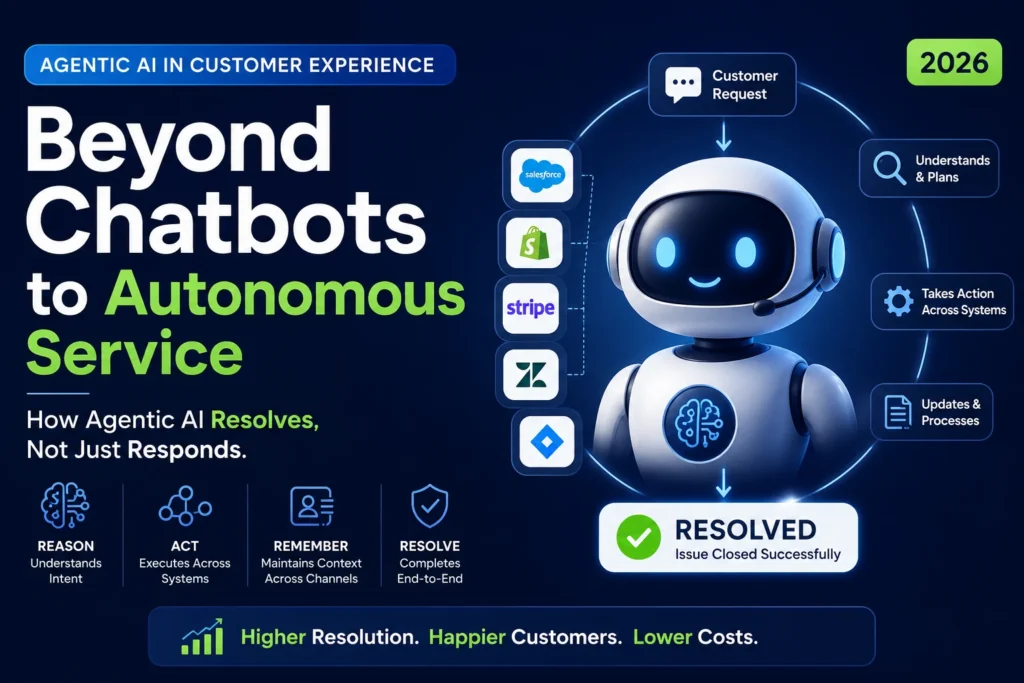
Most organizations deploying customer service automation eventually hit a hard ceiling. By the time a support ticket reaches a human, it’s usually because the conversational AI chatbot failed to understand the context, hit a logic dead-end, or lacked the backend access to execute a fix. The industry is shifting away from rigid automated responses toward a fundamentally different model. Agentic AI doesn’t just read scripts; it acts as an autonomous digital worker that executes end-to-end workflows.
The distinction between automating tasks and deploying autonomous agents defines the competitive baseline in 2026. While legacy systems require you to map out every possible customer decision tree, an Agentic AI system receives a goal—like “reconcile this billing dispute”—and independently queries databases, checks usage logs, and applies necessary account credits without human intervention.
This approach isn’t about replacing your support team. It’s about offloading the high-volume, logic-heavy transactional work so your human agents can handle escalations that require genuine emotional intelligence and complex judgment.
LAMs vs. LLMs: The Architectural Difference in Customer Service
To understand why traditional bots fail, we have to look at the underlying architecture. Standard chatbots run on Large Language Models (LLMs). They are exceptional at parsing language, summarizing text, and holding a conversation. However, when asked to do something, they hit a wall.
Agentic AI operates on Large Action Models (LAMs). These models are specifically trained not just to talk, but to interact with user interfaces and enterprise software. Where an LLM generates a text response explaining how to process a return, a LAM-driven agentic system physically interfaces with your logistics software to issue the return label and authorize the refund.
The Difference Between Automated Support and Agentic Service
Traditional chatbots operate on strict “if/then” logic. When a customer asks a question outside those mapped boundaries, the bot escalates. Agentic AI breaks down complex intents into sequential steps, using enterprise APIs as tools to solve the problem dynamically.
Comparing CX Architectures: Traditional Bot vs. Agentic System
| Capability Metric | Legacy Chatbots (2023) | Agentic AI Systems (2026) |
|---|---|---|
| Logic Processing | Keyword matching and static decision trees | Goal-oriented reasoning and multi-step planning |
| Context Memory | Single-session, stateless interactions | Long-term, stateful omnichannel context continuity |
| Integration Burden | Superficial (read-only access via plugins) | Deep (read/write access across CRM, billing, and ERP) |
| Resolution Capacity | Escalate 60%+ of complex technical issues | Autonomously resolve end-to-end workflows |
| Auditability | Basic chat transcripts | Complete logic logs tracking decision paths and tool usage |
The 4-Layer Agentic CX Orchestration Engine
To deploy true autonomous service, organizations cannot rely on a single model. The architecture requires a structured orchestration engine to manage the workflow safely.
The 4-Layer Agentic CX Stack
- Layer 1: The Orchestration Engine (The Brain) – Analyzes the customer’s raw input, determines the end goal, and dynamically plans the execution steps utilizing RAG (Retrieval-Augmented Generation) for immediate operational context.
- Layer 2: The Action Space (The Hands) – The integrated API endpoints (Salesforce, Stripe, Zendesk) the agent is authorized to use.
- Layer 3: The Context Memory (The State) – Real-time tracking of what the agent has already done during the session, establishing omnichannel context continuity and preventing repetitive loops.
- Layer 4: The Guardrails (The Brakes) – Strict, hard-coded policy engines that prevent the AI from issuing unauthorized refunds or accessing restricted data (Bounded Execution).
Real Operational Examples of Agentic AI in Customer Support
We see the most immediate ROI when Agentic AI tackles workflows that typically force human agents to toggle between three or four different screens.
Autonomous Dispute Resolution in Billing
Consider a telecom customer arguing that their data overage charge is incorrect. A standard conversational AI chatbot points them to the pricing page. An Agentic AI agent securely checks the network usage database, compares it against the customer’s contract terms in the CRM, identifies a backend logging error during a specific timeframe, and autonomously issues a prorated credit. It then emails the customer a precise breakdown of the correction.
Hyper-Personalized Software Onboarding
In SaaS onboarding, generic product tours fail because they assume a uniform starting point. An Agentic AI system queries the new user’s specific tech stack, provisions their custom API keys in the background, and dynamically guides them through setting up their unique integration—adjusting its instructions based on the error codes the user encounters in real-time.
Real-Time Sentiment Steering & Churn Prevention
Instead of waiting for a post-call survey, Agentic AI monitors ongoing interactions. If it detects rising frustration based on lexical analysis and interaction delays, it autonomously alters the workflow. It might skip standard troubleshooting steps and instantly authorize an appeasement offer or route the interaction to a specialized retention agent with a high-priority flag.
Friction & Industry Reality: Guardrails and Implementation Hurdles
Most carriers and enterprise brands are not operationally ready for true Agentic AI. The marketing promises plug-and-play autonomy, but implementing agentic AI in legacy CRM systems hits structural roadblocks.
The primary point of failure is data silos. An autonomous digital worker cannot resolve a shipping error if your logistics database doesn’t speak to your front-end CRM. Legacy systems built on SOAP or lacking well-documented REST APIs force deployment teams to build brittle RPA bridges, which break every time a UI updates.
Internal conflicts also slow adoption. Compliance teams routinely veto giving an AI “write access” to billing systems due to fear of autonomous hallucination. This is where Bounded Execution and strict Guardrails become mandatory. Without robust, auditable guardrails—where the AI’s reasoning is logged, mathematically verified, and restricted by hard-coded enterprise policy rules—projects remain permanently stuck in sandbox testing.
The 5-Level Agentic CX Adoption Maturity Model
Understanding where your operations sit helps set realistic automation timelines.
- Level 1: Scripted Deflection. Standard decision trees handling FAQs. No backend integration.
- Level 2: Contextual Retrieval. AI reads from the CRM to provide personalized answers (e.g., “Your package arrives Tuesday”) utilizing RAG, but cannot execute changes.
- Level 3: Guided Action. AI suggests necessary actions to a human agent, drafting responses and pre-filling required forms for human approval.
- Level 4: Bounded Autonomy. The AI autonomously handles specific, pre-approved workflows end-to-end (like password resets or sub-$50 refunds) but escalates anything outside strict guardrails.
- Level 5: Full Agentic Resolution. The AI handles novel, unscripted problems by reasoning through required steps, utilizing all available enterprise tools to achieve the customer’s goal autonomously.
Hard Statistics: The 2026 Agentic AI CX Benchmarks
- Cost Per Resolution: How does agentic AI reduce BPO costs? Implementations are driving the cost per resolved ticket down to $0.40, compared to $6.00+ for human-handled interactions in standard models.
- First Contact Resolution (FCR): Deployments utilizing deep CRM integrations show FCR improvements of up to 35% within the first quarter.
- Agent Handle Time: When operating in an “agent-assist” capacity, AI orchestration reduces average handle time by 40% simply by eliminating the need to search multiple knowledge bases.
- System Latency: Top-tier LAMs execute complex, multi-system queries in under 1.5 seconds, matching human conversational pacing.
The “Human-in-the-Loop” Synergy
Agentic AI does not eliminate the need for human agents; it shifts their role from data-gatherers to decision-makers. When an interaction surpasses the AI’s autonomous threshold—whether due to policy guardrails or emotional complexity—the system executes a warm handoff to a human representative.
Crucially, the human agent does not start from scratch. They receive a comprehensive summary detailing exactly what the AI attempted, which databases it queried, and what potential solutions it proposes. This enables the human agent to bypass the repetitive discovery phase and immediately address the core issue.
Frequently Asked Questions
What is the difference between Generative AI and Agentic AI in customer service?
Generative AI creates text or content based on prompts, excelling at summarization and drafting. Agentic AI is an autonomous digital worker that takes actions. It uses reasoning to break down goals into steps and interacts directly with software tools via APIs to complete those tasks without human prompting.
Can Agentic AI autonomously process billing refunds?
Yes, provided it operates within a system of Bounded Execution. Agentic AI can analyze usage logs, identify discrepancies, and issue refunds autonomously, but only up to hard-coded financial limits established by your compliance team.
How do guardrails work in an Agentic AI support system?
Guardrails are strict policy engines that sit above the AI model. They act as “brakes.” If the Agentic AI attempts an action that violates company policy—such as altering a critical contract term or issuing a refund above a set threshold—the guardrail mathematically blocks the API call and forces a human escalation.
What is the ROI of replacing traditional bots with Agentic AI?
The primary ROI comes from moving beyond simple ticket deflection to actual ticket resolution. By autonomously completing multi-step workflows, organizations reduce their cost per resolution from $6.00+ to under $0.40, while simultaneously improving First Contact Resolution rates by up to 35%.
Will Agentic AI replace human BPO agents?
No. It replaces transactional, repetitive tasks. Human agents transition into handling complex escalations, emotional grievance management, and high-value retention efforts that require empathy, nuanced judgment, and lateral thinking that AI cannot replicate.
Executive Summary & ROI Realities
The transition to Agentic AI marks the end of brute-force scaling in customer experience. By shifting from conversational bots to autonomous digital workers that reason and execute, operations can finally decouple ticket volume from headcount. The ROI is undeniable for those who invest the time to integrate their data silos and establish robust API guardrails. For those who delay, the gap in cost-efficiency and customer satisfaction will become insurmountable.
Written by the CapStonePlanet AI Strategy Team
We engineer high-leverage BPO solutions by integrating advanced Agentic AI architectures with elite human-in-the-loop support operations.
About the Author

Kishan Dangi (KK Patel)
Founder & CEO, CapStonePlanet
12+ years in BPO and outsourcing. Founded CapStonePlanet in 2018 to help US and Canadian businesses scale through dedicated offshore teams specializing in ecommerce support, virtual assistants, and customer service operations.
Pricing Notice: Pricing and savings vary depending on volume, scope, workflow requirements, and service configuration. Contact our team for detailed pricing and a customized estimate.