- Have any Questions ?
- info@capstoneplanet.com

HR Outsourcing Companies: How to Choose the Right Model in 2026
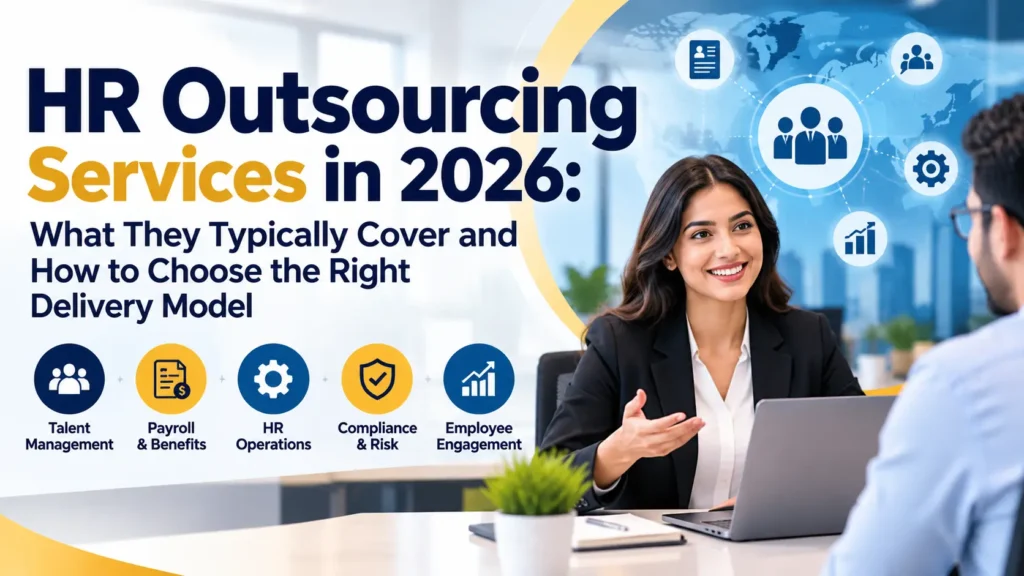
An HR outsourcing company is a third-party firm that takes over named HR functions such as payroll, benefits administration, compliance, recruitment and recordkeeping under a service agreement, while the client usually remains the employer of its staff. That single distinction, between moving a task and moving an employment relationship, is what separates a sound selection from an expensive mistake, and it is where most buying processes go wrong.
This guide is about HR outsourcing companies as businesses you select and manage, not as a definition to memorise. It covers what these companies are, what they actually do, who they suit, why choosing well matters, the benefits, the risks, and the practical work of shortlisting and transitioning.
One thing worth knowing before you start looking at names. The market definition you meet on most vendors of these services is broad: Workday describes HR outsourcing as engaging third-party providers to manage some or all HR activities from payroll and benefits to recruiting and compliance, and it names PEO co-employment inside that definition F5. That breadth is why two providers quoting different prices often turn out to be selling fundamentally different things.
If you are still deciding whether outsourcing fits at all, the wider guide to outsourcing as a scaling model is the better starting point. If you already know you want a provider and you are hunting for named vendors, the top RPO companies comparison is the list-shaped asset on this site; this page deliberately does not publish a ranked list of providers, because a ranking without verified review, pricing or performance data behind it is not worth the paper it is printed on.
Throughout, two buyer profiles are carried forward so the advice stays concrete: a 45-employee professional services firm with no dedicated HR staff, and a 400-employee firm with a two-person HR team.
What Is an HR Outsourcing Company?
An HR outsourcing company is an organisation that contracts to run specific HR functions on behalf of other employers, under a written agreement that defines scope, fees and service levels. It is not a software product and not a staffing agency, even though the market uses the three interchangeably.
Provider scope clusters into five function groups: payroll processing and multi-state tax filing, benefits administration, compliance and recordkeeping, recruitment and onboarding, and employee relations administration. Training administration is often included as a sixth. Capstone Planet’s own definition page frames HR outsourcing as contracting these functions to an external provider and places the activity under business process outsourcing F1. Workday’s definition adds the co-employment variant into the same bucket F5.
Why the definition matters commercially. A provider company that runs payroll for you leaves you as the employer. A PEO co-employs your staff with you, which changes benefits contracts, tax filings and legal exposure. If you compare a PEO bid against a payroll bureau bid as though they were the same offer, you will misread both the price and the risk.
Where the term lets you down. It is used loosely. One provider’s HR outsourcing is a payroll tool with a helpdesk; another’s is a fully staffed HR department. The term tells you almost nothing until you read the scope schedule.
| Provider type | What is transferred | Who employs the worker | What the buyer receives |
|---|---|---|---|
| HR outsourcing company (HRO) | Named HR functions and the staff who run them | The client | A managed service against agreed service levels |
| HR software vendor (HRIS / HCM) | Nothing; you operate the system | The client | A platform and support, with configuration still yours |
| Staffing agency | Sourcing and placement | The client, usually, once placed | Candidates or temporary labour |
| PEO | HR administration plus co-employment | Shared with the PEO | HR service packaged with access to the provider’s benefits and workers’ compensation arrangements |
For a fuller treatment of the outsourcing relationship itself, the what is HR outsourcing explainer covers the concept, and the RPO guide covers the recruitment function in depth.
What Do HR Outsourcing Companies Actually Do?
The work splits cleanly into administrative execution, which outsources well, and judgement calls that stay with the employer. Providers do the former at scale and advise on the latter rather than absorbing it.
The table below is the coverage map. Read the final two columns first: the function that transfers and the duty that does not.
| Function | What it covers | Typical provider type | What the client still owns | Related regulation |
|---|---|---|---|---|
| Payroll processing | Pay calculation, deductions, direct deposit, payroll tax withholding, filing and payment across states | Payroll bureau, PEO, full-service HRO, HR BPO | Approving hours and pay decisions; funding payroll; ultimate accuracy of the filed return | FLSA recordkeeping and pay duties F16 |
| Benefits administration | Enrolment, eligibility tracking, carrier file feeds, open enrolment support, COBRA and ACA administration | PEO, ASO, benefits administrator, full-service HRO | Choosing the plan design and bearing the cost | ACA, COBRA and ERISA obligations as they apply to the plan |
| Compliance and recordkeeping | Policy templates, handbook maintenance, poster and notice compliance, audit support, time and pay records | Full-service HRO, PEO, HR consultancy | Final decision on policy; the statutory duty to keep records | FLSA poster and recordkeeping duties F16 |
| Recruitment and onboarding | Sourcing, screening, interview scheduling, offer administration, background checks, onboarding paperwork | RPO provider, staffing firm, full-service HRO | Hiring decisions, headcount approval, offer terms | Worker classification rules when engaging contractors F14 |
| Employee relations administration | Case logging, documentation support, handbook interpretation guidance, leave administration | Full-service HRO, PEO, fractional HR | Discipline, termination and grievance decisions; the employment relationship | FMLA administration duties where applicable |
| Training administration | Course tracking, completion records, mandatory training scheduling | Full-service HRO, HR BPO | Setting what training is required and why | Industry-specific training mandates |
Practical context: two bundles. A compliance-heavy buyer, typically a multi-state employer with hourly staff, buys payroll, tax filing, recordkeeping and handbook maintenance together. A talent-heavy buyer, typically a growth-stage firm hiring continuously, buys recruitment, onboarding and employer-brand work instead. Providers that can do both exist, but buying both at once makes it harder to compare bids.
How a payroll handover actually works
Take a 120-employee employer operating in three states. The provider takes over pay calculation, deductions, the three state withholding filings and the federal filings, and generates the multi-state reporting the employer needs for its own records. The employer retains the duty to keep employee time and pay records and to display the official FLSA poster, both of which are statutory obligations rather than administrative conveniences F16. The provider can prepare the records; it cannot relieve the employer of the duty to hold them.
Pay arithmetic is not a side issue. The federal minimum wage is $7.25 per hour effective 24 July 2009 and overtime is due at not less than one and one-half times the regular rate after 40 hours in a workweek, with many states setting higher minimums F15. A provider’s system must encode the state variations correctly, which is precisely why multi-state pay is one of the most commonly outsourced functions.
What never fully transfers
Policy design, discipline, termination and the decision to hire all stay with the employer. A provider can coach, draft and document; it cannot make the decision for you, and it should not be asked to. Where your business also outsources adjacent back-office work, the outsourced accounting guide covers the finance-side equivalent of this same split.
Types of HR Outsourcing Company: HRO vs PEO vs ASO vs EOR vs Fractional HR
Five models account for almost every offer you will see. They differ on one axis above all others: who legally employs the worker. Get that right and the rest of the comparison follows.
- HRO (HR outsourcing). A provider runs named HR functions for you. You remain the sole employer. This is the default meaning of an HR outsourcing company.
- PEO (Professional Employer Organization). The provider enters a co-employment arrangement with you, becoming employer of record for certain purposes while you keep day-to-day direction of the work. Workday names co-employment inside its own definition of HR outsourcing, which is why the two terms get confused F5.
- ASO (Administrative Services Only). The provider administers HR, benefits and often payroll, but no co-employment exists and your own benefit plans remain yours. Common among employers that already have good benefits arrangements or in-house HR.
- EOR (Employer of Record). The provider becomes the legal employer of workers in a country where you have no local entity. Useful for a first hire abroad; expensive at scale.
- Fractional HR. A senior HR practitioner works with you part time, typically on policy, employee relations and compliance advice, rather than running transactions.
The PEO market itself is substantial and measurable: NAPEO reports 500 PEOs in the U.S. serving more than 200,000 primarily small and mid-size businesses that employ 4.5 million people F8.
| Model | Who legally employs the worker | Who files payroll taxes | Benefits purchasing power | Compliance ownership | Typical employer size | Relative cost | Best fit |
|---|---|---|---|---|---|---|---|
| HRO | Client | Client, unless payroll is delegated | Client’s own arrangements | Client, with provider support | 50 and above | Moderate | Employers wanting named functions run without changing the employment relationship |
| PEO | Shared, co-employment | PEO under its own tax identifier | Provider’s pooled arrangements | Shared, with the provider taking on much administration | 5 to 200 | Moderate to high | Small employers wanting benefits access plus HR cover |
| ASO | Client | Client | Client’s own plans, administered by the provider | Client | 50 to 500 | Lower than PEO | Employers with plans and some HR capability |
| EOR | Provider | Provider | Provider’s local arrangements | Provider in-country | Any size, for foreign workers | Highest | First hires in a country with no local entity |
| Fractional HR | Client | Client | Client’s own arrangements | Client, with senior advice | 10 to 250 | Lowest | Employers needing judgement and policy, not volume processing |
Decision path from buyer situation to model
| Your situation | Start with | Reason |
|---|---|---|
| 45 employees, no HR staff, thin benefits, US only | PEO | Co-employment brings pooled benefits and full HR administration in one contract |
| 45 employees, good benefits already, want payroll and compliance only | HRO or ASO | You keep your plans and buy the administration |
| 400 employees, two HR staff, multi-state | ASO or HRO | Your team keeps the judgement work; the provider takes volume and multi-state filing |
| 400 employees, want to rebuild the operating model | HR BPO with scoped service levels | Larger engagements with defined service levels and integration work |
| First hire in another country, no entity | EOR | The provider employs locally without you incorporating |
| Need a senior HR voice for two days a month | Fractional HR | Cheapest path to expertise without a full function |
Risk unique to each model. A PEO takes control of benefits and workers’ compensation arrangements, which is an advantage until you outgrow the pooled structure. An EOR carries a genuine cost premium because you are buying local employment. An ASO leaves compliance with you, which is easy to forget when the invoices look like a full-service contract. Fractional HR has a capacity ceiling: your adviser is not available at 2am when a termination goes wrong.
Worked example. Return to the 45-employee firm. Under a PEO it buys pooled benefits and full HR administration, priced as a share of payroll. Under an ASO it keeps its own benefits and pays for administration only, likely less overall but with more of the compliance load on the owner. Under an EOR-like structure it would gain nothing at all, because its workers are domestic. The model follows the problem, not the other way round.
Comparative context. A US employer hiring its first employee in Germany has essentially two choices: set up an entity and run payroll locally, or use an EOR. An ASO does not solve that problem, because there is nothing local to administer. If your outsourcing questions extend beyond HR, the BPO services guide and the BPO versus call centre comparison set the wider context.
Why Employers Use HR Outsourcing Companies
Employers buy for a specific pain, not for a category. Buying for the wrong driver is the most common route to a contract that looks fine at signature and fails a year later.
| Driver | Symptom the buyer feels | Evidence strength and source | Which model addresses it | Condition under which the benefit fails |
|---|---|---|---|---|
| Compliance exposure | Fear of a filing error or an audit finding | Strong on the rules; the FLSA sets the recordkeeping and pay duties a provider must support F16 | HRO, PEO, ASO | You assume the provider has absorbed duties that remain yours |
| Cost and headcount | A payroll clerk, a benefits broker and an HR generalist cost more than one contract | Mixed; NAPEO reports a 27 percent return on investment from cost savings alone for PEO clients F13 | PEO, HRO | Hidden implementation and exit costs outweigh the saving |
| Access to specialist capability | No one on staff can handle a leave case or a multi-state registration | Strong; the function gap is observable in your own team | Fractional HR, HRO | The provider’s model is transactional and you still need advice |
| Technology and reporting | Spreadsheets, no self-service, no reliable headcount data | Moderate; depends on your current stack | PEO, HRO, ASO | You buy a platform, not a service, and still run the process |
| Scalability | Hiring in new states or countries breaks the current process | Strong; multi-state variation is documented in the rules themselves F15 | EOR, HRO, PEO | The provider’s coverage stops at your next state line |
| Growth and retention effects | Turnover and stalled growth attributed to poor HR | NAPEO reports PEO clients growing more than twice as fast and seeing turnover 12 percent lower F11 | PEO primarily | The comparison group in the research differs from your business |
A note on the statistics. NAPEO’s 2024 talking-points document put the growth figure at 7 to 9 percent faster and turnover at 10 to 14 percent lower F10. NAPEO’s 2024 white paper, which NAPEO describes as refining earlier results with a more precisely matched comparison group, reports growth more than 2 times higher and turnover 12 percent lower F11. The white paper figures are the ones to use; the talking-points numbers are superseded and still circulate widely. NAPEO also reports that 14 percent of all employers with 20 to 499 employees use a PEO F12, and that the industry has grown at a compounded annual rate of 7.2 percent since 2008 F13.
A widely repeated claim with no visible research behind it. Workday states that more than half of organisations now rely on third parties for at least some back-office HR functions, but it names no underlying research and cites no external sources on that page F24. Treat it as a marketing claim, not a measurement.
Self-diagnostic: which driver is genuinely yours
Answer these in order and stop at the first honest yes.
- Has an HR or payroll error cost you money, a penalty or a credible scare in the last 24 months? Your driver is compliance.
- Are you hiring in states or countries you have never registered in? Your driver is scalability.
- Is your HR spend mostly one or two people on transactional work? Your driver is cost and headcount.
- Do employee relations questions go unanswered for days? Your driver is capability.
- None of the above, but your people data is unreliable? Your driver is technology, and an HRIS decision may precede any outsourcing decision.
The driver you name should determine the model you buy and the evidence you demand. A compliance-driven buyer who signs on price has bought the wrong thing at the right number.
For the benefits side of the argument in more general terms, the 2026 benefits of outsourcing analysis and the scaling-without-breaking-the-bank piece go wider than HR.
What HR Outsourcing Companies Cost
Three pricing structures cover most of the market: a percentage of payroll, a per-employee rate, and a flat fee. Providers publish structures far more often than they publish rates, and no published range is a quote.
| Pricing structure | How it is calculated | Who typically uses it | What it usually excludes | How to benchmark it |
|---|---|---|---|---|
| Percentage of payroll | A share of total payroll value, or of each worker’s pretax monthly earnings | PEOs and full-service arrangements, where benefits and workers’ compensation are bundled | Implementation, add-on modules, project work | ADP states providers using per-employee pricing can charge between 4 and 8 percent of each worker’s pretax monthly earnings F6 |
| Per employee | A fixed amount for each employee each period, or banded by headcount | Payroll bureaus, ASOs, smaller HRO contracts | Overtime-heavy periods, state registrations, extra filings | Request the banding table and the fee for every band you might cross |
| Flat fee | A fixed monthly or annual amount for a defined scope | Small employers with stable headcount, fractional HR retainers | Anything outside the scope schedule | Compare against the number of hours the scope would take in-house |
The one published structure worth anchoring on. ADP’s HR outsourcing page states that, under per-employee pricing, providers can charge between 4 and 8 percent of each worker’s pretax monthly earnings, or a flat monthly fee F6. That is one provider’s published structure, not a market average, and it should be treated as a reference point for your own arithmetic rather than a benchmark you can hold a provider to.
Worked cost model
Below is arithmetic, not a price list. The worked example is deliberately written at a stated assumption and at band midpoints rather than as a quoted rate, because a single published rate applied to every reader would mislead more people than it helps.
Assume a percent-of-payroll structure at the 4 percent and 8 percent bounds ADP publishes, and assume an average annual salary of 60,000 USD purely for illustration. That gives an annual payroll of 2.7 million USD at 45 employees, 4.5 million USD at 75, and 15 million USD at 250. Applying 4 to 8 percent produces an annual range of roughly 108,000 to 216,000 USD at 45 employees, 180,000 to 360,000 USD at 75, and 600,000 to 1,200,000 USD at 250. These are illustrative arithmetic on an assumed salary, not a market price, and the market-rate portion of the figures is UNVERIFIED.
What the arithmetic shows is the structural point: a percentage-of-payroll structure scales with payroll, so a high-wage professional firm pays far more for the same headcount than a lower-wage employer does. That is why some employers switch to a per-employee or flat-fee structure as headcount grows, and why the break-even headcount between structures depends entirely on your own salary profile rather than on an industry average.
What published figures leave out. Implementation and data-migration fees, parallel-running costs in the first cycles, per-state registration charges, project work, and exit or data-portability charges. NAPEO publishes a single client-side figure for PEO engagement rather than a general range: a 27 percent return on investment from cost savings alone F13. That is a client outcome, not a price, and it says nothing about what any particular contract will cost you.
Use a second cost lens. Wall-clock cost per function is often more comparable than the headline rate. If your outsourced finance function is also under review, the outsourced accounting services guide uses the same structure-versus-quote distinction, and the RPO companies comparison shows how recruitment engagements are priced separately from HR administration.
How to Choose an HR Outsourcing Company
This page does not publish a ranked list of named providers. A method you can apply yourself is worth more than a list you cannot audit, and where you want named vendors the right asset is the RPO companies comparison. What follows is the method: requirements, criteria, evidence, scoring, contracting.
Four steps from requirements to contract
- Write the requirements before you take any calls. List the functions, the headcount band, the states and countries, the systems you must integrate with, and the service levels you actually need. Written requirements are what stops a sales pitch from becoming the brief.
- Shortlist three to five providers you could plausibly score against them. Mix model types only where you are genuinely undecided between models; otherwise compare like with like.
- Demand evidence, not assurances. Certifications, service-level history, named references you can call, and a sample of the reports you will receive monthly.
- Score, negotiate, then contract. The score decides the shortlist order; the contract decides how the relationship behaves when something breaks.
Weighted vendor scorecard
| Criterion | Weight | What to request as evidence | Red flag |
|---|---|---|---|
| Scope fit | 25 | A scope schedule listing every function in and out, with the boundary lines drawn explicitly | Vague scope language such as “and related services” |
| Pricing structure and total cost | 20 | Full fee schedule including implementation, per-state charges and exit | A rate quoted without the fee schedule behind it |
| Service levels | 15 | Written service levels with measurement method and remedies | Commitments described verbally only |
| Data security certifications | 15 | SOC 2 or ISO 27001 evidence, plus the specific controls covering employee data | Evasiveness about which certification, and by whom, is held |
| Compliance track record | 10 | Named references, audit history, how errors are handled | No named reference, only logos |
| Integration capability | 10 | Technical documentation and a tested connection to your systems | A promise to build the integration later |
| Exit and data portability | 5 | Written exit plan, data formats, transition assistance | No exit clause, or an exit fee left undefined |
Certifications and references are necessary but not sufficient, and a scorecard can be gamed by a provider that has learned the questions. Keep at least one requirement written by your own team, not taken from a standard template.
RFP question set
Commercial
- Give the full fee schedule, including implementation, per-state registration, project work and exit.
- Which pricing structure do you recommend for our headcount and salary profile, and what does the alternative structure cost us?
- What happens to fees if headcount falls by 20 percent?
- What is the notice period and the exit fee?
Operational
- Walk us through the first payroll from data handover to confirmed pay.
- What is your error rate on payroll in the last 12 months, and how is it measured?
- Who is our named contact, and what is the escalation path at 6pm on a pay day?
- Which functions do you subcontract, and to whom?
Compliance
- Which filings do you prepare, and which do we still sign?
- How do you handle a state registration that neither party anticipated?
- Describe your process for classifying a worker as employee or contractor, and who decides.
- What is your record of penalties or corrections in the last three years?
Security
- Which data security certifications do you hold, in your own name?
- Where is our employee data stored and processed, and who can access it?
- What is your breach notification commitment, in hours?
The in-house-plus-outsourcing case deserves its own mention here. ADP’s own FAQ answer confirms HR outsourcing can be used by a company that already has in-house HR staff, framing it as a partnership rather than a replacement F7. That matters for the 400-employee profile: your two HR staff should keep the judgement work and hand over the volume.
A practical baseline for the selection process itself is SHRM’s step-by-step guide to HR outsourcing F21. Providers you are evaluating can also be checked against NAPEO’s membership records, though the directory contents were not verified in the research behind this page and should be checked directly before you rely on them. The BPO provider selection guide applies the same discipline outside HR.
Implementation: What the First 90 Days Look Like
Implementation means data migration, system configuration, parallel running, cutover and stabilisation. It is the phase where most outsourcing disappointments are actually created, because a cutover that is under-resourced produces payroll errors in month one, and payroll errors damage employee trust in a way that takes far longer to repair than the error itself.
| Phase | Activities | Client owner | Provider owner | Risk to watch |
|---|---|---|---|---|
| Days 0 to 30 | Scope confirmation, data extraction, employee data validation, system build, integration testing | HR lead or finance lead | Implementation manager | Incomplete or dirty employee data |
| Days 31 to 60 | Parallel running for at least one full cycle, reconciliation checkpoint, benefits file feeds tested, manager training | Payroll or finance owner | Payroll operations lead | Discrepancies discovered too late to fix before cutover |
| Days 61 to 90 | Cutover, first live run, error triage, service-level measurement begins | Operations lead | Service delivery lead | Undocumented one-off arrangements from the old process |
The parallel run is the checkpoint that matters. Keep the old process running for one full cycle and reconcile every line against the provider’s output. A first-payroll cutover with a retained parallel run gives you a clean reconciliation point; a cutover without one gives you a dispute.
Through this period the statutory duties do not pause. The employer remains responsible for keeping employee time and pay records and for displaying the official FLSA poster F16, and the classification rules that apply to any contractor you engage during the transition remain in force, including under the final rule published on 10 January 2024 and effective 11 March 2024 for FLSA classification F14.
Honest limitations of this sequence. Parallel running costs more in the short run because you are paying for two processes at once. Provider timelines slip, often for reasons that are nobody’s fault and often in data migration. A 90-day plan is a template, not a guarantee.
For the broader transition pattern in a different function, the BPO services guide covers the equivalent handover.
Risks and Limitations of HR Outsourcing Companies
Outsourcing HR does not transfer all legal liability. Some duties are statutory and stay with the employer no matter what the contract says. That is the sentence to keep in mind while reading the rest of this section.
| Risk | Mechanism | Who carries the exposure | Early warning sign | Mitigation |
|---|---|---|---|---|
| Loss of control | Decisions move to a standardised process that cannot flex for your case | Client | Exceptions require escalation that used to be a conversation | Scope schedule that names the exception process |
| Data security breach | Employee data moves to a third-party system with new access paths | Client bears the reputational harm; contractual allocation varies | Unclear answers about certification scope | Ask for SOC 2 or ISO 27001 evidence and the specific controls over employee data |
| Integration failure | Systems connect imperfectly and data diverges between platforms | Client, operationally | Manual re-keying creeping back in | Tested integration, with documentation, before signature |
| Lock-in and switching cost | Data and process live inside the provider’s system | Client | No data-portability clause in the draft | Written exit plan and defined data formats |
| Compliance gaps | The employer assumes the provider has absorbed a duty it has not | Client | Nobody on your side can say who signs which filing | A written responsibility matrix by function and filing |
| Service quality degradation | Quality drifts after the implementation team hands over to delivery | Client | Service-level reporting stops being discussed | Measured service levels with remedies |
| Employee experience impact | Employees lose a familiar contact and gain a queue | Client | Complaint volume rises in month two | Named contacts and internal escalation paths published to staff |
| Misclassification exposure | Contractor arrangements are recharacterised as employment | Client | Contractor arrangements with no written classification review | Classification review before any engagement, not after |
The risk that carries the most weight is misclassification, and it is not the provider’s to fix. GAO reported that a study commissioned by the Department of Labor in 2000 found that 10 to 30 percent of firms audited in nine selected states had misclassified employees as independent contractors F17. GAO also reported that misclassification is not itself a violation of federal labour law but often results in violations of federal and state laws, with a firm’s biggest exposure running through FLSA recordkeeping, minimum wage and overtime violations plus IRS employment taxes F18. A provider can run your payroll correctly; it cannot retroactively make a misclassified arrangement compliant.
Risk pattern to check, not a documented case. Where a misclassified worker claim lands, it typically lands on the client rather than the provider, because the client made the engagement decision and controls the working arrangement. Treat that as a pattern worth testing in your own contracts rather than as an account of a specific dispute.
Which risks bite hardest, by size. A small employer is most exposed to loss of control and to compliance gaps, because it has no in-house person to catch a missed filing. A mid-market employer is most exposed to integration failure and lock-in, because its systems and data volume make switching genuinely painful.
Data security due diligence checklist
- Which certification does the provider hold, in its own legal name: SOC 2, ISO 27001, or both?
- What is the scope of that certification, and does it cover the system that will hold your employee data?
- Where is data stored and processed, and which sub-processors are involved?
- Who inside the provider can access employee records, and is access logged?
- What is the breach notification window, in hours?
- What happens to your data at exit, in what format, and by when?
Specific legal limits on what a provider may do with employee data depend on jurisdiction and on the terms of your agreement, and this page does not assert a general rule. Get that question answered in writing for your own jurisdiction.
Red flags to walk away from. No named reference you can call. A refusal to put service levels in writing. Vagueness about which entity holds the certification. An exit clause that is described verbally but absent from the draft.
For the wider risk landscape around outsourcing decisions, the benefits of outsourcing analysis balances this section, and the virtual assistant cost guide covers the staffing-adjacent case where the classification question often first appears.
HR Outsourcing Companies for Small Business and Mid-Market Employers
Headcount is the single best predictor of which model you will buy and what shape the contract will take. The bands below are commercial conventions, not legal thresholds, but providers organise their offers around them.
| Headcount band | Dominant model | Typical provider type | Contract shape | Watch-outs |
|---|---|---|---|---|
| 1 to 19 | Fractional HR; payroll bureau | Local payroll provider, fractional practitioner | Fixed monthly fee, short term | Little negotiating leverage; check the fee schedule line by line |
| 20 to 49 | PEO becomes viable | PEO, small ASO | Percentage of payroll, annual term | Benefits control sits with the provider; check the exit terms |
| 50 to 199 | PEO or ASO | PEO, ASO, regional HRO | Percentage or per-employee, annual with renewal | Outgrowing the PEO structure is a real risk |
| 200 to 499 | ASO or HRO | National HRO, ASO, HR BPO | Scoped contract with service levels | Integration and data migration complexity rises sharply |
| 500 plus | HR BPO, multi-provider | HR BPO, specialist providers per function | Multi-year, scoped, service-level driven | Governance overhead; internal capacity to manage the provider is essential |
NAPEO’s observation that 14 percent of all employers with 20 to 499 employees use a PEO F12 confirms the 20 to 499 band as the PEO heartland, which matches the segmentation above.
The hybrid case: you already have an HR person
This is the question the market leader owns and most other pages skip. The answer is yes, and the practical result is a division of labour, not a replacement.
Someone in-house typically keeps policy design, employee relations judgement, manager coaching, investigations, discipline and termination decisions, plus the relationship with the provider. A provider typically takes payroll processing, multi-state tax filing, benefits administration, recordkeeping, leave paperwork and onboarding logistics. The in-house person becomes the buyer and quality controller of the provider rather than the person who does the transactions.
That division is not theoretical. ADP’s own FAQ answer confirms HR outsourcing can be used by a company that already has in-house HR staff and frames the arrangement as a partnership F7. It is the right shape for the 400-employee profile and often the wrong shape for the 45-employee firm, where there is no one in-house to hold the judgement side.
The outgrowing problem
A 30-employee employer choosing a PEO is making a sensible decision: pooled benefits, full administration, one contract. At 150 employees the same employer may find the percentage-of-payroll structure costly and the loss of benefits control restrictive. This is not a failure of the original decision, but it does mean the exit terms matter more than the entry terms when you are small. For employers at the low end, the virtual assistant cost guide covers a lighter-weight staffing option, and the RPO companies comparison covers recruitment-specific engagements.
How to Evaluate and Compare Provider Claims
A verifiable claim names a source, dates it, and can be checked against that source today. A marketing claim sounds specific but cannot be traced. Most provider statistics are the second kind.
Four tests to apply to any statistic a provider shows you:
- Who measured it? A provider measuring its own clients is not independent of the result.
- When was it published, and has the same source updated it since? Superseded figures are worse than no figures, because they look settled.
- What is the comparison group? Growth and turnover claims depend entirely on who the provider is being compared against.
- Can you find the figure at the cited URL? If not, it is not evidence yet.
| Claim as commonly stated | Source | Date of source | Current figure per the same source | Verdict |
|---|---|---|---|---|
| PEO clients grow 7 to 9 percent faster | NAPEO talking points F10 | 2024 | Growth more than 2 times higher F11 | Superseded |
| PEO clients have 10 to 14 percent lower turnover | NAPEO talking points F10 | 2024 | Turnover 12 percent lower F11 | Superseded |
| PEO clients are 50 percent less likely to go out of business | NAPEO F9 | Current | 50 percent less likely to go out of business F11 | Current |
| 14 percent of 20 to 499 employee employers use a PEO | NAPEO F12 | Current | Unchanged | Current |
| Market size of roughly 35 billion USD in 2024 | Grand View Research, attributed by Capstone Planet F20 | Not confirmed | Not confirmed | UNVERIFIED |
| Roughly 40 percent of US companies outsource some or all payroll | SHRM, attributed by Capstone Planet F21 | Not confirmed | Not confirmed | UNVERIFIED |
The worked correction, in full. NAPEO’s 2024 talking points state PEO clients grow 7 to 9 percent faster and have 10 to 14 percent lower turnover F10. NAPEO’s 2024 white paper, which NAPEO describes as refining earlier results with a more precisely matched comparison group, reports growth more than 2 times higher and turnover 12 percent lower F11. NAPEO’s current published figures differ from the talking points, and NAPEO describes the white paper as an update and refinement F23. The reason to prefer the white paper is not that it is more flattering; it is that the same organisation, with a better-matched comparison group, published it later. When a provider quotes the older numbers, they are quoting a superseded figure from a source that has corrected itself.
Two figures on this topic that we could not verify. Capstone Planet’s existing page cites a market size to Grand View Research and a payroll outsourcing percentage to SHRM F22. Grand View Research does publish a dedicated human resource outsourcing market size report F20, and SHRM does publish a step-by-step guide to HR outsourcing F21, but the specific figures were not confirmed in the source material behind this page. They are therefore marked UNVERIFIED and are not repeated here as facts. If you see them in a proposal, confirm them at the cited source before you rely on them.
Limitations of this section. This page cannot verify every provider claim, and some primary research sits behind paywalls. The four tests and the table above cover the claims most commonly encountered on this topic; they will not settle every number a provider shows you.
For the definitional material a provider claim often leans on, the what is HR outsourcing explainer is the reference point, and the RPO companies comparison shows how the same claim-audit discipline applies to recruitment providers.
Frequently Asked Questions
What are HR outsourcing companies?
HR outsourcing companies are firms that contract to run named HR functions, typically including payroll, benefits administration, compliance and recordkeeping, recruitment and onboarding, and employee relations administration, for other employers under a service agreement. The employer usually remains the employer of its staff, which is what separates a provider from a PEO. The [What Is an HR Outsourcing Company](#what-is-an-hr-outsourcing-company) section expands this.
What is the difference between HR outsourcing and a PEO?
An HR outsourcing provider runs named functions for you and leaves you as the employer; a PEO enters a co-employment arrangement and takes on employer responsibilities alongside you. The practical consequence is that a PEO changes your benefits contracts, tax filings and legal exposure in ways an HRO contract does not. The five-model comparison covers the full distinction.
What is the difference between HRO, PEO, ASO and EOR?
The four models sit on a single axis: who legally employs the worker. Under HRO and ASO you do; under a PEO it is shared; under an EOR the provider does. That axis determines benefits control, tax filing responsibility and compliance ownership. See the types comparison for the full table.
Can I outsource HR if I already have an in-house HR person or department?
Yes. ADP’s own FAQ answer confirms HR outsourcing can be used by a company that already has in-house HR staff, framing it as a partnership rather than a replacement F7. In practice your in-house person keeps policy, employee relations judgement and discipline decisions and becomes the manager of the provider, while the provider takes payroll, benefits administration and recordkeeping. The hybrid case section sets out the division line by line.
How much do HR outsourcing companies charge?
Providers publish pricing structures more often than rates: a percentage of payroll, a per-employee fee, or a flat fee. ADP states that providers using per-employee pricing can charge between 4 and 8 percent of each worker’s pretax monthly earnings, or a flat monthly fee F6. That is one published structure, not a market average. The worked cost model applies it to three headcounts.
What HR functions can be outsourced?
Payroll processing and multi-state tax filing, benefits administration, compliance and recordkeeping, recruitment and onboarding, employee relations administration, and training administration. What does not transfer is the decision-making: policy design, discipline, termination and hiring decisions stay with the employer. The function coverage table sets out each function and what the client still owns.
Is HR outsourcing the same as offshoring?
No. Offshoring describes where the work is delivered; HR outsourcing describes who is responsible for it. A domestic provider can run your payroll, and an offshore team can work under your own HR leadership. Location changes the time zone, language and data-handling questions, not the transfer of responsibility. The risks section covers data handling and jurisdiction.
What are the risks of using an HR outsourcing company?
The main mechanisms are loss of control, data security exposure, integration failure, lock-in and switching cost, compliance gaps, service quality drift, employee experience impact and misclassification exposure. The most consequential is compliance, because outsourcing HR does not transfer all legal liability. The risk register sets out each mechanism with its mitigation.
Does outsourcing HR transfer legal liability to the provider?
No, not all of it. Statutory duties such as keeping employee time and pay records and displaying the official FLSA poster remain with the employer F16, and misclassification exposure sits with the firm that made the engagement decision. A contract can allocate responsibilities and indemnities, but it cannot move a statutory duty. See the risks section for the detail.
How do I choose an HR outsourcing provider?
Write your requirements first, shortlist three to five providers against them, demand evidence rather than assurances, score against written criteria, and negotiate the contract before you sign it. The four-step selection sequence and the weighted scorecard give you the working tools.
Is HR outsourcing suitable for a small business?
Often yes, particularly between 20 and 499 employees, where NAPEO reports 14 percent of employers already use a PEO F12. Below 20 employees a payroll bureau or fractional HR adviser is usually a better fit than a full HR contract. The headcount band table sets out the model for each band.
What are HR outsourcing companies legally able to do with employee data?
That depends on the jurisdiction, the agreement and the certifications the provider holds. Request SOC 2 or ISO 27001 evidence and ask which entity holds it, where data is stored and processed, and what the breach notification commitment is. Specific legal limits on data handling vary by jurisdiction and are not asserted here; get that answered in writing for your own jurisdiction, using the security checklist.
Next Steps: Building Your Shortlist
A shortlist is three to five providers scored against written requirements. Not a longlist of names you have heard of, and not the first three that returned your call.
- Write your requirement template. Functions in scope, headcount by band, states and countries, systems to integrate, service levels, and the three things that would make a proposal unacceptable.
- Choose your model before your providers. Use the decision path to settle HRO, PEO, ASO, EOR or fractional HR. Comparing across models without deciding first wastes the entire process.
- Send the same brief to every provider. Identical briefs make the proposals comparable and make the scorecard meaningful.
- Score every proposal on the same weighted criteria. Record the evidence behind each score, including the red flags.
- Call the references and ask about errors, not about satisfaction. How a provider behaves when payroll goes wrong tells you more than any testimonial.
| Shortlist tracker | Model | Fee structure | Service level commitments | References checked | Score |
|---|---|---|---|---|---|
| Provider A | PEO | Percentage of payroll | Written, with remedies | Two, one negative | 72 |
| Provider B | ASO | Per employee, banded | Written, no remedies | One, positive | 64 |
| Provider C | HRO | Flat fee plus project | Verbal only | None | 41 |
In that illustrative tracker, the highest score goes to the provider that did not have the cheapest fee but did have written service levels and a reference willing to discuss a problem. That is the pattern the scorecard is designed to surface.
What this page gives you, and what it does not. It gives you method: definitions, the model comparison, a cost model you can apply to your own payroll, a risk register, a scorecard and an implementation plan. It does not give you vendor recommendations, and it does not publish a ranking, because the research behind it carries no verified performance, review or pricing data for any named provider.
If you want named providers, the RPO companies comparison is where this site lists them for the recruitment function. If you want the wider frame for the decision, start with the outsourcing guide and the BPO provider selection guide. If you are still working out whether you have an HR outsourcing problem at all, the what is HR outsourcing explainer is a shorter read.
The decision that matters most is not which provider you pick. It is whether you are transferring a task or an employment relationship. Answer that first, and the shortlist almost writes itself.