- Have any Questions ?
- info@capstoneplanet.com

What is Recruitment Process Outsourcing (RPO)? The Ultimate Guide
Key Takeaways
- Cost is only one part of the decision. Access to specialized skill, process maturity, and scale matter as much as the rate.
- You keep control of what matters: approval authority, vendor selection, and quality standards stay with you; the provider executes.
- The biggest operational win is focus — offshore teams absorb routine work so your in-house team can concentrate on growth.
- Transition is the riskiest phase — a documented process handover and a parallel run protect quality during cutover.
- Scope and governance decide the outcome — clear SLAs, defined escalation paths, and a regular review cadence make or break the engagement.
Finding the right talent in today’s hyper-competitive market is a massive challenge. If your HR team is bogged down by administrative tasks, struggling to scale hiring up or down, or missing out on top-tier candidates, you are not alone. This is where Recruitment Process Outsourcing (RPO) steps in as a game-changer.
In this comprehensive guide, we will break down exactly what RPO is, how it works, the different models available, and why it might be the strategic talent acquisition move your business needs to outpace the competition.
What Does RPO Mean in Recruitment?
Recruitment Process Outsourcing (RPO) is a form of business process outsourcing where an employer transfers all or part of its recruitment processes to an external service provider.
Unlike traditional staffing agencies that simply send over resumes to fill a single seat, an RPO provider acts as a seamless extension of your company’s HR department. They integrate closely with your internal culture, use your brand voice, and manage the entire hiring lifecycle—from workforce planning and sourcing to onboarding and reporting.
Key Takeaway: RPO is a strategic partnership focused on optimizing your entire talent acquisition system, rather than a transactional service just filling open roles.

How Does Recruitment Process Outsourcing Work?
Implementing an RPO solution involves a highly structured process designed to align with your overarching business goals. Here is a breakdown of how the partnership functions:
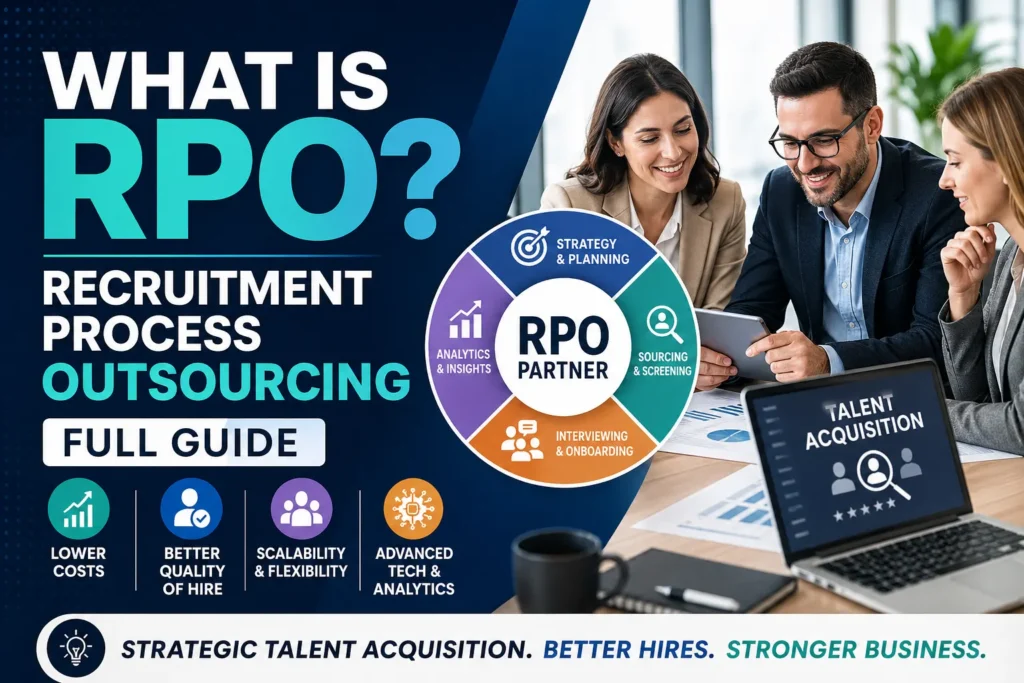
Discovery and Strategy
The RPO provider begins by auditing your current hiring practices. They analyze your employer brand, historic time-to-fill metrics, and recruitment strategy to identify gaps and build a customized roadmap.
Sourcing and Screening
Using advanced AI-driven sourcing tools and deep talent pools, the RPO team proactively identifies both active and passive candidates. They handle the initial screening, ensuring candidates meet the technical requirements and align with your corporate culture.
Interviewing and Onboarding
The provider schedules interviews, preps hiring managers, and facilitates the offer negotiation process. Once an offer is accepted, many RPO partners also handle the initial onboarding paperwork, ensuring a smooth transition for the new hire.
Types of RPO Models
There is no “one-size-fits-all” approach to RPO. Providers typically offer different models to suit varying business needs:
End-to-End RPO
This is a complete outsourcing of the talent acquisition function. The provider handles everything from job profiling to the candidate’s first day. It’s ideal for companies looking to completely transform their recruitment strategy.
Project-Based RPO
Need to hire 50 software engineers to launch a new product? Project RPO brings in a dedicated team to manage hiring for a specific objective, location, or department within a defined timeframe.
On-Demand RPO
This flexible model allows companies to scale recruiter resources up or down depending on seasonal hiring spikes or unexpected business growth, paying only for the services they use.
RPO vs. Staffing Agency vs. In-House Recruiting
Understanding the difference between an RPO, a traditional staffing agency, and an internal HR team is crucial for making the right business decision. Here is a clear comparison:
| Feature | In-House Recruiting | Staffing Agency | RPO Provider |
|---|---|---|---|
| Focus | Internal company culture | Transactional, filling seats fast | Strategic, long-term talent pipeline |
| Pricing Model | Fixed salaries + software costs | High margin fee per placement (20-30%) | Monthly management fee or cost-per-hire |
| Scalability | Low (hard to adjust team size quickly) | High (for volume, but costly) | Very High (flexes with your needs) |
| Technology | Limited by internal budget | Uses their own internal tools | Brings advanced tech stack (AI, ATS) to you |
| Employer Branding | High | Low (they promote the agency) | High (they recruit under your brand name) |

Top 5 Benefits of Using an RPO Provider
Why are major enterprises and growing mid-market companies shifting toward RPO? According to SHRM, outsourcing recruitment offers distinct competitive advantages.
Scalability and Flexibility
Business needs fluctuate. RPO provides the elasticity to scale your recruiting team instantly without the headache of hiring and firing internal HR staff based on market conditions.
Reduced Cost-Per-Hire
By streamlining operations, decreasing time-to-fill, and eliminating hefty headhunter fees, RPO models typically reduce the overall cost-per-hire. You pay for a streamlined process, not massive individual placement margins.
Improved Quality of Hire
RPO firms dedicate their entire existence to mastering recruitment. They utilize predictive analytics, behavioral assessments, and massive talent networks to ensure you are hiring top-tier talent that sticks around.
Advanced Tech Stack and Analytics
Investing in the latest Applicant Tracking Systems (ATS) and AI screening tools is expensive. RPO providers bring their cutting-edge tech stack to the table, providing you with real-time data and analytics to optimize the hiring funnel.
How to Choose the Right RPO Partner for Your Business
Selecting the right recruitment outsourcing partner requires careful consideration. Look for a provider with experience in your specific industry. Ask about their implementation timeline, tech integration capabilities, and how they define and measure success (KPIs like time-to-hire, retention rate, and candidate satisfaction).
Frequently Asked Questions (FAQs)
What is the difference between RPO and BPO?
BPO (Business Process Outsourcing) covers a wide range of back-office functions like customer service, IT, and payroll. RPO is a specialized subset of BPO focused exclusively on talent acquisition and recruitment processes.
What drives the cost of an RPO engagement?
RPO engagements are priced by model. Some providers charge per hire, others run a monthly management retainer, and some blend both. What drives the number is your hiring volume and how much of the recruitment process you hand over. Bring your actual hiring plan to the conversation rather than asking for a rate card.
Can an RPO integrate with my existing ATS?
Yes, integration is a core component of RPO. Providers can usually seamlessly integrate with your existing Applicant Tracking System or, if you don’t have one, implement their proprietary software to streamline operations.
About the Author

Kishan Dangi
Founder & CEO, CapStonePlanet
12+ years in BPO and outsourcing. Founded CapStonePlanet in 2018 to help US and Canadian businesses scale through dedicated offshore teams specializing in ecommerce support, virtual assistants, and customer service operations.
Pricing Notice: Pricing and savings vary depending on volume, scope, workflow requirements, and service configuration. Contact our team for detailed pricing and a customized estimate.
Ready to Outsource the Right Way?
CapStonePlanet provides dedicated offshore teams for back-office, finance, mortgage, insurance and customer-support operations — inside your systems, under your approval authority.