- Have any Questions ?
- info@capstoneplanet.com

Outsourced Accounting Services: The 2026 Small Business Guide to Costs & Providers
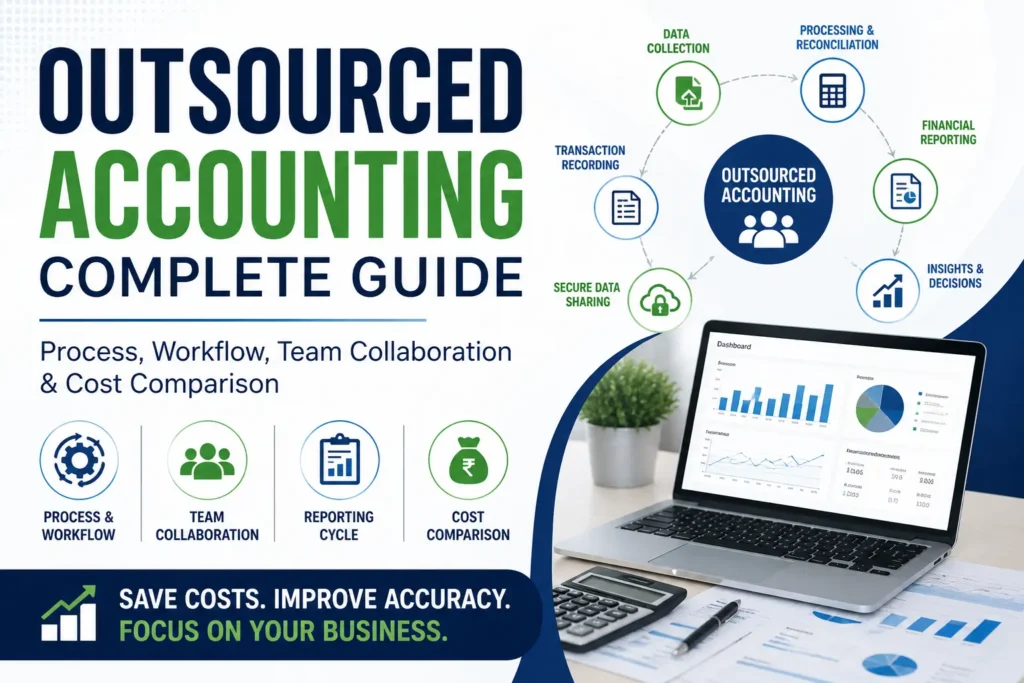
Let’s be honest for a second. If you’re still spending your Sunday nights staring at a messy QuickBooks dashboard or trying to figure out why your payroll taxes don’t align with your bank statement, you aren’t really “running” your business—the business is running you. For years, the move was to hire a full-time accountant once the paperwork got too heavy. But as we head into 2026, that traditional “one-person-in-an-office” model is breaking down.
Between the massive shortage of qualified CPAs and the exploding costs of employee benefits, many founders didn’t plan on outsourcing their accounts. But then they realized they could get a whole team of experts for less than the cost of a single junior hire. This is the new reality of outsourced accounting services: it’s not just about delegating tasks; it’s about gaining the financial firepower to actually scale.
What Exactly Are Outsourced Accounting Services?
In simple terms, outsourced accounting services mean you’re hiring an external firm to act as your finance department. This isn’t your grandfather’s bookkeeping. In 2026, this model is built on fractional finance—where you get exactly the level of help you need, when you need it.
Maybe you need a virtual assistant for daily entry, a controller for your month-end close, and a fractional CFO for your quarterly board meetings. Instead of hiring three people, you hire one finance outsourcing provider in India that manages the whole stack. The 2025 Deloitte Global Business Services Survey shows that most high-growth companies are now pivoting toward this “intelligent automation” model to stay agile.
The “ACE” Model: How We Think About Your Money
Most accounting firms just give you reports that look at the past. We think that’s a waste of time. To really win, you need our outsourcing service model, which we call the ACE Framework. According to Forbes, this kind of specialized expertise is exactly what separates the winners from the “just surviving” in today’s economy.
1. Automation (Not Just Software)
We don’t just “use” software; we build pipelines. Your invoices, bank feeds, and expenses should talk to each other without you lifting a finger. By cutting out the manual data entry, we get rid of the errors that usually creep in when humans get tired.
2. Compliance (Staying Out of Trouble)
Tax laws change. Fast. Whether it’s GAAP, SOC2, or some obscure state tax update, you shouldn’t have to keep track of it. Our job is to make sure your books are “audit-proof” so you can sleep at night.
3. Expertise (The CFO Brain)
This is the fun part. It’s the strategy. We analyze your burn rate and help you figure out if you can actually afford that next big hire or expansion. It’s like having a high-level CFO brain in your pocket for a fraction of the price.
In-House vs. Outsourced: The “Hidden Cost” Reality
Founders often look at a a scalable monthly retainer outsourcing fee and compare it to a $6,000 salary for a staffer. That’s a trap. When you add in payroll taxes, health insurance, office space, and the sheer time it takes to manage a person, that “cheap” hire actually costs you 40% more. You can cut costs and improve accuracy by simply removing the overhead of an in-house department.
As Gartner points out, the real value of BPO in 2026 isn’t just saving pennies; it’s getting access to a technological ecosystem that most small businesses could never build on their own.
| Feature | The Old Way (In-House) | The V7 Elite Way (Outsourced) |
|---|---|---|
| Actual Cost | Salary + 40% in hidden taxes/benefits | One predictable, flat monthly fee |
| The Risk | They quit, and you’re starting from zero | Full team redundancy (Never goes dark) |
| Technology | You buy it and hope it works | Top-tier systems are included |
| Growth | Requires a whole new recruitment cycle | Scales instantly with your volume |
Is This Right for Your Business?
If you’re a startup trying to manage your burn rate, or a mid-market company that’s outgrown its one-person accounting department, then yes. We see companies using outsourced agencies for accounting to move faster, stay leaner, and actually understand their numbers for the first time.
Frequently Asked Questions
Is my financial data actually safe?
Honestly? It’s probably safer with a specialized firm. We use bank-grade encryption and secure portals that are far more robust than most local office networks. Plus, we prioritize data outsourcing security as a core part of our contract.
What if I need to talk to someone right now?
That’s the beauty of the virtual model. You aren’t waiting for one person to get back from lunch. You have a team and a dedicated account manager who is only a Slack message or email away.
How hard is it to switch?
It takes about 30 to 45 days to fully transition. We handle the heavy lifting, the data migration, and the system mapping so you can stay focused on your customers.
Ready to Finally Scale?
Stop playing accountant and start being the CEO again. The business landscape in 2026 doesn’t wait for slow finance teams.
👉 Book Your Free Finance Efficiency Audit
Let Capstone Planet show you exactly how to scale faster while cutting your overhead by up to 50%.
About the Author

Kishan Dangi (KK Patel)
Founder & CEO, CapStonePlanet
12+ years in BPO and outsourcing. Founded CapStonePlanet in 2018 to help US and Canadian businesses scale through dedicated offshore teams specializing in ecommerce support, virtual assistants, and customer service operations.
Pricing Notice: Pricing and savings vary depending on volume, scope, workflow requirements, and service configuration. Contact our team for detailed pricing and a customized estimate.