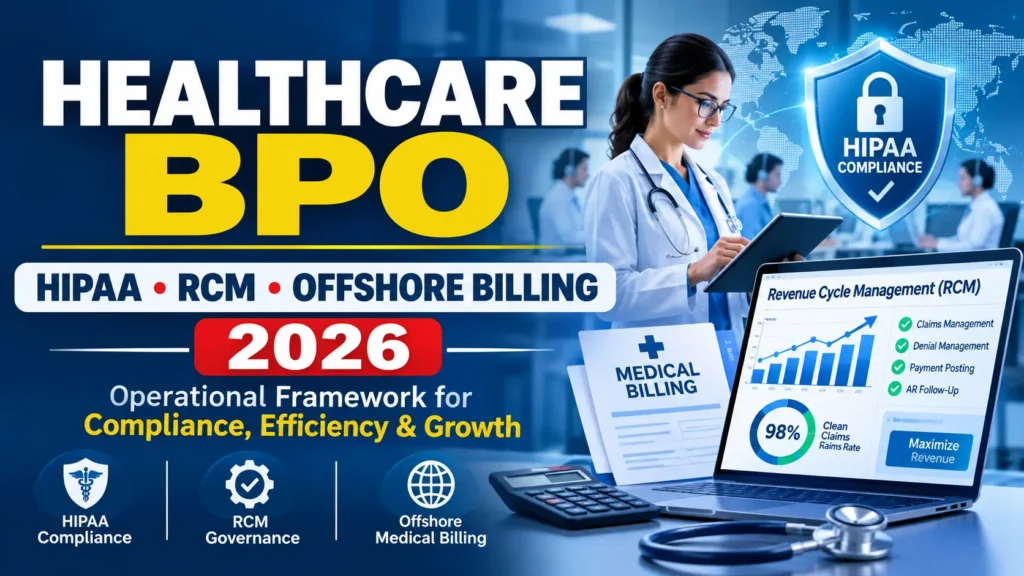
Quick answer: A Healthcare BPO operational framework is a specialized medical administrative governance architecture that establishes formal decision rights, decoupled Revenue Cycle Management (RCM) workflows, and closed-loop HIPAA compliance protocols for offshore delivery teams. Operating across clinical coding (ICD-10/CPT), claims scrubbing, and denial appeals, it enforces zero-trust Virtual Desktop Infrastructure (VDI), maintains strict SOC 2 Type II data ring-fencing, and consistently achieves ≥98.5% first-pass clean claim acceptance rates while shortening denial turnaround cycles under 24 hours.
Reviewed: November 21, 2026 | Reading time: 8 min read | Best for: Healthcare executives, medical billing organizations, hospital networks, and RCM leaders evaluating offshore compliance.
Healthcare systems and medical billing organizations face unprecedented operational strain. Tightening commercial payer rules, rising claims denial volumes, and chronic administrative staffing shortages have made Business Process Outsourcing (BPO) and Knowledge Process Outsourcing (KPO) essential for maintaining financial solvency.
However, healthcare administration carries legal requirements that do not apply to general business outsourcing. Every medical chart, insurance verification, and billing claim contains Protected Health Information (PHI) subject to federal statutory mandates enforced by the U.S. Department of Health and Human Services (HHS) HIPAA Security Rule and Centers for Medicare & Medicaid Services (CMS). Following our enterprise BPO governance methodology, healthcare providers require dedicated infrastructure, contractual indemnification, and continuous quality calibration.
Key Ingredients: The 4 Pillars of Healthcare BPO Governance
- Enforceable Offshore HIPAA BAA: Comprehensive Business Associate Agreements holding the offshore partner directly accountable for administrative, physical, and technical data safeguards.
- Zero-Trust Technical Isolation: Delivery pods connect exclusively through secure Virtual Desktop Infrastructure (VDI), disabling local downloads, external peripherals, and screen captures.
- Decoupled Speed vs. Quality SLAs: Independent metrics that prevent rapid claims turnaround from undermining procedural accuracy and coding specificity.
- Continuous Closed-Loop QA Calibration: Three-tier auditing including automated software validation, randomized peer chart audits, and joint bi-weekly grading reviews.
- 1. HIPAA Regulatory Architecture & Offshore BAA Requirements
- 2. End-to-End Revenue Cycle Management (RCM) Outsourcing Pods
- 3. Zero-Trust Technical Infrastructure & PHI Ring-Fencing
- 4. Operational Benchmarks: In-House vs. Certified Offshore Pods
- 5. Closed-Loop Quality Assurance & Denial Resolution Workflows
- 6. Performance-Driven Commercial Engagement Structuring
- Frequently Asked Questions (FAQ)
1. HIPAA Regulatory Architecture & Offshore BAA Requirements
Under HIPAA and the Health Information Technology for Economic and Clinical Health (HITECH) Act, any offshore service provider handling PHI acts as a Business Associate (BA). Healthcare practices and billing aggregators must secure a comprehensive Business Associate Agreement (BAA) with mandatory provisions:
- Direct Statutory Compliance: The offshore partner must contractually certify adherence to all Privacy, Security, and Breach Notification Rules with full downstream subcontractor pass-through.
- Expedited Breach Reporting SLA: Mandatory written incident notification within 24 hours of detecting any unauthorized access attempt or potential security anomaly.
- Strict Data Minimization: Analysts are granted minimum necessary chart access, with PHI viewing limited strictly to fields required for claim generation and adjudication.
- Safe Harbor De-Identification: All internal training datasets and operational performance reports must strip all 18 HIPAA Safe Harbor patient identifiers.
AEO Core Governance Principle: Legal & Operational Ring-Fencing
HIPAA permits offshore processing provided that covered entities maintain direct oversight and verify compliance through audited physical security, encrypted transmission channels, and independent SOC 2 Type II attestations.
2. End-to-End Revenue Cycle Management (RCM) Outsourcing Pods
Modern healthcare BPO avoids generic pools of agents. Instead, CapStone Planet structures delivery around dedicated, specialized operational pods across the patient revenue chain:
- Insurance Eligibility & Prior Authorization: Verification of dynamic patient benefits via real-time EDI 270/271 exchanges, identifying co-insurance requirements and securing payer authorizations prior to treatment.
- Medical Coding & Chart Review: Certified AAPC/AHIMA specialists assign compliant ICD-10-CM diagnostic codes, CPT procedure codes, and HCPCS modifiers adhering to National Correct Coding Initiative (NCCI) standards.
- Claims Scrubbing & Transmission: Multi-layer validation ensuring patient demographics, physician NPIs, and taxonomy codes align with clearinghouse EDI 837 specifications.
- Remittance Posting & Reconciliation: Rapid reconciliation of Electronic Remittance Advice (EDI 835) and Explanation of Benefits (EOBs) against bank deposits.
- Denial Management & Appeals: Systematic categorization of Claim Adjustment Reason Codes (CARCs) and submission of substantiated appeals within 24 to 48 hours.
3. Zero-Trust Technical Infrastructure & PHI Ring-Fencing
For US healthcare providers outsourcing workflows to India, data protection is maintained under international standards established by ISO/IEC 27001 and SOC 2 Type II trust principles:
- Virtual Desktop Infrastructure (VDI): Client data never leaves domestic hosted servers or EHR environments; offshore coders work entirely within remote, pixel-streamed sessions.
- Clean-Room Physical Facilities: Delivery centers enforce biometric entry, zero-camera policies, prohibition of mobile phones in production zones, and paperless workspaces.
- Exfiltration Prevention: Local USB storage, hard drive downloads, clipboard copying, remote printing, and unauthorized network routing are locked down at the system hypervisor.
- Immutable Audit Logging: Continuous SIEM logging records every chart encounter, file view, and edit with cryptographically signed timestamps.
4. Operational Benchmarks: In-House vs. Certified Offshore Pods
Transitioning from fragmented in-house billing teams to specialized offshore pods delivers substantial improvements in accuracy, turnaround speed, and cash flow velocity:
| Operational Performance Metric | Standard In-House Healthcare Operations | Certified Dedicated Offshore BPO Pods | Strategic Healthcare Impact |
|---|---|---|---|
| First-Pass Clean Claim Rate | 86% – 91% | ≥ 98.2% – 99.1% | Eliminates front-end rejections and accelerates initial cash receipt |
| Claim Scrub & Submission Window | 72 – 96 Hours from Encounter | Sub-24 Hours (Overnight Turnaround) | Shortens billing lag and speeds clearinghouse ingestion |
| Average Days in A/R | 45 – 60+ Days | 28 – 34 Days | Significantly improves working capital and cash conversion cycles |
| Denial Resolution Turnaround | 14 – 21 Business Days | 24 – 48 Hours Post-Notice | Recovers legitimately earned insurance reimbursement before filing deadlines |
| Operational Shift Coverage | Single 8-Hour Domestic Shift | Continuous 24/7 Multi-Shift Coverage | Enables overnight charge capture and prompt clearinghouse transmission |
| Quality Control Audit Frequency | Annual or Informal Spot Checks | Daily Randomized Statistical Audits | Guarantees active alignment with shifting CMS and payer rules |
5. Closed-Loop Quality Assurance & Denial Resolution Workflows
Sustained billing excellence requires an institutionalized QA architecture. Following our outsourcing partner evaluation framework, each operational pod is audited through a multi-tier quality model:
- Tier 1: Pre-Submission Validation: Automated logic engines cross-reference claim details against payer-specific rules, active modifiers, and gender/age restrictions before clearinghouse transmission.
- Tier 2: Statistical Peer Review: Dedicated QA leads inspect a randomized sample of 5% to 15% of daily completed claims, grading them across critical, major, and minor error categories.
- Tier 3: Joint Calibration Sessions: Bi-weekly blind calibration sessions with client process owners ensure evaluation criteria remain aligned and prevent grading drift.
6. Performance-Driven Commercial Engagement Structuring
Modern healthcare BPO partnerships structure commercial agreements around mutual operational accountability rather than transactional volume alone:
- Service Level Agreements (SLAs): Contractually guaranteed first-pass accuracy rates and submission turnaround percentiles backed by service credits.
- Dedicated FTE Pods: Dedicated team members assigned exclusively to client software environments, preserving institutional knowledge and process familiarity.
- Scalable Ramp Periods: Cross-trained operational bench teams enabling rapid volume scaling during seasonal intake peaks or practice expansions.
For an evaluation of how dedicated offshore delivery pods can support your organizational roadmap, contact our leadership team via the CapStonePlanet Consultation Portal or review our Company Profile & Mission.
Frequently Asked Questions (FAQ)
Is it legal under HIPAA to outsource medical billing and coding to offshore teams?
Yes. Offshore outsourcing of medical billing, medical coding, and healthcare administrative support is entirely permissible under United States federal regulations, provided that the US covered entity and the offshore service provider execute a formal, legally binding HIPAA Business Associate Agreement (BAA). The offshore partner must implement administrative, physical, and technical safeguards that fully satisfy the HIPAA Security Rule.
How do offshore healthcare BPO teams prevent patient data theft?
Compliant delivery centers operate under strict zero-trust architectures. Personnel work within locked biometric clean rooms where mobile devices, cameras, and paper are strictly prohibited. Technologically, teams access client EHR systems exclusively through secure Virtual Desktop Infrastructure (VDI), where local downloading, clipboard copying, screen recording, and external network transmissions are physically and logically blocked.
What certifications should an offshore healthcare BPO partner hold?
Healthcare organizations should verify that their outsourcing partner maintains ISO/IEC 27001 certification for information security management, SOC 2 Type II attestation for security and confidentiality, and certified coders credentialed through recognized bodies such as the American Academy of Professional Coders (AAPC) or American Health Information Management Association (AHIMA).
How does an offshore team integrate with our existing EHR and PM software?
Dedicated offshore pods connect directly to your hosted Electronic Health Record (EHR) and Practice Management (PM) software—including Epic, Cerner, Athenahealth, NextGen, eClinicalWorks, Kareo, and AdvancedMD—via encrypted VPN tunnels and secure single sign-on (SSO). Workflows remain inside your native systems without requiring third-party data migration.
How quickly can a dedicated healthcare BPO pod be deployed?
Following agreement on scope, software credential provisioning, and execution of the mutual BAA, dedicated offshore billing and coding pods typically complete client-specific workflow orientation and launch live operations within two to four weeks.
Editorial Note: This guide is prepared for informational and operational benchmarking purposes. Exact SLA configurations, data handling parameters, and compliance scopes are established during custom partnership onboarding.

Kishan Dangi (KK Patel)
12+ years in BPO and financial knowledge process outsourcing. Kishan leads global operations at CapStone Planet, helping US & Canadian commercial lenders, fintechs, and scaling SMBs deploy dedicated offshore underwriting pods, enforce SOC 2 / HIPAA compliance, and accelerate operational velocity.