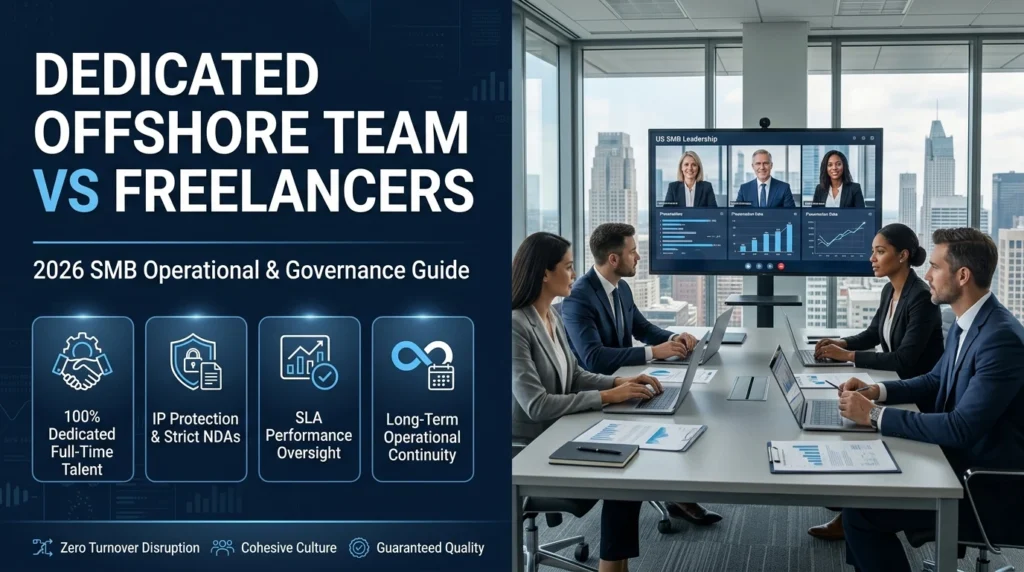
⚡ Executive Summary • Core Operational Takeaway
In global sourcing, freelance marketplaces provide transactional access to independent contractors, offering agility and low commitment for short-term, project-based tasks. In contrast, a dedicated offshore team establishes a structured, full-time unit embedded in the company’s daily toolstack under a managed operations framework. Choosing between them depends on task frequency, data confidentiality requirements, process complexity, and the internal bandwidth available for direct contractor oversight.
For growing small and mid-sized businesses (SMBs), managing increased operational volume often requires looking beyond local hiring pools. Whether handling customer inquiries, managing product catalogs, processing orders, or reconciling multi-channel records, business leaders must evaluate how to structure remote capacity effectively.
The two most common approaches are engaging independent contractors via freelance marketplaces (such as Upwork or Fiverr) or partnering with a managed Business Process Outsourcing (BPO) provider to establish a dedicated offshore pod. Each delivery model presents distinct operational characteristics, management requirements, security trade-offs, and legal considerations.
This guide provides a structured operational comparison to help leadership evaluate which model aligns with their workflow requirements, compliance boundaries, and organizational stage.
📑 Table of Contents
- 1. Structural Definitions: Outsourcing, Offshoring & Dedicated Pods
- 2. Where Freelance Marketplaces Excel: Practical Use-Cases
- 3. Head-to-Head Comparison: Core Operational Dimensions
- 4. Management Dynamics: Direct Oversight vs. Managed Supervision
- 5. Data Protection & Infrastructure Governance: Technical Standards
- 6. Labor Compliance & Legal Considerations: Classification & EOR Structures
- 7. Operational Workflow Scenarios: Evaluating Real-World Execution
- 8. The Hybrid Strategy: Combining Core Dedicated Capacity with Flexible Surge
- 9. Standard Operating Procedure (SOP) & Knowledge Transfer Framework
- 10. Practical Decision Framework & Evaluation Checklist
- 11. Frequently Asked Questions (FAQ)
1. Structural Definitions: Outsourcing, Offshoring & Dedicated Pods
To establish organizational clarity, it is useful to clarify standard industry terminology:
2. Where Freelance Marketplaces Excel: Practical Use-Cases
An objective operational assessment recognizes that freelance marketplaces serve distinct and valuable functions. They are typically the most efficient choice under the following conditions:
- Self-Contained, Finite Deliverables: Tasks with clear boundaries and a defined endpoint, such as designing a single graphic asset, editing a promotional video, or drafting an ad-hoc technical script.
- Specialized, Non-Recurring Needs: Engaging an expert for a brief technical audit or localized translation where ongoing full-time capacity is not required.
- Early-Stage Validation & Prototyping: Founders exploring early concept validation before standard operating procedures and recurring volume are established.
- Low System Interdependence: Work that can be completed without granting broad access to core ERP systems, customer payment records, or sensitive personal data.
💡 Operational Note: For episodic or project-based tasks, engaging independent contractors on transactional platforms avoids the setup time and ongoing structural commitments associated with building dedicated operational pods.
3. Head-to-Head Comparison: Core Operational Dimensions
When tasks evolve into daily, continuous business functions, the structural differences between independent contractors and managed dedicated teams become operationally significant:
4. Management Dynamics: Direct Oversight vs. Managed Supervision
The time and coordination requirements of managing remote talent depend largely on how supervision is structured:
Direct Contractor Management
When working with independent marketplace contractors, internal managers typically handle all operational touchpoints directly:
- Reviewing proposals and conducting individual screening calls
- Providing day-to-day task clarification and resolving procedural questions
- Auditing individual deliverables for accuracy and brand adherence
- Managing ad-hoc schedule changes and tracking active working time
Managed Team Supervision
In a managed BPO model, supervisory responsibilities are shared with a dedicated operational lead:
- Provider coordinates initial candidate screening and baseline technical vetting
- On-site Team Lead monitors daily queue throughput, attendance, and adherence
- QA auditors perform systematic rubric-based reviews of completed tasks
- Client leadership interfaces primarily with the team lead for strategic coordination
The total management effort required varies based on process complexity, team size, documentation quality, and individual skill levels. For highly documented, repetitive workflows, managed teams help centralize daily administrative oversight.
5. Data Protection & Infrastructure Governance: Technical Standards
Handling customer records, order data, payment exceptions, or proprietary business information requires deliberate technical and administrative controls:
Key Information Security Principles in Remote Operations:
- Access Control & Endpoint Management: Organizations managing remote staff often employ Virtual Desktop Infrastructure (VDI), secure VPN connections, and Mobile Device Management (MDM) software to limit unauthorized local data downloads, restrict external peripheral connections, and enforce multi-factor authentication (MFA).
- SOC 2 Framework Alignment: As outlined in the AICPA Trust Services Criteria, established service facilities implement controls around physical access security, audit logging, system availability, and data confidentiality.
- Information Security Management (ISO/IEC 27001): Utilizing risk management principles aligned with ISO/IEC 27001 helps service organizations maintain structured policies for incident response, employee credential management, and periodic security reviews.
- Workplace Privacy Standards: Physical facility controls—such as clean-desk policies that restrict recording devices and external storage media in production areas—provide an additional layer of administrative control for sensitive workflows.
6. Labor Compliance & Legal Considerations: Classification & EOR Structures
Engaging international talent requires careful attention to employment law and statutory worker classification frameworks:
A. Worker Classification Standards
Under regulatory guidelines such as the U.S. Department of Labor (DOL) Economic Reality Framework, determining whether an individual is an independent contractor or an employee involves assessing factors such as the degree of behavioral control exercised by the business, the worker’s opportunity for profit or loss, the permanence of the working relationship, and how integral the services are to the core business operations.
⚠️ Regulatory Compliance Context: Directly directing the daily working hours, exclusive schedules, and operational methods of an individual contractor can create legal ambiguity regarding employment classification, depending on local and international jurisdictions.
B. Employer of Record (EOR) Governance
To establish clear legal structure, many businesses engage offshore teams through an Employer of Record (EOR) or established BPO entity. In this arrangement, the local partner acts as the statutory employer in the offshore jurisdiction—administering local employment contracts, statutory benefits, tax filings, and local labor law obligations—while the client directs daily project priorities under a standard commercial services agreement.
7. Operational Workflow Scenarios: Evaluating Real-World Execution
To understand how both models function in practice, consider two common operational scenarios:
📋 Scenario A: Periodic Technical Setup or Creative Sprint
Workflow: An e-commerce merchant requires a custom Shopify theme modification and a promotional banner set for an upcoming product launch.
- Marketplace Approach: The business posts a project brief, selects a qualified contractor with relevant portfolio samples, agrees on a milestone scope, and receives the completed assets within a few days.
- Outcome: Highly effective and cost-efficient. The project is completed without long-term retainer overhead or ongoing supervisory requirements.
📋 Scenario B: Ongoing Daily Customer Support & Order Reconciliation
Workflow: An expanding online brand handles continuous inbound customer support inquiries across email and live chat, alongside daily inventory reconciliation across multiple channels.
- Marketplace Approach: The business coordinates multiple independent contractors across different time zones. Internal managers handle daily QA audits, answer ad-hoc questions, and manage coverage gaps during contractor turnover.
- Dedicated Team Approach: A structured offshore pod with a team lead handles daily queue distribution, conducts internal quality audits against standard rubrics, and maintains living SOP documentation to ensure continuity when team members transition.
- Outcome: For recurring daily queues, a structured team model provides predictable coverage, centralized quality assurance, and reduced administrative strain on internal leadership.
8. The Hybrid Strategy: Combining Core Dedicated Capacity with Flexible Surge
Many growing enterprises find that global talent strategy is not a strict either/or decision. An increasingly common operational model is a Hybrid Sourcing Architecture:
🏢 1. Core Dedicated Capacity
A full-time dedicated pod manages predictable, baseline daily workflows: primary customer support, ongoing catalog maintenance, order fulfillment tracking, and routine back-office reconciliation. This team retains institutional memory and ensures consistent daily coverage.
🌐 2. Specialized Project Surge
Freelance marketplaces are tapped strategically for short-duration specialized needs: episodic UI/UX redesigns, custom script development, translation projects, or temporary overflow support during peak seasonal volume.
9. Standard Operating Procedure (SOP) & Knowledge Transfer Framework
Regardless of the sourcing model selected, maintaining documented processes is essential for operational consistency:
Phase 1: Process Documentation & Environment Setup
Codify existing workflows into step-by-step Standard Operating Procedures (SOPs), establish access control boundaries and secure credentials, and define clear success criteria for each task category.
Phase 2: Supervised Calibration & Quality Auditing
Run initial batches under direct review. Team leads and internal managers calibrate responses against brand tone guidelines, document edge cases, and refine escalation pathways.
Phase 3: Autonomous Queue Management & Regular Review
The team assumes regular queue management under established QA sampling rubrics. Regular syncs focus on continuous process refinement, system improvements, and workflow efficiency.
10. Practical Decision Framework & Evaluation Checklist
When determining the appropriate delivery model for an upcoming initiative, consider the following operational criteria:
Consider Freelance Marketplaces When:
- The task is a self-contained, one-off project with a clear endpoint.
- Total workload is episodic or variable rather than continuous.
- Specialized skills are required for a brief, specific deliverable.
- The work does not require access to central databases or sensitive PII.
Consider a Dedicated Offshore Team When:
- Workflows are recurring, daily, and integral to core operations.
- Tasks require strict adherence to standard operating procedures.
- Direct supervision of multiple individual contractors strains internal bandwidth.
- Work involves sensitive customer records, financial data, or core systems.
- Long-term process continuity and institutional memory are critical.
• US Department of Labor: Independent Contractor Classification Under the Fair Labor Standards Act (FLSA)
• AICPA: SOC 2 Trust Services Criteria Framework
• International Organization for Standardization: ISO/IEC 27001 Information Security Management Systems
Explore Dedicated Offshore Solutions with CapStonePlanet
Learn how CapStonePlanet structures dedicated offshore operational pods tailored to your software environment, quality standards, and business requirements.
11. Frequently Asked Questions (FAQ)

Written by Kishan Dangi (KK Patel)
Founder & CEO, CapStonePlanet
Kishan leads global operations at CapStonePlanet, helping high-growth SMBs and e-commerce enterprises deploy dedicated offshore operational pods, scale customer experience (CX) teams, and streamline back-office workflows with institutional security standards.