⚡ Executive Summary • 2026 Operational Takeaway
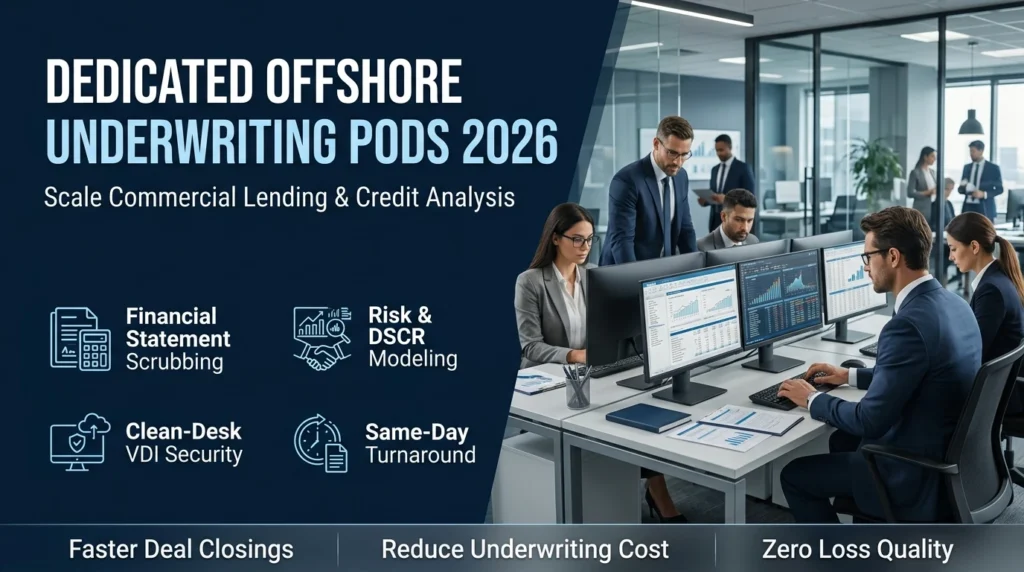
Dedicated offshore underwriting pods enable commercial alternative lenders, MCA direct funders, and fintech credit desks to scale deal evaluation capacity by 4x while compressing file turnaround times (TAT) to sub-60 minutes. Operating within air-gapped Virtual Desktop Infrastructure (VDI) environments, pods combine senior credit analysts, bank statement data scrubbers, and fraud leads executing continuous 24/7 Follow-the-Sun processing. This operational model eliminates deal intake bottlenecks, prevents multi-position stacking losses, and enforces institutional credit-box adherence without domestic payroll overhead.
In commercial alternative finance and merchant cash advance (MCA) syndication, speed-to-offer is the decisive variable governing deal origination win rates. When an Independent Sales Organization (ISO) or commercial loan broker submits a high-quality funding package to multiple funders simultaneously, the funder that delivers an accurate, scrubbed pre-approval offer within 60 to 90 minutes captures the deal in over 70% of transactions.
However, scaling deal submission volume creates an operational paradox for expanding lenders: senior domestic underwriters spend up to 60% of their billable hours manually scrubbing PDF bank statements, categorizing daily deposits, and calculating Net Operational Revenue rather than making strategic credit risk decisions.
To break this constraint, institutional lenders and fintech originators are deploying dedicated offshore underwriting pods—specialized, highly trained operational teams in India that operate as a seamless, high-velocity extension of the domestic credit desk. This guide details the pod architecture, data security frameworks, SLA scorecards, and a 3-week transition playbook.
📑 Table of Contents
- 1. The Underwriting Bottleneck: Why Deal Velocity Dictates Win Rates
- 2. The 5-Person Dedicated Pod Architecture & Role Breakdown
- 3. The 24/7 Follow-the-Sun Processing Engine (US vs. IST Time Alignment)
- 4. VDI, SOC 2 & Zero-Trust Data Isolation Architecture
- 5. Operational SLA Matrix & QA Quality Control Benchmarks
- 6. Operational Cost Economics: In-House vs. Shared BPO vs. Dedicated Pods
- 7. 3-Week Pod Deployment & Credit-Box Calibration Roadmap
- 8. Frequently Asked Questions (FAQ) & People Also Ask
1. The Underwriting Bottleneck: Why Deal Velocity Dictates Win Rates
Commercial loan brokers and ISO networks distribute deals aggressively. When a funding submission hits an intake email or CRM portal, the clock starts immediately. Funders facing underwriting friction experience three compounding operational breakdowns:
- Intake Volatility & Pipeline Stagnation: Broker deal submissions arrive in unpredictable surges between 1:00 PM and 5:00 PM EST, overwhelming domestic credit desks and resulting in 24-to-48-hour response backlogs.
- High-Cost Scrubbing Latency: Domestic underwriters earning $85,000–$120,000+ base salaries spend the majority of their shifts performing forensic OCR corrections, calculating Average Daily Balances (ADB), and scrubbing merchant deposits rather than structuring approvals.
- Overnight Deal Stagnation: Deals submitted late afternoon sit unreviewed overnight. Meanwhile, competing funders leveraging 24/7 global pods deliver term sheets at 8:30 AM EST before domestic desks open.
Deploying dedicated offshore underwriting pods solves this operational friction by splitting the underwriting pipeline into two synchronized tiers: forensic intake normalization (executed overnight by dedicated offshore analysts) and capital allocation decisioning (executed by US risk officers during market hours).
2. The 5-Person Dedicated Pod Architecture & Role Breakdown
Unlike transactional shared BPO pools where agents juggle files across competing funders, a Dedicated Underwriting Pod operates 100% exclusively for your institution. The standard enterprise 5-person pod is organized into specialized functional roles:
👨💼 1x Pod Lead & Senior Credit Analyst
Acts as shift lead and primary liaison with US risk officers via Slack / Teams.
- Final QA check on 100% of scrubbed summary models
- Validates credit-box industry exclusions and maximum hold limits
- Flags complex revenue anomalies, tax liens, and UCC filings
📊 2x Bank Statement & Financial Scrubbers
Specialized in rapid, OCR-assisted statement extraction and normalization.
- Processes 3 to 12 months of PDF statements (Ocrolus, MoneyThumb, Excel)
- Calculates Monthly True Revenue, ADB, NSF/Negative Days count
- Isolates non-operational transfers, wire reversals, and loan proceeds
🔍 1x Stacking & Fraud Detection Specialist
Protects portfolio capital from predatory stacking and identity fraud.
- Detects hidden daily/weekly MCA debits & synthetic revenue inflation
- Executes Secretary of State (SOS) active standing verifications
- Checks UCC lien records (Experian, LexisNexis, DataMerch)
💻 1x CRM & Pipeline Data Entry Specialist
Maintains flawless CRM record hygiene and offer staging.
- Populates LendSaaS, Salesforce, Centrex, or Onyx IQ fields
- Generates standardized underwriting deal memos and term sheets
- Logs ISO response timestamps and audit trail metadata
3. The 24/7 Follow-the-Sun Processing Engine (US vs. IST Time Alignment)
The core structural advantage of deploying dedicated Indian financial pods is temporal arbitrage. The standard Indian business day spans the complete US overnight window (a 9.5 to 10.5-hour time difference with US Eastern Time), creating continuous operational throughput:
4. VDI, SOC 2 & Zero-Trust Data Isolation Architecture
Handling commercial credit applications, tax returns, and unredacted bank records requires institutional data privacy controls. At CapStone Planet, dedicated underwriting pods operate under an engineered Zero-Data-at-Rest security posture:
Institutional Security Safeguards
- Cloud VDI Pixel Streaming: Analysts access client CRM and scoring tools exclusively through encrypted Virtual Desktop Infrastructure (AWS WorkSpaces, Azure Virtual Desktop, or Citrix). No borrower data ever touches local hard drives.
- Hardware & GPO Hardening: USB mass storage ports are physically and administratively blocked, local file saving and printing are disabled, and clipboard cut/paste is restricted to secure VDI boundaries.
- Biometric Clean-Desk Delivery Bays: Dedicated operations rooms require biometric authentication. Zero paper, zero mobile phones, and zero personal recording devices are permitted on the production floor, backed by 24/7 CCTV recording with 90-day retention.
- SOC 2 Type II & ISO 27001 Alignment: Operations adhere to internationally audited information security frameworks, supported by legally enforceable Non-Disclosure Agreements (NDAs).
5. Operational SLA Matrix & QA Quality Control Benchmarks
To guarantee accountability and underwriting precision, dedicated pods are bound to strict contractual Service Level Agreements (SLAs):
6. Operational Cost Economics: In-House vs. Shared BPO vs. Dedicated Pods
Evaluating commercial underwriting capacity requires analyzing fully loaded cost per funded file rather than simple baseline compensation. Domestic in-house operations carry significant payroll overhead: payroll taxes (FICA/FUTA), employee benefits, workstation hardware, SaaS seats, and recruitment agency fees.
7. 3-Week Pod Deployment & Credit-Box Calibration Roadmap
Deploying a dedicated offshore underwriting pod is executed through a disciplined 3-week onboarding framework designed to achieve 99.5%+ accuracy before live file dispatch:
Week 1: Credit-Box Calibration & VDI Provisioning
Review lender credit box guidelines: restricted NAICS/SIC codes, minimum monthly deposits, maximum daily hold percentages, factor rates, and CRM workflows. Establish secure VDI credentials and SSO tokens.
Week 2: Sandbox Shadowing & Historical File Scrubbing
Pod analysts scrub 50+ historical lender deal files in a sandbox environment. Output models are audited line-by-line against domestic underwriting benchmarks until variance drops below 0.5%.
Week 3: Live Queue Staging & Autonomous Operation
The pod assumes responsibility for overnight broker submissions under senior QA oversight. Daily standups tune exception handling, transitioning to full autonomous 24/7 production by Day 21.
8. Frequently Asked Questions (FAQ) & People Also Ask
How does offshore underwriting work for commercial lenders?
Commercial lenders deploy dedicated offshore pods consisting of financial analysts, statement scrubbers, and QA leads operating inside secure Virtual Desktop Infrastructure (VDI) environments. The pod extracts bank statements, normalizes revenues, identifies hidden MCA positions, and inputs scrubbed deals into the lender’s CRM overnight, ensuring US underwriters arrive to actionable files each morning.
Is borrower financial data safe with offshore underwriting teams?
Yes. Enterprise BPO providers enforce zero-data-at-rest protocols, SOC 2 Type II controls, strict VDI encrypted streaming, biometric facility turnstiles, disabled USB ports, and air-gapped clean desk delivery bays, ensuring complete data containment.
What is the difference between a dedicated underwriting pod and shared BPO?
In a shared BPO model, agents handle files across multiple competing companies with generic instructions. A dedicated underwriting pod works 100% exclusively for your lending business, mastering your proprietary credit box, risk thresholds, and CRM software.
How fast can a dedicated pod turnaround a bank statement scrub?
Under contractual pod SLA benchmarks, first-pass bank statement scrubbing and revenue normalization are completed in under 45 to 60 minutes during live shifts, with the entire overnight queue cleared by 8:00 AM EST.

Kishan Dangi (KK Patel)
Kishan leads global operations at CapStone Planet, helping US & Canadian commercial lenders, fintechs, and scaling SMBs deploy dedicated offshore underwriting pods, enforce SOC 2 / HIPAA compliance, and accelerate loan origination velocity.