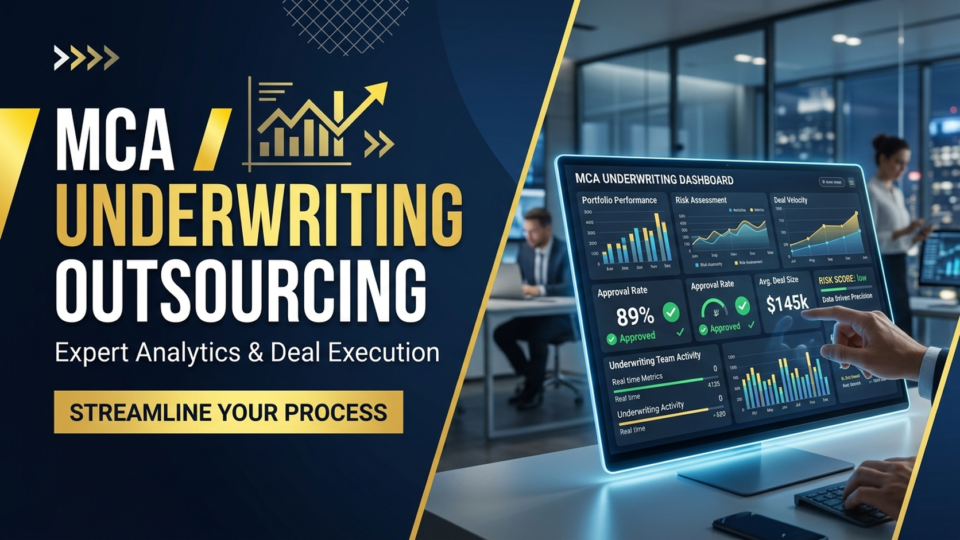
MCA underwriting is the engine that powers merchant cash advance funding decisions. It’s the systematic evaluation of a business’s repayment capacity based on daily revenue, bank statement history, credit card processing data, and risk indicators. For funders processing 30 to 100+ deals per month, getting underwriting right — fast, accurate, and consistent — is the single biggest lever for portfolio performance and profitability.
Many MCA lenders run their underwriting function as a KPO (Knowledge Process Outsourcing) operation, with certified financial analysts handling risk-tiering offshore. For the broader KPO vs BPO distinction, see our KPO vs BPO comparison.
This guide covers the complete MCA underwriting lifecycle: what it is, how the process works step-by-step, how paper grades are assigned, what red flags underwriters look for, and how to scale your operations with strategic outsourcing. Whether you’re a new ISO looking to understand underwriting fundamentals or an established funder optimizing your workflow, this is the definitive operational playbook for 2026.
What Is MCA Underwriting?
MCA underwriting is the risk evaluation process used by merchant cash advance funders to assess a business’s ability to repay an advance. Unlike traditional loan underwriting, which relies heavily on FICO scores, collateral, and debt-to-income ratios, MCA underwriting focuses on daily cash flow, credit card processing volume, and bank statement history.
Why does it work this way? Because an MCA is legally structured as a purchase of future receivables, not a loan. That distinction is the reason the whole process looks different: the buyer of those receivables needs to know one thing above all else — will this merchant’s card sales reliably cover what we advance them, every single day? That question drives everything else in the underwriting file, from the six-month bank statement pull to the daily balance check. The CFPB’s own guidance describes the product the same way: a merchant receives a cash advance and promises to repay it “plus some additional amount or multiple of the amount advanced (e.g., 1.2 or 1.5, the ‘payback’ or ‘factor’ ‘rate’),” repaid by pledging a percentage of future card receipts or by fixed daily ACH withdrawals.
The core question every MCA underwriter answers is: Can this business generate enough daily revenue to support the holdback without cash flow disruption?
An MCA underwriter reviews 3 to 6 months of business bank statements, analyzes revenue patterns, checks for NSF occurrences, and assigns a paper grade — from A through D — that determines the pricing and advance amount a merchant qualifies for.
MCA Underwriting vs. Traditional Loan Underwriting
| Factor | MCA Underwriting | Traditional Loan Underwriting |
|---|---|---|
| Primary focus | Daily cash flow & bank statements | Credit score, collateral, DTI |
| Credit check | Secondary (soft pull often sufficient) | Primary (hard pull required) |
| Collateral | None (future receivables) | Required (property, equipment) |
| Time to decision | 24–72 hours | 2–6 weeks |
| Repayment structure | Daily/weekly holdback from sales | Fixed monthly payments |
| Risk assessment tool | Paper grading (A–D) | Credit tiering (prime, subprime) |
| Documentation | 3–6 months bank statements, processing reports | Tax returns, P&L, balance sheet, business plan |
How MCA Underwriting Works
MCA underwriting combines automated pre-screening and manual review. When a merchant submits an application, the system pulls bank account data — often through secure API connections like Plaid — and runs preliminary analysis on revenue trends, average daily balances, and risk indicators. Files that pass automated screening move to manual underwriting, where the underwriter examines the complete bank statement PDF, verifies deposit sources, flags unusual activity, and makes a funding decision.
The MCA Underwriting Process Step by Step
Step 1: Application Submission
The merchant submits basic business information, bank account details, and credit card processing data. Most applications (75%) are submitted via mobile device [R2].
Step 2: Automated Data Pull
Bank account data is pulled via API or manual statement upload, typically covering 3–6 months of transaction history.
Step 3: Pre-Screening
Automated systems check for obvious deal-breakers: open bankruptcies, unresolved judgments, restricted industries, or bank account type restrictions (Fintech banks often conflict with ACH debits and many funders automatically decline these accounts).
Step 4: Manual Underwriting Review
The underwriter examines the bank statement PDF in detail, verifying:
- Deposit sources and consistency
- Revenue trends (stable, growing, or declining)
- Average daily balance levels
- NSF occurrences and negative days
- Evidence of existing MCA stacking
- Seasonal patterns
Step 5: Paper Grade Assignment
Based on the review, the file receives a paper grade (A, B, C, or D) that determines:
- Factor rate (pricing)
- Advance amount
- Holdback percentage
- Repayment term structure
Step 6: Funding Decision
The underwriter makes the final call — approve, counter-offer, or decline — and documents the reasoning in the deal file.
Paper Grades: How Funders Classify Risk
The paper grading system is the standardized risk classification framework used across the MCA industry. It determines how much a merchant pays for capital and how much a funder is willing to advance.
A-Paper (Lowest Risk)
Strong, consistent card sales volume; long processing history; clean bank statements with almost no NSF items; stable or growing revenue trend.
Lowest risk — qualifies for the funder’s best pricing and the largest advance percentage of monthly card sales.
- Credit card sales: strong monthly volume with 12+ months processing history
- Bank statement quality: Fewer than 2 NSF items in 90 days; consistent positive daily balances
- Revenue trend: Stable or growing
- Time in business: long processing history
- Pricing: set by the funder per file
- Advance amount: a percentage of monthly credit card sales, sized by the funder to the file’s strength
B-Paper (Moderate Risk)
Solid card sales in a mid range; a small number of NSF items in the last 90 days with occasional low balances; generally stable revenue with minor fluctuations; an established recent history.
Moderate risk — pricing and advance percentage are set between the strongest and weakest grades.
- Credit card sales: solid mid-range monthly volume
- Bank statement quality: a small number of NSF items in the last 90 days occasional low balances
- Revenue trend: generally stable with minor fluctuations
- Time in business: established recent history
- Pricing: set by the funder per file
- Advance amount: a percentage of monthly credit card sales, sized by the funder to the file’s strength
C-Paper (Higher Risk)
Lower card sales volume; several NSF items in the last 90 days with frequent low or negative balances; declining or inconsistent revenue; a shorter recent history.
Higher risk — pricing rises and the advance percentage of monthly card sales shrinks materially.
- Credit card sales: lower monthly volume
- Bank statement quality: several NSF items in the last 90 days frequent low or negative balances
- Revenue trend: Declining or inconsistent
- Time in business: established recent history
- Pricing: set by the funder per file
- Advance amount: a percentage of monthly credit card sales, sized by the funder to the file’s strength
D-Paper (Highest Risk)
Minimal card sales; many NSF items in the last 90 days with frequent negative days and possible stacking evidence; significantly declining revenue; very little history.
Highest risk — often declined outright; when funded, pricing is at the funder’s maximum and the advance is the smallest share of monthly card sales.
- Credit card sales: Under $5,000 monthly
- Bank statement quality: many NSF items in the last 90 days frequent negative days; possible stacking evidence
- Revenue trend: Significantly declining
- Time in business: Under 4 months
- Pricing: set by the funder per file
- Advance amount: a percentage of monthly credit card sales, sized by the funder to the file’s strength (if approved at all)
Paper grades directly impact the deal economics for the borrower. The factor rate a merchant qualifies for is set by the funder based on the paper grade, and it determines the total amount the merchant repays relative to the advance. Exact rates vary by funder, file strength, and market conditions, and are quoted directly by the funder — not published as fixed ranges.
Key Criteria Every MCA Underwriter Evaluates
Monthly Credit Card Sales
Underwriters evaluate credit card sales volume through merchant processor reports and bank deposits. Higher and consistent monthly credit card sales signal reliable repayment ability, since repayments are often deducted daily from card sales.
Annual and Monthly Revenue
Total business revenue — credit card and otherwise — is analyzed to calculate funding capacity. Most providers cap funding at 10% to 25% of annual gross revenue.
Debt-to-Income (DTI) Ratio
Existing monthly debt obligations are compared against monthly revenue. Most MCA providers prefer a DTI of 36% or lower.
Ending Daily Balance
Many underwriters check daily ending balances to ensure the business maintains enough cash reserves. A pattern of low or negative daily balances is a significant red flag.
NSF (Non-Sufficient Funds) Events
Frequent NSFs signal poor cash flow management and increase risk. More than 3 NSF items in 90 days typically results in at least one paper grade downgrade.
Chargebacks
High rates of customer chargebacks indicate potential instability in revenue or customer service issues that could impact repayment capacity.
Revenue Trends and Seasonality
Underwriters assess whether revenue is stable, growing, or declining. Seasonal businesses may receive adjusted approval criteria if they have predictable off-peak months.
Business Type and Industry Risk
Some industries face more scrutiny. Travel agencies, adult entertainment, and cannabis businesses are often higher risk, while healthcare and legal services typically score better. The NAICS code helps determine this risk level.
Time in Business
Most providers prefer businesses with at least 6 months of operating history. Less than that may result in automatic denial or require stronger credit card volume to offset risk.
MCA Stacking Evidence
The presence of existing MCAs from other funders is one of the most critical risk factors. Stacking increases the total holdback on the merchant’s daily revenue, significantly raising default risk.
Red Flags That Hurt MCA Approval Odds
Understanding what makes an underwriter pause is just as important as knowing what they’re looking for. Here are the red flags that increase cost or stop approval altogether:
Bank Statement Red Flags:
- More than 3 NSF items in 90 days
- Consistent negative daily ending balances
- Unexplained large deposits or withdrawals
- Frequent overdrafts
- Deposits from non-business sources (personal accounts, loans)
Credit Red Flags:
- Open bankruptcies (automatic decline with most funders)
- Unresolved judgments or tax liens
- Prior MCA defaults
- Personal FICO below 500
- Multiple recent credit inquiries
Business Red Flags:
- Restricted industry (cannabis, adult entertainment, gambling)
- Home-based business with no physical location
- Foreign-owned entity
- Bank account with Fintech banks (Chime, Varo, etc.) that conflict with ACH debits
- Incomplete or doctored bank statements
Stacking Red Flags:
- Daily ACH debits from multiple MCA companies
- Holdback percentage exceeding 25% of daily revenue
- Rapid succession of new MCAs (multiple advances in 3 months)
- Declining revenue trend concurrent with new advances
MCA Underwriting Requirements: Complete Documents Checklist
Before a file enters underwriting, ensure the following documents are complete:
- 3–6 months of business bank statements (all pages, no gaps)
- Credit card processing reports (last 3 months minimum)
- Monthly revenue summaries (from accounting software or bank deposits)
- Owner’s personal credit report (soft pull authorization)
- Business credit profile (if available — Dun & Bradstreet, Experian)
- Government-issued ID (owner’s driver’s license or passport)
- Business entity documents (LLC formation, articles of incorporation, EIN verification)
- Voided business check (for ACH verification)
- Bank account ownership verification (micro-deposits or Plaid connection)
- Signed MCA agreement and disclosure forms
Scaling MCA Underwriting Operations
As MCA funders grow from 30 to 100+ deals per month, manual underwriting becomes a bottleneck. Here’s how successful funders are scaling operations in 2026.
Automation: The First Layer
Automated pre-screening tools handle the first pass on every file — pulling bank data, running basic calculations, and flagging obvious pass or fail criteria. This reduces the manual review burden by 40–60%.
Tools commonly used:
- Plaid or Finicity for bank data aggregation
- Automated NSF and negative day calculators
- Revenue trend analysis algorithms
- Stacking detection (monitoring ACH debits across accounts)
Strategic Outsourcing: The Scaling Layer
For the manual review that remains — statement verification, exception handling, and final grade assignment — funders are increasingly turning to specialized MCA underwriting outsourcing partners like CapStonePlanet.
Expert MCA underwriting outsourcing teams handle the complete manual review process:
- Bank statement scrubbing and verification
- NSF and negative day analysis
- Paper grade assignment
- Funding recommendation documentation
- File preparation for final approval
A dedicated underwriting team processes standard files in under 24 hours with documented accuracy rates. This allows funders to scale deal volume without scaling headcount or sacrificing underwriting quality.
Quality Control Framework
Every underwriting decision should be auditable. The best operations run a three-tier QC process:
1. Pre-funding QC: Peer review of every file before funding approval
2. Post-funding QC: Random audit of 10–20% of funded deals within 7 days
3. Monthly portfolio review: Aggregate analysis of paper grade distribution, default rates by grade, and underwriter accuracy metrics
MCA Underwriting Industry Statistics and Benchmarks (2026)
- The global merchant cash advance market was valued at $20.67 billion in 2025, projected to reach $41.81 billion by 2035 [R1]
- 42% of small businesses use MCA funds for inventory or equipment purchases [R2]
- 62% of businesses using MCAs have fewer than 10 employees [R2]
- The average annual revenue of an MCA borrower is $450,000 [R2]
- 55% of MCA recipients are repeat borrowers within the same calendar year [R2]
- 38% of MCA borrowers had previously been denied a loan by a bank [R2]
- MCA pricing runs on factor rates rather than disclosed interest rates — the CFPB describes the typical structure as repaying the advance plus a multiple of it (commonly expressed as 1.2 or 1.5) via pledged daily card receipts or fixed ACH withdrawals [R7]. Demand for this product is significant and rising: Federal Reserve Small Business Credit Survey data cited by the Fed’s Consumer & Community Context report shows 37% of small employer firms applied for a loan, line of credit, or merchant cash advance in a recent 12-month window, and the survey’s 2025 report found the share of applicants specifically seeking merchant cash advances rose to 12% from 9% the prior year [R6]
- Decision speed is a live competitive variable in MCA funding: merchants commonly apply to multiple funders simultaneously, and slow turnaround loses files [R4]
- Many funders now pair automated pre-screening (API bank-data pulls and transaction parsing) with a manual review layer for exceptions, verification, and final grading [R5]
Frequently Asked Questions About MCA Underwriting
What is MCA underwriting in simple terms?
MCA underwriting is the process funders use to decide whether a business qualifies for a merchant cash advance and on what terms. Underwriters review bank statements, check cash flow, and assign a risk grade that determines the factor rate and advance amount.
How long does MCA underwriting take?
For a clean file with six months of consistent business bank statements and an established processor history, most funders give a decision within 24 to 72 hours — and funded money can arrive in one to three days. The wide range comes from exceptions: newer accounts, NSF history, or suspected stacking trigger deeper manual review. If a funder quotes an exact hour count for every deal, treat that as marketing, not an operating guarantee.
What documents do I need for MCA underwriting?
You need 3–6 months of business bank statements, credit card processing reports, a government-issued ID, business entity documents, and a signed application. Some funders also request bank login access for real-time data verification through Plaid.
What is a paper grade in MCA underwriting?
A paper grade is a risk classification (A through D) that funders assign based on bank statement quality, revenue consistency, NSF occurrences, and time in business. A-paper gets the best rates. D-paper is the highest risk and most expensive.
Can I get an MCA with bad credit?
Yes, relatively often — and that is exactly the trade-off the product is built on. MCA underwriters price the receivables, not your personal credit file, so a 540 FICO with strong daily card volume can clear review where a bank would auto-decline. The cost of that access shows up in the structure itself: the CFPB describes repayment as the advance plus a multiple such as 1.2 or 1.5, collected daily from card receipts or by fixed ACH withdrawals. Weak credit does not change that structure — it pushes the multiplier toward the expensive end and invites tighter holdback percentages.
What is MCA stacking and why is it a red flag?
MCA stacking is when a merchant has multiple outstanding MCAs from different funders simultaneously. Each advance adds another daily holdback, increasing the total deduction from the merchant’s revenue. Stacking significantly raises default risk and is one of the most important red flags underwriters look for.
What banks are not accepted for MCA?
Fintech banks like Chime, Varo, Current, and similar online-only banks often conflict with ACH debits used by MCA providers. Most funders prefer traditional brick-and-mortar banks for this reason.
How does outsourcing MCA underwriting work?
Funders partner with a specialized outsourcing provider like CapStonePlanet, which assigns dedicated underwriters to review bank statements, calculate risk metrics, assign paper grades, and prepare funding recommendations. The funder retains final approval authority while the outsourcing team handles the full manual underwriting workflow.
References
[R1] Precedence Research. “Merchant Cash Advance Market Size, Share and Trends 2026 to 2035.” Precedence Research MCA market report
[R2] WifiTalents. “Merchant Cash Advance Industry Statistics 2026.” WifiTalents MCA industry statistics
[R3] Nav. “A Guide to Merchant Cash Advance Underwriting.” Nav guide to MCA underwriting and paper grades
[R4] Liftoff Platform. “MCA Funding Strategies 2026.” Liftoff Platform MCA funding strategies
[R5] MCashAdvance. “MCA Underwriting: Process Criteria, Red Flags.” MCashAdvance underwriting criteria and red flags
[R6] Board of Governors of the Federal Reserve System. “Consumer & Community Context 2025” (citing Small Business Credit Survey data, 2023–2025 reports). Federal Reserve Consumer and Community Context 2025
[R7] Consumer Financial Protection Bureau. “Small Business Lending Rule FAQs” (merchant cash advance definition and factor-rate structure). CFPB Small Business Lending Rule FAQs
About CapStonePlanet: CapStonePlanet is a specialized MCA underwriting and back-office outsourcing provider. Our team processes bank statement scrubbing, paper grading, and funding decisions for funders handling 30–100+ deals per month. With dedicated underwriters, 24-hour turnaround on standard files, and documented accuracy rates, we help MCA funders scale operations without scaling overhead.
About the Author

Kishan Dangi
Founder & CEO, CapStonePlanet
12+ years in BPO and outsourcing. Founded CapStonePlanet in 2018 to help US and Canadian businesses scale through dedicated offshore teams specializing in ecommerce support, virtual assistants, and customer service operations.
Pricing note: For specific pricing or cost details, please contact our support team directly. Pricing is not displayed publicly because requirements and solutions can vary from one business to another.