Direct Answer: What are underwriting red flags?
Underwriting red flags are warning signs in a mortgage application that cause the underwriter to question the borrower’s ability to repay the accuracy of documentation or the value of the property. Common red flags include large unexplained deposits, new debt taken during escrow, employment gaps, high debt to income ratios and low property appraisals. Most red flags can be resolved with proper documentation and a clear letter of explanation.
You got pre approved. You found the house .Your offer was accepted then your loan officer says the words that make every homebuyer’s stomach drop: “The underwriter flagged something on your file.”
Before you spiral into worst case thinking take a breath. Most underwriting red flags are not deal killers. They are speed bumps the underwriter is not trying to deny your loan. They are trying to verify that the story your documents tell is accurate, consistent and complete.
This guide breaks down every major red flag that mortgage underwriters watch for in 2026. You will learn what triggers them how to fix them, and how to recognize the signs that your loan is actually on track for approval.
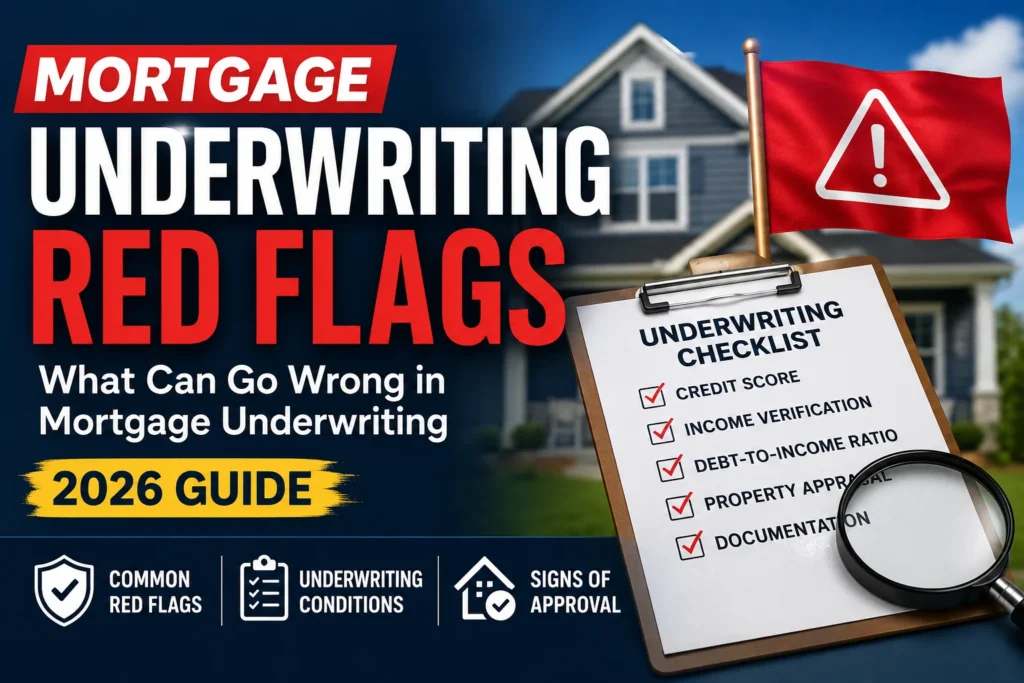
Common mortgage underwriting problems borrowers face during the loan approval process in 2026.
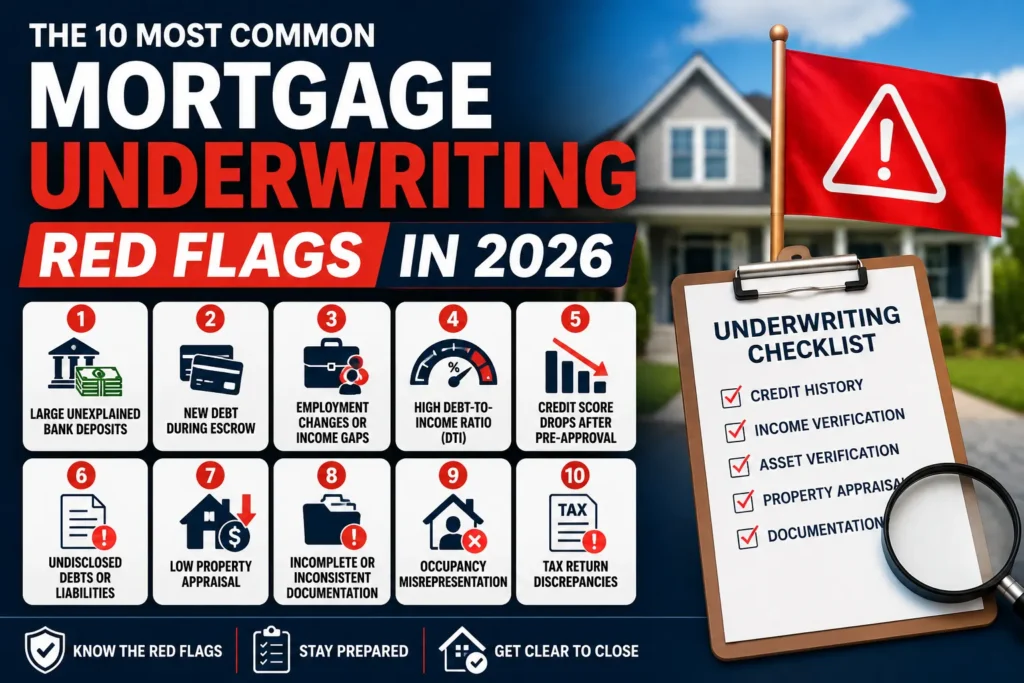
Top mortgage underwriting warning signs every homebuyer should understand before closing.
What Are Underwriting Red Flags?
An underwriting red flag is any element in your mortgage application that creates doubt about your financial stability the accuracy of your paperwork or the value of the property securing the loan.
Red flags do not automatically mean denial. They mean the underwriter needs more information before they can approve your file. In most cases the fix is simple. Provide a document. Write a letter of explanation. Clarify a transaction.
The key difference between a red flag and a denial is documentation if you can document and explain the issue the underwriter can usually clear it.
The 10 Most Common Mortgage Underwriting Red Flags in 2026
1. Large Unexplained Bank Deposits
This is the single most common red flag in mortgage underwriting. If your bank statements show a deposit that does not match your regular paycheck pattern the underwriter will ask where the money came from.
Why it matters: Lenders need to verify that your down payment and reserves come from acceptable sources. Unexplained cash could indicate undisclosed loans which would affect your debt to income ratio.
Examples that trigger this flag:
- A $5,000 cash deposit with no paper trail
- A transfer from an account not listed on your application
- Venmo or PayPal transfers without clear descriptions
- Insurance payouts or legal settlements without documentation
The fix: Provide a written letter of explanation with supporting documents. Bank transfer confirmations gift letters from family members or pay stubs showing bonus income will satisfy the underwriter in most cases.
2. New Debt or Credit Applications During Escrow
Opening a new credit card, financing furniture or leasing a car while your mortgage is being processed is one of the fastest ways to derail your approval.
Why it matters: New debt changes your debt to income ratio. A new hard inquiry can lower your credit score. Both of these can push your file outside of qualifying guidelines.
Real world example: A borrower was pre approved at a 42% DTI. During escrow they financed $3,200 in appliances. The new monthly payment pushed their DTI to 46% which exceeded the lender’s maximum. The loan was suspended until the appliance loan was paid off.
The fix: Do not take on any new debt from the day you apply until the day you close. No exceptions. If you absolutely must make a large purchase call your loan officer first.
3. Employment Changes or Gaps
Underwriters verify your employment at least twice during the loan process. Once at application and once just before closing. Any change between those two points creates a red flag.
What triggers this flag:
- Switching employers during escrow
- Moving from salaried to commission-based pay
- Gaps of 30 or more days between jobs
- Transitioning from W 2 employment to self employment
The fix: If a job change is unavoidable staying in the same industry and at the same or higher pay level reduces the risk. Your new employer will need to provide a written verification of employment with start date, position and salary.
4. High Debt to Income Ratio
Your DTI ratio is the percentage of your gross monthly income that goes toward debt payments. In 2026 most conventional loans cap DTI at 45% to 50%. FHA loans allow up to 57% with strong compensating factors.
Front end ratio: Housing costs divided by gross income. Ideal target is below 28%.
Back end ratio: All monthly debt payments divided by gross income. Ideal target is below 36%.
The fix: Pay down revolving debt before applying. Even paying off a $200 monthly credit card payment can significantly improve your ratio. For borrowers with high DTI but strong compensating factors, manual underwriting may offer more flexibility through human review rather than automated systems.
5. Credit Score Drops After Pre Approval
Your credit score at pre approval is not locked in. The underwriter pulls a fresh credit report during final review. If your score has dropped, the terms of your approval may change or the loan may be denied entirely.
Common causes of score drops during escrow:
- Late payments on existing accounts
- Increased credit card balances
- New hard inquiries from other lenders or credit applications
- Closing old credit accounts which reduces available credit history
The fix: Monitor your credit actively during the mortgage process. Set up autopay on all accounts. Keep credit card utilization below 30%. Do not close any existing accounts.
6. Undisclosed Liabilities
Failing to disclose existing financial obligations is a serious red flag that can lead to immediate denial. Automated underwriting systems in 2026 cross reference multiple databases to identify hidden debts.
What underwriters check for:
- Alimony or child support obligations
- Student loans in deferment or forbearance
- Co signed loans for family members
- Tax liens or unpaid judgments
- Business debts for self-employed borrowers
The fix: Full disclosure from the start. Even debts in deferment count toward your DTI in most loan programs. Being upfront allows your loan officer to structure the application correctly from day one.
7. Property Appraisal Problems
The property is the collateral for the loan. If the appraisal reveals problems the underwriter must protect the lender’s investment.
Red flags from the appraisal:
- Appraised value comes in lower than the purchase price
- Comparable sales used are from different neighborhoods or property types
- Significant deferred maintenance such as roof damage or foundation issues
- Health and safety concerns like mold, lead paint or faulty electrical systems
- Non permitted additions or modifications
The fix for a low appraisal: You have three options. Negotiate a lower price with the seller. Bring additional cash to cover the gap. Request a reconsideration of value if you believe the appraiser used incorrect comparables.
8. Incomplete or Inconsistent Documentation
Missing pages from bank statements, unsigned forms or numbers that do not match between documents will slow your file down immediately.
The fix: Provide complete documents from the start. Every page of every bank statement. Every schedule of your tax return. If you are organized on day one you will save weeks. For a complete list of what you need see our mortgage documents checklist.
9. Occupancy Misrepresentation
Claiming a property will be your primary residence when you intend to use it as an investment property or second home is mortgage fraud. Underwriters use multiple data points to verify occupancy intent.
Why it matters: Primary residence loans have lower interest rates and more favorable terms. Misrepresenting occupancy to get better terms is a federal offense.
The fix: Be honest about your intended use. If you are purchasing an investment property apply for an investment property loan. The rate will be higher but the risk of fraud charges is zero.
10. Tax Return Discrepancies
For self employed borrowers and anyone with complex income tax returns are one of the most heavily scrutinized documents in the underwriting file.
Red flags underwriters find in tax returns:
- Business income that decreased significantly year over year
- Excessive business deductions that reduce qualifying income
- Unreported income that appears in bank deposits but not on returns
- Filed extensions without clear justification
The fix: Work with your CPA and loan officer together before applying. Understand that the income the underwriter uses is your adjusted gross income after deductions not your gross revenue.
What Are Underwriting Conditions? Common Examples
Underwriting conditions are specific requirements the underwriter attaches to your approval. Meeting these conditions is required before your loan can move to closing. Conditions are normal. They are not red flags. Nearly every mortgage file receives at least a few.
Prior to Document Conditions
| Condition | What It Means |
|---|---|
| Updated pay stub | Provide your most recent 30 – day pay stub |
| Letter of explanation | Written statement explaining a specific item such as a large deposit or employment gap |
| Verification of rent | Proof of 12 months of on time rent payments |
| Gift letter | Signed letter confirming a financial gift is not a loan |
| Updated bank statement | Most recent statement showing current balances |
Prior to Closing Conditions
| Condition | What It Means |
|---|---|
| Clear title | Title search confirms no liens or disputes on the property |
| Proof of insurance | Homeowners insurance policy in place with lender listed |
| Final inspection | Confirmation that any required repairs have been completed |
| Flood certification | Verification of flood zone status for the property |
| Final verification of employment | Verbal or written confirmation you are still employed |
Signs Your Mortgage Will Be Approved
While only the underwriter can issue a formal approval, these indicators suggest your file is in strong shape:
- Your pre approval was based on verified documents. A pre-approval backed by tax returns, pay stubs, and bank statements carries far more weight than a simple pre-qualification. See what a strong approval looks like in our pre-approval letter samples guide.
- Your financial situation has not changed since application. Same job. Same income. Same debt levels. No major purchases.
- The appraisal came in at or above the purchase price. This confirms the collateral supports the loan amount.
- Your loan officer is not asking for unusual documents. A smooth document collection process usually means the automated system gave your file a clean initial review.
- You received a conditional approval quickly. A fast conditional approval often means the AUS gave your file a strong initial rating.
- Conditions are minor and routine. If the only conditions are updated pay stubs and proof of insurance, your file is likely in excellent shape.
What Does Clear to Close Mean?
Clear to close is the final milestone before your closing appointment. It means the underwriter has reviewed every document, verified every condition and officially approved your loan for funding.
What happens after clear to close:
- The lender prepares your final Closing Disclosure document
- You review the CD and confirm all numbers match your expectations
- A closing date is scheduled with the title company or attorney
- You sign the final documents and the loan is funded
Important: Clear to close does not mean the process is over. Lenders perform a final credit pull and employment verification in the days before closing. Maintain your financial stability until the keys are in your hand.
What to Do If Your Loan Gets Denied During Underwriting
- Request the specific reason in writing. Lenders are legally required to provide an adverse action notice explaining exactly why your application was denied.
- Talk to your loan officer immediately. Sometimes the issue can be resolved with additional documentation or a letter of explanation.
- Explore alternative loan programs. If a conventional loan was denied due to credit issues, an FHA loan may have more flexible guidelines. If the automated system rejected your file manual underwriting allows a human underwriter to evaluate compensating factors that algorithms miss.
- Address the root cause. If the denial was due to high DTI, focus on paying down debt. If it was a credit score issue, work on rebuilding for 6 to 12 months before reapplying.
- Get a second opinion. Different lenders have different overlays. A file that is denied at one institution may be approved at another with more flexible internal guidelines.
How to Avoid Underwriting Red Flags: Expert Tips
- Freeze your financial life from application to closing. No new credit. No job changes. No large purchases. No moving money between accounts without documentation.
- Document everything proactively. If you receive a gift, get the gift letter signed before the money is transferred. If you sell a vehicle, keep the bill of sale.
- Communicate with your loan officer early. If you know your file has complexity such as self employment income or a recent bankruptcy raise it during the pre-approval stage.
- Keep every page of every document. Bank statements, tax returns and pay stubs must be complete. Even blank pages must be included.
- Respond to conditions within hours, not days. The faster you provide requested documents, the faster your file moves through the pipeline.
- Understand the underwriter’s perspective. The underwriter is not your adversary. They are a risk analyst following specific guidelines. Understanding what the underwriter actually does helps you prepare a stronger file from the start.
Frequently Asked Questions
What are the most common underwriting red flags in 2026 ?
The most common mortgage underwriting red flags include large unexplained bank deposits, new debt taken during escrow, employment changes, high debt to income ratios, credit score drops after pre approval, low property appraisals, and incomplete documentation. Most of these can be resolved with proper paperwork and a clear letter of explanation.
What can go wrong during underwriting ?
Several things can go wrong during underwriting including property appraisal issues, discovery of undisclosed debts, income that cannot be properly verified and documentation inconsistencies. The most serious problems involve misrepresentation of occupancy intent or income which can result in denial and potential fraud charges.
What are underwriting conditions ?
Underwriting conditions are specific requirements the underwriter attaches to a conditional approval. They are items you must provide or actions that must be completed before the loan can be finalized. Common conditions include updated pay stubs, letters of explanation, proof of homeowners insurance and clear title verification.
How do I know if my mortgage will be approved?
Strong approval indicators include a pre approval based on verified documents, stable employment and income since application, an appraisal that meets or exceeds the purchase price and only minor routine conditions from the underwriter. For a deeper look at the full underwriting journey see our guide on what happens when a loan is submitted to underwriting.
What does clear to close mean?
Clear to close means the underwriter has reviewed and approved every aspect of your mortgage file. All conditions have been satisfied and the loan is authorized for funding. After receiving clear to close you will review a final Closing Disclosure document and schedule your signing appointment with the title company.
Can I fix underwriting red flags after they are found?
Yes. Most underwriting red flags can be resolved with proper documentation. A letter of explanation, supporting financial documents or additional verification from your employer or bank will address the majority of issues. The key is responding quickly and providing complete honest information.