- Have any Questions ?
- info@capstoneplanet.com

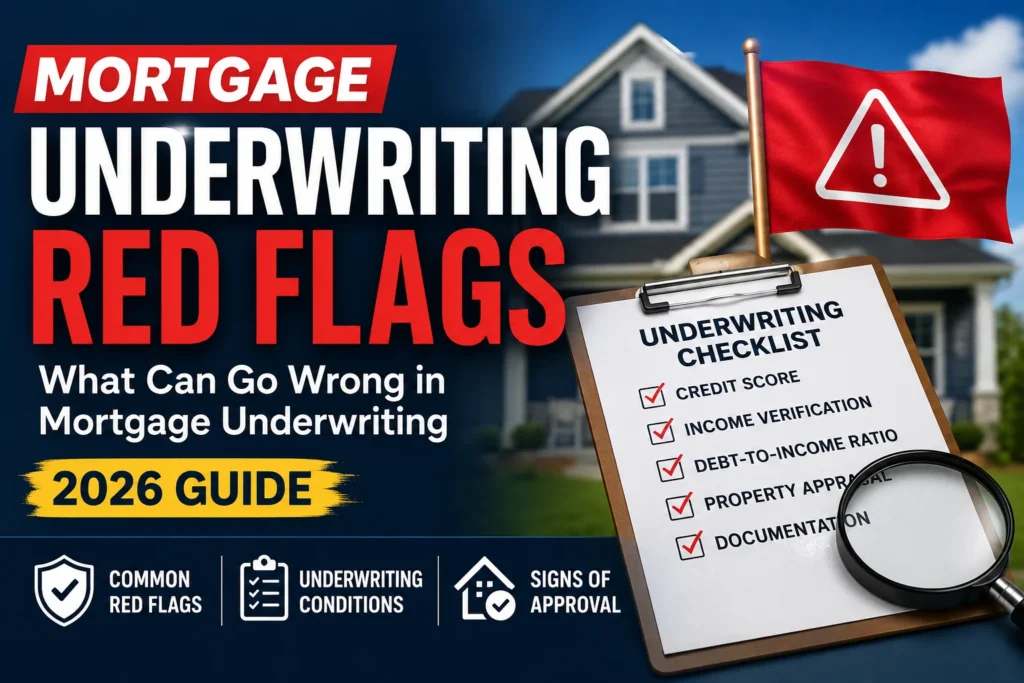
Mortgage Underwriting Red Flags: 10 Problems That Can Delay or Stop Approval in 2026
- Red flag ≠ fraud. Most underwriting concerns are documentation items, not evidence of wrongdoing.
- Red flag ≠ denial. Many issues can be resolved during the underwriting process.
- DTI requirements vary by loan program, underwriting method (automated vs. manual), and lender. No single universal limit applies to every conventional loan.
- Employment history guidance exists (Fannie Mae, Freddie Mac, FHA/HUD), but specific requirements depend on the loan program and borrower circumstances.
- Occupancy misrepresentation is a serious matter under federal law (18 U.S.C. §1014). Disclose occupancy intent truthfully.
- Clear documentation of income, assets, debts, and employment is one of the most effective ways to avoid delays during underwriting.
- Pre-underwriting with an experienced loan officer can identify potential conditions early.
What Are Mortgage Underwriting Red Flags?
An underwriting red flag is any item that prompts the underwriter to pause and verify information more closely. It is not a conclusion — it is a signal that something needs clarification.
Underwriters are required to evaluate whether a loan meets applicable guidelines for its program. When a red flag appears, they may request additional documentation or clarification. The nature of the issue determines how it is handled.
Categories of Underwriting Concerns
Not every underwriting issue is the same. Below is a logical taxonomy showing how these concerns group together:
| Category | Includes |
|---|---|
| Borrower / Financial | Large unexplained deposits, new debt, DTI concerns, credit changes, undisclosed liabilities, employment changes |
| Documentation | Missing documents, inconsistent information, unexplained discrepancies, verification gaps |
| Property / Transaction | Appraisal issues, occupancy inconsistencies, property condition concerns, title clouds |
| Integrity / Misrepresentation | Material misrepresentation, identity inconsistencies, undisclosed material information, falsified documentation |
How a Red Flag Moves Through Underwriting
The following flow illustrates a typical path, though the exact process varies by lender, loan program, and the specific issue:
Potential Red Flag
↓
Underwriter Review — issue identified and evaluated against program guidelines
↓
Documentation Request — borrower asked to provide clarifying information
↓
Underwriting Condition — requirement for the loan to proceed
↓
Additional Verification / Re-Underwriting — if circumstances change materially
↓
Final Loan Decision
Each step can take a different path depending on the lender, the loan program, the automated underwriting system (AUS) findings, and the documentation provided.
Red Flag vs. Underwriting Condition vs. Fraud
These terms describe fundamentally different things:
- A red flag is an indicator the underwriter wants to understand better. It means “let’s look closer.”
- An underwriting condition is an ordinary, routine step in the loan process. Conditions are issued for virtually every mortgage — they are not inherently negative. Documentation conditions are normal.
- Fraud means a borrower (or other party) knowingly provided materially false information with intent to deceive. A documentation discrepancy is not automatically fraud.
Every underwriting condition is not a red flag. Conditions are part of every mortgage approval. A request for pay stubs or bank statements is standard due diligence, not a sign of trouble.
Every red flag is not a reason for denial. Many red flags are simply documentation gaps that, once addressed, allow the loan to proceed. The outcome depends on the nature of the issue and whether applicable guidelines can be satisfied.
The 10 Mortgage Underwriting Red Flags in 2026
1. Large Unexplained Deposits
What Is It?
Underwriters review bank statements to verify the source of funds used for the down payment, closing costs, and reserves. A large deposit that cannot be traced to a documented source may require explanation. What constitutes “large” depends on context — often deposits exceeding a meaningful portion of monthly income trigger review.
Why Does the Underwriter Care?
Lenders must verify that the borrower’s funds are their own and not from an undisclosed loan, which would change the debt calculation. Undocumented deposits may also raise questions about whether the borrower met the asset requirements on their own.
What May Be Reviewed?
- Bank statements (typically 60 days or two full statement cycles)
- The specific deposit transaction(s) and surrounding account activity
What Might the Borrower Be Asked to Provide?
- Source documentation (pay stub showing direct deposit, sale of an asset, gift letter)
- Gift funds require: a signed gift letter, donor bank statement showing funds, and proof of transfer
- Business distributions may require business tax returns and ownership documentation
How Can It Potentially Be Resolved?
Providing a clear, documented source generally satisfies the underwriter. If the deposit cannot be documented, some lenders may exclude those funds from the loan file.
What Can Happen Next?
The underwriter may exclude undocumented funds from qualifying assets, issue a condition for documentation, or, if the deposit represents a material concern, refer for further review. Most cases resolve with proper documentation.
Realistic Scenario
Situation: A borrower deposits $8,000 in cash three weeks before closing.
Underwriting Concern: The underwriter cannot verify whether the funds are the borrower’s own or from an undisclosed loan.
Potential Documentation: The borrower provides a bill of sale for a vehicle sold for $8,000, along with a copy of the title transfer.
Possible Resolution: The underwriter accepts the documentation; the funds are included in qualifying assets.
Possible Outcome: Closing proceeds on schedule.
2. Credit Score Changes During Underwriting
What Is It?
Lenders typically pull a credit report at application and may refresh it before closing. A drop in credit scores between these pulls can affect loan eligibility or pricing. Mortgage lenders use specific FICO versions (Score 2/Experian, Score 4/TransUnion, Score 5/Equifax) and take the middle score (or the lower of two middle scores for joint applications).
Why Does the Underwriter Care?
Credit scores are part of the loan eligibility and pricing framework. A change may affect whether the borrower meets the program’s minimum requirements or the pricing tier.
What May Be Reviewed?
- Updated credit report showing what changed
- Explanation of any new inquiries, accounts, or balances
What Might the Borrower Be Asked to Provide?
- Letter of explanation for new inquiries or accounts
- Proof of payment if a balance increased significantly
How Can It Potentially Be Resolved?
If the score change is minor and the borrower remains within program requirements, the loan may proceed unchanged. If the score drops below a program threshold, the borrower may need to address the underlying issue (pay down balances, correct errors).
What Can Happen Next?
The underwriter may re-run AUS with the updated score. Outcomes range from no change, to a pricing adjustment, to a requirement to resolve the issue.
Realistic Scenario
Situation: During underwriting, a credit refresh shows the borrower opened a new credit card and charged $5,000, pushing utilization above 30%.
Underwriting Concern: The new inquiry and higher utilization dropped the middle score by 15 points.
Potential Documentation: Borrower provides a letter explaining the card was for moving expenses and proof the balance will be paid before closing.
Possible Resolution: The score remains within the program’s range; the loan proceeds with a documented condition that the balance is paid at closing.
Possible Outcome: Loan closes as scheduled.
3. Employment Changes, Gaps, or Unverifiable Income
What Is It?
Lenders review employment history and income to assess whether the borrower has stable, ongoing income sufficient to repay the loan. Gaps in employment, recent job changes, or difficulty verifying income can prompt additional review. Fannie Mae and Freddie Mac guidelines, as well as HUD Handbook 4000.1 for FHA loans, provide frameworks for evaluating employment and income.
Why Does the Underwriter Care?
The underwriter must establish that income is stable and likely to continue. An unexplained gap or a recent change raises a question that needs documentation.
What May Be Reviewed?
- Employment verification (written or verbal verification of employment)
- Pay stubs (often 30 days) and W-2s (often 2 years)
- Tax returns (for self-employed, commissioned, or variable-income borrowers)
What Might the Borrower Be Asked to Provide?
- Written explanation of any employment gap
- Offer letter and/or first pay stub for a new job
- For self-employed borrowers: 2 years of personal and business tax returns, plus a year-to-date profit-and-loss statement
- For variable income (bonus, commission, overtime): evidence of 2-year history and likely continuance
How Can It Potentially Be Resolved?
Most employment and income concerns are resolved with documentation. If income cannot be verified or does not meet guidelines, the qualifying income may be reduced, which could affect DTI.
What Can Happen Next?
The underwriter may issue a condition, adjust qualifying income, or, in cases where requirements cannot be met, the loan may not proceed under that program. A different loan program or lender may be an option.
Realistic Scenario
Situation: A borrower switched jobs three months before applying — same field, higher salary.
Underwriting Concern: The employment history is short at the current employer; the underwriter needs to confirm stability and verify the new income.
Potential Documentation: Borrower provides offer letter, first pay stubs, and employment verification confirming full-time, permanent status.
Possible Resolution: Because the change was within the same field with higher pay, and documentation is complete, AUS approves with an employment condition.
Possible Outcome: Loan closes after verification of employment is completed.
A Note on Qualifying Income
For self-employed borrowers, qualifying income is not necessarily the same as adjusted gross income (AGI) or taxable income. Underwriters may add back certain non-cash expenses (such as depreciation, depletion, and amortization) per applicable guidelines. Operating expenses are typically not added back. The specific methodology depends on the loan program and the underwriting system in use.
4. Debt-to-Income Ratio Concerns
What Is It?
Debt-to-income (DTI) ratio compares a borrower’s monthly debt obligations to their gross monthly income. The back-end (total) DTI includes the proposed housing payment plus all recurring debts. DTI is one factor among many that underwriters consider.
Why Does the Underwriter Care?
DTI helps the underwriter evaluate whether the borrower has sufficient income to manage the proposed housing payment alongside existing obligations. It is evaluated alongside credit history, assets, and loan-to-value (LTV) ratio.
What DTI Guidelines Exist?
DTI requirements are not one universal number. They depend on the loan program, the underwriting method, AUS findings, and lender-specific requirements:
- Conventional (Fannie Mae / Freddie Mac): Desktop Underwriter® (DU) and Loan Product Advisor® evaluate DTI in context with credit score, LTV, and reserves. Under current Fannie Mae guidance, DU-approved loans can reach up to 50% DTI; manually underwritten loans are generally limited to 36% DTI, with up to 45% available under specific eligibility conditions. These are guideline ceilings, not approvals — lender overlays may apply.
- FHA: FHA’s TOTAL Mortgage Scorecard uses a risk-based automated evaluation. HUD Handbook 4000.1 provides manual underwriting tiers (e.g., 31/43% with no compensating factors; higher ratios possible with documented compensating factors).
- VA: VA evaluates residual income rather than a fixed DTI ratio, though high DTI may still prompt additional review.
- Portfolio lenders: May set their own standards, which can be stricter or more flexible than GSE/FHA guidelines.
What Might the Borrower Be Asked to Provide?
- Written explanation of any debts paid off during underwriting
- Evidence of reserves (retirement accounts, savings)
- Documentation supporting compensating factors
How Can It Potentially Be Resolved?
If DTI exceeds the applicable threshold for the program, options may include: paying down or paying off revolving debt, adding a co-borrower, increasing down payment to reduce the loan amount, or exploring a different loan program. Some borrowers work with their loan officer to explore non-QM or portfolio options if agency guidelines cannot be met.
What Can Happen Next?
If DTI is within the program’s parameters (including compensating factors as applicable), the loan proceeds. If it exceeds what AUS or manual underwriting supports, the loan may not close under that program.
Realistic Scenario
Situation: A borrower has a back-end DTI of 47% on a conventional loan. The DU findings require compensating factors.
Underwriting Concern: DTI is above the baseline recommendation.
Potential Documentation: Borrower documents 6 months of reserves in a retirement account and a credit score of 740.
Possible Resolution: DU approves with the compensating factors documented.
Possible Outcome: Loan proceeds with no further DTI conditions.
5. Undisclosed Liabilities
What Is It?
An undisclosed liability is any debt or financial obligation that was not listed on the loan application but appears on the credit report, bank statements, or through verification. Examples include co-signed loans, buy-now-pay-later obligations, alimony/child support, or business debts.
Why Does the Underwriter Care?
If a liability was not included in the initial DTI calculation, the borrower’s actual DTI may be higher than reported. Lenders are required to include all known recurring obligations in the DTI calculation.
What May Be Reviewed?
- Credit report showing the undisclosed account
- Bank statements showing recurring payments
- Divorce decree or separation agreement for alimony/child support
What Might the Borrower Be Asked to Provide?
- Explanation of the liability and why it was not initially disclosed
- For co-signed debts: proof that the primary obligor has made payments for a specified period (often 12 months)
- For student loans in deferment: documentation of the actual or expected payment
How Can It Potentially Be Resolved?
If the liability is verified and included in the DTI calculation, and the ratio remains acceptable, the loan proceeds. If the updated DTI exceeds program limits, the borrower may need to reduce debt or explore other options.
What Can Happen Next?
DTI is recalculated. The outcome depends on whether the revised DTI meets program requirements.
Realistic Scenario
Situation: The credit report shows a co-signed auto loan the borrower forgot to list.
Underwriting Concern: Monthly payment of $350 was not included in DTI.
Potential Documentation: Borrower provides 12 months of canceled checks from the primary borrower showing on-time payments.
Possible Resolution: Underwriter excludes the debt per applicable guidelines; DTI remains unchanged.
Possible Outcome: Loan proceeds.
6. Property Appraisal Issues
What Is It?
An appraisal provides an independent estimate of the property’s market value. If the appraised value comes in below the contract price (an “appraisal gap”), the loan-to-value ratio changes. Appraisers are required to be independent under Fannie Mae’s Appraiser Independence Requirements (AIR) and similar rules.
Why Does the Underwriter Care?
The lender uses the lesser of the purchase price or appraised value to calculate LTV. A low appraisal can increase the effective LTV, potentially requiring mortgage insurance, a higher rate, or additional down payment.
What May Be Reviewed?
- The full appraisal report and comparable sales
- Additional comparable sales provided by the borrower or agent
- Property condition notes in the appraisal
What Might the Borrower Be Asked to Provide?
- Comparable sales supporting the contract price (for a rebuttal)
- Proof of additional funds to cover the gap
How Can It Potentially Be Resolved?
Options include: negotiating a price reduction with the seller, paying the difference in cash, requesting an appraisal rebuttal with supporting data, or invoking an appraisal contingency to exit the contract. A second appraisal may be ordered in some circumstances, but there is no guarantee it will produce a higher value.
What Can Happen Next?
If the gap cannot be bridged and the parties do not agree, the transaction may not close. If resolved, the loan proceeds at the applicable LTV.
7. Title Issues and Clouds
What Is It?
A title search examines public records to confirm the seller’s legal right to transfer ownership and to identify any claims (liens, judgments, easements, boundary disputes) against the property. A “cloud” is any outstanding claim or defect that could affect ownership rights.
Why Does the Underwriter Care?
The lender requires a clear title to secure its lien position. Title insurance generally will not be issued over a known, unresolved defect.
What May Be Reviewed?
- Title commitment / preliminary title report
- Recorded documents: deeds, mortgages, liens, judgments, easements
- Survey (if boundary or encroachment issues are identified)
What Might the Borrower Be Asked to Provide?
- Satisfaction/release of a paid judgment or lien
- Survey confirming boundaries
- Divorce decree or probate documentation clarifying ownership
How Can It Potentially Be Resolved?
Most clouds can be cleared with documentation. Liens that have been paid need a recorded release. More complex issues (boundary disputes, missing heirs) may require legal action and can extend timelines significantly.
What Can Happen Next?
Simple title issues may be cleared within days. Complex issues can take weeks or months. The transaction closes once title is clear.
8. Occupancy Misrepresentation
What Is It?
Borrowers certify the intended occupancy of the property on the loan application — primary residence, second home, or investment property. Occupancy affects pricing, down payment requirements, and program eligibility. Claiming primary-residence occupancy for a property the borrower intends to rent or not occupy is a form of misrepresentation.
Why Does the Underwriter Care?
Primary residence loans have different (often more favorable) terms than investment property loans. Lenders verify occupancy through multiple channels: driver’s license address, voter registration, tax returns, utility records, and post-closing occupancy checks.
What May Be Reviewed?
- Borrower’s current address on identification and tax returns
- Proximity of the subject property to the borrower’s employment
- Utility setup and mail forwarding records
What Might the Borrower Be Asked to Provide?
- Explanation of occupancy intent if discrepancies exist
- Documentation supporting the stated occupancy
How Can It Potentially Be Resolved?
If the borrower genuinely intends to occupy, documentation typically satisfies the underwriter. If the intent was misrepresented, the loan may need to be reclassified as an investment property with different terms.
What Can Happen Next?
If occupancy intent is verified, the loan proceeds as a primary residence. If misrepresentation is identified, the loan may be reclassified, adjusted, or denied depending on the circumstances and program requirements.
Note: Living in one unit of a 2-4 unit property and renting the others (“house hacking”) is permitted under many FHA and conventional owner-occupied programs. The borrower must occupy one unit as their primary residence.
9. Property Condition / Minimum Property Requirements
What Is It?
FHA, VA, and some conventional programs require the property to meet minimum property requirements (MPR) for safety, soundness, and structural integrity. The appraisal or home inspection may identify deficiencies that must be addressed before closing. Common items include: roof leaks, foundation issues, non-functional mechanical systems, missing handrails, or health hazards (lead-based paint, mold, radon).
Why Does the Underwriter Care?
The lender must confirm the collateral meets minimum standards for the specific loan program. Properties that do not meet these standards are not eligible for financing under that program until the issues are corrected.
What May Be Reviewed?
- Appraisal report noting required repairs
- Home inspection report (if available/required)
- Specialist reports (structural engineer, mold assessment, radon test)
What Might the Borrower Be Asked to Provide?
- Licensed contractor bids for required repairs
- Completion certificates or re-inspection reports confirming repairs
- Clearance documentation for health hazards (lead, mold, radon)
How Can It Potentially Be Resolved?
Required repairs must be completed and re-inspected before closing for most programs. Renovation loans (FHA 203(k), Fannie Mae HomeStyle®) allow financing of repairs within the mortgage. Cosmetic issues (“dated kitchen”) typically do not block financing but may affect value.
What Can Happen Next?
If repairs are completed and verified, closing proceeds. If repairs cannot be completed before closing, an escrow holdback may be possible in some programs. If the property cannot meet requirements, the loan may not close under that program.
10. Documentation Inconsistencies or Misrepresentation
What Is It?
When information on the loan application, supporting documents, and third-party verifications does not match, the underwriter must resolve the inconsistency. This ranges from honest errors (a typo, an omitted account) to material misrepresentation (falsified pay stubs, altered bank statements, fabricated employment).
Why Does the Underwriter Care?
The underwriter must verify that all information is accurate and consistent. Material misrepresentation is a serious matter. Honest errors and omissions, when promptly disclosed, are generally straightforward to correct.
What May Be Reviewed?
- Cross-referencing the application against third-party verifications (credit report, employment verification, tax transcripts)
- Fraud detection tools used by lenders
What Might the Borrower Be Asked to Provide?
- Corrected documents or letters of explanation for discrepancies
- Direct third-party verification
How Can It Potentially Be Resolved?
Honest errors: disclose to your loan officer and provide corrected documentation. The loan may be re-underwritten with the corrected information. Intentional misrepresentation can result in denial and potential legal consequences.
What Can Happen Next?
A corrected error: the loan proceeds after re-verification. Material misrepresentation: denial and possible referral.
Realistic Scenario
Situation: The employment verification form returns a start date that is 3 months different from what the borrower listed on the application.
Underwriting Concern: Inconsistency in employment dates raises a verification question.
Potential Documentation: Borrower explains they started as a contractor before converting to full-time; provides contract agreement and first pay stub as an employee.
Possible Resolution: The underwriter verifies the explanation against tax transcripts and updated employment verification; dates align.
Possible Outcome: Loan proceeds with the corrected employment history.
Summary: 10 Underwriting Red Flags at a Glance
| Underwriting Issue | Why It Matters | Possible Documentation | Possible Next Step |
|---|---|---|---|
| Large unexplained deposits | Source of funds must be verified | Gift letter, sale receipt, pay stub | Documentation reviewed; funds included or excluded |
| Credit score changes | May affect eligibility or pricing | Explanation of new activity, proof of payment | Re-run AUS with updated score; proceed or address |
| Employment gaps or changes | Income stability must be documented | Offer letter, pay stubs, employment verification | Condition satisfied; income verified or adjusted |
| DTI concerns | DTI is a key underwriting factor | Reserves, debt payoff evidence, compensating factors | DTI accepted or restructured; program change if needed |
| Undisclosed liabilities | DTI must reflect all obligations | Payment history for co-sign, loan statements | DTI recalculated; excluded if documented per guidelines |
| Appraisal issues | LTV based on appraised value | Comparable sales, additional funds proof | Negotiate, pay gap, rebut, or invoke contingency |
| Title issues | Clear title required to close | Lien releases, survey, legal docs | Cleared before closing; timeline varies |
| Occupancy misrepresentation | Occupancy affects loan terms and eligibility | Address verification, intent documentation | Verified or reclassified; terms adjusted if needed |
| Property condition / MPR | Collateral must meet minimum standards | Contractor bids, repair completion certs | Repairs completed and verified; or renovation loan |
| Documentation inconsistencies | Information must be accurate and verifiable | Corrected docs, letters of explanation | Error corrected; or escalated if material |
What to Do If Underwriting Flags an Issue
If the underwriter identifies a concern during underwriting:
- Respond promptly. Delays in providing documentation can extend the timeline or lead to a missed closing date.
- Ask exactly what is needed. Understand the specific documentation or clarification the underwriter requires.
- Provide complete, accurate documents. Partial or inconsistent documentation often generates follow-up requests.
- Stay in communication with your loan officer. They can explain what the condition means and help coordinate the response.
- Be honest about any errors. If you realize you made a mistake on the application, disclose it immediately.
Many conditions resolve quickly with proper documentation. If the concern cannot be resolved under the current program, your loan officer may be able to explore alternative programs or lenders.
How Long Does Underwriting Take?
Underwriting timelines depend on the lender, loan program, complexity of the file, and current volume. Industry estimates suggest:
- Initial review: typically 3-5 business days
- Conditional approval: typically 7-14 days from submission
- Clear-to-close: typically 21-30 days total
Complex files (self-employed borrowers, gift funds, multiple properties) may extend these timelines. The CFPB provides a mortgage process timeline for additional context.
| Stage | Typical Duration | Potential Delays |
|---|---|---|
| Document collection and initial disclosure | 1-3 days | Incomplete borrower documents |
| AUS run (DU/LP) and initial conditions | 1-2 days | Complex income calculation |
| Appraisal order and completion | 7-10 days | Appraiser availability, rebuttal |
| Title search and clearance | 5-7 days | Liens, probate, boundary issues |
| Condition clearing and final review | 3-7 days | Verification backlogs |
| Clear-to-close to funding | 1-3 days | Wire verification, closing disclosure timing |
Frequently Asked Questions
Can a mortgage be denied after underwriting?
Yes. Underwriting is a detailed review, and new information can emerge. However, many conditions identified during underwriting can be resolved. Denial occurs when the loan cannot meet applicable guidelines after all reasonable documentation and corrections have been addressed. Under ECOA (Regulation B), lenders must provide an adverse action notice explaining the specific reasons for denial.
Can a large deposit delay closing?
It can, if the source cannot be documented promptly. Underwriters need to verify the origin of significant deposits. Providing documentation upfront — gift letters, sale receipts, pay stubs — helps avoid delays. Cash deposits (“mattress money”) are particularly challenging to source and may need to be excluded from qualifying assets.
What happens if my debt changes before closing?
Any new debt that appears during underwriting — including credit cards, auto loans, or buy-now-pay-later arrangements — is generally included in the DTI calculation. This can change the underwriting outcome. It is advisable to avoid opening new credit accounts or making large purchases on credit during the mortgage process.
Does changing jobs affect mortgage underwriting?
It can. Underwriters need to verify stable, ongoing income. A job change within the same field with equal or higher pay is often viewed more favorably than a change to a new field or a gap without explanation. Documentation — offer letter, pay stubs, employment verification — is typically requested. Guidelines vary by loan program; consult your loan officer.
What happens when an underwriter finds an undisclosed liability?
The liability is added to the DTI calculation. If the revised DTI remains within program limits, the loan may proceed. If it exceeds limits, options include paying off the debt, providing documentation for exclusion (e.g., 12 months of payments by another party for a co-signed loan), or exploring alternative programs.
Is every underwriting condition a red flag?
No. Underwriting conditions are a normal part of virtually every mortgage approval. They are items the underwriter needs to verify to satisfy program requirements. Conditions are issued for routine items like pay stubs, bank statements, and employment verification. A condition is not inherently a sign of a problem.
What happens after an underwriting condition is submitted?
The underwriter reviews the documentation. If it satisfies the condition, the condition is cleared. If additional information is needed, a follow-up request may be issued. Once all conditions are cleared and the loan meets final requirements, the file moves to “clear-to-close” status.
What is the most common reason underwriting issues arise?
Many underwriting back-and-forth processes stem from documentation gaps: incomplete asset statements, unverified deposits, inconsistent income figures, or undisclosed liabilities. Thorough document preparation before application — working with a loan officer who pre-underwrites the file — can reduce the volume of conditions issued during formal underwriting.
Related Resources

Kishan Dangi
Founder & CEO, CapStonePlanet
12+ years in BPO and outsourcing. CapStonePlanet provides mortgage underwriting BPO services — conventional, FHA, VA, USDA, and jumbo loan underwriting support — to US mortgage lenders with full compliance certification coverage and operational accountability.
Disclaimer: This article is for informational purposes only and does not constitute legal, financial, or mortgage advice. Underwriting requirements vary by lender, loan program, and individual circumstances. Borrowers should consult a qualified mortgage professional regarding their specific situation. References to statutes (18 U.S.C. §1014) are provided for informational context; penalties described are statutory maximums and do not predict individual outcomes. Links to government and GSE resources are provided as authoritative references; inclusion does not imply endorsement.