Key Takeaways
- Manual underwriting means a human underwriter reads your full file when the automated system returns a Refer, a Caution, or a flat no.
- It is normal, not a red flag: FHA, VA and USDA all have published manual-underwriting pathways, and many borrowers never realise their loan was manually reviewed.
- Compensating factors win files: cash reserves, clean rental history, stable income and low payment shock offset a high DTI or thin credit.
- Documents do the talking: a letter of explanation, 12 months of payment history and complete income records count more than any rate pitch.
- Timeline reality: expect 5–10 days of underwriting inside a 3–6 week end-to-end process — how fast you answer conditions sets the pace.
Quick Answer: What Is Manual Underwriting?
Manual underwriting means a human mortgage underwriter reads your full financial file by hand, instead of letting a computer score it. Lenders use it when a borrower has no credit score, a past bankruptcy, high debt, or an income the algorithms cannot read fairly. FHA, VA and USDA still offer this path in 2026.

What Is Manual Underwriting on a Mortgage?
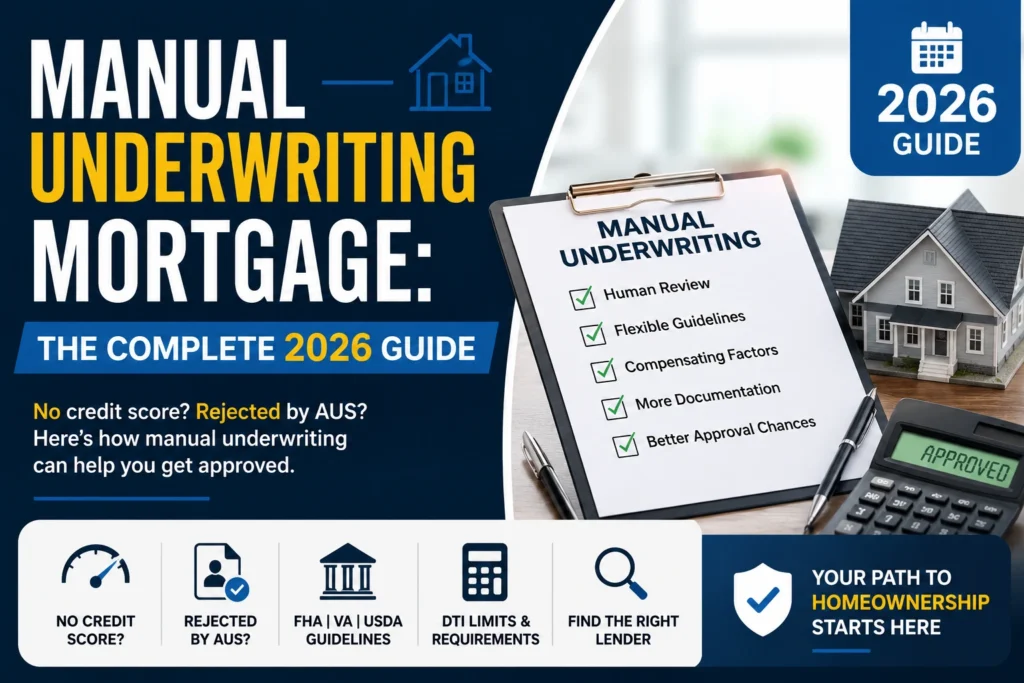
Manual underwriting is a mortgage approval process where a licensed human underwriter reviews your application file from scratch. That means your income documents, bank statements, employment history and payment records. The decision does not rest solely on an automated credit score.
Underwriting is the lender’s formal risk check on a credit application. We explain it in depth in our complete guide to what underwriting means. Manual underwriting is the opposite of automated underwriting (AUS), which uses algorithms to issue instant approvals.
An “AUS downgrade” is the most common way in. Your application runs through Desktop Underwriter (Fannie Mae), Loan Product Advisor (Freddie Mac), TOTAL (FHA) or GUS (USDA). Instead of “Approve / Eligible / Accept,” the system returns “Refer” or “Caution.” That is not a denial. It means the algorithm cannot safely score the file, so a human underwriter must review the exceptions. Many borrowers never learn their loan was manually underwritten. To them, it simply took a few days longer. A Refer finding can also flag issues an underwriter will scrutinize. Our breakdown of the most common mortgage underwriting red flags covers what lenders look for — and which ones you can fix before you apply.
A file usually moves to manual underwriting for one of these reasons:
- Your file receives a “Refer” or “Caution” finding from the AUS
- You have no FICO credit score (a “thin file”)
- You had a bankruptcy, foreclosure or short sale within the past 1-4 years
- Your Debt to Income (DTI) ratio exceeds standard automated limits
- Your income comes from self employment, rental properties or non traditional sources
Manual underwriting is not a punishment. It is simply a different path to the same destination a mortgage approval.
Manual Underwriting vs Automated Underwriting: Key Differences
| Feature | Automated (AUS) | Manual Underwriting |
|---|---|---|
| Reviewer | Algorithm / Software | Licensed Human Underwriter |
| Speed | Minutes to hours | 1–4 weeks |
| Credit Score Required? | Usually yes (620+) | No (can use alternative credit) |
| Documentation | Standard | Extensive (12–24 months) |
| Flexibility | Low | High (compensating factors matter) |
| Best For | Standard borrowers | Complex or unique financial profiles |
| Loan Types | Conventional, FHA, VA, USDA | FHA, VA, USDA (not typically conventional) |
Who Qualifies for a Manually Underwritten Loan?
Manual underwriting is not available for every loan type. In 2026 it is primarily used for government backed loans: FHA, VA and USDA. Conventional loans (Fannie Mae / Freddie Mac) very rarely allow manual review.
The “No Credit Score” Borrower
You have never had a credit card, auto loan or installment debt. The major credit bureaus have no file on you. Your FICO score is listed as “0” or “N/A.” This is common among:
- People who live debt free by choice (Dave Ramsey followers)
- Recent immigrants
- Young adults entering the housing market for the first time
Programs call this “alternative credit.” FHA and USDA generally want at least three open tradelines. For example: rent, a utility or phone account, and an insurance or student-loan obligation. Each one needs a documented 12-month history of on-time payments. Exact counts and lookback windows vary by program and lender overlay, so ask your underwriter which combination your file needs. The practical takeaway is simple: pay rent, phone and insurance on time, and keep the records. Bank statements and payment ledgers let a human underwriter see a borrower the algorithms cannot.
For these borrowers, the underwriter builds an “alternative credit history” from 12 months of on-time payments to:
- Rent (verified by landlord letter or canceled checks)
- Utility bills (electric, gas, water)
- Phone bills (cell or landline)
- Insurance premiums (auto, renters or life)
The Post Credit Event Borrower
You had a financial hardship — a bankruptcy, foreclosure or short sale — but you have since rebuilt your finances. Manual underwriting lets lenders look past the event and judge your current stability instead.
Waiting period guidelines (2026):
- FHA after Chapter 7 Bankruptcy: 2 years
- FHA after Foreclosure: 3 years
- VA after Bankruptcy: typically 2 years from discharge — confirm current VA Lender’s Handbook guidance with your lender
- USDA after Foreclosure: generally 3 years — waiting periods vary by circumstance; confirm current Rural Development guidance
The High DTI Borrower
Your Debt to Income ratio is above the automated threshold but you have strong compensating factors that an algorithm cannot weigh. This is where a human underwriter’s judgment becomes critical.
FHA, VA and USDA Manual Underwriting Guidelines (2026)
FHA Manual Underwriting DTI Limits
FHA is the most common path for manual underwriting. With a credit score of 580 or above, HUD allows the ratios below. The exact limit depends on how many compensating factors you can document (Handbook 4000.1, II.A.5.d; see also HUD Mortgagee Letter 2023-14 / 14-02).
| DTI Scenario | Front-End Ratio | Back-End Ratio |
|---|---|---|
| Standard (no compensating factors) | 31% | 43% |
| With 1 compensating factor | 37% | 47% |
| With 2+ compensating factors | 40% | 50% |
Common FHA Compensating Factors:
- Verified cash reserves of at least 3 months of mortgage payments (1–2 unit properties; 6 months for 3–4 units)
- Minimal payment shock — your new total monthly housing payment rises only modestly above your current payment. FHA expresses the limit as a small dollar amount or 5%, whichever is less; confirm the current figure with your lender. This factor needs a documented 12-month payment history
- Stable employment history
- Additional income not reflected in the qualifying ratios
VA Manual Underwriting (For Veterans)
VA loans are uniquely flexible. The VA does not enforce a hard DTI cap for manually underwritten loans. Instead, the underwriter focuses on residual income.
What residual income is
Residual income is the money left over each month after every fixed obligation is paid. The VA uses it instead of a single debt-to-income cutoff for a simple reason. Two borrowers with the identical 45% DTI can end the month in very different places. One keeps a comfortable margin. The other keeps almost nothing. The VA calls the first a safer loan, whatever the percentage says.
The VA’s own wording is that these residual income figures are “to be used as a guide” (38 CFR 36.4340(e)) — not an automatic pass-or-fail line.
How it is calculated
Start with take-home income — that is pay after taxes and deductions. Then subtract your full monthly housing payment (principal, interest, taxes, insurance, and HOA), every recurring monthly debt, and an estimate for utilities and maintenance. Whatever remains is your residual income. The utility and maintenance estimate depends on the property’s location and type. The regulation says it must be “realistically estimated” rather than set as a flat rule-of-thumb rate.
What the VA minimums are
The VA publishes minimum residual income thresholds by region (Northeast, Midwest, South, West) and household size. These are qualification benchmarks, not costs or fees — no borrower pays them, and they say nothing about the price of the loan. If your leftover income meets your region’s minimum for your household size, the file can pass even when your DTI looks high.
The VA revises the exact figures over time, so we do not republish a static table that can go stale. Pull the current matrix from the regulation itself: 38 CFR 36.4340(e). Or ask your lender for the numbers in force today, for your region and family size.
What this means in practice
The benefit: a borrower whose DTI is above the usual ceiling can still be approved, because the VA cares more about real cash flow than a percentage.
The limitation: the VA sets different residual-income benchmarks by loan size (38 CFR 36.4340(e)), and it revises them over time. Residual income is judged alongside credit history and the whole file, never on its own. The regulation puts it plainly: “a poor credit history alone is a basis for disapproving a loan, as is an obviously inadequate income.”
The DTI exception: if your ratio exceeds 41%, you can still be approved. The path is residual income at least 20% above the applicable minimum (38 CFR 36.4340(c)(3)). That also skips the extra layer of supervisor review. If the ratio is only marginally over, the underwriter must document a justification instead.
What you should do
Treat the residual-income framework as a planning checkpoint, not a quote. The VA sets no minimum credit score and no hard DTI cap. These thresholds do not set the price of your loan. Lenders may add their own overlays on top. Confirm your numbers with your lender before you rely on them.
Source: 38 CFR 36.4340 (federal regulation, verified 2026-09-27 against the current CFR text); also published in VA Pamphlet 26-7, Chapter 4.
USDA Manual Underwriting
USDA manual underwriting is triggered when a file doesn’t receive an “Accept” result through the Guaranteed Underwriting System (GUS).
| Scenario | Front-End | Back-End |
|---|---|---|
| Standard | 29% | 41% |
| Above those benchmarks | Waiver possible | Waiver possible |

What Are “Compensating Factors” and Why Do They Matter?
A compensating factor is a financial strength that offsets a perceived risk. When your DTI is high or your credit history is thin, compensating factors are what tip the scales in your favor. Think of them as your “points” with the underwriter.
| Compensating Factor | Why It Helps |
|---|---|
| Large cash reserves (3–12+ months) | Proves you can handle payment if income dips |
| Low payment shock (< 5%) | Shows you’re not overextending vs. current rent |
| Long-term stable employment (2+ years) | Reduces income risk |
| Significant down payment (10–20%+) | Reduces lender’s collateral risk |
| Additional non-qualifying income | Shows financial depth |
| History of managing similar debt levels | Proves behavioral creditworthiness |
The more compensating factors you can document, the higher DTI the underwriter can approve.
What Documents Does Manual Underwriting Require?
Expect more paperwork than a standard mortgage asks for. Here is the 2026 document checklist:
- ✅ 24 months of tax returns (personal and business if self employed)
- ✅ 12–24 months of bank statements (all accounts, all pages)
- ✅ 12 months of alternative credit history (rent ledger, utility statements)
- ✅ Letter of Explanation (LOE) for any credit events, employment gaps or large deposits
- ✅ Written Verification of Employment (VOE) from employer
- ✅ Gift letters if any portion of the down payment is a gift
- ✅ 12 months of canceled checks or landlord letter (for rental history)
Pro tip: Have these documents organized before you apply. A disorganized file slows the process and signals to the underwriter that you may be hiding something. Organized borrowers get faster approvals.
How Long Does Manual Underwriting Take?
Manual underwriting is slower than automated approval here is a realistic 2026 timeline:
| Stage | Automated Underwriting | Manual Underwriting |
|---|---|---|
| Initial Review | Hours | 3–5 business days |
| Document Collection | 1–3 days | 5–10 business days |
| Final Decision | 24–48 hours | 7–14 business days |
| Total (Estimate) | 5–10 days | 3–6 weeks |
The timeline depends heavily on how quickly you respond to document requests. In manual underwriting, your speed is the underwriter’s speed.
Many borrowers turn to credit unions and FHA-approved lenders for manual underwriting mortgage approvals in 2026.
What Banks Offer Manual Underwriting in 2026?
Not all lenders will manually underwrite a mortgage. Many large banks and online lenders run every file through an automated underwriting system (AUS) and will not review a declined file manually. However, several categories of lenders regularly do — and knowing which type to approach is the key to finding one that will say yes.
Which Loan Programs Support Manual Underwriting?
Most government-backed loan programs explicitly allow human underwriter review when the automated result is not fully approving:
- FHA loans: Lenders may manually underwrite when an AUS result is “Refer” or “Ineligible.” FHA does not set a minimum credit score for manual review, though most lenders apply an overlay of around 580. Some lenders will go lower with compensating factors.
- VA loans: VA guidelines explicitly permit manual underwriting for files that receive an AUS “Refer” result. VA does not require a minimum credit score for manual underwriting. Compensation factors (residual income, low DTI, stable employment) guide the underwriter’s decision.
- USDA loans: USDA’s automated engine (GUS) issues “Accept” or “Refer” findings. A “Refer” finding triggers manual underwriting — not a denial. USDA sets no minimum credit score for manual review. Its DTI benchmarks are 29% for housing and 41% for total debt. You can win a waiver above those levels with compensating factors — for example, a credit score of 680 or higher. Rural Development grants the waiver, and it must be documented for a manually downgraded file (7 CFR 3555 / Handbook HB-1-3555, Chapter 11).
- Conventional (Fannie Mae / Freddie Mac): Manual underwriting is less common but possible through DU or LPA “Refer” findings. Reserves, equity, and credit history are key factors.
- Non-QM (Non-Qualified Mortgage): Non-QM lenders deliberately design loans outside standard AUS criteria and often specialize in manually reviewing complex files — including bank statements, asset-based income, and unique credit situations.
Where to Find a Lender That Manually Underwrites
Large national banks (Chase, Wells Fargo, Bank of America) frequently apply strict internal overlays and will decline AUS-Refer files outright. More productive options include:
- Credit unions: Often more flexible; underwriters at credit unions may review files that a bank algorithm would reject. Membership may be required but is sometimes easy to obtain.
- Community and regional banks: Local institutions that understand regional income patterns (seasonal work, small business income, self-employment) and are more willing to manually review nuanced files.
- FHA- and VA-approved mortgage brokers: A broker works with multiple wholesale lenders, each with different overlay policies. A broker can identify which lender is likely to manually review your specific file type.
- Lenders specializing in manual underwriting: Some lenders — particularly those focused on non-QM, USDA, or complex income situations — have built their process around human file review. These are often smaller operations or niche lenders.
What Borrowers Should Ask a Lender
Before applying, ask these questions. They tell you whether a lender will genuinely review your file by hand:
- “If my automated underwriting result is a Refer, will you review the file manually — or will the AUS result be treated as a decline?”
- “Do you have lender overlays on top of FHA/VA/USDA guidelines? What are they?”
- “What documentation do you require for a manually underwritten file that you would not require for a standard AUS approval?”
- “What credit score do you require for manual underwriting — and will you consider my file if my score is below that threshold?”
- “Do you allow compensating factors — such as cash reserves, low DTI, or stable employment history — to offset a borderline credit score?”
A lender who answers these questions directly is a stronger candidate than one that runs every file through an AUS and declines on the algorithm’s say-so.
What Determines Eligibility for Manual Underwriting
Manual underwriting does not mean automatic approval. A human underwriter checks the full file against program guidelines. When a credit score or DTI is marginal, they look for compensating factors. These items strengthen a manual underwriting file:
- Cash reserves (typically 2–3 months of PITI after closing)
- Low payment shock (new housing payment not significantly higher than current rent)
- Stable, documented employment history (2+ years with the same employer or in the same field)
- Conservative use of existing credit
- Significant equity (for refinances) or large down payment (for purchases)
Bottom line: manual underwriting opens doors an automated system closes — but the right lender matters as much as the loan program. Compare at least three lenders. Ask each one directly how they handle manual underwriting. Be ready to document your finances in more detail than a standard approval would need.
Does Manual Underwriting Affect Your Interest Rate?
The honest answer: sometimes slightly. Manual underwriting does not automatically mean a higher rate. But a human review adds processing time and perceived risk, so some lenders price these loans a little differently from an instant automated approval. Pricing is lender-specific. It varies by program, credit profile and market conditions. FHA, VA and USDA set no fixed manual-underwriting surcharge.
Shopping at least 3 lenders is essential to avoid overpaying.
How Manual Underwriting Fits Into the Full Mortgage Process
Manual underwriting is one step inside the larger mortgage approval journey. Here is where it fits: Still organizing income, asset and employment records before a file reaches an underwriter? Start with our mortgage pre-approval documents checklist. It covers the paperwork lenders ask for at the front of the process.
- Pre-qualification → You estimate your budget
- Pre-approval → Lender reviews initial documents
- Loan Submission → Your file is submitted to underwriting (learn what happens here)
- AUS Decision → Software reviews your file
- Manual Review (if triggered) → Human underwriter takes over ← You are here
- Conditional Approval → Underwriter requests additional documents
- Clear to Close → All conditions met approval is final
If you’re worried about what any stage of this process means for your approval odds our full guide Should I Be Worried About Underwriting? — walks you through every outcome in plain language.
Tips to Maximize Your Manual Underwriting Approval Odds
- Build your alternative credit file before applying. 12 months of documented on-time rent and utility payments significantly strengthens a no score application.
- Pay down debt aggressively. Every percentage point you drop your DTI below 43% improves your file.
- Avoid new credit applications during the process. New inquiries can flag the underwriter.
- Write a clear, honest Letter of Explanation. If you had a bankruptcy or a gap in employment a clear, factual explanation builds trust.
- Choose the right lender. Do not waste time with banks that have overlays. Work with an FHA approved broker or a no overlay lender from the start.
- Have your documents organized. Present your file like a business plan. Tabs, labels and a cover letter make a difference.
Frequently Asked Questions
What is manual underwriting for a mortgage?
Manual underwriting is a mortgage approval process where a human underwriter personally reviews your financial file rather than relying on an automated system. It is used for borrowers who are self employed have no credit score or have had past credit events like bankruptcy.
What banks offer manual underwriting?
Most big banks do not actively offer manual underwriting due to internal overlays. Your best options are credit unions, community banks, FHA approved mortgage brokers and specialized lenders with no overlay policies. Always ask: “Do you have overlays on FHA manual underwriting?”
Can I get a mortgage with no credit score through manual underwriting?
Yes FHA and VA loans allow manual underwriting for borrowers with no FICO score. The underwriter uses 12 months of alternative payment history rent, utilities, phone bills to establish your creditworthiness.
Does manual underwriting take longer?
Yes. Manual underwriting typically takes 3 to 6 weeks total, compared to 5–10 days for automated approvals. You can speed up the process by responding to all document requests immediately and having your paperwork organized in advance.
What DTI do I need for FHA manual underwriting?
With no compensating factors: 31% front-end / 43% back-end. With one strong compensating factor: up to 37% / 47%. With two or more compensating factors: up to 40% / 50%.
Is manual underwriting harder to pass?
It requires more documentation and scrutiny but it is specifically designed to help borrowers who cannot pass automated underwriting. With the right compensating factors and an organized file many borrowers who were rejected by an AUS are successfully approved through manual review.
Bottom Line: Manual Underwriting Is Not a Last Resort — It’s the Right Tool
If you’ve been told you “don’t fit the system” manual underwriting exists precisely for you. It takes longer and requires more paperwork. But for millions of borrowers veterans, debt free families self employed professionals and recent bankruptcy survivors it is the only path to homeownership.
For lenders and mortgage teams: CapStonePlanet supports banks and credit unions with mortgage underwriting BPO services — document collection, AUS downgrade triage and credit analysis support under US guidelines.
The key is finding a lender who has experience with manual files and walking in with an organized, honest, well documented application.