- Have any Questions ?
- info@capstoneplanet.com

Customer Service Outsourcing: The Complete 2026 Guide

Key Takeaways
- Customer service outsourcing means contracting support operations — voice, chat, email, social — to a specialist provider instead of staffing them in-house.
- Costs are driven by delivery location, channel mix, languages, shifts, and compliance scope; we don’t publish rate cards, only the variables that determine them.
- Four models dominate in 2026: shared BPO, dedicated pods, freelance/contract agents, and AI-assisted blended support.
- The highest-value engagements normalize vendor quotes to identical scope before comparing anything.
- Compliance (PCI DSS, HIPAA, GDPR), exit terms, and SLA measurement are the clauses that decide whether outsourcing works.
Short answer: customer service outsourcing is the practice of contracting your customer support operations — phone, chat, email, and social handling — to a specialist provider, in exchange for predictable cost structure, faster scaling, and access to trained agents and technology without building them in-house.
What Is Customer Service Outsourcing?
Customer service outsourcing is the practice of contracting an external provider to handle customer interactions on behalf of your business. Those interactions can span phone, email, live chat, social media, SMS, and back-office tasks like order processing and returns.
It is a subset of business process outsourcing (BPO), but not all BPO is customer service. The distinction matters because the stakes are different: a billing-error mistake in back-office data entry can be caught and fixed quietly, while a poor support interaction damages the relationship in real time, in front of the customer.
What makes this model work is that the provider absorbs the operational burden — recruiting, screening, training, infrastructure, telecom, scheduling, and quality assurance — while you retain control over what the customer experience actually feels like. You define the brand voice, the escalation rules, and the service levels. The provider staffs and runs the operation against them.
Customer Service Outsourcing vs. Customer Care vs. Customer Support
These terms are used interchangeably across the industry, and most providers treat them as one service line. But the distinction is useful when you are scoping what to outsource:
- Customer service is the broadest term: transactional, front-line interactions across every channel.
- Customer support tends to mean technical or product-specific help — troubleshooting, setup, bug triage. See our technical support outsourcing strategy guide for that specific scope.
- Customer care implies the relationship and empathy layer — proactive outreach, retention, loyalty. This is where outsourced teams most often supplement rather than replace in-house staff.
Why US Businesses Outsource Customer Service
The reasons are usually practical rather than ideological. Customer expectations have risen faster than most internal teams can scale to meet them. Zendesk’s Customer Experience Trends Report found that 80% of customers expect support representatives to assist them with everything they need — not just the narrow slice of a product they were hired to answer questions about. That expectation puts pressure on response times, channel coverage, and product knowledge simultaneously.
Against that backdrop, Deloitte’s Global Outsourcing Survey found that 80% of executives plan to maintain or increase their outsourcing investment. The customer experience outsourcing market continues to grow through 2026, according to Fortune Business Insights.
The specific drivers usually fall into five categories:
1. Staffing Cost and Predictability
A full-time, in-house customer service representative in the US carries salary, benefits, equipment, office space, and training costs that compound quickly. An outsourced arrangement converts that fixed cost into a variable one priced per agent-hour or per seat, and shifts the burden of idle capacity during slow periods onto the provider.
2. Scaling Without Hiring Cycles
Seasonal peaks — holiday commerce, open enrollment, product launches — arrive on schedules that do not match a six-to-eight-week recruitment and onboarding cycle. Outsourced teams can typically add or reduce capacity in days or weeks rather than months, and you stop paying for that capacity the moment the peak ends.
3. Round-the-Clock Coverage
Customers do not stop needing help at 5 pm local time. Covering nights and weekends in-house means either a second shift with premium pay or an understaffed queue. Offshore and nearshore providers in complementary time zones can extend coverage to genuinely 24/7 without a night-shift premium.
4. Multilingual Capability
For US businesses serving Spanish-speaking customers, or any business with international ambitions, language coverage is a hiring problem first and a cost problem second. Specialized providers recruit, screen, and certify agents in dozens of languages. Our multilingual support scaling guide covers how to scope this without overbuilding.
5. Focus on Core Work
Every hour an internal team spends answering routine, repeatable questions is an hour not spent on the work that actually grows the business. Delegating routine support does not remove customer insight from the company — reporting should bring it back — but it does change who is reading the queue.
What Drives Customer Service Outsourcing Costs
We deliberately do not publish hourly or per-seat rate cards here. Two reasons: the market figures floating around are averages that don’t reflect any specific engagement, and quoting a price we can’t stand behind would be dishonest. What we can do is show you exactly which variables move the number, so you can evaluate real quotes from any vendor on like-for-like terms.
Five factors drive the cost of an outsourced support program:
- Delivery location. Onshore, nearshore, and offshore teams carry very different labor bases. This is the single largest variable, and it trades directly against accent fit, timezone overlap, and cultural alignment.
- Channel complexity. Voice-only programs cost less to staff than omnichannel programs requiring chat, email, and social agents with different skill profiles.
- Language coverage. Every additional language is effectively a separate hiring pool with its own wage dynamics.
- Shift structure. 24/7 coverage and holiday schedules carry shift-premium economics that flat business-hours programs avoid.
- Specialization and compliance. HIPAA-eligible, PCI-scoped, or licensed-industry (mortgage, insurance) support requires vetted, trained agents and audit infrastructure — that costs more than generic tier-1 handling, and should.
One structural point vendors rarely volunteer: a lower hourly rate with unbundled QA, training, and integration work can end up costing more in practice than a higher rate from a provider whose quote includes those items. Always normalize quotes to the same scope before comparing. For the full cost framework across onshore, nearshore, and offshore models — including the compliance and infrastructure costs that surface later — see our onshore vs nearshore vs offshore comparison guide.
Pricing note
For specific pricing or cost details, please contact our support team directly. Pricing is not displayed publicly because requirements and solutions can vary from one business to another.
Customer Service Outsourcing Models
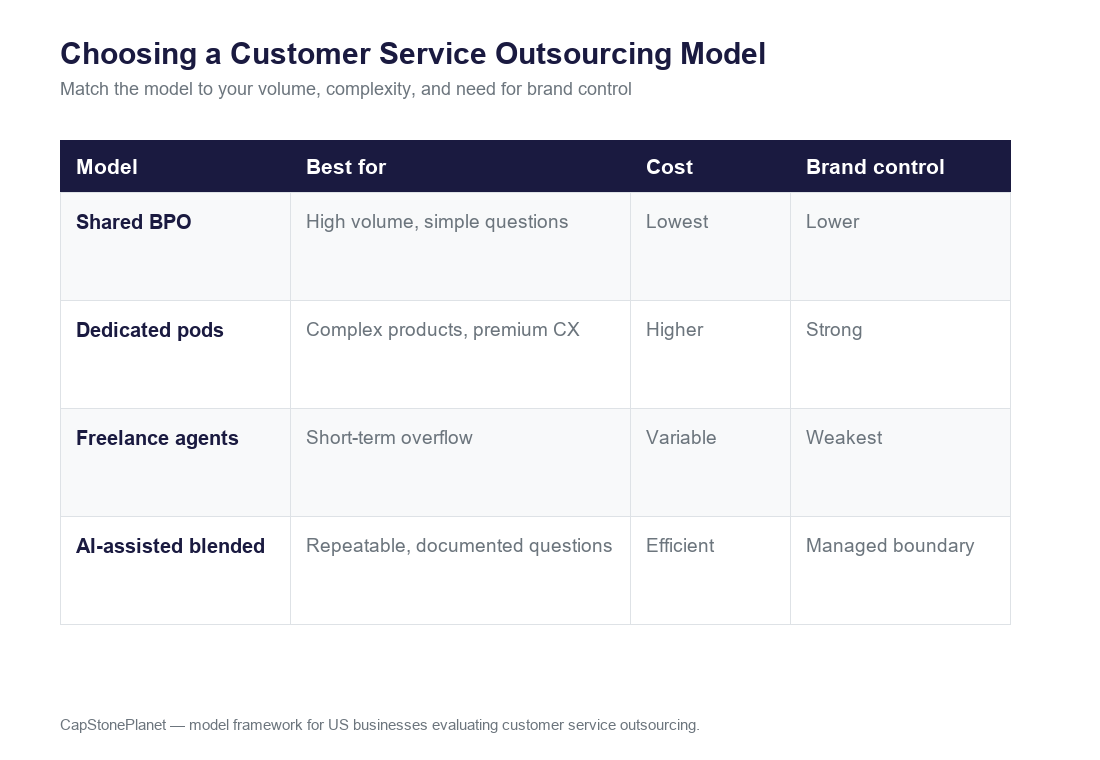
Choosing a model is the decision that shapes everything downstream — pricing structure, level of agent dedication, how fast you can scale, and how much management attention the relationship needs. There are four models in active use, and they are not interchangeable.
Model 1: Shared BPO / Call Center
Your volume is handled by a shared pool of agents who work across multiple clients in the same shift. This is the traditional call center model and generally the lowest cost per interaction, because agent utilization is pooled across accounts.
Best for: high-volume, low-complexity interactions — order status, balance inquiries, password resets, basic triage — where consistency of script matters more than deep account knowledge.
Trade-offs: agents context-switch between clients, so product fluency is shallower and brand voice is harder to maintain. Priority changes require going through a provider account layer rather than directly to the agent team. The distinction between this model and a call center specifically is covered in our BPO vs call center differences guide.
Model 2: Dedicated Agents or Pods
You get agents who work exclusively on your account — either as individual dedicated agents or as a dedicated pod with a team lead, QA, and escalation path built in. The agents learn your product, your tone, and your escalation rules, and they do not serve other clients.
Best for: businesses where interactions require real product depth — healthcare scheduling, insurance claims questions, financial services, technical products — or where brand consistency is a core differentiator.
Trade-offs: priced higher per seat than shared, and you are paying for a team whether the queue is busy or not. For a concrete example of the dedicated-pod model applied to a specific vertical, see our e-commerce customer support pods guide.
Model 3: Freelance / Individual Agents
Individual contractors hired directly or through a marketplace, working remotely on their own equipment. This is the most flexible arrangement and the lowest committed cost, since there is no provider overhead embedded in the rate.
Best for: short-term surges, a single channel that needs overflow capacity, or a very small queue that cannot justify a contracted team.
Trade-offs: you inherit the management burden — scheduling, QA, performance management, and coverage when an agent is unavailable. Security and data-handling controls are yours to verify per agent. Most businesses that start here and grow move to a dedicated model within a year.
Model 4: AI-Assisted and Blended Models
Automation handles a defined share of contact volume — chatbot triage, self-service deflection, AI-drafted agent replies — and human agents handle the remainder. Some providers price this as a per-resolution or per-contact rate rather than per-hour.
Best for: high-volume, well-documented support content where most questions are genuinely repeatable, and where the knowledge base is already in good shape.
Trade-offs: the automation boundary has to be actively managed. Misrouted or poorly answered bot interactions land in the human queue anyway, now with a frustrated customer attached. Reporting should separate bot-resolved and human-resolved volume so the blended cost per contact is visible.
Choosing Between Models: A Practical Framework
| If your priority is… | Lean toward | Why |
|---|---|---|
| Lowest cost per interaction | Shared BPO | Pooled agent utilization across clients |
| Deep product knowledge and brand control | Dedicated agents / pods | Agents work only on your account |
| Flexibility with minimal commitment | Freelance agents | No provider overhead, no minimum seats |
| High volume of repeatable questions | AI-assisted blended | Automation deflects routine volume |
Onshore, Nearshore, and Offshore Customer Service Outsourcing
The delivery-location decision is separate from the model decision, and it is where most of the cost conversation actually lands. Zendesk’s guidance categorizes the three options and the trade-offs are consistent across the industry:
- Onshore — the provider operates in your country. Highest cost, strongest cultural and linguistic alignment, and no time-zone friction for your internal team.
- Nearshore — a nearby country, usually sharing most of your business hours. Lower cost than onshore with minimal language barriers and easier site visits.
- Offshore — a distant country, often several time zones away. Lowest cost, and the time-zone offset can be turned into a genuine 24-hour coverage advantage rather than a liability.
The most common mistake is treating this as a pure cost decision. A blended model — onshore or nearshore agents for premium and complex interactions, offshore for high-volume routine volume — often outperforms a single-location strategy on both cost and quality. For the full comparison, including the security and compliance differences, see our onshore vs nearshore vs offshore guide and our broader outsourcing vs offshoring guide.
Benefits of Outsourcing Customer Service
Most published benefit lists stop at cost savings. The ones that hold up under scrutiny are:
- Cost structure: fixed staffing becomes a variable, provider-priced cost, and the realized saving depends heavily on the delivery-location mix and scope bundling you negotiate.
- Scalability: capacity flexes with demand rather than with your hiring cycle. Seasonal spikes are absorbed instead of absorbed-painfully.
- Access to vetted talent: a capable provider runs continuous recruitment and screening, so you access screened agents without running the funnel yourself. Some providers process tens of thousands of applications per quarter and place a small fraction of them.
- Specialized expertise: providers serving regulated verticals bring HIPAA, PCI DSS, and GDPR experience that an internal team would have to build from scratch. This is where CX and compliance overlap, and it is undervalued in most comparisons.
- Multilingual and extended-hours coverage: both become a procurement decision rather than a hiring problem.
- Internal focus: routine volume moves off the internal queue so the core team works on growth rather than triage.
Zendesk’s CX Trends data supports the underlying business case for investing in experience at all: 64% of people find customer experience more important than price when making a purchase, and organizations that invest in improving customer experience can see revenue increases from 10% to 15%. The economics of outsourced support are strongest when the arrangement protects that experience rather than simply cheapening it.
Risks of Outsourcing Customer Service (and How to Reduce Them)
Every risk below is real, and every one has a concrete mitigation. A provider that will not discuss these in the sales cycle is a signal in itself.
Loss of Direct Control Over Interactions
A third party represents your brand in every conversation, and distance means problems can compound before you see them. Mitigation: require call/chat monitoring, scheduled quality scoring against your own rubric, a named account manager with defined escalation authority, and a contractual replacement guarantee if an agent does not perform.
Knowledge Transfer Takes Longer Than Expected
Outsourced agents are support experts, not experts in your business. Baseline product training is rarely enough for complex products, and knowledge gaps surface as escalated tickets and slow resolution times. Mitigation: build a documented knowledge base before go-live, schedule agent certifications at defined milestones, and budget for a ramp period of several weeks rather than assuming day-one productivity.
Data Security and Compliance Exposure
Sharing customer data with an external provider introduces real risk, and in regulated industries it is a hard gate rather than a soft preference. Mitigation: verify PCI DSS, HIPAA, or GDPR compliance as applicable before signing — certification, attestation reports, data-handling policies, and access controls. Ask where data is stored, who can access it, and what the breach-notification timeline is.
Brand Voice Inconsistency
Agents serving multiple clients default to neutral scripts unless your brand voice is explicitly trained and reinforced. Mitigation: supply tone-and-voice guidelines with before/after examples, have the provider’s QA score against them, and review sample interactions weekly during the first months.
Attrition and Agent Turnover
Industry turnover in contact centers is genuinely high, and churn on your dedicated team means repeated knowledge transfer. Mitigation: ask for the provider’s actual retention rate for dedicated accounts, build documented playbooks so knowledge lives in your materials rather than in individual agents’ heads, and structure the contract so replacement agents are covered rather than re-priced.
Hidden Costs After Signing
The quoted rate rarely covers everything. Mitigation: require an itemized scope before signing — product training hours, QA coverage, telecom/CRM seats, reporting, holiday and overtime premiums, integration engineering, and any volume minimums. A rate that excludes these is not a lower rate; it is an unclear one.
How to Outsource Customer Service: A Step-by-Step Process
This is the part most guides compress into a bullet list. Each step below has a concrete output — if you cannot produce that output, the step is not finished.
Step 1: Define What You Actually Need Outsourced
Before talking to any provider, document the scope. Which channels (phone, email, chat, social), what hours and time zones, what languages, what volume per channel per week, and what complexity tier the average interaction sits in. Separate the repeatable questions from the ones that require deep product knowledge — that split usually determines which model fits.
Output: a one-page scope sheet with channels, hours, languages, weekly volume by channel, and a complexity rating.
Step 2: Set Your Baseline Metrics
You cannot tell an outsourced team to be “good” at support. You have to define it numerically before the contract, or you will be arguing about quality after it. Baseline your current performance: first response time, average resolution time, CSAT, contact rate, and current cost per contact.
Output: a baseline metrics table with current values, target values, and how each will be measured.
Step 3: Shortlist and Evaluate Providers
Evaluate against criteria in this order, because order matters:
- Security and compliance first — PCI DSS, HIPAA, GDPR as applicable. This is a pass/fail gate, not a scored preference. If the provider cannot evidence it, nothing else matters.
- Experience in your industry or complexity tier — ask for references in your vertical, not just logo lists.
- Channels and languages you need — confirmed, not aspirational.
- Technology fit — whether they work in your CRM (Zendesk, Salesforce, HubSpot, Freshdesk and similar) and what integration is required.
- Pricing transparency — itemized scope, no bundled vagueness.
- References in comparable account sizes — a provider excellent at 500-seat enterprise accounts may be the wrong fit at 8 seats.
Output: a scored comparison across these criteria for 3–5 shortlisted providers, plus our customer support outsourcing companies guide as a starting shortlist.
Step 4: Run a Pilot Before Committing
For any account of meaningful size, a paid pilot on a defined slice of volume — one channel, one shift, a fixed contact volume — reveals more than any reference call. Define the success criteria before the pilot starts, in writing, and hold both sides to them.
Output: a pilot report showing measured metrics against the targets from Step 2, plus a list of what did not work.
Step 5: Contract With Exit Terms
Negotiate the operational terms that matter after the honeymoon: service level agreements with remedies, data ownership and portability (your data, exportable, in a usable format), transition assistance if you leave, notice periods, and an exit clause that does not lock you into a painful migration. Ownership of training materials and knowledge base content should be yours in writing.
Output: a signed agreement with SLAs, data-portability terms, and a defined exit path.
Step 6: Knowledge Transfer and Onboarding
Provide documented product material, tone guidelines, escalation rules, and access to the systems the agents will use. Train the provider’s team leads first — they multiply the training — then run joint calibration sessions on sample tickets before any live customer interaction.
Output: trained agents, certified against your knowledge base, with sample-ticket calibration completed.
Step 7: Go-Live, Quality Assurance, and Continuous Review
Start with a limited volume and ramp up in stages rather than flipping the switch on full volume. Set up weekly reporting on the metrics from Step 2, scheduled QA calibration reviews, and a defined cadence for feedback in both directions. Revisit pricing and scope quarterly as volume and complexity drift.
Output: a live operation with a weekly review rhythm and a QA process that catches drift early.
Customer Service Outsourcing Trends in 2026
- AI-assisted support is now table stakes, not a differentiator. Bot triage, AI-drafted replies, and self-service deflection are standard in most provider offerings. The differentiator is how well the handoff to a human is executed — and whether the reporting separates bot-resolved volume from human-resolved volume so the blended cost per contact stays visible.
- Blended onshore/nearshore/offshore strategies. Single-location strategies are giving way to portfolios: nearshore for complex or premium interactions, offshore for high-volume routine volume. This matches the cost spread documented above.
- Compliance as a procurement gate. Security and data-handling certifications are being checked earlier in the evaluation, not after the commercial terms are settled. This is a positive development for buyers.
- Dedicated pods over shared pools for quality-sensitive accounts. As customer experience becomes a more visible competitive differentiator, more businesses are accepting higher per-seat cost in exchange for agent dedication and product fluency.
Customer Service Outsourcing by Industry
Requirements differ sharply by vertical, and providers that look identical on a pricing sheet are rarely identical in practice.
E-Commerce and Retail
Seasonality is the defining constraint — holiday volume can be several times baseline — and returns, order status, and shipping exceptions dominate the queue. AI-assisted models with human escalation handle this vertical well. E-commerce support pods guide.
Healthcare
HIPAA compliance is a hard gate, and patient scheduling, insurance verification, and claims status questions require trained, certified agents. Not every provider is cleared for this work, and the ones that are will tell you immediately.
Insurance and Financial Services
Claims processing, policy servicing, and premium inquiries sit on top of regulatory requirements and sensitive data. PCI DSS and data-residency questions come first; pricing comes after.
Technology and SaaS
Technical support depth is the differentiator — tiered models with escalation paths from L1 triage to L3 engineering. Dedicated agents with real product fluency beat shared pools here almost universally.
Travel and Hospitality
Disruption handling is the skill that matters: cancellations, rebookings, itinerary changes, often across time zones and languages. Multilingual capability is usually a requirement rather than a nice-to-have.
Customer Service Outsourcing Checklist
Before You Sign
- Channels, hours, languages, and weekly volume documented in writing
- Baseline metrics captured (FRT, resolution time, CSAT, cost per contact)
- Security and compliance verified for your industry (PCI DSS, HIPAA, GDPR)
- Itemized pricing — what the rate includes and what costs extra
- References in your vertical and account size
- Technology fit confirmed with your CRM and tooling
- SLA terms with remedies, data portability, and an exit clause
During Onboarding
- Knowledge base and escalation rules delivered before go-live
- Team leads trained first, then agents certified against your material
- Sample-ticket calibration completed before live interactions
- Ramp plan in stages, not a full-volume cutover
Ongoing
- Weekly metric reporting against baseline targets
- QA scoring on your rubric with scheduled calibration
- Quarterly scope and pricing review
- Knowledge base updated as products change
Frequently Asked Questions
What is customer service outsourcing?
Customer service outsourcing is contracting an external provider to handle customer interactions — phone, email, chat, social, and back-office tasks — on behalf of your business. You define service levels and brand voice; the provider staffs, trains, and runs the operation.
How much does customer service outsourcing cost?
Costs are driven by delivery location, channel mix, language coverage, shift structure, and compliance requirements rather than a fixed rate card. CapStonePlanet does not publish pricing on this page because quotes depend on your scope; request a custom proposal from a shortlisted vendor and normalize every quote to the same included services before comparing.
What is the difference between onshore, nearshore, and offshore outsourcing?
Onshore means the provider operates in your country; nearshore means a nearby country sharing most of your business hours; offshore means a distant country, often several time zones away. Cost decreases from onshore to offshore, while time-zone overlap and cultural proximity decrease with it. Many businesses blend all three.
How long does it take to onboard an outsourced customer service team?
Typical onboarding runs two to four weeks for a trained team, and some providers complete matching and onboarding within that window. Complex products or regulated industries take longer because product training and compliance certification cannot be compressed without cost.
Is customer service outsourcing secure?
It can be, when the provider is properly certified for your requirements. Verify PCI DSS for payment data, HIPAA for health information, and GDPR for EU residents before signing — with certifications, attestation reports, and data-handling policies in writing. Providers serving regulated industries will evidence this readily.
What is the difference between a call center and a customer service outsourcing company?
A call center typically focuses on phone-based support and pools agents across many clients. A customer service outsourcing provider generally offers multichannel support — email, chat, social, back-office — and often places dedicated agents who work exclusively for your account rather than rotating across a shared pool.
When should a business outsource customer service?
Common triggers: response times or first reply times trending upward, CSAT trending downward, seasonal volume exceeding staffing capacity, high internal team turnover, or a need for 24/7 and multilingual coverage that cannot be staffed internally. Any KPI trending in the wrong direction is worth investigating.
Can outsourced agents use my existing CRM and tools?
Most providers train on mainstream platforms including Zendesk, Salesforce, HubSpot, and Freshdesk. Confirm integration specifics for your stack — including any custom or industry-specific platforms — during evaluation, not after signing.
References
| Code | Source | Topic |
|---|---|---|
| [R1] | Zendesk — Customer service outsourcing guide | Industry overview, best practices |
| [R2] | Clutch — BPO category research | Provider landscape and buyer reviews |
| [R3] | Fortune Business Insights — Customer experience outsourcing market outlook | Market growth direction |
| [R4] | PCI Security Standards Council | PCI DSS scope for support calls |
| [R5] | HHS — HIPAA | Healthcare data obligations for outsourced support |
Ready to Outsource Customer Service the Right Way?
CapStonePlanet provides dedicated customer service outsourcing for US businesses — voice, chat, and email support with compliance coverage for BPO, mortgage, insurance, and healthcare workflows. Start with a scoped pilot to validate quality before scaling. For the full playbook on this internal-processing half of BPO, see our complete back office outsourcing guide.
About the Author

Kishan Dangi
Founder & CEO, CapStonePlanet
12+ years in BPO and outsourcing. CapStonePlanet provides customer service outsourcing, BPO, and back-office support — voice, chat, email, mortgage underwriting, insurance processing — to US businesses with full compliance coverage.
Conclusion
Customer service outsourcing is an operational decision with a clear structure: define the scope first, baseline the metrics, choose the model and delivery location deliberately rather than by hourly rate alone, verify compliance before commercial terms, and manage the relationship against numbers both sides agreed to in advance.
The businesses that get this right are not the ones that negotiated the lowest rate. They are the ones that treated customer experience as the asset it is — worth protecting through every handoff — and structured the arrangement accordingly.
If you are evaluating customer service outsourcing and want a partner that handles recruitment, training, compliance, and quality assurance as part of the engagement, talk to CapStonePlanet.