- Have any Questions ?
- info@capstoneplanet.com

Customer Service in BPO: What It Is and How to Decide
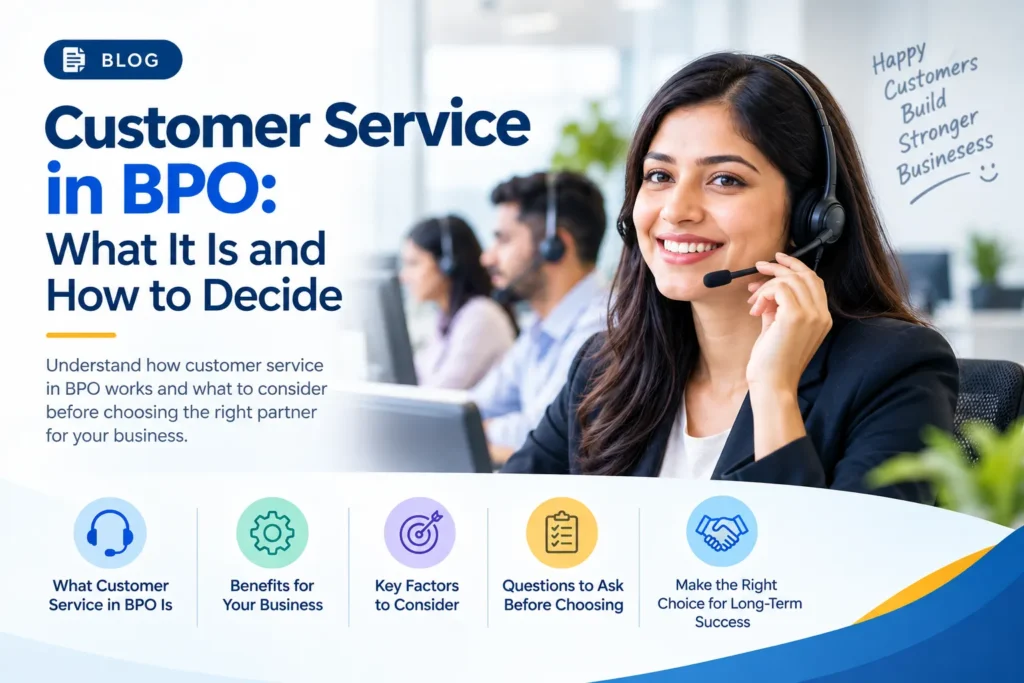
Outsourcing customer support is one of the few decisions a growing business makes that touches cost, customer experience, and control at the same time. This guide explains what customer service in BPO actually means, how the delivery models differ, and how to decide whether outsourcing fits your business. This guide is for the person who has to make that call, not for someone looking for a job.
Quick answer
Customer service in BPO means an outside provider handles your customer interactions for you while you keep the brand. The team covers voice, email, chat, and social channels, and you retain control of brand voice, policy, and escalation rules. The provider manages staffing, training, and daily operations.
What is customer service in BPO?
Customer service in BPO is the practice of handing part or all of your customer support function to an outside provider that runs it as a service. Instead of hiring, training, and scheduling your own support staff, you contract a team that already does this work for other companies. It sits inside the broader category of business process outsourcing, alongside back-office, finance, and data work.
Put simply, it is the same support your customers experience today, delivered by an outside team instead of your own staff. That team can sit in the same city, the same country, or offshore, and the meaning of the arrangement stays the same in all three cases. The word BPO describes the delivery model, not the quality of the support.
The difference from running support in-house is not the work itself but who owns the operation. In-house, you recruit, train, schedule, and supervise your own agents. Under a BPO arrangement, the provider carries those responsibilities and reports against metrics you agree on. You still own the customer relationship and the standards.
Is BPO customer service the same as a call center?
No, and the difference is worth knowing before you compare providers. A call center is a place and a technology setup for handling contacts, most often by phone. BPO is a commercial arrangement where a provider runs a process for you, and that process may include a call center as well as email, chat, and back-office work behind it.
You can have a call center without outsourcing it, and you can outsource customer service without it looking like a traditional call center at all. A provider running chat and email support with no phone channel is still doing BPO. A company running its own phone desk in its own office has a call center but no BPO. The two terms overlap often enough that people use them interchangeably, but they answer different questions: a call center describes where and how contacts arrive, while BPO describes who runs the function.
Why it matters in 2026
Two things have changed the economics of customer support in the last few years: labor projections and AI. Both are worth understanding before you decide, because they affect how much of your front line is worth moving and how much is worth automating.
What the labor data actually says
The U.S. Bureau of Labor Statistics projects that employment for customer service representatives will decline by about 141,800 from 2025 to 2035. This is an occupation-wide national projection for the whole occupation, not a figure for the BPO industry, and it is worth reading carefully rather than quoting loosely. The figure comes from the BLS Occupational Outlook Handbook page for customer service representatives, and you can check it directly at the source: BLS customer service representatives outlook.
The BLS attributes the decline to automation. Its occupation page states that the decline is projected as tasks continue to be automated, and notes that self-service systems let customers resolve simple requests without speaking to a representative. The BLS also notes the decline is concentrated especially in retail trade.
How to read that trend
There are two honest readings of this data. The first is the one above, exactly as the BLS states it: the occupation is shrinking, and automation is the stated driver. The second is our interpretation, and it is an interpretation, not a fact: support work appears to be splitting into simple, repeatable contacts that automation handles well and complex, judgment-heavy contacts that still need a person. If that split is real, then the durable value of a BPO team is in the complex work, and the simple work is the part most exposed to automation.
We are presenting that second reading as our reasoning, not as a claim the BLS makes. The BLS projection is occupation-wide and ranges across many industries, so it should not be treated as a BPO-specific forecast or as a prediction of any single company’s volumes.
The practical takeaway: when you decide whether to outsource, ask which of your contacts are simple enough to automate, which need judgment, and which the provider will help you route. That question matters more than the headline number.
How BPO customer service works
The workflow you should expect
A standard BPO customer service engagement runs through the same sequence. Knowing it in advance makes provider conversations easier to judge.
- Scope, where you and the provider agree channels, hours, and work types
- Knowledge transfer, where your policies and product details move to the provider’s team
- Pilot, a narrow start on one channel measured against your baseline
- QA review, where sampling and calibration confirm quality before you scale
- Ramp, where volumes move across channel by channel
- Ongoing optimization, where metrics and reviews drive further change
Most outsourcing relationships follow a similar path, whether the provider is large or small. The differences are in how carefully each step is run.
- Scope and baseline. You and the provider agree on which channels, which hours, and which work types are in scope, and you measure your current volumes, handle times, and satisfaction scores as a starting point. Skipping the baseline makes every later comparison meaningless.
- Transition and knowledge transfer. The provider learns your products, your tone, and your escalation rules. This is usually the slowest step, and the one most often underestimated. A realistic transition is a project with milestones, not an overnight switch.
- Pilot. A small team answers a narrow slice of contacts, often one channel or one product line, while you compare its results with your baseline. The pilot is where you find out whether the provider’s process matches its pitch.
- Ramp. If the pilot meets the targets you both agreed on, volumes move across in planned stages. This stage is where staffing curves and training quality show up in the numbers.
- Steady state and review. The team runs at full scope, and you review performance on a fixed cadence against the metrics set in step one. Improvement plans belong here, not in ad hoc escalations.
The FAQ covers how long transition typically takes in scope terms, without inventing a specific timetable, because the honest answer depends on your products and channels.
Delivery models
The model you choose determines cost structure, control, and how fast you can scale. Four choices matter most, and they combine.
Dedicated versus shared
A dedicated team works only on your account. You effectively rent a group of people who give their attention to you alone. This gives you the most control over process and brand alignment, and it usually suits businesses with stable or growing volume.
A shared team serves several clients, often with a common process. It costs less to start because you are sharing overhead, and it can work well for low or unpredictable volume. The trade-off is less control over how closely the team mirrors your specific way of working.
Onshore, nearshore, and offshore
These describe where the team sits relative to you. Onshore means the team is in your own country. Nearshore means a nearby country in a similar time zone. Offshore means a more distant location, often chosen for cost and available talent. The choice affects real-time collaboration, language fit, time-zone overlap, and cost, and there is no single correct answer.
Blended and hybrid
Many providers run a blended model, where channels and work types are mixed across a team, and a hybrid model, where some work sits with the provider and some stays in-house. Hybrid is often the most practical starting point for a first outsourcing move, because it limits the blast radius if a pilot underperforms.
Types of customer service in BPO
Providers organise support in recognisable types. Most contracts combine several of them.
Inbound voice support
Customers call you and a trained agent answers. This is the most visible type, and usually the most expensive per contact because one agent handles one conversation at a time. It suits billing questions, complaints, and anything a customer needs to talk through.
Outbound customer service
Agents contact customers rather than waiting for a call. Common uses are order updates, appointment reminders, renewal notices, and follow-up after a resolved complaint. It is customer service rather than sales when the purpose is to help, not to sell.
Email and ticket support
Customers write in and agents reply through a helpdesk queue. Agents can work several conversations at once, so the cost per contact is lower than voice. It suits questions that need a written record or a detailed answer.
Live chat support
Customers type to an agent in real time on your website or app. Chat usually handles several concurrent conversations per agent, which keeps cost moderate while still being immediate. It works well for pre-purchase questions and quick fixes.
Social media support
Agents answer public comments and private messages on the platforms your customers use. The work mixes speed with tone, because replies are visible. Most providers route sensitive cases out of public view quickly.
Technical support
Agents help customers resolve product or service problems, often following a diagnostic script and escalating to your engineering or specialist team when the issue needs deeper work. It requires stronger product knowledge than general support.
Omnichannel customer service
The provider runs several channels together so a customer can start in chat and finish by email without repeating themselves. It requires shared customer history and consistent policy across channels, which is harder to operate than any single channel.
Back-office support connected to customer requests
Some work behind a contact is not customer-facing but exists because a customer asked. Order processing, returns, refunds, account updates, and record corrections fall here. Handling them in the same team reduces the handoffs that cause delays.
Customer service roles and responsibilities in BPO
A BPO customer service team typically carries the following responsibilities. Use this as a checklist when you scope a contract.
- Answering customer questions across the agreed channels
- Resolving complaints and following through to a resolution
- Processing orders, returns, and refunds
- Handling basic technical troubleshooting with a defined escalation path
- Maintaining customer records and updating account details
- Following your brand voice and compliance policies
- Escalating complex or sensitive cases back to you
- Tracking CSAT, first contact resolution, SLA attainment, and quality scores
Benefits of BPO customer service
The benefits of outsourcing customer service are real, but each one arrives with a condition, and the condition is the part most sales conversations skip. The three that matter for a decision are volume stability (below a stable threshold, a dedicated team is not the cheaper option), transition investment (a larger hiring pool only helps if you fund training), and contract certainty on capacity (peak and 24/7 coverage should be confirmed in writing, not assumed).
We cover the full benefit and risk picture, including the seven-step process, the industry breakdown, and the checklist, in the companion guide on customer service outsourcing. This page stays on the definition and decision layer: what the model means, how it differs from a call center, and how the labor and AI picture should shape your choice.
Challenges and risks of BPO customer service
Outsourcing introduces real risks, and naming them is how you reduce them. The ones that affect the decision most are loss of direct control, brand and tone drift, data and security exposure, and dependency on a single provider. Each has a standard mitigation, and the mitigations are contract and process terms rather than hopes.
The detailed mitigation list, with the full treatment of attrition, hidden costs, and knowledge transfer timing, is in the companion outsourcing guide. Here, the point is narrower: which of these risks your decision actually turns on.
BPO vs in-house customer service vs call center
| Factor | In-house customer service | BPO customer service | Call center |
|---|---|---|---|
| Ownership | You hire and manage every agent | Provider employs and manages agents | Describes a facility, either yours or a provider’s |
| Staffing | You recruit, train, and cover absences | Provider recruits, trains, and covers absences | Agents sit in one location and work shifts |
| Channels | Whatever you build, often voice first | Voice, email, chat, social, and back-office | Traditionally voice, sometimes chat |
| Scalability | Slow, since each change means hiring | Faster, since the provider moves existing staff | Depends on spare capacity at that site |
| Control | Direct, through your own managers | Indirect, through policy, reporting, and reviews | Direct only if the center is yours |
| Cost structure | Fixed payroll and overhead, predictable | Variable and volume-linked, less predictable | Fixed site and telecom cost plus agents |
| Best suited for | Businesses with steady volume and a strong internal quality culture | Businesses with variable or growing volume that need staffing flexibility | Operations that are genuinely phone-led |
None of these three is best in every situation. In-house suits steady volume and tight control. BPO suits variable or growing volume. A call center is a description of channel and location, not a competing choice on its own.
The decision is rarely binary. The table below compares the three main options on the factors buyers ask about most.
| Factor | In-house | BPO | Hybrid |
|---|---|---|---|
| Cost structure | Mostly fixed payroll, predictable | Variable and volume-linked, less predictable | Mixed, with the in-house core and the variable edge |
| Control over tone and process | Highest | Lowest, unless the team is dedicated | High for the retained work, moderate for outsourced work |
| Speed to scale | Slow, limited by hiring | Fast, limited by provider capacity | Fast at the edge, slow at the core |
| Coverage hours | Limited by local law and shifts | Easy to extend with follow-the-sun staffing | Flexible, mixed |
| Hiring burden | Fully yours | Transferred to the provider | Split |
| Knowledge retention | Strong, team is yours | Depends on documentation and contract | Strong for the retained core |
| Best fit | High-volume, sensitive, or highly specialized work | Routine or stable-volume work, or peak coverage | First outsourcing move, or a business that wants a safety margin |
Read this table as a decision aid, not a uniform answer. Most businesses end up hybrid, keeping a small internal core for sensitive and complex contacts and moving the predictable volume to a provider.
How to choose a BPO customer service provider
This page gives the decision overview. For the full commercial process, including implementation planning and the complete vendor-selection framework, see the customer service outsourcing guide. If you already know you want to outsource and want to talk scope, the customer service outsourcing service page is the place to start.
This section holds provider selection, the metrics that measure it, the cost drivers to discuss, and the compliance note. It is the practical home for the buying decision.
Selection criteria
Use the same criteria for every provider you shortlist, so the comparison is fair:
- Relevant experience in your industry or a close one
- Demonstrated process for knowledge transfer and training
- Evidence of quality management, not just a claim of it
- Reporting you can actually read, with defined metrics
- Security and data-handling practice, in writing
- Contract flexibility on volume changes, exit, and knowledge handover
- References you can contact, with outcomes they are willing to describe
Key customer service KPIs in BPO
| Metric | What it measures | Note when you set it |
|---|---|---|
| CSAT | Customer satisfaction after a contact | Agree the survey method, not just the score |
| First contact resolution | Resolved without a follow-up contact | Confirm how a repeat contact is defined |
| Average response time | How long a customer waits for a first reply | Measure per channel, not as one number |
| Service level | Share of contacts answered within a target time | State the target and the hours it applies to |
| Quality score | Sample-based review of agent interactions | Agree the scorecard and who calibrates it |
| Escalation rate | How often cases move to a senior agent or to you | Watch it after launch, it reveals unclear scope |
| Customer effort score | How hard the customer found the interaction | Useful when CSAT stays flat but complaints rise |
Agree the metrics before the pilot, then hold them constant. The common set:
| Metric | What it measures | Note |
|---|---|---|
| CSAT | Customer satisfaction after a contact | Get the survey method, not just the score |
| First contact resolution | Resolved without a follow-up | Confirm how it is defined |
| Average handle time | Time per contact | A guardrail, never a quality target on its own |
| Quality score | Sampled accuracy against a rubric | Ask who scores it and how it is audited |
| Service level | Share of contacts answered within a target time | Confirm the target and the measurement window |
| Abandon rate | Contacts that end before an answer | Watch it during peaks, not just the average |
Whatever numbers you set, they are your business’s targets, and a provider should be able to show the method behind each one.
Customer service BPO pricing and cost drivers
We do not publish rates, because a rate without scope is misleading. What matters is understanding what drives the number and which model you are buying. Typical cost drivers are:
- Volume, meaning the number of contacts per month and their pattern
- Channel, since voice is usually more expensive than chat or email
- Complexity, since technical or regulated contacts need more training and time
- Coverage hours, since 24/7 and weekend coverage cost more than business hours
- Languages, since multilingual support needs specific recruiting
- Dedicated versus shared staffing
- The technology and reporting layer, if it sits with the provider
The common pricing models are per-contact or per-transaction, per-full-time-equivalent, per-hour, and a managed-service model with a fixed scope and a monthly fee. Each shifts risk differently: per-contact pricing puts volume risk mostly on the provider, while per-FTE pricing puts it mostly on you. Ask which model each provider prefers and why, because the answer tells you who they think carries the risk. Ask for a written statement of how volume changes affect price. If support is only one of several processes you are considering, the difference between process outsourcing and knowledge process outsourcing is worth understanding before you scope the work: KPO compared with BPO explains where the two diverge.
Compliance note for regulated businesses
If your business is a financial institution, or handles customer financial information covered by the Gramm-Leach-Bliley Act (GLBA), the FTC Safeguards Rule requires you to oversee the service providers that handle that information, including by contract and by reasonable oversight of their safeguards. The rule applies to those covered businesses, not to every business that buys customer service. The FTC explains the rule and who it covers here: FTC Safeguards Rule: what your business needs to know.
If the rule does not cover you, ask for the same evidence as good practice anyway: security certifications, access controls, and data-handling terms, and get them in writing. The evidence is worth requesting either way, even though the legal obligation does not apply to everyone.
A provider checklist you can take to the call
Bring these questions to every provider conversation and write the answers down:
- Which work types do you recommend for a pilot, and why those?
- What is your knowledge transfer process, and how long does each stage take?
- Who owns the trainer, the team lead, and the quality analyst on my account?
- Which metrics do you report, by what method, and how often?
- How do you handle volume spikes within the agreed scope?
- What are the security certifications and data-handling terms?
- How do you handle exit, including knowledge handover and data return?
- Can I speak to two references with a similar scope?
A worked example, clearly labelled
The example below uses illustrative numbers. It is a worked example, not a case result, and no outcome is promised. Its purpose is to show how the pieces fit together.
Imagine a business with about 4,000 contacts per month, split across voice and email, using three agents worth of coverage and a service level target (the SLA) of answering 80 percent of contacts within 30 seconds. In that illustration, the pilot would start on the email queue with one agent, measured against the current first contact resolution and CSAT as the baseline. After four weeks, if first contact resolution holds or improves and CSAT does not fall, volumes move across one channel at a time, with a scorecard tracking CSAT, first contact resolution, service level, and quality score against the baseline month. If the pilot underperforms, the fixed scope means you can stop without having moved your whole front line.
That is the shape of a disciplined start, and it is the pattern that limits risk. The numbers are there to make the shape concrete. They are not a forecast of your business.
AI and human support in BPO
AI has changed what belongs with a person and what does not. The useful question is not whether to use AI, but which contacts it should handle alone, which it should support, and which should reach a human directly.
- AI handles the simple, high-volume, low-variance contacts: order status, tracking questions, standard policy answers, and simple account queries. This is exactly the work the labor trend in an earlier section shows is most exposed to automation.
- Human agents handle the complex, emotional, or high-value contacts: complaints, escalations, billing disputes, retention conversations, and anything needing judgment or negotiation.
- The hybrid pattern puts AI first for deflection and triage, with a clean handoff to a human whenever the request is unusual, urgent, or the customer asks. The handoff quality, not the AI alone, decides whether customers accept it.
Where automation helps, and where it hurts
The honest caveat: automation reduces cost on simple contacts and can frustrate customers when it is forced on complex ones. The BLS projection supports the direction of change, not a specific company forecast, and you should measure any automation decision on your own contacts, not assume it from a trend.
Can you just use a general AI tool instead
A question we hear often is whether a business can simply use a general-purpose AI tool, such as ChatGPT, for customer service and skip the team. For narrow, low-risk queries it can handle a first pass, and that is genuinely useful for deflection. What it does not carry is your policies, your escalation rules, your customer history, or accountability for a wrong answer. Left unsupervised, it will occasionally answer confidently and incorrectly, which is the one failure mode customers remember.
In a BPO context the AI layer is normally paired with human oversight and your knowledge base, with a defined handoff to a person whenever the request is unusual, urgent, or the customer asks. That pairing, not the tool alone, is what makes it safe to use. If a provider proposes replacing agents entirely with a general AI tool, ask what happens on the day it is wrong, and who owns that answer.
The same logic applies to your channel mix. Automation usually earns its place on the high-volume, low-variance end, while the entrances and exits stay human. That is the hybrid pattern, and it is why the sections above treat AI as a layer over the team rather than a replacement for it.
Illustrative example: what a first pilot can look like
This is a worked illustration, not a client case study. The numbers are round figures chosen to show the shape of a pilot, and they are not a promise of results.
Say a business handles about 4,000 support contacts a month, split roughly 60 percent email and 40 percent voice, with the current team resolving about 70 percent of email contacts on first contact and averaging a satisfaction score around 4.2 out of 5. A common first scope is one channel, email, handled by a small dedicated team during business hours, with voice kept in house for the pilot period.
Before anything moves, the same three numbers are recorded as the baseline: first contact resolution, satisfaction, and average handling time. The pilot runs for four to six weeks. At the end, the decision is made against that baseline, not against a general impression of the provider.
What this illustrates is the sequence rather than the figures: pick the narrowest scope that answers the question, fix the baseline first, and let the pilot, not the pitch, decide the second phase. A provider that is comfortable with this structure is showing you how it will be measured. One that is not is asking you to take the outcome on trust.
How CapStonePlanet approaches it
CapStonePlanet builds dedicated offshore teams for US and Canadian businesses across customer support, back-office, recruitment support, and domain BPO. For customer service, that means an India-based team working as an extension of your business rather than a call queue shared with strangers. You can see the service scope on the customer service outsourcing page.
In practice, the approach is the process described above: scope and baseline first, a written knowledge transfer plan, a narrow pilot on one channel, then a staged ramp and a fixed review cadence. Teams are dedicated where volume supports it and blended where it does not, and we design the reporting so the person who owns the customer relationship can read it, not only an analyst.
Two limits are worth stating plainly. Capacity and timelines depend on your scope and your hiring window, so agree them in writing rather than assume them. And if your volumes are very small or your work is heavily regulated and needs specialist compliance review, an outsourced team may not be the right first step, and we would rather say so than take the work.
If you have decided to explore outsourcing, the sensible next step is a scoped conversation, not a commitment.
Frequently asked questions
What is customer service in BPO in simple words?
In simple words, it means an outside company answers your customers for you. Your customers still contact your brand, and the people who reply belong to a provider that you pay to run that support. You set the standards; the provider supplies and manages the team that meets them.
Is BPO customer service the same as a call center?
No. A call center is a place and a phone setup. BPO is a business arrangement where a provider runs a process for you, which may include a call center plus email, chat, and back-office work. You can run a call center in-house without any BPO, and you can outsource customer service with no phone channel at all.
What are the main types of customer service in BPO?
The main types are inbound voice, outbound contact, email and ticket support, live chat, social media support, technical support, omnichannel support, and back-office work tied to customer requests. Most real contracts combine several types, and the mix is usually set by your volume and your channel split.
What does a BPO customer service team handle?
Answering questions, resolving complaints, processing orders, returns and refunds, basic troubleshooting, maintaining customer records, following your brand and compliance rules, escalating complex cases, and tracking service metrics. The exact list belongs in the contract, because unclear scope causes most early disagreement.
Which KPIs measure BPO customer service quality?
Customer satisfaction, first contact resolution, average response time, service level attainment, quality score, escalation rate, and customer effort score. Pick a small set you will act on, agree the definitions in writing, and set a baseline before the team starts. A metric nobody reviews is not a control.
What are the benefits and risks of outsourcing customer service?
Benefits are staffing flexibility, faster scaling, access to trained agents, and often lower cost per contact. Risks are loss of direct control, weaker brand alignment, hidden fees, and slower resolution when escalation paths are unclear. Most risks shrink when scope, metrics, and escalation rules are written down before launch.
When should a business outsource customer service?
Usually when volume is variable or growing faster than you can hire, when after-hours or multilingual coverage is needed, or when routine contacts consume time your own team should spend on complex work. If your volume is steady, your team is stable, and quality is strong, staying in-house is a reasonable choice.
Conclusion
If you take one thing from this guide, take the sequence. Define what customer service in BPO means for your business, decide which of your contacts are routine and which need judgment, pick the model that matches your volume and control needs, and then start with a narrow pilot measured against a baseline you set first.
The decision is not whether outsourcing is universally good or bad. It is whether a specific scope, with specific metrics and a specific exit path, fits your business. Answer the eight checklist questions, keep the cost drivers in view, and let a pilot, not a pitch, make the final case.
About the Author

Kishan Dangi (KK Patel)
Founder and CEO, CapStonePlanet
Kishan leads CapStonePlanet, an India-based outsourcing partner that builds dedicated offshore teams for US and Canadian businesses across customer support, back-office, recruitment support, and domain BPO. (Identity verified from the team page of the company; practitioner context presented as the actual positioning of the company, not invented credentials.)
If you want to evaluate this against your own workflows, connect with CapStonePlanet: we build dedicated offshore teams for US and Canadian SMBs across customer support, back-office, insurance, mortgage, and data processes.