- Have any Questions ?
- info@capstoneplanet.com

What Is Business Process Outsourcing (BPO)? A Complete 2026 Guide
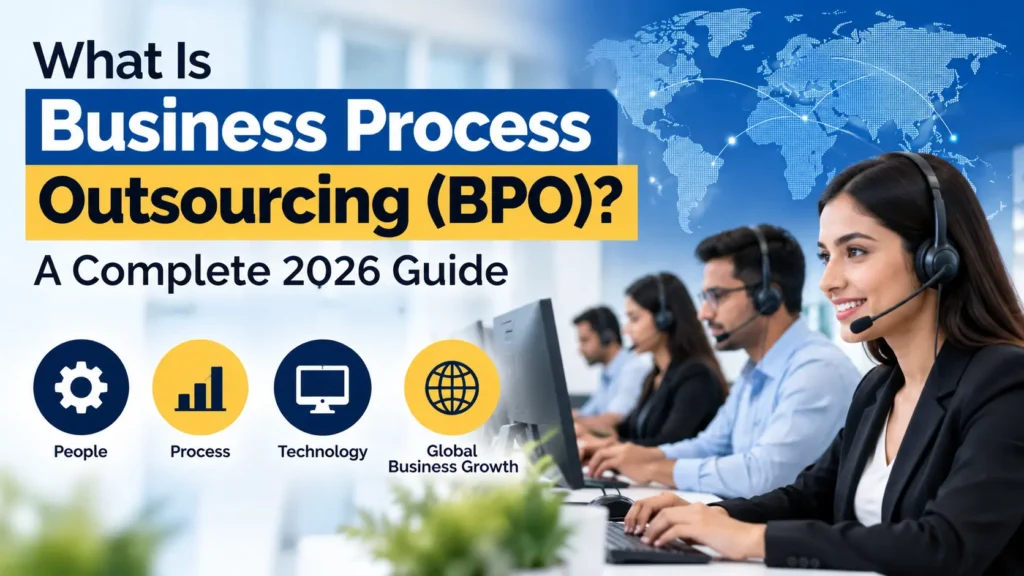
If you have ever wondered what BPO actually means and whether it could work for your business, this guide answers both questions. Business process outsourcing is the practice of hiring an outside company to run a specific business function for you, and for many small and mid-sized businesses it is the fastest way to add capability without adding headcount. This guide explains what BPO is, how it works day to day, the types you will encounter, real examples, the risks, and a practical framework to decide whether it fits your business.
What Is Business Process Outsourcing?
Business process outsourcing (BPO) is the practice of contracting a third-party company to perform a business process or function on your behalf, instead of running that function with in-house staff. The outside company, the BPO provider, supplies the people, training, management, and usually the tooling needed to deliver the process to an agreed standard.
The practice did not start in tech: firms first outsourced business tasks for supply-chain efficiency in manufacturing, and the model spread through the 1970s onward before exploding with the internet era (as IBM and G2 BPO histories note). A simple example: an online store that receives 300 customer emails per day hires a BPO provider whose trained agents answer those emails under the brand and quality rules of the store. The store keeps full ownership of the process outcome; the provider owns the staffing and day-to-day execution.
Two boundaries matter when defining BPO:
-
- BPO covers business processes, not manufacturing of physical goods. Factories offshore are usually called contract manufacturing, not BPO.
- BPO is a subset of outsourcing in general. Outsourcing also includes IT outsourcing (ITO) and knowledge process outsourcing (KPO), which involve higher-skilled analytical work. Industry usage varies, but ITO is generally treated as its own discipline rather than a type of BPO.
Looking for a different angle? Our guides cover what BPO really means in practice and the complete BPO implementation guide for 2026.
Customer support is one of the most common BPO services, we cover that specialty in depth separately in what is customer service in BPO. This guide covers the wider discipline.
How Does BPO Work?
A working BPO engagement follows the same basic sequence regardless of industry. The mechanics below reflect how providers typically run the first 90 days, and they are the questions an SMB should ask before signing.
- Discovery and scope. You and the provider document the process: volume, systems, quality bar, working hours, and the metrics that define success. A clear scope document is the single best predictor of a healthy engagement.
- Transition and training. The provider recruits (or redeploys) staff and trains them on your process, your systems, and your brand voice. For typical SMB processes, providers commonly quote transition windows of two to six weeks; ask your shortlisted vendors to commit to a written timeline for your scope.
- Staffing model. You choose dedicated agents (a team that works only for you), a shared pool (agents handle multiple clients), or a hybrid. Dedicated teams give better product knowledge; shared pools absorb spiky volumes more economically.
- Service-level agreement (SLA). Performance is measured: first response time, resolution time, quality scores, uptime. Expect defined targets, a reporting cadence, and corrective-action rules when targets are missed.
- Quality assurance loop. Good providers monitor sampled interactions weekly, score them against your rubric, and retrain agents on failures. Ask for a sample QA report before signing, if a provider cannot show you what they would report, they will not manage what they cannot measure.
- Ongoing reporting and scaling. Volume ramps up or down per agreement. This flexibility is the core economic benefit of BPO over fixed in-house teams.
The practical consequence of this sequence: the quality of the first three steps (scope, transition, staffing model) determines almost everything downstream. Industry practitioners consistently report that most BPO disappointments trace back to a vague scope rather than to the outsourcing concept itself.
Types of BPO
Two taxonomies are commonly used, and they overlap.
By function
- Front-office BPO: customer-facing work: customer support, inbound and outbound sales, live chat, social media response.
- Back-office BPO: internal operations: data entry and processing, invoice and accounting support, HR administration, document management.
- Middle-office BPO: processes that bridge both: risk and compliance support, fraud monitoring, claims processing, transaction tracking.
By location
- Onshore BPO: the provider operates in your own country. Maximum cultural alignment; the heaviest internal investment of the three models.
- Nearshore: a nearby country in a similar or adjacent time zone (for a US firm: Latin America). Balanced investment level with useful timezone overlap.
- Offshore: a distant country, classically India or the Philippines for English-language business services. The strongest efficiency case and the deepest specialist talent pools for many business processes; the trade-off is distance in time zone and culture, which disciplined reporting practices largely manage.
Note on IT outsourcing: outsourcing of technology infrastructure and software development (ITO) is a sibling discipline that is frequently classified separately from BPO because the skills, risks, and staffing models differ. When a provider offers a combined BPO and ITO package, the processes follow different management practices even under one contract.
Common BPO Services and Real Examples
Generic lists hide how specific BPO work gets in practice. These are real service areas in active delivery for US and Canadian SMBs from India-based teams:
- Insurance BPO: underwriting support (gathering and validating applicant data, preparing underwriting files for licensed underwriters), policy administration, and fraud-detection support. The provider executes defined checks and data work; licensed professionals retain the decision authority. See insurance underwriting support BPO.
- Mortgage processing support: loan file collection, income and asset verification, and pipeline documentation for lenders and brokers. See mortgage underwriting BPO.
- Healthcare BPO: non-clinical processes such as claims data processing, provider data maintenance, and revenue-cycle documentation. Clinical judgment never moves offshore; documentation and processing work does. See healthcare BPO services.
- Data entry and outsourcing: high-volume data capture, cleaning, enrichment, and database upkeep with QA sampling. See data entry company in India and data outsourcing company in India.
- Finance and accounting support: invoice processing, accounts payable/receivable documentation, reconciliation support, and reporting packs. See finance outsourcing in India.
- Customer support: email, chat, and voice support under the brand of the client with agreed SLAs.
The pattern across all six: the process is rules-based or documentation-heavy, quality is measurable, and the client keeps decision authority. When a process requires licensed judgment (a doctor, an underwriter, a CPA), BPO supports that professional rather than replacing them.
BPO vs Outsourcing vs KPO
These terms are easily confused:
- Outsourcing is the umbrella term for any work moved to an external provider, including manufacturing, IT, and logistics.
- BPO is outsourcing of defined business processes, typically operations-heavy and repeatable.
- KPO (knowledge process outsourcing) is a higher-skill subset: analytical and domain-expert work such as research, financial analysis, and underwriting support. See our guides on knowledge process outsourcing and types of KPO services for the detail.
- ITO (IT outsourcing) is technology-specific outsourcing, infrastructure, software development, helpdesk for IT systems.
A related term you may encounter is ITES (information technology-enabled services), an older label, still used in India-based industry literature, that overlaps heavily with BPO. A practical test: if the work needs deep process discipline and volume, it is BPO territory. If it needs advanced analytical judgment, it drifts toward KPO. If it is about technology assets, it is ITO. (Large enterprises sometimes run a similar model in-house, called shared services; shared services are internally managed staff functions, while BPO means an external provider runs the same functions, a distinction we break down further in our KPO vs BPO comparison, one that matters mostly at enterprise scale.)
| Term | What it covers | Typical work | Who runs it |
|---|---|---|---|
| Outsourcing | Any work given to an external provider | Manufacturing, IT, logistics, business processes | External vendor |
| BPO | Defined business processes, operations-heavy | Customer support, data entry, back office, insurance files | External provider (BPO firm) |
| KPO | High-skill analytical subset of outsourcing | Research, analytics, underwriting support | External domain experts |
| ITO | Technology-specific outsourcing | Infrastructure, software development, IT helpdesk | External IT firm |
| ITES | Older label overlapping with BPO | Same process families as BPO, India-industry usage | External provider |
| Shared services | Enterprise-internal shared functions | HR, finance operations at group scale | In-house shared unit |
The BPO Market in Context
Business process outsourcing is a large, established global industry. Industry research firms such as Statista (cited in the G2 BPO guide) and Maximize Market Research (cited by Enate) all estimate the global BPO market in the hundreds of billions of dollars and project continued growth through the end of the decade. Their precise figures differ because each firm defines the market differently, which processes, which geographies, and which contract types are counted, so the more useful signal for an SMB is the direction of travel: enterprises and mid-market buyers keep expanding the share of back-office and customer-facing work they delegate to specialists, and provider specialization keeps deepening.
For an SMB, the practical takeaway is simpler than any forecast: the industry is large enough that mature, specialized providers already exist for nearly every common business process, which is what makes a scoped pilot low-risk.
Why SMBs Use BPO
Small and mid-sized businesses do not outsource because it is fashionable. They do it for concrete operational reasons:
- Operational flexibility. BPO converts fixed payroll obligations into variable capacity that scales with volume. You avoid recruiting time, benefits administration, management overhead, and idle capacity during slow months.
- Coverage without burnout. Time-zone-spanning coverage, evenings, weekends, seasonal peaks, is often the first practical win an SMB notices, before any efficiency benefit shows up.
- Access to trained specialists. Established providers maintain trained teams for specialized processes (insurance data checks, claims documentation), which an SMB could not economically hire for parts of the year.
- Focus. Founders and core staff reclaim time for the work only they can do.
The strongest argument against BPO for a given SMB is equally real: if a process requires constant context-switching with in-house knowledge, has never been documented, or changes weekly, outsourcing it now will create more overhead than it removes. That is what the decision framework below is for.
Risks of BPO and How to Mitigate Them
Every BPO risk has a management practice that mitigates it. Providers that cannot describe the mitigation are the warning sign.
- Data security and confidentiality. Require contractually defined data-handling standards (access control, NDAs per agent, breach notification). If you operate under GDPR or related obligations, verify the compliance posture of the provider in writing. Data-protection questions belong in the sales conversation, not after it.
- Brand voice drift. Provide brand guidelines and worked examples; require QA scoring against your rubric on sampled work, with retraining on misses.
- Quality variability. Insist on the SLA with defined metrics and corrective-action clauses; ask for sample QA reports; start with a pilot cohort before full volume.
- Vendor lock-in. Own your systems of record. Insist that processes are documented in runbooks that you keep, and that exit assistance terms exist in the contract.
- Commercial terms outside the headline. Providers differ widely in what sits outside the headline engagement: onboarding effort, minimum commitments, and out-of-hours coverage terms all shape the real effort involved. Get the complete commercial picture in writing before you compare providers, and model your own total effort, not just the visible engagement size.
Onshore vs Nearshore vs Offshore: The India Example
The location question is not only about efficiency, it is about talent depth and process maturity.
India is one of the most established offshore destinations for English-language business processes, with a services industry whose roots go back to the early 1980s. For an SMB buying services, the practical differences look like this:
- Talent depth. India is widely regarded as having one of the deepest talent pools for insurance, finance, and data processes, a dedicated team can often be assembled in weeks rather than months.
- Time-zone leverage. An India-based team works while the US sleeps: overnight queues are cleared by the morning. The same distance makes scheduled overlap essential, define the hours when your team and theirs are online together.
- Communication discipline. Mature providers run written stand-ups, shared dashboards, and recorded QA sessions; the distance functions well when communication is asynchronous-first.
- Total effort. Offshore engagements often show the strongest efficiency case in vendor comparisons, but the advantage narrows once you account for management time. Compare the full delivery picture, supervision overhead, quality controls, rework, rather than any single headline number, and be careful when vendors include different scope assumptions.
Nearshore (for example, Latin America for a US buyer) trades some of that efficiency for timezone alignment and travel convenience. Onshore trades maximum efficiency for maximum cultural and regulatory alignment. The right answer depends on which process you are moving: a customer-facing voice process may value timezone alignment highly; a documentation process with a 24-hour turnaround may gain the most from offshore delivery.
Is BPO Right for Your Business? An SMB Decision Framework
No article in our top-10 competitor research set gives the reader a decision procedure, so here is one. Work through the five questions in order:
- Is the process documented, or documentable in one to two weeks? If nobody can describe the current process on paper, the first project is internal, not outsourcing.
- Is the work rules-based or review-based? Processes with clear pass/fail criteria (data checks, invoice capture, tier-1 support) outsource predictably. Processes that need constant improvisation with tacit in-house knowledge do not, yet.
- Can quality be measured weekly? If you cannot define a quality metric, you cannot manage an external team against one. Define the metric first.
- Does volume justify a fixed team? If the workload occupies less than roughly half of one full-time person, in-house or freelance is usually simpler. If it fluctuates seasonally, BPO flexible staffing is a genuine fit.
- Are you ready to manage at a distance? Expect to spend real management hours in the first 60 days: training, feedback, calibration. BPO removes execution work, not management work.
Illustrative example (not a specific client): a 20-person e-commerce firm spends 900 hours per month on order-related support emails, spiking 2x in Q4. The process is documented, quality is measurable (first-response time, CSAT, refund accuracy), and volume fluctuates. That profile scores strongly for a dedicated offshore support team with a seasonal ramp. Contrast: the pricing-strategy brainwork of the same firm should stay in-house.
If four or more answers point toward outsourcing, a scoped pilot (one or two agents, four to six weeks, defined metrics) is the lowest-risk next step. A pilot that hits its SLA tells you more than any sales deck.
AI and Automation in BPO
AI has changed what BPO providers can deliver, and honest providers will tell you exactly how. Three changes matter to an SMB buyer:
- Robotic process automation (RPA) now handles repetitive screen-and-rules work (copying data between systems, claim form generation) inside outsourced processes, cutting handling time and error rates.
- AI-assisted quality assurance lets providers score most interactions rather than small samples, catching quality drift weeks earlier.
- AI chat deflection handles predictable questions so human agents take only the cases that need judgment. The IBM BPO guide makes the same point: new technologies like RPA and AI have impacted BPO processes, changing what buyers should expect from a provider.
The buyer-side implication: when you evaluate providers, ask which parts of your process would be automated and which parts are human-delivered. A leaner automated process can be excellent, but you are entitled to know which is which, because pricing and quality profiles differ between the two.
How to Choose a BPO Provider
Use the same checklist across candidates so the comparison means something:
- Scope discipline. Did they push back on vague requirements, or accept everything? Providers that ask hard discovery questions early deliver better later.
- Vertical proof. Ask for anonymized work samples in your vertical (insurance, mortgage, healthcare, e-commerce), not only testimonials.
- QA mechanics. Ask to see an actual QA scorecard and a sample weekly report. If they cannot show one, they do not run one.
- Staffing model honesty. Confirm whether agents are dedicated or shared, and who owns the training content.
- Security posture. NDA terms per agent, access controls, breach-notification clauses, and (if relevant to you) compliance attestations in writing.
- Exit terms. Data return, runbook handover, and notice periods in the contract, not in a verbal promise.
- Pilot-first willingness. Providers confident in delivery accept a scoped pilot with defined success criteria.
Customer support is one of the most commonly outsourced functions, and the guide to customer service in BPO explains how that specific model is scoped and measured.
Frequently Asked Questions
What does BPO stand for?
BPO stands for Business Process Outsourcing: contracting an external company to run a specific business process, such as customer support, data entry, or insurance documentation, on your behalf.
What is an example of BPO?
An online retailer hiring a provider to answer its daily customer support tickets under the SLAs and brand rules of the retailer is a typical BPO example. Other common examples: insurance file-preparation support, invoice processing, and high-volume data entry.
How does a BPO company work?
A BPO company runs an agreed business process with its own trained staff and management: it documents the process with you, trains a team, delivers against defined service levels, reports on quality metrics weekly, and scales the team as your volume changes.
What is the difference between BPO and outsourcing?
Outsourcing is the general term for any work given to an external provider. BPO is the specific subset that covers business processes, operations like support, data, and back-office work, as opposed to, say, manufacturing (contract manufacturing) or IT systems (ITO).
Is BPO the same as call centers?
No. Voice and chat support is one common BPO service, but BPO also covers back-office work: data processing, finance documentation, insurance file preparation, and HR administration.
Can small businesses benefit from BPO?
Yes, a scoped pilot gives an SMB access to a trained team without a long-term hiring commitment. The key is picking a measurable, documented process and defining success metrics before the pilot starts.
Conclusion
Business process outsourcing is not a mysterious enterprise playbook; it is a structured way to run defined business processes with a specialist team outside your payroll. The decision comes down to process fit: documented, measurable, volume-fluctuating work outsources well and pays back quickly, especially with an offshore team that extends your coverage across time zones. If your process passes the five-question framework above, the lowest-risk next move is a scoped pilot with defined metrics.
If you want to evaluate this against your own workflows, connect with CapStonePlanet: we build dedicated offshore teams for US and Canadian SMBs across customer support, back-office, insurance, mortgage, and data processes.
About the Author

Kishan Dangi (KK Patel)
Founder & CEO, CapStonePlanet
Kishan leads CapStonePlanet, an India-based outsourcing partner that builds dedicated offshore teams for US and Canadian businesses across customer support, back-office, recruitment support, and domain BPO. (Identity verified from the team page of the company; practitioner context presented as the actual positioning of the company, not invented credentials.)