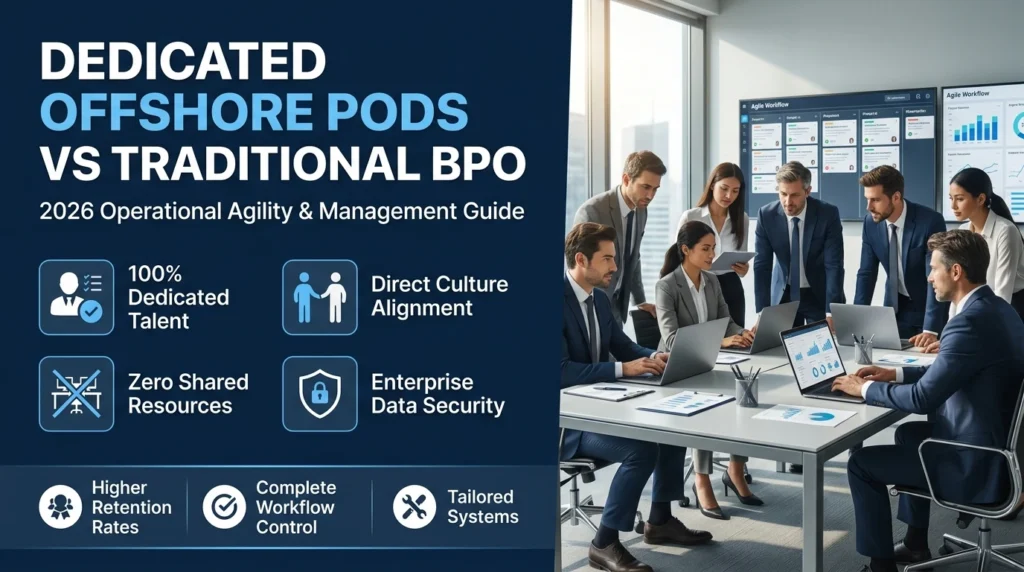
Quick Answer: A dedicated offshore operational pod is an exclusive, modular remote team — including a Pod Lead, Subject Matter Analysts, Quality Assurance Specialists, and Data Processors — embedded directly into a company’s daily operations. Unlike traditional shared BPOs that distribute fractional agents across multiple accounts, dedicated pods provide 100% focused capacity, cumulative institutional knowledge, and tighter data governance under SOC 2 and ISO 27001 security frameworks. [R1][R2]
Key Takeaways:
- Dedicated Capacity vs. Multi-Tenant Pools: Shared BPOs rotate agents between unrelated client queues, increasing cognitive switching and error risk. Dedicated pods focus solely on one company’s workflows, preserving domain context. [R1]
- Embedded Quality Governance: Dedicated pods integrate an internal QA reviewer who audits files against structured scoring rubrics, identifying calibration drift before final queue sign-off. [R2]
- Zero-Trust Technical Controls: Operations run through secure Virtual Desktop Infrastructure (VDI) with disabled local storage, blocked removable media, and role-based access controls to protect sensitive non-public personal information (NPI). [R3]
- Overnight Operational Velocity: Domestic teams hand off daily processing queues at market close, allowing offshore pods to clear tasks overnight before the next business day. [R1]
- Phased Deployment Framework: Successful transitions follow a 3-phase progression: workflow codification, supervised calibration runs, and autonomous production management. [R2]
What Is the Dedicated Offshore Pod Model?
The dedicated offshore pod model is an organizational structure in which a specialized, cross-functional team located in an international delivery center operates as an integrated extension of a domestic department. Rather than purchasing fractional tickets or unmanaged freelancer hours, organizations deploy structured pods to manage continuous operational pipelines.
According to global outsourcing industry research from Grand View Research and Gartner, business process outsourcing has increasingly evolved from basic call handling toward specialized Knowledge Process Outsourcing (KPO) and managed operational pods. [R1][R2] As business processes become more integrated with cloud applications, operational leaders require teams that understand their specific standard operating procedures (SOPs), regulatory constraints, and quality benchmarks.
Head-to-Head Comparison: Shared BPO vs. Dedicated Pods
To evaluate which operational model aligns with specific business requirements, organizations must examine how resource allocation, training depth, quality control, and technical security differ across models:
| Operational Dimension | Traditional Shared BPO | Freelance Marketplaces | Dedicated Offshore Pod |
|---|---|---|---|
| Resource Allocation | Fractional multi-tenant pool | Solo individual contractor | 100% Exclusive Dedicated Team |
| Domain Training & Memory | Generic scripting; agent rotation | Isolated individual knowledge | Codified SOPs & Retained Memory |
| Security Architecture | Standard facility physical controls | Unmanaged personal devices | Zero-Trust VDI, DLP & RBAC Controls |
| Quality Governance | Periodic randomized sampling | Self-inspected by contractor | Embedded QA Lead & Calibration Syncs |
| Collaboration Method | Vendor ticket management portal | Marketplace messaging / Email | Direct Slack / Teams & Standups |
| Queue Turnaround SLA | Variable queue timelines | Unpredictable schedule availability | Agreed Service Level Target (e.g. 24h) |
For an analysis of worker classification and direct management differences, review our comparison guide on Dedicated Offshore Teams vs. Freelance Marketplaces.
Anatomy of a Dedicated Offshore Pod
An effective operational pod is composed of distinct functional tiers designed to ensure self-sufficiency, process adherence, and quality control:
- 1. Pod Lead / Operations Coordinator: Acts as the primary point of contact for domestic team leaders. The Pod Lead coordinates daily shift schedules, balances queue volume, conducts daily standups, and manages initial exception escalations.
- 2. Senior Subject Matter Specialists: Experienced analysts who evaluate complex cases requiring domain judgment, such as conditional underwriting checks, forensic cash flow reviews, or complex customer resolutions.
- 3. Operational Processors: Dedicated team members executing structured, rule-based workflows, including document indexing, data extraction, CRM updates, and transaction validation.
- 4. Embedded Quality Assurance (QA) Specialist: An internal reviewer responsible for sampling completed work against objective scoring rubrics to catch errors, monitor compliance, and identify training opportunities.
Key Operational Verticals & Pod Applications
Dedicated operational pods are utilized across diverse industries with structured, data-intensive workflows:
1. Financial Lending & Underwriting Support
Lenders, credit unions, and alternative financing firms use dedicated pods to streamline transaction evaluation:
- Bank Statement Analysis: Detailed review of business financial statements, tracking average balances, deposit frequency, NSF occurrences, and existing funding positions as outlined in our MCA Bank Statement Scrubbing Guide.
- Mortgage Loan Processing: Income verification, document indexing, appraisal reviews, and condition clearing described in our Mortgage Underwriting BPO Guide.
2. eCommerce & Retail Operations
Growing online retail brands deploy dedicated pods to manage recurring administrative queues:
- Catalog & Inventory Management: Multi-channel product listings, inventory reconciliation, and dispute management detailed in our eCommerce BPO Services Guide.
- Customer Support Operations: Managing live chat, email inquiries, order tracking, and returns across omnichannel helpdesk platforms.
3. Healthcare Administration & KPO Analytics
Managing knowledge-intensive and compliance-sensitive operational queues:
- Healthcare Back-Office: Prior authorization documentation, medical billing support, and claims verification under strict privacy controls.
- Analytical & Financial KPO: Data modeling, market research compilation, and operational reporting reviewed in our Guide to KPO Services.
Quality Governance & SLA Management
Maintaining output consistency across remote delivery teams requires structured quality governance:
| Stage | Operational Protocol | Objective Measurement |
|---|---|---|
| 1. Intake & Triage | Ingest queues, verify document completeness, assign to pod tiers | Initial queue allocation time |
| 2. Production Execution | Process items according to codified SOPs and business logic | Turnaround time against SLA |
| 3. Embedded QA Review | Independent review of completed files against error rubrics | Accuracy percentage benchmark |
| 4. Calibration Syncs | Weekly review of edge cases and continuous SOP updates | Reduction in repeated error categories |
For additional insight into capacity planning and team management, explore our comparison on BPO vs. Virtual Assistant Models.
Security Controls & Data Governance
When handling sensitive customer data, non-public financial records, or healthcare documentation, operational pods implement technical and organizational security controls aligned with industry frameworks such as AICPA SOC 2 and ISO/IEC 27001 [R3]:
- Virtual Desktop Infrastructure (VDI): Team members operate within centralized, encrypted remote desktop sessions. Data remains inside the client’s cloud environment and is not stored on local client endpoints.
- Data Loss Prevention (DLP): Local downloads, external storage access, clipboard exports, and unauthorized print functions are restricted at the administrative policy level.
- Role-Based Access Control (RBAC): Access is granted on a least-privilege basis, ensuring associates only access data fields required for their designated tasks.
- Dynamic Session Watermarking: Remote displays incorporate identifier watermarks to discourage unauthorized photo recording.
- Audit Logging & Telemetry: User session activities, access events, and authentication attempts are logged for security oversight and compliance reporting.
The 3-Phase Pod Deployment Framework
A structured transition methodology minimizes operational disruption during pod deployment:
- Phase 1 — Discovery & Process Codification: Document workflows into step-by-step SOPs, configure access permissions and VDI environments, and establish initial quality benchmarks.
- Phase 2 — Supervised Calibration Batches: Execute initial task batches with 100% QA review. Daily calibration syncs refine edge-case handling and align expectations.
- Phase 3 — Autonomous Queue Execution: The pod transitions to standard production management under regular QA sampling, with weekly metric reviews and continuous process refinement.
Frequently Asked Questions (FAQ)
What is a dedicated offshore operational pod?
A dedicated offshore operational pod is a cross-functional remote team comprising a Pod Lead, Subject Matter Analysts, QA Reviewers, and Processors allocated exclusively to one company. Unlike shared BPOs where agents handle multiple accounts, pod members operate exclusively within the client’s internal software systems, workflows, and standard operating procedures.
How does a dedicated pod differ from a shared BPO call center?
Shared BPOs allocate fractional agents across multiple client queues with ticket-based billing and generalized training. In contrast, dedicated pods provide full-time resource allocation, cumulative institutional knowledge, direct communication via tools like Slack or Teams, and custom quality assurance rubrics tailored to complex operational workflows.
What workflows are best suited for dedicated pods?
Dedicated pods are designed for recurring, high-accountability workflows that require domain precision, such as loan underwriting support, bank statement analysis, insurance policy administration, healthcare revenue cycle management, eCommerce catalog operations, and multi-tier customer support.
How is data security governed in a dedicated offshore pod?
Security governance relies on Zero-Trust Network Access (ZTNA) and Virtual Desktop Infrastructure (VDI). Operations occur within encrypted remote cloud sessions with disabled local downloads, restricted USB ports, dynamic screen watermarking, role-based access control (RBAC), and adherence to SOC 2 and ISO 27001 data protection standards.
How does the pod deployment lifecycle work?
Standard pod onboarding follows a structured 3-phase methodology: Phase 1 maps processes and codifies SOPs; Phase 2 executes supervised calibration batches with 100% QA audits; Phase 3 transitions into autonomous queue execution with continuous sampling and weekly calibration reviews.
Explore Dedicated Offshore Operational Pods
CapStonePlanet structures dedicated operational pods tailored to your software environment, SLA requirements, and quality standards across underwriting, back-office, and customer operations.
About the Author

Kishan Dangi (KK Patel)
Founder & CEO, CapStonePlanet
12+ years in BPO and outsourcing. Kishan leads global operations at CapStonePlanet, helping US businesses build, deploy, and manage dedicated offshore operational pods across loan underwriting support, back-office data operations, and customer experience workflows.
References
| Code | Source | Link |
|---|---|---|
| [R1] | Grand View Research — Business Process Outsourcing Market Report | View → |
| [R2] | Gartner Research — Agile Pod Sourcing and IT/BPO Frameworks | View → |
| [R3] | AICPA — SOC 2 Trust Services Criteria for Service Organizations | View → |