Mortgage Pre-Approval Documents Checklist (2026 Guide)
By Kishan Dangi | CapStonePlanet
What mortgage papers are required?
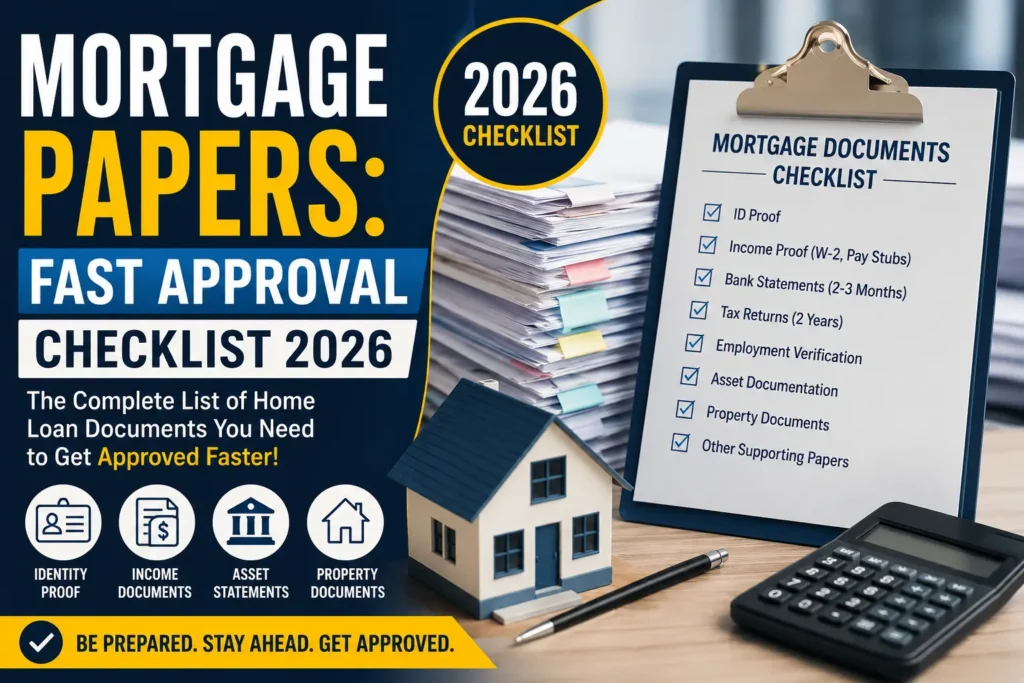
The standard mortgage doc checklist includes a government-issued ID, the last two years of W-2 forms or tax returns, 30 to 60 days of recent pay stubs, and two to three months of complete bank statements. Self-employed borrowers must also provide a profit and loss statement.
One distinction saves confusion before you gather anything: a pre-qualification is a quick, largely self-reported estimate of what you might borrow, while a pre-approval is a documented evaluation where the lender has verified your identity, pulled your credit and confirmed what you earn and owe. This checklist exists because pre-approval is proof-based — every paper below replaces a claim with evidence. The same verified file carries forward into the underwriter’s review once you are under contract.
1. What Identity Documents Are Needed for a Mortgage Application?
Before any lender reviews your income, they must comply with federal regulations to verify exactly who you are. This protects both the bank and you from identity theft.
- Government-issued photo ID: A valid driver’s license, passport, or state ID.
- Social Security card: Or official documentation showing your SSN (like a W-2 form).
Real-world clarity: Make sure your ID is not expired. An expired driver’s license will instantly halt your loan estimate until you provide an updated one.
Identity Documents Checklist (At a Glance)
| Document | Purpose | When Required |
|---|---|---|
| Government-issued photo ID (driver’s license or passport) | Identity verification | At application |
| Social Security number | Credit pull authorization | At application |
| Social Security card (if number is not on the ID) | Number verification | At application |
| Authorization to run credit (signed by applicant) | Credit bureau access | At application |
| Residency documentation (visa, green card, or work permit) | Legal residency verification (non-citizens) | At application if applicable |
| Divorce decree or separation agreement (if applicable) | Alimony/child support income or obligation | If applicable |
2. How Do Lenders Verify Income and Employment?
Your ability to repay the loan is the most critical factor for a mortgage underwriter. They will calculate your debt-to-income ratio using these home loan documents needed for income verification:
- Recent Pay Stubs: Typically covering the last 30 to 60 days. These must show your year-to-date earnings.
- W-2 Forms: You need these from the past two years to prove consistent employment.
- Tax Returns: If you receive 1099 income or are self-employed, prepare your personal and business tax returns for the last two years (all schedules included).
- Profit and Loss Statement (P&L): Self-employed borrowers usually need a year-to-date P&L and balance sheet.
- College Transcripts: If you graduated within the last two years and don’t have a long work history, lenders can use your transcripts to count your time in school as employment history.
Example: If you earn commission or bonuses, you must provide a two-year history of this extra income for it to count toward your pre-approval.
3. What Asset Documentation Is Required for Closing Funds?
Lenders need proof that you have the cash required for your down payment, closing-day funds, and financial reserves. You cannot simply use cash that suddenly appears in your account; the money must be “seasoned,” meaning it has been sitting in your account for at least 60 days.
- Bank Statements: Two to three months of checking and savings account statements to verify your source of funds.
- Investment Accounts: Statements for 401(k)s, IRAs, and brokerage accounts.
- Gift Letters & Down Payment Assistance: If a family member gives you money, they must sign a gift letter stating it is not a loan. If you use a state grant, provide the award letter.
- Earnest Money Deposit (EMD): You will need a copy of the cleared check or wire transfer receipt showing you paid the EMD.
The “All Pages” Rule: When submitting statements, you must include every single page. If a statement says “Page 1 of 6,” you must submit all 6 pages—even if the last page is intentionally left blank.
4. Why Must You Provide Proof of Debts and Obligations?
An underwriter checks your credit score and pulls your credit report, but they also require paperwork to verify your monthly liabilities.
- Divorce Decree: If you are legally required to pay alimony or child support, lenders need the court orders to factor this into your debt-to-income (DTI) ratio.
- Bankruptcy Papers: If you have a prior bankruptcy, you must provide your discharge papers to prove the debts were legally cleared.
- Rental History: First-time buyers may be asked for canceled rent checks or contact information for previous landlords to prove a history of on-time payments.
- Other Real Estate: If you own other properties, you must provide the mortgage doc, property tax bills, and homeowners insurance declarations for those homes.
Simplified explanation: Think of this section as the “honesty check.” If a debt appears on your credit report but you didn’t list it on your application, or if there is a sudden large deposit in your bank account, the underwriter will ask for a Letter of Explanation to clarify your financial situation.
5. What Property-Specific Documents Do You Need?
Once you find a home, your mortgage application shifts from a pre-approval to an active loan process. At this stage, lenders require documents tied directly to the home you are buying.
- Purchase Agreement: A fully executed sales contract signed by both the buyer and the seller.
- Homeowners Insurance: A declarations page proving you have secured sufficient insurance coverage for the new property.
6. When Should You Update Your Mortgage Doc File?
The mortgage underwriting process can typically take anywhere from 30 to 45 days once the file is complete, and document-freshness rules assume that window. During this time, your initial documents might become outdated. Always keep your newest pay stubs and bank statements ready, as lenders often do a final check just days before you receive your closing disclosure or loan estimate.
Why the Lender Asks for Each Document (Not Just What to Send)
Most checklists tell you what to gather. This table explains why each item exists — because once you know what a document proves, you can pre-empt the follow-up conditions that slow files down.
| Document | What the underwriter actually checks it against | What a missing or messy version signals |
|---|---|---|
| Photo ID + Social Security card | Confirms the person applying, the person on the credit report, and the person who will own the property are all the same legal entity. | Identity mismatch — the file stops until it is reconciled in writing. |
| W-2s (last 2 years) | Cross-checks employer-reported income against your stated income and shows employment continuity. | A gap year or an employer name change raises self-employment or stability questions. |
| Recent pay stubs (30 days) | Verifies the current rate of pay still matches the W-2 year and that income is ongoing, not ending. | Overtime-heavy or variable stubs make the underwriter average them — which can lower the qualifying income. |
| Two months of full bank statements | Every page, including blank ends: they are verifying that closing cash actually exists and tracking where large deposits came from. | Unexplained large deposits become a Letter of Explanation condition — one of the most common last-week delays. |
| Gift letter (if any down payment is gifted) | Proves the money is a true gift, not a loan you will owe — a disguised loan changes your debt-to-income math. | Without the signed letter, the deposit may be excluded from funds-to-close entirely. |
| Tax returns (2 years; all schedules for self-employed) | Reconciles declared income with what you told the lender. For self-employed borrowers this is the primary income document — W-2s do not apply. | Writing off heavy business expenses lowers taxable income — and therefore qualifying income — even if your real cash flow is strong. |
| Credit report (pulled by lender) | Payment history, current balances, new inquiries, and the score the loan pricing is based on. | A new credit card opened mid-process can change your score and re-price or re-approve the whole file. |
| Existing loan statements / lease | Feeds monthly obligations into the debt-to-income calculation the approval limit is built on. | An omitted obligation that later appears on the credit report re-runs the DTI math — sometimes at a lower approval amount. |
| Homeowners/purchase insurance binder | Protects the collateral the lender is financing; required before closing, increasingly requested before final approval. | Delays here stop clear-to-close even when your own file is perfect. |
The pattern: every document answers the same three questions from the lender’s side — is this you, is this income real and continuing, and is the cash actually available? When a file stalls, it is almost never because a paper was missing from the list; it is because a paper that was submitted answered one of those questions ambiguously. If a document creates doubt instead of resolving it, expect a condition.
What Happens After You Submit Your Documents?
Knowing the destination keeps the packing effort in perspective. Once your file is in, a loan processor assembles and gap-checks it, the lender pulls your credit and orders the appraisal, and an underwriter — automated first for conventional loans, human for complex files — verifies the three questions every document on this list exists to answer: that you are who you claim to be, that your income reliably covers your debts, and that your funds are genuinely yours and seasoned. If something is unclear you will receive a condition list: specific, answerable requests, not a rejection. Answer promptly and the file usually returns to the same desk within days.
The Missing-Document Problems That Delay Real Files
Most pre-approval delays are not exotic — they are the same handful of gaps:
- Partial bank statements. Every page of every month, even blank backsides — a missing page restarts the clock on that document’s freshness.
- Undocumented large deposits. A sudden credit without a paper trail (gift letter, sale receipt, prior-transfer record) pauses asset verification until you show its source.
- Stale pay stubs. Documents typically must be under 30–60 days old at final review, so an early-assembled file ages out and needs refreshing.
- Employment gaps without letters. A two-line explanation for any six-month gap avoids a mandatory employer-verification loop.
- Overlooked obligations. Child support, co-signed loans or deferred student debt surface in the credit pull and must be papered late.
Self-employed borrowers face one extra trap: reporting minimal net income on tax returns while living comfortably. Underwriters read taxable income, not cash flow. If that describes you, ask your lender early whether a manual underwriting review with accountant support letters fits your file better than an automated pass.
Frequently Asked Questions (FAQ)
What mortgage papers are required for pre-approval?
For pre-approval, lenders typically need your W-2s from the past two years, recent pay stubs, 2-3 months of bank statements, and a government-issued ID.
Why do I need to submit all pages of a bank statement?
Underwriters must verify there are no hidden debts or undisclosed withdrawals. Even if the last page of your statement is blank, it proves no pages are missing.
How does my credit score affect the home loan documents needed?
Borrowers with borderline credit scores or a complex credit history may be asked for additional Letters of Explanation to clarify past late payments or collections. If your score falls below a certain threshold, you may need to undergo manual underwriting.
How long are my mortgage documents valid?
Most lenders consider income and asset documents, such as pay stubs and bank statements, to be valid for 60 to 90 days. If your closing takes longer, you will need to provide updated copies.
What documents do self-employed borrowers need for a mortgage?
Self-employed applicants usually need to provide two years of personal and business tax returns, recent Profit and Loss (P&L) statements, and business bank statements.