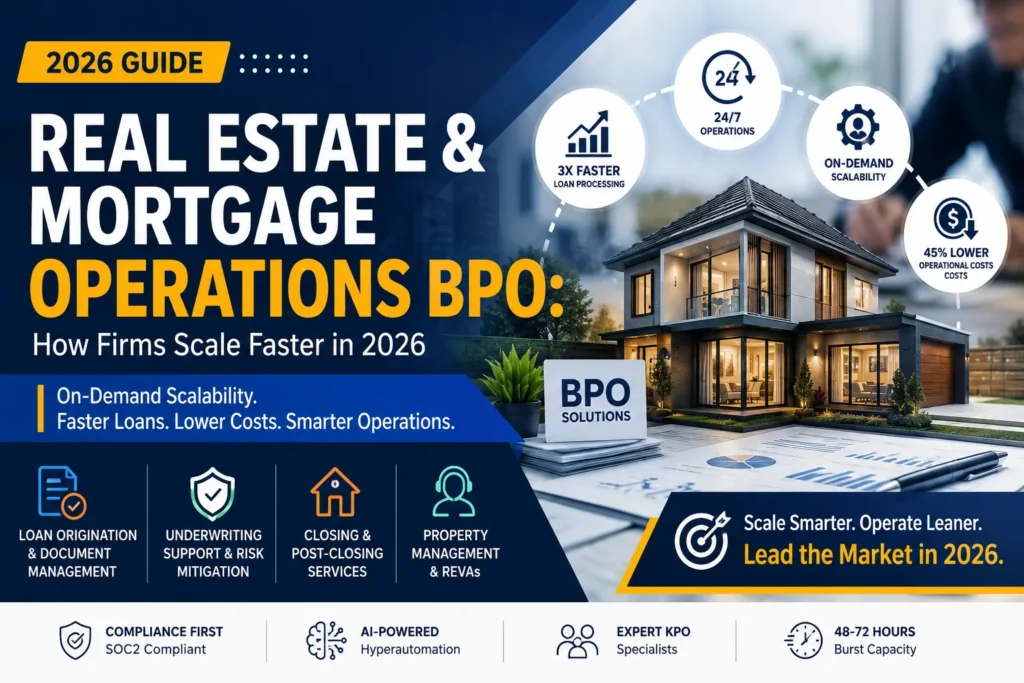
Real estate and mortgage operations are undergoing a fundamental shift toward “On Demand Scalability.” In 2026 leading lenders and brokerages are utilizing specialized BPO and KPO models to eliminate the traditional “hire and fire” cycle. By integrating offshore operational velocity with local expertise, firms are achieving 3x faster loan processing times and significant overhead reduction. According to Statista’s Mortgage Processing Market Analysis, the demand for specialized third party fulfillment has grown by 18% as firms prioritize operational elasticity.
Before diving into the technical workflows, it is essential to understand how outsourcing transforms the operational cost structure.
| Feature | In House Operations | Outsourced KPO (CapStonePlanet) |
|---|---|---|
| Operational Cost | High Fixed Overhead | Low Variable/Scale Based Cost |
| Scaling Velocity | Slow (3-6 Months to Hire/Train) | Immediate (48-72 Hours Burst Capacity) |
| Operating Hours | 8/5 (Standard Business Hours) | 24/7 (Follow the Sun Workflow) |
| Compliance Load | Internal Management Burden | Automated Audit & Expert Validation |
| Technology Access | Heavy Capital Expenditure | Included AI Powered Processing Tools |
Real estate business process outsourcing (BPO) helps firms accelerate underwriting, compliance, document processing and closing preparation without expanding internal staffing. While often confused with “Broker Price Opinions,” operational BPO focuses on the administrative and technical engine that powers property management and lending cycles.
In the 2026 market the distinction between BPO (Operational) and KPO (Knowledge Based) is critical. As noted in Gartner’s Roadmap for Strategic Outsourcing, the integration of AI driven “Hyperautomation” is now a baseline requirement for competitive BPO partnerships.

End-to-end mortgage fulfillment lifecycle process from loan origination to post-closing and compliance operations.
Mortgage fulfillment services begin with the rapid ingestion and validation of borrower data. Efficient document intake reduces pogo sticking in the underwriting phase by ensuring that 1003 applications and secondary proofs are 100% complete before reaching the credit committee.
By leveraging automated document recognition (ADR) and expert human review we ensure that your Loan Origination System (LOS) is populated with clean data within hours of submission. This “Zero Error” intake is the foundation of high velocity lending.
Underwriting operations outsourcing provides the technical forensic analysis required to qualify complex files. By offloading the “data scrubbing” phase your licensed underwriters can focus exclusively on the final credit decision, significantly increasing their daily file output.
This includes the mandatory verification of KPO Data Security standards, ensuring that sensitive borrower PII never leaves a secured, SOC2 compliant environment.
Closing and post closing BPO ensures that title commitments, escrow coordination, and collateral file audits are completed with surgical precision. This phase is critical for ensuring that loans meet secondary market guidelines for immediate liquidity.
| Entity Type | Role in Closing | KPO Optimization |
|---|---|---|
| Title Support | Commitment Review | Overnight title search analysis |
| Escrow | Coordination | Seamless communication with all stakeholders |
| Post-Closing | Collateral Audit | Zero defect trailing document retrieval |
Real estate virtual assistants (REVAs) provide property managers and brokerages with the scalability to handle high occupancy portfolios without increasing local payroll. These specialists manage the entire tenant lifecycle from lead generation and CRM management to lease administration and renewals.
By integrating REVAs into your property management workflow firms typically see a 40% reduction in response times and a 20% increase in tenant retention through consistent, 24/7 engagement.
Scaling your operations should not disrupt your current workflow. Our Mortgage Scalability Model follows a 4 step deployment:
We don’t just claim scalability; we engineer it. Our benchmarks reflect the reality of 2026 mortgage operations:
* Turnaround Time (TAT): Reduction of 5-7 days in the total loan cycle.
* Accuracy Rate: 99.8% on initial document indexing and DTI calculations.
* Burst Capacity: Capability to handle a 300% volume spike within 5 business days.
* Cost Savings: Average 45% reduction in back-office operational expenses compared to US based in house teams.
Mortgage fulfillment services cover the end to end processing of a loan, from the moment an application is submitted to the final funding and delivery to the secondary market.
By shifting fixed payroll costs to a variable per file or per hour model, lenders only pay for the capacity they use, eliminating overhead during market downturns.
Yes. All data is processed within SOC2 Type II and GDPR compliant “Clean Rooms” with biometric access and end to end encryption following the latest Knowledge Process Outsourcing (KPO) security protocols.
Absolutely. REVAs are trained in major real estate CRMs to provide instant lead responses, appointment setting, and follow up sequences.
Because our teams operate in different time zones, files submitted at the end of the US business day are processed overnight and are ready for review by your US team the next morning.
Yes, we provide specialized support for title searches, commitment reviews, and escrow coordination to ensure a smooth closing process.
Standard onboarding for a mortgage cluster takes between 7 to 14 days, depending on the complexity of your LOS integration.
Our model is designed for elasticity. You can scale your support down during quiet periods to preserve capital, then ramp back up instantly when the market shifts.
Expert Review & Authority: This guide was authored by the CapStonePlanet Strategic Operations Team, specialists in high velocity BPO Customer Support Solutions and mortgage KPO architecture with over 15 years of industry experience.