- Have any Questions ?
- info@capstoneplanet.com

Offshore BPO KPI Tracking & SLA Governance Playbook: The 2026 Quality Assurance & Performance Scorecard Framework
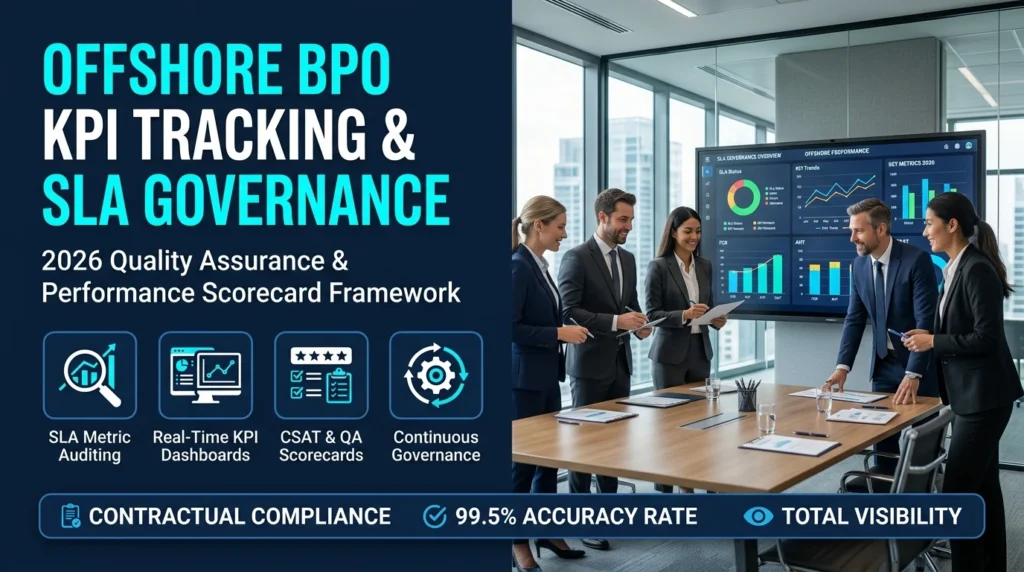
Quick Answer: Offshore BPO KPI tracking and SLA governance is the systematic framework of aligning contractual commitments (SLAs) with granular operational metrics (KPIs) and randomized Quality Assurance (QA) scorecards to manage remote dedicated teams. High-growth enterprises achieve seamless execution by tracking Turnaround Time (TAT), First Contact Resolution (FCR), and defect rates through automated cloud dashboards and asynchronous handoff protocols—eliminating micromanagement while maintaining 99%+ procedural accuracy under SOC 2 and HIPAA compliance standards.
Key Takeaways:
- SLA vs. KPI Separation: SLAs govern macroscopic client-level commitments (system uptime, queue completion deadlines), while KPIs measure individual analyst throughput and operational process health.
- Weighted QA Scorecard Model: Enterprise governance assigns 40% to Process Accuracy, 30% to Regulatory Compliance/Data Security, 15% to TAT Velocity, and 15% to Queue Hygiene.
- Asynchronous Operational Velocity: Leveraging timezone arbitrage enables continuous 24-hour processing where domestic evening handoffs are cleared overnight by dedicated offshore pods.
- Automated Dashboard Governance: Modern operations replace manual timesheet tracking with real-time API-driven backlog monitoring and statistical process control (SPC).
- Dedicated Pod Superiority: Exclusive offshore pods outperform shared BPO pools by maintaining continuous institutional domain memory and lower calibration drift.
1. The Evolution of Offshore Performance Governance in 2026
Scaling back-office, financial underwriting, data extraction, and customer support operations through global talent hubs is no longer merely a labor-arbitrage initiative. In modern mid-market and enterprise organizations, offshore operational excellence is defined by predictable delivery velocity, zero-defect quality control, and auditable compliance standards.
Traditional business process outsourcing (BPO) management historically struggled with opacity: domestic department heads often felt disconnected from international delivery centers, relying on aggregated monthly reports that masked daily queue bottlenecks. As detailed in our operational comparison of dedicated offshore pods vs traditional BPO centers, modern organizations have transitioned to embedded, modular teams operating under rigorous, real-time KPI tracking frameworks.
2. Deconstructing Performance Architecture: SLAs vs. KPIs
A common failure mode in managing remote offshore teams is conflating contractual Service Level Agreements (SLAs) with internal Key Performance Indicators (KPIs). While closely interrelated, they fulfill fundamentally distinct roles across executive leadership and frontline operations:
| Governance Dimension | Service Level Agreement (SLA) | Key Performance Indicator (KPI) |
|---|---|---|
| Strategic Purpose | Defines external contractual commitments and minimum performance baselines. | Measures internal operational efficiency, process velocity, and agent productivity. |
| Primary Audience | Executive Stakeholders, General Counsel, VP of Operations, Client Sponsors. | Pod Leads, QA Evaluators, Operational Managers, Individual Analysts. |
| Review Frequency | Monthly Business Reviews (MBR) and Quarterly Strategy Reviews (QBR). | Real-Time Dashboards, Daily Queue Standups, and Weekly Pod Calibrations. |
| Core Metrics | 99.5% Queue Uptime, Underwriting TAT < 4 Hours, 98% Monthly QA Pass Rate. | Average Handling Time (AHT), File Scrubbing Speed, First Contact Resolution (FCR). |
3. Core Operational Metrics Matrix for Offshore Pods
Whether managing dedicated back-office data teams, loan scrubbing analysts, or customer experience specialists, tracking the right combination of lagging and leading indicators ensures operational transparency:
A. Turnaround Time (TAT) & Queue Velocity
Turnaround Time measures the elapsed duration from task ingestion to verified resolution. In high-velocity environments such as financial services or merchant cash advance (MCA) underwriting, TAT determines deal conversion. Pod leads track:
- First-Touch Latency: Time taken for an available analyst to claim an incoming file from the shared queue.
- Active Processing Time (AHT): Net duration spent validating bank statements, cross-checking tax documents, or executing CRM updates.
- Queue Dwell Duration: Stagnant file time waiting for secondary management sign-off or external document clarification.
B. Quality Assurance (QA) Scorecards & Defect Tracking
Speed without quality creates compounding rework. High-performing offshore governance models mandate randomized multi-point audits across 5% to 15% of all completed tasks. Evaluators score files against an objective rubric divided across critical operational pillars.
Operational Protocol: Never allow individual analysts to self-audit. Establish an independent QA Specialist role within each dedicated pod who reports directly to the Operations Director, ensuring unbiased compliance audits and early detection of process calibration drift.
4. The 2026 Quality Assurance (QA) Scorecard Weighting Model
To maintain enterprise-grade rigor, QA evaluations must avoid subjective grading. The standard CapStone Planet scorecard allocates percentage weights based on operational risk severity:
| Scorecard Category | Weight | Evaluation Criteria & Audit Focus |
|---|---|---|
| Process & Procedural Accuracy | 40% | Strict adherence to Standard Operating Procedures (SOPs), accurate data extraction, correct spreadsheet calculations, and proper folder archiving. |
| Data Security & Compliance | 30% | Zero PII/NPI leakage, strict execution inside secure VDI environments, adherence to SOC 2 and HIPAA security protocols, and no unauthorized local file caching. |
| Turnaround Velocity (TAT) | 15% | Task completion within agreed SLA benchmark windows without unnecessary queue stagnation or handover delays. |
| Communication & Queue Hygiene | 15% | Clear status notes in CRM/ticketing systems, prompt escalation of ambiguous cases, and concise daily handover summaries. |
5. Asynchronous Handoff Protocols & 24-Hour Operations
One of the greatest competitive advantages of deploying dedicated offshore pods in international talent hubs (such as India or the Philippines) is the ability to unlock a 24-hour continuous production cycle. However, capturing this advantage requires eliminating reliance on synchronous meetings:
The Overnight Processing Engine
- Domestic Evening Queue Freeze (5:00 PM EST): The domestic team tags end-of-day back-office submissions, financial verification requests, or document queues.
- Overnight Pod Processing (9:00 PM – 6:00 AM EST): The dedicated offshore pod processes files, executes bank statement scrubs, verifies database entries, and runs internal QA audits.
- Domestic Morning Review (8:30 AM EST): Domestic managers log in to find completed, verified, and score-graded files ready for immediate executive sign-off.
6. Frequently Asked Questions (FAQ)
What is the difference between an SLA and a KPI in offshore BPO management?
A Service Level Agreement (SLA) defines contractual commitments and minimum acceptable performance baselines (such as 99.5% uptime or 4-hour file turnaround). In contrast, Key Performance Indicators (KPIs) measure tactical efficiency and individual productivity metrics (like average handling time, file throughput, or first contact resolution rate).
How do enterprise leaders govern dedicated offshore pods without micromanagement?
Governance is achieved by establishing clear asynchronous communication protocols, automated cloud-based queue dashboards, structured QA scorecards, and weekly calibration meetings. Focusing on verified throughput and defect rates replaces the need for intrusive keystroke tracking or micromanagement.
What QA scorecard weighting is standard for offshore back-office operations?
Enterprise models allocate 40% to Process & Procedural Accuracy (strict SOP adherence), 30% to Compliance & Security (PII/NPI protection under SOC 2 and HIPAA), 15% to Turnaround Velocity (TAT compliance), and 15% to Communication & Queue Hygiene.
How does timezone disparity impact SLA tracking and handoff velocity?
When properly architected, timezone differences unlock a continuous 24-hour operational cycle. Domestic US teams package complex underwriting files, customer inquiries, or data entry queues at market close, allowing offshore dedicated pods to execute and audit workflows overnight for next-day review.
Ready to Deploy High-Performance Dedicated Offshore Pods?
Scale your back-office, financial underwriting, and customer operations with custom-built dedicated pods governed by rigorous SLAs and real-time QA scorecards.