- Have any Questions ?
- info@capstoneplanet.com

Building a SOC 2 & HIPAA-Compliant Dedicated Offshore Back-Office: The 2026 Security & Governance Blueprint
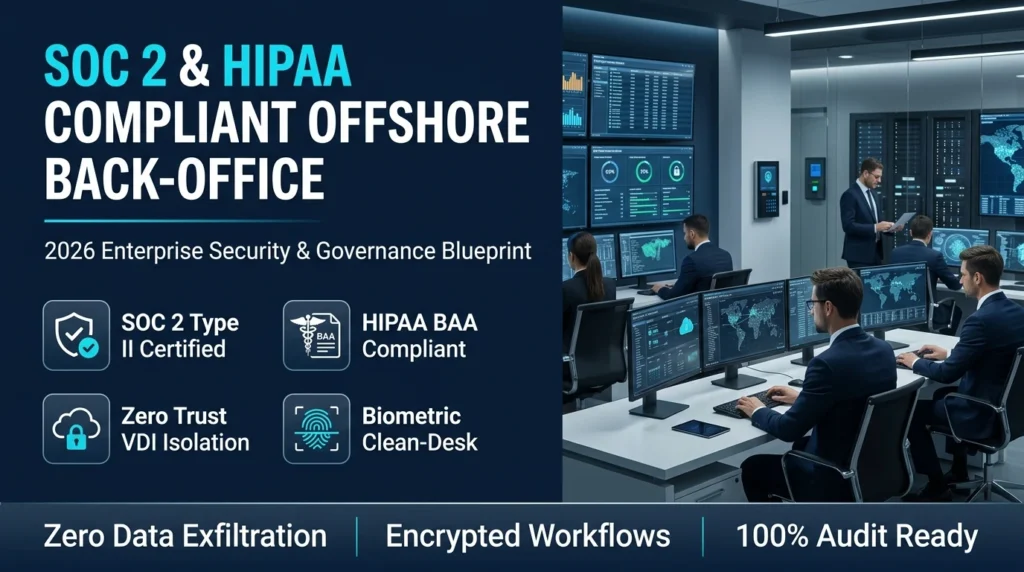
⚡ Executive Summary • Core Operational & Compliance Takeaway
Deploying a hipaa compliant offshore staffing and soc 2 offshore bpo governance model requires moving beyond consumer-grade VPNs to an engineered defense-in-depth architecture. By combining Virtual Desktop Infrastructure (VDI) pixel streaming, Zero Trust Network Access (ZTNA), biometric Clean Desk production bays, and enforceable Business Associate Agreements (BAAs), scaling mid-market enterprises can eliminate data exfiltration risks while scaling dedicated operational capacity across global talent hubs.
For growing small and mid-sized businesses (SMBs), fintechs, and healthcare organizations, managing surge operational volume often requires expanding beyond domestic talent constraints. Whether handling medical claims, scrubbing loan applications, managing accounting reconciliations, or supporting complex customer workflows, operational leaders must evaluate how to secure remote capacity without exposing sensitive data.
As organizations transition from ad-hoc contractor arrangements to an institutional dedicated offshore team model, data security governance becomes the defining operational bottleneck. Enterprise compliance frameworks—such as the Health Insurance Portability and Accountability Act (HIPAA) and the AICPA SOC 2 Trust Services Criteria—demand continuous, auditable control over physical, technical, and administrative safeguards.
This blueprint provides a comprehensive operational framework for COOs, CTOs, and compliance leaders to build, audit, and manage high-security offshore back-office pods that satisfy rigorous U.S. and international regulatory standards.
📑 Table of Contents
- 1. The Compliance Reality: Why Traditional Freelance Staffing Fails Enterprise Audits
- 2. The 6-Pillar Enterprise Security Architecture for Dedicated Offshore Pods
- 3. VDI & Zero Trust Cloud Isolation: Technical Data-Flow Mechanics
- 4. Physical Facility Governance & Biometric Clean-Desk Delivery Bays
- 5. Regulatory Alignment: HIPAA BAAs, SOC 2 Type II & International Jurisdictions
- 6. Head-to-Head Comparison: Freelance Marketplaces vs. SOC 2 Managed Pods
- 7. The 10-Point Vendor Due-Diligence Security Audit Scorecard
- 8. Industry-Specific Deployment: Healthcare RCM, Fintech & Underwriting Pods
- 9. Practical Operations Decision Framework: Evaluating Your Risk Profile
- 10. Frequently Asked Questions (FAQ)
1. The Compliance Reality: Why Traditional Freelance Staffing Fails Enterprise Audits
Many growing companies attempt to manage operational overflow by contracting independent workers on transactional gig platforms. While transactional marketplaces provide short-term agility for episodic tasks, they introduce critical vulnerabilities when handling regulated data:
- Unmanaged Consumer Hardware: Contractors execute tasks on personal computers that lack enterprise Mobile Device Management (MDM), antivirus centralization, and disk encryption.
- Local Data Persistence: Unrestricted downloading permits sensitive customer files, bank statements, and patient health records to remain stored on unencrypted local drives.
- Absence of Facility Perimeter Security: Remote contractors operate from shared living spaces or public networks with zero physical clean-desk enforcement or CCTV oversight.
- Non-Enforceable Legal Recourse: Individual freelance agreements rarely provide enforceable cross-border indemnification or satisfy U.S. Business Associate Agreement (BAA) statutory pass-through mandates.
💡 Operational Takeaway: Under HIPAA Enforcement Rules and FTC Safeguards, a data breach resulting from an unvetted contractor carries the same statutory penalties as an internal corporate breach. Security cannot be outsourced as an afterthought—it must be structurally engineered into the talent delivery model.
2. The 6-Pillar Enterprise Security Architecture for Dedicated Offshore Pods
To provide complete operational containment, institutional Business Process Outsourcing (BPO) and Knowledge Process Outsourcing (KPO) domains organize dedicated staffing around a closed-loop, multi-layered security model:
3. VDI & Zero Trust Cloud Isolation: Technical Data-Flow Mechanics
The technical foundation of secure offshore staffing is Virtual Desktop Infrastructure (VDI) deployed within a Zero Trust framework. When scaling specialized teams—whether in healthcare BPO and medical billing operations or mortgage and loan underwriting back-office—associates do not execute software on local endpoint devices.
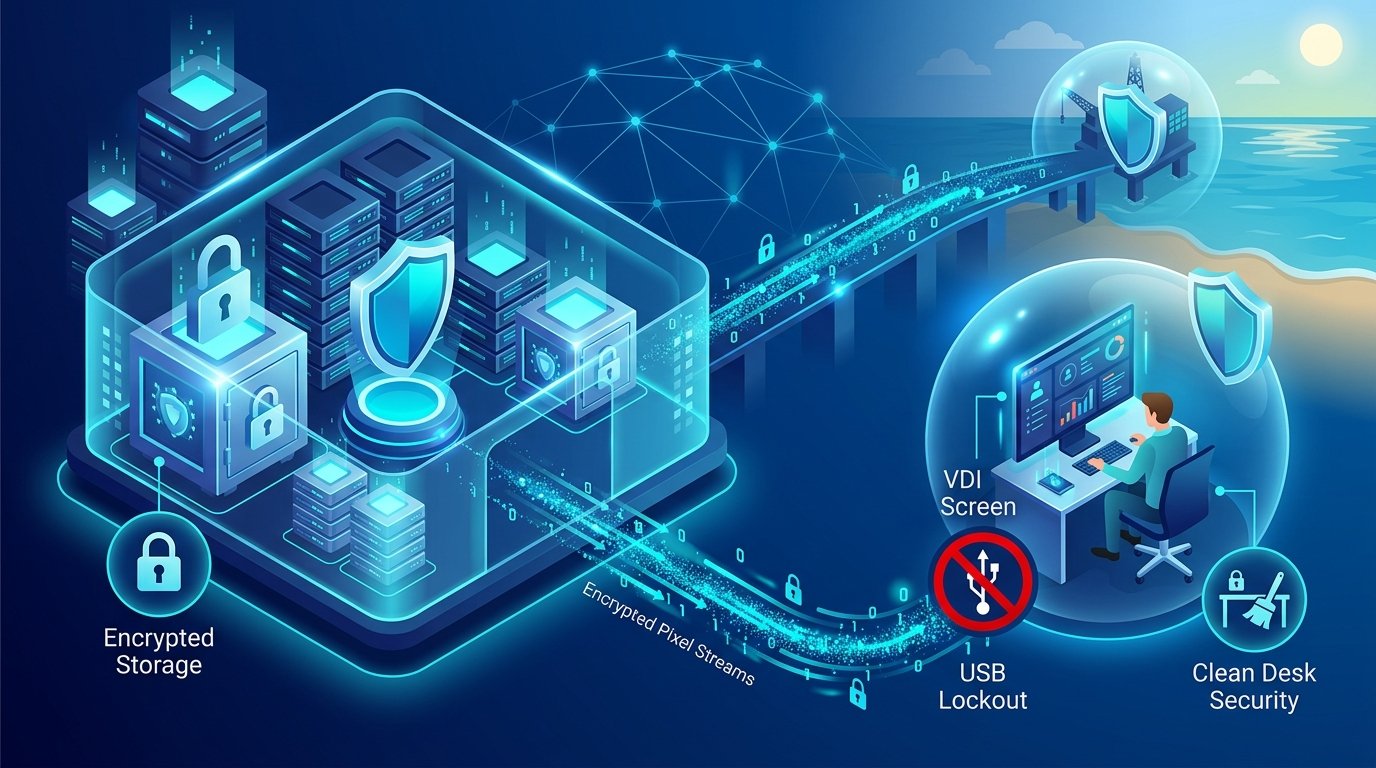
Figure 1: VDI pixel-streaming architecture ensures sensitive financial and healthcare records never touch local offshore hardware.
Instead, dedicated analysts connect to virtualized machines hosted in the client’s domestic cloud region (e.g., AWS US-East or Azure East US). The remote worker’s monitor displays an encrypted stream of rendered display pixels over TLS 1.3 encryption. If network connectivity is interrupted or a terminal is disconnected, zero data residues exist on the physical machine.
Forensic Dynamic Screen Watermarking
To neutralize the risk of external mobile photography, managed delivery bays implement dynamic forensic watermarking. A transparent grid displaying the associate’s employee ID, workstation IP address, and continuous real-time UTC timestamp is permanently overlaid across active sessions, serving as a powerful visual deterrent against unauthorized data capture.
4. Physical Facility Governance & Biometric Clean-Desk Delivery Bays
Digital isolation must be supported by physical containment. At institutional delivery facilities, operations adhere strictly to ISO/IEC 27001:2022 Annex A 7.7 Clear Desk and Clear Screen standards:
- Biometric Perimeter Access: Secure production floors require multi-factor biometric authentication (fingerprint and facial recognition turnstiles) for authorized personnel.
- Total Device Prohibition: Personal mobile phones, smartwatches, recording electronics, bags, and physical paper/pens are strictly banned from production bays and stored in external biometric lockers.
- 24/7/365 CCTV Coverage: High-definition surveillance cameras cover 100% of workstation seating, server rooms, and access corridors with video logs archived for at least 90 days.
- Infrastructure Redundancy: Dual-redundant enterprise fiber uplinks from Tier-1 ISPs, automated generator backups, and secure server rooms ensure continuous uptime and zero failover disruptions.
5. Regulatory Alignment: HIPAA BAAs, SOC 2 Type II & International Jurisdictions
Operational safeguards must be codified into binding legal structures. When managing enterprise workflows, leadership must verify compliance across three regulatory pillars:
1. The Offshore Business Associate Agreement (BAA)
Under 45 CFR § 164.502(e) and § 164.504(e), U.S. Covered Entities are legally permitted to engage offshore business associates to process Protected Health Information (PHI), provided a formal BAA is executed. A valid offshore BAA mandates:
- Strict operational boundaries preventing secondary data use, indexing, or unauthorized sub-processing.
- Contractual obligation to maintain administrative, physical, and technical safeguards complying with the HIPAA Security Rule.
- Mandatory incident reporting SLAs requiring written breach notification within 24 to 72 hours.
- Guaranteed rights for the Covered Entity to audit access logs, physical bays, and security configurations.
2. SOC 2 Type I vs. SOC 2 Type II Verification
A SOC 2 Type I report evaluates only whether a vendor’s security controls are suitably designed at a single snapshot in time. A SOC 2 Type II report independently tests and audits the operational effectiveness of those controls over a continuous 6 to 12-month evaluation window. Enterprise buyers should always mandate a Type II attestation.
3. International Data Privacy Legislation
In premier delivery hubs like the Philippines and India, compliance is further reinforced by national privacy laws, such as the Republic Act No. 10173 (Philippines Data Privacy Act of 2012), ensuring enforceable legal remedies and statutory penalties for breach of confidentiality.
6. Head-to-Head Comparison: Freelance Marketplaces vs. SOC 2 Managed Pods
The structural differences between transactional contractor hiring and dedicated, managed operations directly determine risk exposure and process continuity, as detailed in our analysis of the BPO vs. Virtual Assistant decision framework:
7. The 10-Point Vendor Due-Diligence Security Audit Scorecard
Operations leaders evaluating staffing partners should mandate compliance across these 10 technical due-diligence criteria before signing contracts:
- Independent SOC 2 Type II Attestation: Active, unredacted SOC 2 Type II report issued by an accredited CPA firm within the last 12 months.
- Bilateral HIPAA BAA Execution: Legal capacity and willingness to sign an enforceable U.S. Business Associate Agreement with breach indemnification.
- Cloud VDI Pixel Isolation: 100% of workflows executed via cloud virtual desktops with zero local storage downloads.
- Hardware Peripheral Lockouts: Physical USB ports, external drive connections, and printing disabled at the operating system and BIOS levels.
- Clean Desk Physical Controls: Biometric turnstile access, 24/7 CCTV surveillance (90-day archive), and total ban on personal mobile devices in work bays.
- Comprehensive Personnel Screening: 10-year criminal background audits, identity validation, reference checks, and mandatory pre-hiring drug tests.
- Role-Based Access Control (RBAC): Least-privilege credential allocation with mandatory Multi-Factor Authentication (MFA) and auto-lockout timers.
- Dynamic Forensic Screen Watermarking: Traceable employee identifiers and timestamps overlaid across active sessions to prevent external photography.
- Real-Time SIEM & DLP Telemetry: Continuous log correlation and automated session termination upon anomaly detection.
- Contractual Incident Reporting SLAs: Legally binding commitment to report security incidents within 24 to 72 hours of detection.
8. Industry-Specific Deployment: Healthcare RCM, Fintech & Underwriting Pods
Dedicated compliance pods deliver immediate operational leverage across regulated verticals:
Healthcare & Clinical Back-Office
Dedicated medical billing, claims adjudication, and patient scheduling pods process electronic health records (EHR) within HIPAA-compliant VDI sessions, as detailed in our Healthcare BPO Services Guide.
Fintech & Commercial Underwriting
Fintech lenders and MCA funders deploy specialized pods to scrub bank statements, verify EIN tax filings, and perform credit calculations with dynamic screen watermarking, expanding upon our Underwriting Support BPO framework.
eCommerce & Multi-Channel Catalog
High-volume retailers deploy dedicated catalog maintenance, inventory reconciliation, and tier-1 support pods governed by centralized QA, aligning with our eCommerce BPO Guide.
9. Practical Operations Decision Framework: Evaluating Your Risk Profile
To determine the appropriate staffing model for an emerging workflow, evaluate your operational characteristics against this risk threshold framework:
Opt for Freelance Contractors When:
- The deliverable is a self-contained, one-off project with a defined endpoint.
- Total workload volume is episodic or highly unpredictable.
- Specialized technical skills are required for a brief, single-stage audit.
- Tasks require zero access to sensitive customer records, banking data, or PII.
Deploy a Dedicated Offshore Pod When:
- Workflows are daily, recurring, and core to business velocity.
- Tasks require strict adherence to standard operating procedures (SOPs).
- Work involves sensitive PII, electronic health records, or financial data.
- Long-term process continuity, QA governance, and low churn are essential.
• U.S. Department of Health and Human Services (HHS): HIPAA Business Associate Requirements (45 CFR § 164.502/504)
• American Institute of CPAs (AICPA): SOC 2 Type II Trust Services Criteria Framework
• National Institute of Standards and Technology (NIST): NIST Special Publication 800-53 Rev. 5 Security & Privacy Controls
• International Organization for Standardization: ISO/IEC 27001:2022 Information Security Management
Explore Dedicated Offshore Solutions with CapStone Planet
Learn how CapStone Planet structures SOC 2 and HIPAA-compliant dedicated offshore pods tailored to your software environment, quality benchmarks, and operational scale.
10. Frequently Asked Questions (FAQ)

Written by Kishan Dangi (KK Patel)
Founder & CEO, CapStone Planet
Kishan leads global operations at CapStone Planet, helping high-growth SMBs, fintechs, and healthcare organizations deploy dedicated offshore operational pods, scale back-office workflows, and enforce institutional data compliance.