- Have any Questions ?
- info@capstoneplanet.com

Data Security and Outsourcing: What to Ask Before You Sign
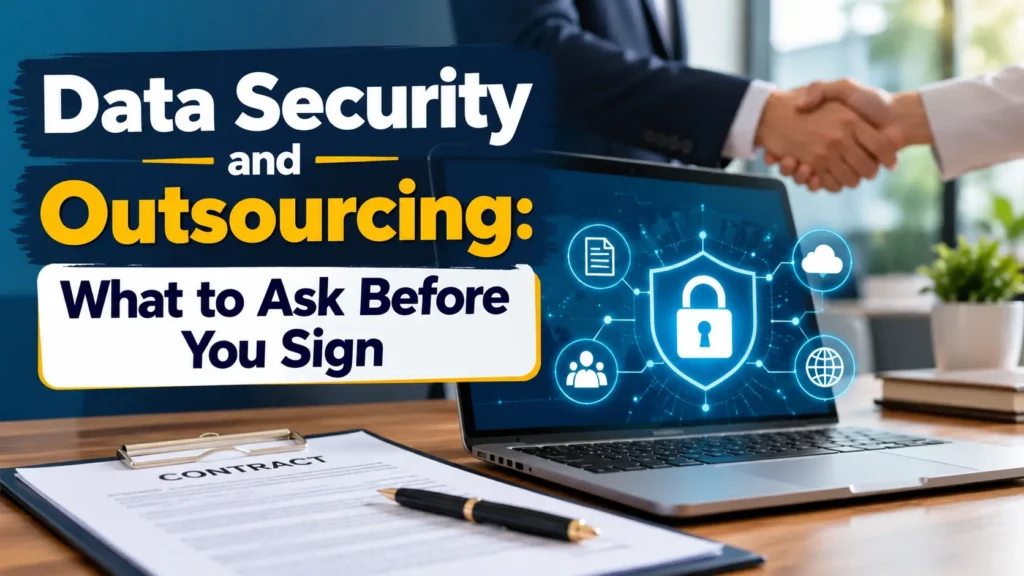
Data security in outsourcing comes down to one uncomfortable fact: the operational work can be delegated, the legal accountability cannot. You can move a function to a delivery team in another country. You cannot move your obligations to your regulator, your customers or your bank. Every question on this page exists to make that gap visible before you sign, while you still have leverage.
This is a buyer-side question list, not a vendor explainer. It is built for the moment you have a shortlist and a draft contract in front of you. Each block gives you the question, the evidence you should demand, and the clause that makes the answer enforceable. Where a legal obligation applies, this page names the specific provision and cites the primary source, because the pages currently ranking for this topic generally do not. A research review of the top results for outsourcing data security found that all ten organic positions were vendor or vendor-adjacent marketing pages, with no government or standards-body page ranking, and that the highest-ranking competitor names contract contents such as breach notification timelines without citing any statute or regulation for them [F34][F36].
Key Takeaways
- Outsourcing the work does not move legal accountability, so the buyer stays answerable to its regulator and its customers.
- Read the scope and the period of a SOC 2 Type II report and the scope statement of an ISO/IEC 27001:2022 certificate, not the logo.
- Get the sub-processor register with roles and countries, plus a notice-and-objection window before any change.
- Pin the breach notification clock in the contract; statutes set a floor, the agreement sets the deadline that governs.
- Fix data return, deletion and proof of destruction at signature, when you still have leverage.
Quick Answer
Before you sign with an offshore data processing vendor, confirm the data categories and every country they reach, obtain the sub-processor register, read the SOC 2 Type II scope and period, fix the contract instrument, and set the breach notification window in writing. Data security in outsourcing comes down to one uncomfortable fact: the operational work can be delegated, the legal accountability cannot. You can move a function to a delivery team in another country.
The short answer
Before signing with an offshore data processing vendor, verify these seven things in order:
- The data categories that will reach the vendor and every country where that data is stored, backed up or accessed from.
- The vendor’s current sub-processor register, with roles and countries.
- The SOC 2 Type II report scope and period, and the scope statement on any ISO/IEC 27001:2022 certificate.
- The contract instrument: a business associate agreement where protected health information is involved, a data processing agreement otherwise.
- The breach notification window and the mandatory content of the first notice.
- Data return and destruction terms, including what happens to backups.
- The liability cap and whether breach costs sit inside or outside it.
You will notice this list is mostly documents. That is deliberate. A verbal assurance takes a conversation to test. A document takes a checkmark.
How to use this question list (procurement quick start)
Most vendor security pages exist to be read. This one exists to be sent. The procedure has three steps, and it takes about an hour to set up.
Step 1: identify which data categories will reach the vendor. Not the categories in theory. The actual fields in the actual files, tickets, returns, records or ledgers that the delivery team will touch. Customer PII, protected health information, financial records and employee data carry different obligations, and the difference decides which question blocks below become mandatory rather than optional.
Step 2: select the question blocks that apply to those categories. Use the worksheet below. Anything marked mandatory is a blocking item: no answer, no access. Anything marked conditional becomes mandatory only if the condition is present.
Step 3: send the list and require written answers with attachments before any access is granted. Answers in a sales call do not count. If a vendor will not put an answer in writing with a document attached, treat the block as unanswered.
That last point is the operating principle for the whole page: the questions are grouped so that an unanswered block is itself a finding, not a scheduling problem.
Worksheet: data category to mandatory question blocks
Reading this worksheet. The Q numbers below refer to the ten question blocks in this guide, which appear in the same order as you scroll. Q1 is the data scope question, Q2 is accountability, Q3 is breach notice, Q4 is sub-processors, Q5 is certification scope, Q6 is access control, Q7 is exit terms, Q8 is the audit right, Q9 is the law that applies, and Q10 is what the vendor will not answer. Use the worksheet to decide which blocks you must raise in your own negotiation, and which evidence to demand before you grant access.
| Data category | Mandatory question blocks | Conditional blocks | Evidence required before access |
|---|---|---|---|
| Customer PII (names, contact details, account records) | Q1 scope, Q2 accountability, Q3 breach notice, Q4 sub-processors, Q5 certification scope, Q9 jurisdiction | Q7 exit terms if the vendor hosts the data | Data flow diagram, sub-processor register, breach notice schedule |
| Protected health information (PHI or ePHI) | All of the above plus Q9 HIPAA sub-block | Q8 audit right if the buyer is a covered entity conducting its own reviews | Executed business associate agreement containing the required elements [F6][F9] |
| Financial records (ledgers, payment data, tax returns) | Q1, Q2, Q3, Q4, Q5, Q9 | Q8 audit right | Sector applicability confirmation plus certification scope page |
| Employee data (payroll, benefits, HR files) | Q1, Q2, Q3, Q4, Q9 Canada sub-block for Canadian staff | Q6 access control where the vendor provisions its own accounts | Data flow diagram, notice content schedule, access provisioning plan |
Worked example: a 40-person US accounting firm
A 40-person US accounting firm is routing client tax records to an India delivery team during filing season. Here is how the worksheet resolves.
Mandatory blocks: Q1 (what data and where), Q2 (who owns the accountability), Q3 (breach notice window), Q4 (sub-processors), Q5 (certification scope), Q9 (jurisdiction). Q6 on access control is conditionally mandatory because the firm will provision vendor-side accounts for peak season. Q7 and Q8 become mandatory at the point the firm asks for a multi-year term, because exit terms and audit mechanics are cheapest to negotiate at signature and most expensive to add later.
Two blocks the firm might assume are optional are not. Tax preparation firms sit inside the FTC Safeguards Rule example categories, so the sector question in Q9 is mandatory rather than theoretical [F11]. And if any client file contains health information, the engagement needs a business associate agreement, not just a data processing agreement [F6][F9].
The block that is genuinely optional here is the EU transfer sub-block, unless the firm has EU-resident clients or an EU-facing service. If it does, that block moves from optional to first priority.
Download the question pack as a worksheet you can take into a vendor conversation today. The full printable version sits at the end of this page, with the evidence column attached so you can forward it as-is.
What this list will not do
Three limits worth stating plainly.
First, this is a diligence instrument, not legal advice. It states obligations that commonly apply to US and Canadian SMBs sending data offshore. State law, sector regulators and your own customer contracts can add duties that are not listed here.
Second, completing every block does not prove a vendor is secure. It proves the vendor was able to produce evidence. A control can be fully documented and still fail.
Third, a certification is a point-in-time statement about a defined scope, not a continuing guarantee. The evidence you collect is a snapshot, and it goes stale.
Another useful frame, before the blocks: the highest-ranking page on outsourcing data security presents buying criteria as a three-part requirement, namely verifiable evidence such as SOC 2 Type II or ISO 27001, hardened technical controls such as client-owned repositories and role-based access, and enforceable contract terms including a signed data processing agreement and right-to-audit clauses, and argues that all three must be demanded before signing [F34]. That is a reasonable structure It is also a useful reminder of what is missing from it: a statute
The same page names data processing agreement contents, 24 to 48 hour notification timelines and certificate-of-destruction requirements without citing any regulation for any of them [F36]. You can use the structure and supply the legal grounding yourself, which is what the blocks below do See the CapstonePlanet blog index for the rest of this cluster, and the guide to what business process outsourcing is for the parent pillar that this page answers the risk objection to.
Question 1: What exactly are you doing with our data, and where does it go?
What it means. Data scope is the factual description of what the engagement actually processes: what enters, what is created, what leaves, who touches it, and from which country.
What it is for. It determines which laws attach and which clauses are non-negotiable. Get this wrong and every clause you negotiate afterwards aims at the wrong risk.
Who it is for. Your operations lead, who is the person best placed to confirm the vendor understood the brief. Ask them to sign off the scope statement, not the sales contact.
Why it matters. Destination country is a legal question, not a logistics detail. GDPR Article 44 provides that any transfer of personal data to a third country, including onward transfers, takes place only if the conditions in Chapter V are complied with, so that the level of protection guaranteed by the GDPR is not undermined [F20]. That provision attaches to specific destinations. Before you have a destination list, you cannot say whether it applies.
Benefits. It prevents scope creep and reveals undocumented data flows early, while a vendor is still motivated to answer.
Limitations. A vendor’s narrative answer is not evidence. Prose describing where data lives is marketing. Ask for a data flow diagram and a system inventory instead.
Practical context and what to do next
Practical context. First, review what you already have on file. Then, Here is the question to send, and the follow-up for a vague reply.
Question to send:
“Describe our engagement in data terms. What categories of our data will you receive, create, store, transmit and delete? For each, name every country where it lives, where backups sit, and where it is accessed from, including access by support, engineering and administration staff, whether that access is permanent or temporary.”
Follow-up when the answer is vague:
“You said data is processed in India. Name every country where data is stored, backed up or accessed from, including support and engineering access. ”
That follow-up matters because the common failure is not a false answer, it is an incomplete one. A reply that names a delivery country but no backup region and no support-access path is not an answer to the question asked.
| Question | Weak answer to reject | Acceptable answer | Evidence attachment required |
|---|---|---|---|
| Where is our data processed? | “In our secure global delivery network” | Named country and named delivery centre, matched to your service line | Data flow diagram with the four required elements |
| Where is it stored and backed up? | “In the cloud” | Named hosting region and named backup region, with the provider named | System inventory listing hosting and backup systems |
| Who can access it? | “Only authorised staff” | Role names, count of people per role, and the access method used | Access provisioning record or role matrix |
| Is any data accessed from a fourth location? | “No” or silence | Explicit statement covering support, engineering and administration paths | Support access path documented on the diagram |
| What happens to the data at the end? | “It is deleted” | Named deletion method, named systems, and who certifies it | Exit terms schedule (see Question 7) |
Ask for the data flow diagram and system boundary
What it means. A data flow diagram shows where data is collected, processed, stored and transmitted.
What it is for. It converts a verbal assurance into a checkable map. Once you have a diagram, you can test the vendor’s residency statements against the contract rather than against its sales deck.
Who it is for. Your IT lead, and any external auditor you appoint, because a diagram is the artifact they will ask for first.
Why it matters. Transfer conditions attach to specific destinations, so an incomplete map hides a compliance gap rather than displaying one. Under GDPR Article 44, the transfer analysis depends on where the data goes [F20], and a diagram that omits a backup or support-access location is exactly the blind spot that provision penalises.
Benefits. It enables you to test residency claims against the contract term by term, and it gives you a document to compare across vendors during shortlisting.
Limitations. Diagrams go stale. Vendors re-platform, change hosting providers and add tooling. Require a change-notice obligation in the contract, or the diagram you approved in March describes a system that no longer exists by September.
Practical context and what to do next
Practical context. First, review what you already have on file. Then, Four elements must appear on the diagram. If any is missing, treat the diagram as not supplied.
| Required element | What it must show | Your internal sign-off owner |
|---|---|---|
| Storage location | Named hosting region and provider for every system holding buyer data | IT lead |
| Access locations | Every country from which data can be accessed, including remote and administrative access | IT lead |
| Backup location | Named backup region, retention period and whether backups are encrypted | IT lead |
| Support access path | How support, engineering and administration staff reach buyer data, and whether that access is permanent or time-bound | Compliance lead |
A red flag here is specific and worth memorising: a diagram that shows one processing country but names no backup location and no support-access location. That is not an incomplete drawing, it is an incomplete answer.
For the wider context on how delivery models and risk allocation fit together, see the back office outsourcing complete guide, which is the deeper security page for that cluster.
Ask how the vendor handles onward transfers
What it means. Onward transfer is a further transfer of data by the vendor to another party or another country, made after you have already agreed to the first transfer.
What it is for. To stop the vendor from moving your data after signature without telling you.
Who it is for. Your compliance lead, who owns the transfer analysis and has to keep it accurate.
Why it matters. GDPR Article 44 expressly covers onward transfers, not only the initial one [F20]. Article 28(4) reinforces this by requiring the same data protection obligations to be imposed on any further processor by contract, with the initial processor remaining fully liable to the controller for that other processor’s performance [F16]. Onward transfer is therefore a separate, controlled event with its own authorisation requirement. It is not an implicit right attached to the first transfer.
Benefits. It keeps your transfer analysis accurate over the life of the contract, and it gives you a documented decision point each time the vendor wants to add a destination.
Limitations. Be realistic: you may not be able to object to some sub-processors in practice, particularly smaller specialist providers the vendor genuinely cannot replace. That is why the objection right needs a defined consequence, not just a notification.
Practical context and what to do next
Practical context. First, review what you already have on file. Then, Ask this:
“Which transfer mechanism do you rely on for each non-US, non-Canada destination, and where is the signed instrument held? ”
Then demand a notification and objection window. A 30-day notice before a new destination is added, with your right to object in writing and to terminate the affected service without penalty if the objection is not resolved, converts a courtesy email into a decision you control.
| Destination country | Transfer mechanism relied on | Who is accountable | Buyer approval status |
|---|---|---|---|
| Declared processing country | Mechanism named, with the instrument identified | Vendor as processor, buyer as controller | Approved at signature |
| Declared backup region | Same or separate mechanism, stated explicitly | Vendor as processor | Approved or flagged |
| Support-access location | Mechanism stated, even where no data is stored locally | Vendor as processor | Often missed, ask directly |
| Any added destination after signature | Mechanism to be confirmed before the change takes effect | Vendor as processor, buyer with objection right | Requires notice and objection window |
For how these controls operate in a transaction-heavy function, see the accounts receivable outsourcing complete guide, which applies the same primary-source standard to a payment-adjacent process.
Question 2: Who owns the accountability if something goes wrong?
This is the anchor question on this page, and the one most vendor content answers with a sentence rather than a citation. So start with the citation.
What it means. Accountability is who the regulator and the affected individual will pursue when something goes wrong. It is a legal question, not a service question.
What it is for. To stop you assuming that signature transfers the risk. It does not.
Who it is for. Your owner or general counsel, because the answer changes how much the engagement is worth and what you are prepared to pay for it.
Why it matters. The Office of the Privacy Commissioner of Canada interprets the position as follows: where personal information has been transferred to a third-party processor and a breach occurs at the processor, the principal organization has control of the personal information and therefore responsibility for breach reporting, notification and record-keeping. That interpretation is why the OPC directs organizations to ensure sufficient contractual arrangements are in place with the processor [F4]. Under PIPEDA, the report to the Commissioner and the notification to affected individuals must be made as soon as feasible after the organization determines that a breach has occurred, and there is no fixed statutory 72-hour clock [F2].
The same allocation appears in the EU regime from the other direction. Under GDPR Article 28(4), where a processor engages another processor, the initial processor remains fully liable to the controller for the performance of that other processor’s obligations [F16]. The controller stays responsible to the supervisory authority.
The practical consequence: your clock does not stop because the vendor’s clock is running.
Benefits. It sets realistic expectations inside your own organization, and it justifies insisting on contractual remedies. If the sales team knows the firm carries the reporting duty, a nominal liability cap looks very different.
Limitations. HIPAA cuts the other way in one important respect, and a clear-eyed buyer should know it. HHS states that a covered entity is not required to monitor or oversee how its business associate carries out privacy safeguards or complies with the contract, but if it learns of a material violation it must take reasonable steps to cure it or end the violation and, if those steps fail, terminate the arrangement where feasible [F32]. So the regulation limits your continuous monitoring duty while still holding you to act on what you learn. That is precisely why the contract has to create the visibility and the remedies that the rule does not supply automatically.
Practical context and what to do next
Practical context. First, review what you already have on file. Then, A plain-English statement of who calls whom after a breach, in what order:
- The vendor detects or is told of an incident. Its duty is to notify you without undue delay. Under GDPR Article 33(2), the processor notifies the controller without undue delay after becoming aware of a personal data breach, and the processor has no separate 72-hour regulator clock [F19].
- You assess whether the incident meets your own reporting threshold. Under PIPEDA, that threshold is the real risk of significant harm test [F1].
- You report to your regulator. Under PIPEDA s. 10.1(1), that is the Privacy Commissioner of Canada, where you reasonably believe the breach creates a real risk of significant harm to an individual [F1].
- You notify affected individuals, using the content the OPC expects, which is a separate obligation from reporting to the regulator [F5].
- You keep the record. PIPEDA requires records of all breaches to be kept, including those below the reporting threshold [F3].
The vendor’s role in this sequence is to supply facts fast and to preserve evidence. Yours is to decide and to file.
| Duty | Who performs it | Who remains legally exposed |
|---|---|---|
| Detect the incident | Vendor, in most offshore models | Buyer, if the vendor’s window is slow or its definition is narrow |
| Assess risk and severity | Buyer decides, using vendor facts | Buyer |
| Notify the regulator | Buyer, in the PIPEDA model, as the principal organization with control [F1][F4] | Buyer |
| Notify affected individuals | Buyer, with the content the OPC expects [F5] | Buyer |
| Keep breach records | Buyer, for all breaches including unreported ones [F3] | Buyer |
| Preserve evidence for the buyer’s filing | Vendor, by contract | Buyer, if there is no preservation clause |
Two further points worth carrying into the conversation. First, under HIPAA a business associate is directly liable and subject to civil penalties for failing to safeguard electronic protected health information in accordance with the Security Rule [F8]. The vendor has its own exposure, which is useful leverage. Second, the highest-ranking competitor on this topic makes the same point in plain language, namely that a buyer can outsource the operational work of data protection but cannot outsource the legal accountability for it, and that the buyer remains the controller even when a vendor handles processing [F35]. That convergence is evidence of what buyers are searching for. It is not legal authority, and it is not a substitute for the provisions above.
If your main concern is who carries the risk, the next two documents to read are the HR outsourcing services 2026 guide, which frames liability across a delivery model, and the parent pillar on what business process outsourcing is, which places that liability in the wider outsourcing picture.
Worked example: a breach at an Indian processor of a Canadian customer list
A Canadian SMB outsources customer support to a Philippine delivery centre, with a sub-processor relationship that routes ticket data to India. A breach is discovered by the Indian team on a Monday morning.
What happens under the rules above: the Indian party’s duty under its own local law runs in parallel and is covered in Question 9. The vendor’s duty to the Canadian SMB is to notify without undue delay. The Canadian SMB has a PIPEDA duty to report to the Commissioner if it reasonably believes the breach creates a real risk of significant harm, made as soon as feasible after it determines the breach occurred, with no fixed 72-hour clock [F1][F2]. That last point is the trap in this example: because PIPEDA gives no hard number, the contractual number is the only deadline in the transaction that anyone can be held to. Without a clause, the vendor has no obligation to move faster than its own judgement allows.
Question 3: How fast will you tell us about a breach?
What it means. The notification window is the interval between the vendor knowing about an incident and you knowing about it.
What it is for. To give you enough time to meet your own downstream deadline. That is the whole purpose.
Who it is for. Your compliance lead, the person who owns regulatory filings and who is personally answerable for the filing date.
Why it matters. Your statutory clock starts when you become aware, not when the vendor becomes aware. A slow vendor consumes your statutory time. Under GDPR Article 33(1), the controller must notify the supervisory authority without undue delay and, where feasible, not later than 72 hours after becoming aware of a breach, unless it is unlikely to result in a risk to the rights and freedoms of natural persons, and late notification must be accompanied by reasons for the delay [F18]. Under Article 33(2), the processor notifies the controller without undue delay, with no separate 72-hour regulator clock of its own [F19].
So the regulation sets a floor. The contract sets the deadline that actually governs the transaction. The two are not the same thing, and the pages ranking for this topic routinely conflate them.
Benefits. It converts an abstract assurance into a measurable service level with a remedy attached. A window you can measure is a window you can enforce.
Limitations. No statutory window is guaranteed to be met by a vendor clause alone. A clause is a promise; a test exercise is evidence. Ask the vendor to describe how it has tested its notification process, and when. None of the statutory windows below are satisfied automatically by contract wording.
Practical context and what to do next
Practical context. First, review what you already have on file. Then, The recommended contractual window, and why a particular number keeps appearing.
A common contractual standard emerging across vendor-side buyer guides is a breach notification window of 24 to 48 hours [F33]. That figure is materially shorter than the HIPAA 60-day individual notification window and it demonstrates the central point: the contract, not the regulation, sets the operative deadline for the buyer [F33]. It is worth being precise about what that number is and is not. A 24 to 48 hour window appears repeatedly in vendor-side guidance and is not itself a statutory requirement anywhere in the sources reviewed for this page. Treat it as a negotiated service level backed by a remedy, not as a compliance requirement you can point to.
Statutory breach notification windows: the comparison no vendor page currently supplies
| Regime | Who must notify whom | Window | Primary source |
|---|---|---|---|
| GDPR Article 33(1) and 33(2) | Controller to supervisory authority; processor to controller | Controller: without undue delay and where feasible within 72 hours. Processor: without undue delay, no separate 72-hour clock | GDPR Article 33 [F18][F19] |
| PIPEDA s. 10.1(1) | Organization to the Privacy Commissioner of Canada, and to affected individuals | As soon as feasible after determination. No fixed clock | PIPEDA s. 10.1 [F1][F2] |
| India DPDP Act 2023 s. 8(6), with DPDP Rules 2025 Rule 7 (G.S.R. 846(E)) | Data Fiduciary to the Data Protection Board and to each affected Data Principal | Intimation without delay, plus a detailed report within 72 hours | DPDP Act s. 8(6) [F21][F22]; Rule 7 mechanics recorded as inferred from the notified Rules text [F24] |
| HIPAA business associate to covered entity | Business associate to covered entity | No single statutory number. HHS states the parties may agree a stricter timeframe | HHS sample business associate agreement provisions [F6][F7] |
| California Civil Code s. 1798.82, as amended by SB 446 (2025) | Business to affected California residents | Within 30 days of discovering the breach | California SB 446 [F30] |
Two caveats on this table, stated plainly. The India Rule 7 two-stage mechanic is recorded in the research for this page as inferred from the notified Rules text rather than read in full from the notification document, so it should be re-verified against the primary source before it is relied on [F24]. And the Act-level obligation in DPDP s. 8(6) is verified directly from the Ministry of Electronics and Information Technology Act text [F21].
Worked timeline example
A breach is discovered by an Indian processor on a Monday at 09:00.
| Time | Event | Who acts |
|---|---|---|
| Monday 09:00 | Processor discovers unauthorised access | Vendor |
| Monday 09:00 to Wednesday 09:00 | Contractual window of 48 hours, if you negotiated one | Vendor must notify buyer |
| Wednesday 09:00 | Buyer becomes aware. Statutory clock starts | Buyer |
| Wednesday to Saturday | Buyer has 72 hours from awareness to notify the supervisory authority under GDPR Article 33(1), if the GDPR applies to the data | Buyer determines whether the data set triggers the GDPR |
| Within the same period | Buyer assesses the PIPEDA threshold if Canadian personal information is involved | Buyer determines real risk of significant harm |
The arithmetic is the argument. A 48-hour contractual clause preserves the full GDPR 72-hour controller window. A two-week contractual silence consumes it entirely and leaves you filing late with reasons for the delay [F18].
Request the breach notification timeline worksheet and check your own current vendor contracts against the table above. Most SMBs discover that their existing agreements specify nothing at all, or specify a window that has never been tested.
Ask what counts as a reportable incident in their contract
What it means. A reportable incident definition determines what the vendor is obliged to disclose to you.
What it is for. To remove the vendor’s discretion to filter events before you see them. Definition is where the discretion lives.
Who it is for. Your security and compliance leads jointly, because the definition has to be security-coherent and filing-adequate at the same time.
Why it matters. HHS guidance states expressly that the parties may add specificity to breach notification obligations, including a stricter timeframe for the business associate to report a potential breach to the covered entity [F7]. That is the legal basis for demanding a tighter and broader definition than the default. It also confirms that the default position is not sufficient for a buyer who wants early visibility.
Benefits. Earlier visibility, and a documented decision trail for your own regulator filing. When a regulator asks why you did not report, a dated internal assessment showing you evaluated the incident is a strong answer.
Limitations. An over-broad definition creates alert fatigue, and alert fatigue produces the worst outcome available: a real incident buried in a stream of noise nobody reads. That is why tiering matters rather than a blanket obligation.
Practical context and what to do next
Practical context. First, review what you already have on file. Then, The tiered definition to demand, with the vendor’s obligation attached to each tier.
| Tier | Definition | Vendor notification deadline | Buyer action | Evidence the vendor must attach |
|---|---|---|---|---|
| Tier 1: confirmed breach | Unauthorised access to or disclosure of buyer data that is confirmed by the vendor’s investigation | Within the contractual window, typically 24 to 48 hours [F33] | Statutory assessment begins | Incident report with affected record count and data categories |
| Tier 2: suspected breach | Facts indicating unauthorised access is reasonably possible, before confirmation | Within 24 hours | Standby and monitoring, no filing yet | Initial facts, systems involved, containment steps taken |
| Tier 3: attempted access | Any unauthorised access attempt directed at buyer data or credentials, whether or not it succeeded | Within 5 business days | Pattern review across the estate | Log extract and any related indicators |
The clause wording to request:
“Suspected or actual unauthorised access to buyer data, whether or not confirmed, reported within 24 hours.”
Note what that wording does. It removes confirmation as a precondition, which is the single most common evasion in vendor incident clauses. You do not need the vendor to be certain. You need the vendor to tell you early enough to form your own view.
For how incident definitions operate in a payment-adjacent workflow, the accounts payable outsourcing complete guide applies the same structure to fraud and access controls.
Ask for the notice content, not just the notice
What it means. Notice content is the factual set your regulator expects you to be able to provide.
What it is for. To prevent a two-stage disclosure that wastes your statutory window. A notice that says “we are investigating” starts your clock without giving you anything to file.
Who it is for. Your compliance lead, who is drafting the regulator filing while the vendor is deciding what to disclose.
Why it matters. The OPC expects notification to individuals to be conspicuous and given directly, and to include the circumstances of the breach, the day or period it occurred, the personal information involved, the steps the organization took to reduce risk, the steps individuals can take, and contact information [F5]. Those are the fields you will need. If the vendor’s first notice does not contain them, you will be drafting an incomplete filing or waiting on a second message while time runs.
Benefits. A single complete notice you can act on immediately, plus a defensible record of when you learned what.
Limitations. Forensic facts are genuinely unknown at hour one. A vendor cannot always name an affected record count before its investigation completes. So allow an initial notice within the window, plus a bounded update deadline. Demanding certainty in 24 hours produces a rushed and unreliable first notice, which helps nobody.
Practical context and what to do next
Practical context. First, review what you already have on file. Then, The itemised checklist to put in the contract as a minimum notice content schedule.
| Required field in the initial notice | Source of the expectation | Deadline to supply |
|---|---|---|
| Circumstances of the breach | OPC notification content expectation [F5] | Initial notice |
| Day or period the breach occurred | OPC notification content expectation [F5] | Initial notice |
| Personal information involved, or best available approximation | OPC notification content expectation [F5] | Initial notice, confirmed on update |
| Steps taken to reduce risk | OPC notification content expectation [F5] | Initial notice |
| Steps individuals can take | OPC notification content expectation [F5] | Initial notice |
| Contact information for the individual | OPC notification content expectation [F5] | Initial notice |
| Confirmed affected record count | Buyer’s own filing needs | Bounded update, agreed at signature |
| Root cause and remediation status | Buyer’s own filing and governance needs | Bounded update, agreed at signature |
A single-field difference separates a usable notice from an unusable one: a notice that names the affected record count and data categories versus one that says only “we are investigating”. Put the first version in the contract as a requirement.
Question 4: Who else touches our data, and how do we approve them?
What it means. A sub-processor is another organisation the vendor engages to help process your data. It might be a hosting provider, a transcription service, a quality-monitoring tool or another delivery centre.
What it is for. To make the full chain visible before data moves, not after. Once data has moved, your leverage drops sharply.
Who it is for. Your procurement and compliance leads together. Procurement owns the approval right; compliance owns the assessment.
Why it matters. GDPR Article 28(2) provides that a processor shall not engage another processor without prior specific or general written authorisation of the controller, and in the case of general written authorisation the processor must inform the controller of intended additions or replacements so the controller can object [F12]. Article 28(4) requires that the same data protection obligations be imposed on the other processor by contract and keeps the initial processor fully liable to the controller for that other processor’s performance [F16]. HHS takes a parallel position for health data: a subcontractor that creates, receives, maintains or transmits protected health information on behalf of another business associate is itself a business associate [F9].
Read those two positions together and the conclusion is unavoidable. The chain is your chain, even where you did not choose the links.
Benefits. It avoids the discovery that a fourth party holds your data in a country you never approved. That discovery tends to arrive at the worst possible moment.
Limitations. A vendor with a large subcontractor base may resist named-list disclosure, sometimes for legitimate reasons. Other clients’ confidentiality can genuinely prevent a full named list. In that case, negotiate a maintained register with a change log instead, plus an objection right. That is the practical substitute, and it is a reasonable one.
Practical context and what to do next
Practical context. First, review what you already have on file. Then, Four things to require, and the exact question to send.
Question to send:
“Give us the current sub-processor register with countries and purposes, and the notice period you will give before adding one, with our right to object and terminate. ”
| Register field | What to require | Why it matters |
|---|---|---|
| Sub-processor name | Legal entity name, not a trading name | You cannot assess an entity you cannot identify |
| Role | What function it performs for your data | Determines which obligations attach |
| Country | Country of processing, storage and access | Feeds your transfer analysis [F20] |
| Data categories touched | Which of your categories each one sees | Limits exposure and scopes your assessment |
| Safeguards claimed | Certification, contractual terms or other basis | Evidence to request alongside the register |
| Buyer approval status | Approved, conditional or outstanding | Makes your own decision visible |
Send the sub-processor register request template to your shortlisted vendor and require the completed register as a condition of the next stage. A vendor that cannot produce a register does not know who holds your data, which is a finding in itself.
Ask how the flow-down obligation is enforced
What it means. Flow-down means the same data protection obligations are written into the next contract down the chain, and the one after that.
What it is for. To stop protection weakening at each layer. Obligations that bind the vendor but not the vendor’s subcontractor do not bind the data.
Who it is for. Your legal reviewer, who will want to see where in the vendor’s template the obligation sits.
Why it matters. Article 28(4) makes the flow-down mandatory and keeps the first processor liable to you [F16]. The consequence is directional and important: an unenforced flow-down transfers risk straight back to you, because you are the party who remains accountable to the regulator while holding no direct contract with the party that broke the obligation.
Benefits. Your obligations hold all the way to the last handler, which is the only point at which a flow-down clause has real value.
Limitations. You will rarely see those downstream contracts, and you should not expect to. A certificate of flow-down or a compliance warranty is the practical substitute. Accept it, but test it against the register.
Practical context and what to do next
Practical context. First, review what you already have on file. Then, The warranty wording, and the evidence a vendor can realistically produce.
| Obligation | Contractual location in the vendor’s template | Evidence offered | Acceptable substitute |
|---|---|---|---|
| Equivalent data protection terms imposed on each sub-processor | Data processing agreement, sub-processor clause | Certificate of flow-down naming entities and dates | Written warranty plus the maintained register |
| Sub-processors bound by confidentiality | Same clause or a separate confidentiality provision | Warranty | Clause reference with template extract |
| Buyer notified before a sub-processor change | Notices or change-control clause | Change log | Register with version dates |
| Buyer right to object and terminate on objection | Termination clause | Clause reference | Defined objection window and remedy |
| Vendor remains liable for sub-processor performance | Liability or data protection clause | Clause reference | Express statement referencing Article 28(4) [F16] |
The request to send:
“Confirm in writing that you have executed data protection terms with every sub-processor on the register, and provide the names and execution dates.”
For the cluster-level view of how these chains are managed across functions, see the parent pillar on what business process outsourcing is.
Question 5: Is your certificate the same as our assurance?
What it means. SOC 2 is an examination reporting on controls at a service organisation relevant to security, availability, processing integrity, confidentiality or privacy, and AICPA states its SOC offerings provide assurance reports users need to assess and address the risks associated with outsourcing services [F25]. ISO/IEC 27001:2022 is the international standard defining the requirements an information security management system must meet, published as Edition 3 in October 2022 [F27]. ISO states that an ISMS meeting ISO/IEC 27001 preserves the confidentiality, integrity and availability of information by applying a risk management process [F28].
What it is for. To use the report to answer a specific question about your data, instead of treating it as a pass or fail badge.
Who it is for. Your IT and compliance leads, ideally together, because the scope review is technical and the adequacy judgement is compliance.
Why it matters. The value of a SOC 2 report is in the trust services categories included, the period covered and the described system boundary. AICPA frames these reports as assurance users need to assess outsourcing risk [F25], which is a statement about scope and period, not about the existence of a logo. ISO 27001 confirms confidentiality, integrity and availability are preserved through a risk management process [F28], which again is a statement about the system covered by the certificate, not about every system the vendor operates.
Benefits. A short, defensible evidence review that replaces a long vendor conversation. Two or three documents will usually resolve it.
Limitations. Three, and they matter. First, a point-in-time certificate does not evidence control operation across the contract year. Second, neither certification proves the vendor’s specific controls apply to your data. Third, AICPA states it is looking into anonymous allegations about a compliance vendor offering SOC services, and assists regulators with referrals regarding unlicensed firms [F26]. So confirm the report was issued by a licensed practitioner. A report of unknown provenance is not evidence.
Practical context and what to do next
Practical context. First, review what you already have on file. Then, The four-page read of a SOC 2 report and the scope page of an ISO certificate.
Deliberately not a generic SOC 2 explainer
Most pages on this topic become certification explainers, and a certification explainer does not help you buy anything. Every question below is anchored to your own data instead of to the framework’s taxonomy. Ask which categories are in scope, whether the report covers the environment your data will use, and whether the period reaches your signature date.
| Artifact | What it actually proves | What it does not prove | The question that resolves the gap |
|---|---|---|---|
| SOC 2 Type II report | That controls relevant to the trust services categories selected operated over the stated period, within the described system boundary [F25] | That your data sits inside that boundary, or that excluded categories are controlled | Which trust services categories are in scope, and does the system description include the delivery centre and support team that will access our data? |
| SOC 2 Type II report, period ending before signature | Assurance for the period examined | Assurance for the interval between period end and today | Provide the bridge letter for the current period and your management response to exceptions |
| ISO/IEC 27001:2022 certificate | That an information security management system meets the standard’s requirements against a defined scope, preserving confidentiality, integrity and availability through a risk management process [F27][F28] | That every service, system or location the vendor operates is inside the certified scope | Provide the current certificate and its scope statement. Does the scope cover the unit delivering our work? |
| HITRUST CSF | An additional healthcare assurance signal where it is held | Nothing on its own about your specific data flow | Treat as supplementary, not as a substitute for scope review |
Ask which trust services categories are in scope and what was excluded
What it means. Scope is the defined boundary of the system and the control areas the report covers.
What it is for. To test whether the report covers the environment your data will actually use. This is the question that catches the most common certification illusion.
Who it is for. Your IT reviewer, who can compare the described system against the vendor’s own architecture answers from Question 1.
Why it matters. SOC 2 covers only the trust services categories selected [F25], and ISO 27001 is certified against a defined scope [F27]. Both facts are stated in the standards themselves. Neither certificate is a statement about the vendor in general.
Benefits. It catches the common case where a certificate covers a data centre your work never touches. That happens more often than buyers expect, particularly with vendors that hold a certificate for a head office environment while delivering from a separate location.
Limitations. Vendors may not easily expand scope on your timeline. Expanding a SOC 2 scope means bringing a new environment into the examination, which takes an audit cycle. If the scope gap is material, your realistic choice is to accept the gap with compensating controls or to choose a different vendor.
Practical context and what to do next
Practical context. First, review what you already have on file. Then, Two documents to request, and the reconciliation you run yourself.
Request: the scope or system description page from the SOC 2 report, and a current ISO certificate with its scope statement.
Example question: “Does the report cover the delivery centre and the support team that will access our data, and which trust services categories are included?”
| Buyer data location (from your Q1 diagram) | Vendor scope as stated in the report or certificate | In scope or excluded | Remediation asked for |
|---|---|---|---|
| Primary processing environment | Described system boundary | State it explicitly | Compensating controls if excluded |
| Backup environment | Often unstated | Often excluded in practice | Confirm backup controls separately |
| Support and engineering access path | Often unstated | Ask directly | Access controls evidenced independently |
| Administrative or head office systems | Frequently in scope | Usually covered | Confirm they reach the delivery environment |
Ask for the bridge letter and the remediation evidence
What it means. A bridge letter covers the interval between the report period end and today. Remediation evidence shows how exceptions raised in the report were closed.
What it is for. To stop a stale report from being treated as current assurance. A report that ended eleven months ago describes a vendor that may no longer exist in that form.
Who it is for. Your compliance lead, who maintains the vendor evidence file and will be asked about it by your own auditor or regulator.
Why it matters. AICPA frames SOC reports as assurance users need to assess outsourcing risk [F25], and a report whose period does not reach the signature date does not carry that assurance forward. The gap is real even when the vendor is honest, because controls change, systems migrate and people leave.
Benefits. A defensible vendor file for your own auditor or regulator, with a dated trail showing what you reviewed and when.
Limitations. Bridge letters are self-reported and not independently examined. Treat them as a management representation, useful for continuity but not equivalent to an examined period.
Practical context and what to do next
Practical context. First, review what you already have on file. Then, The document set to request, and the freshness expectation to set in the contract.
Example request: “Provide the bridge letter for the current period and your management response to each exception raised in the last two reports.”
| Document | Period covered | Age at signature | Acceptable or refresh required |
|---|---|---|---|
| SOC 2 Type II report | Twelve months, typically | Under three months is comfortable | Accept. Over twelve months, require the next report |
| Bridge letter | Period end to current date | Should be current at signature | Accept with the caveat that it is self-reported |
| Management response to exceptions | Last two report periods | Any age, if exceptions are closed | Accept. Unclosed exceptions need compensating controls |
| ISO/IEC 27001:2022 certificate | Certificate validity period | Must be unexpired at signature | Accept if valid and scope matches |
| ISO certificate scope statement | As at certification | Must match the delivering unit | If the scope excludes your delivery centre, treat as not covered |
| Sub-processor register update | Current | Should be dated | Accept if dated within the last quarter |
Worked example. A vendor presents a SOC 2 Type II with only the security category in scope, and with a report period ending eleven months before your signature date. What you still have to ask: whether confidentiality and availability are controlled given they were excluded from the examined scope; whether the delivery centre is inside the described system boundary; how the eleven-month gap is bridged; and what exceptions were raised and whether they were closed. A clean report with a narrow scope and a stale period is a much weaker artifact than a report with a stated exception and documented remediation, and buyers routinely treat them the wrong way round.
Request the certification scope review checklist and use it to read the next report you are sent. For the sector context where these obligations land hardest, see the property management outsourcing complete guide and the outsourced underwriting services guide 2026, where the same primary-source standard is applied to two regulated verticals.
Question 6: How do we keep control of access once work starts?
What it means. Access control is who can reach your data, from where, for how long and with what record. It is the operational half of the security question, after the contractual half is settled.
What it is for. To shrink the exposure surface that outsourcing creates. Outsourcing widens the number of people and locations that can reach your data, and access control is the only mechanism that draws that boundary back in.
Who it is for. Your IT lead, who provisions the engagement and who will answer for it during an incident review.
Why it matters. GDPR Article 28(3) requires the processor contract to stipulate that the processor processes personal data only on documented instructions, ensures authorised persons are bound by confidentiality, takes all measures required by Article 32, and assists the controller [F13]. NIST SP 800-66 Rev. 2 confirms that covered entities and business associates may agree to more stringent cybersecurity terms in a business associate agreement, which is the basis for using the contract to obtain evidence and remedies the regulation does not automatically provide [F31].
Benefits. It limits blast radius and produces the audit trail you will need after an incident, when reconstructing who could see what is the first question anyone asks.
Limitations. Overly tight controls slow delivery, and a frustrated delivery team working around controls is a worse outcome than a slightly wider boundary. Define tiered access rather than blanket restrictions.
Practical context and what to do next
Practical context. First, review what you already have on file. Then, The provisioning questions are short, and they are the four that matter: whose tenant, whose repository, whose device, whose credentials.
| Control area | Buyer-owned option | Vendor-owned option | Recommended default and reason |
|---|---|---|---|
| Identity | Accounts issued from the buyer’s identity provider | Accounts in the vendor’s directory | Buyer-owned where possible. Removal is then a buyer action with a buyer record |
| Repository and systems of work | Buyer’s own environment, vendor works inside it | Vendor’s environment, data copied in | Buyer-owned. Data that never leaves your tenant cannot be mislaid by the vendor |
| Device | Buyer-managed devices or virtual desktop | Vendor-managed endpoints | Buyer-managed or virtualised where the data is sensitive |
| Secrets and credentials | Buyer-owned vault, vendor holds no standing secrets | Vendor-managed vault | Buyer-owned vault with time-bound release |
| Elevation | Vendor holds no standing administrative rights | Standing admin rights held by vendor staff | Time-boxed elevation for named tasks, logged, with a named approver |
Worked example. Provisioning a five-person offshore support pod. The accounts are created in the buyer’s identity provider, so revocation is a buyer action on a buyer record. The work is done inside the buyer’s own ticketing and CRM tenant, so no customer data is copied into a vendor environment. The team uses a virtual desktop rather than local devices. No standing administrative rights are granted. One weekly administrative task requires elevation, which is granted for a fixed window and logged automatically. The net effect: if the engagement ends abruptly, the buyer disables five accounts and the exposure closes that day.
Ask for the joiner, mover and leaver evidence
What it means. Joiner, mover and leaver controls govern access creation, access change and access removal.
What it is for. To guarantee access disappears when the person does. The highest-risk access in any outsourced engagement is the account nobody remembered to remove.
Who it is for. Your IT lead and the vendor’s delivery manager jointly, since one provisions and the other de-provisions.
Why it matters. Article 28(3)(h) gives the controller the right to obtain the information needed to demonstrate compliance, and access records are that information [F15]. An offboarding process without records is an assertion, not evidence.
Benefits. A clean, evidenced access history for your auditor, and a monthly control you can actually run rather than a clause you hope holds.
Limitations. Attestation is only as good as the records behind it. Require an access review cadence rather than a one-off assurance, because access drifts continuously.
Practical context and what to do next
Practical context. First, review what you already have on file. Then, Example question: “What is your maximum time to remove all access after an individual leaves your organisation, and how do you report that to us?”
| Event | Required vendor action | Evidence supplied | Buyer verification step | Deadline |
|---|---|---|---|---|
| New person joins the engagement | Access granted only against an approved role | Provisioning record and role confirmation | Buyer approves each account before creation | Before first access |
| Person changes role | Access adjusted to the new role, old access removed | Change record | Buyer reconciles against the role matrix | Within 5 business days |
| Person leaves the vendor | All access removed | Removal confirmation | Buyer confirms the account is disabled in its own system | Same day, and a maximum window agreed in the contract |
| Transfer between engagements | Deprovisioned from the buyer’s estate before redeployment | Transfer record | Buyer confirms independently | Before any redeployment |
| Quarterly review | Full access list supplied to the buyer | Access list with role holders | Buyer reviews and challenges exceptions | Quarterly |
Run the monthly review yourself. Do not rely on the vendor to flag its own exceptions.
For how these controls operate in a high-volume transactional process, see the accounts payable outsourcing complete guide. For an environment where access is often the single widest exposure, see the live chat and email support outsourcing guide.
Question 7: What happens at the end of the contract?
What it means. Exit handling covers the return of your data, the deletion of copies, and the proof that both happened.
What it is for. To leave no residual buyer data inside the vendor’s estate. This is a question about the last day of the relationship, negotiated on the first day, which is the only day your leverage is high.
Who it is for. Your procurement lead, the person who will eventually end the engagement and inherit whatever exit terms were agreed.
Why it matters. GDPR Article 28(3)(g) requires the processor, at the controller’s choice, to delete or return all personal data after the end of provision of services, and to delete existing copies unless Union or Member State law requires storage [F14]. HHS requires return or destruction of protected health information at termination if feasible [F6]. Note the structure of both: your choice, their obligation, and a legal-retention exception that has to be identified rather than assumed.
Benefits. It removes a standing liability and simplifies the final audit. It also changes your negotiating position at renewal, because a vendor who knows you can leave cleanly cannot price on lock-in.
Limitations. Legal retention duties and backup cycles mean deletion is rarely instantaneous. A vendor that stores backups on a 90-day rotation cannot delete a backup on day one, and asking it to is asking it to lie to you. The clause must handle backup rotation explicitly, with a defined point at which the last copy expires.
Practical context and what to do next
Practical context. First, review what you already have on file. Then, The exit checklist, and the format question that catches people out.
Example question: “Within how many days of termination will you return our data in a usable format, delete every copy including backups, and give us a certificate of destruction naming the systems covered?”
| Item | Vendor obligation | Evidence required | Deadline after termination |
|---|---|---|---|
| Primary data | Return in a specified machine-readable format, or delete at buyer’s choice [F14] | Export confirmation or deletion record | Agreed window, commonly 30 days |
| Backups | Deleted on the normal rotation cycle, with the final expiry date named | Rotation schedule plus final expiry confirmation | Named date, not open-ended |
| Derived data | Deleted, including extracts, reports and training data derived from buyer data | Inventory of derived datasets plus deletion record | Same as primary data |
| Logs | Retained only as long as needed for the buyer’s audit, then deleted | Log retention statement | Agreed window |
| Documentation | Returned or destroyed, including configurations and runbooks containing buyer detail | Certificate of destruction | Same as primary data |
| Credentials | All buyer-issued credentials revoked and vendor-held secrets destroyed | Revocation record | Immediately on termination |
| Destruction proof | Certificate of destruction naming the systems and the method | Certificate signed by an accountable vendor officer | Within the agreed window |
The format question deserves its own sentence. Ask whose file formats the export will be in, how long access continues after termination, and what happens to derived data and models built on your data. An export in a proprietary format you cannot open is not a return of data.
For how exit and continuity terms sit alongside the delivery model, see the HR outsourcing services 2026 guide.
Question 8: Can we actually audit you, and does the audit mean anything?
What it means. The right to audit is your contractual ability to obtain evidence and, where needed, inspect.
What it is for. To make assurance continuous rather than a one-time check at signature. Everything you reviewed in Question 5 is a snapshot; the audit right is the mechanism that keeps it current.
Who it is for. Your compliance lead and any external auditor you appoint.
Why it matters. GDPR Article 28(3)(h) requires the processor to make available to the controller all information necessary to demonstrate compliance and to allow for and contribute to audits, including inspections, conducted by the controller or an auditor mandated by the controller [F15]. That is a positive obligation on the processor, not a permission you have to beg for. NIST SP 800-66 Rev. 2 supports the same approach in a HIPAA context, confirming that the parties may agree more stringent terms in a business associate agreement [F31].
Benefits. You retain an escalation route that does not depend on the vendor volunteering information. That is its real value: it is the clause you use when you are worried, not the clause you use when you are comfortable.
Limitations. Audit rights cost money and vendor time, and many are written so narrowly they cannot be used in practice. One common defect deserves particular attention: an audit performed by the vendor’s own affiliate, or by an auditor the vendor selects and pays, is not independent evidence. Address that in the drafting.
Practical context and what to do next
Practical context. First, review what you already have on file. Then, Four mechanics to negotiate, and the weak drafting to reject for each.
Example question: “If we appoint an auditor, who pays, how much notice must we give, and what is your deadline to remediate a finding and evidence the fix?”
| Element | Weak drafting to reject | Acceptable drafting | Buyer consequence if unmet |
|---|---|---|---|
| Trigger | Audit permitted at vendor’s discretion, or only on regulator request | Audit permitted on defined triggers, including after a reportable incident or a material scope change | No route to act on your own concern |
| Auditor | Auditor selected or paid by the vendor, or the vendor’s own affiliate | Buyer appoints, subject to a reasonable confidentiality undertaking | No independent evidence; conflict of interest |
| Notice | Notice period so long it outlives the contract | Fixed notice period, commonly 10 to 30 business days | Right exists on paper and cannot be exercised |
| Cost | All costs on the buyer, unlimited | Cost allocation stated, with vendor bearing cost after a material breach | Audit right priced out of use |
| Scope | Information made available only as the vendor determines | Information necessary to demonstrate compliance, per Article 28(3)(h) [F15] | You receive summaries rather than evidence |
| Remediation | Finding noted, no deadline | Written remediation plan with a deadline and evidence of the fix | Findings recur across audit cycles |
| Consequence | No remedy if a finding is unaddressed | Escalation right, including termination for unresolved material findings | The clause has no teeth |
Two documents do most of the work here, and neither is a surprise audit. Request the vendor’s most recent third-party penetration test summary, and request access logs for the period since onboarding. Both are cheap to supply, both are hard to fake, and a refusal to supply either tells you something.
For how audit and evidence expectations flow into a transactional delivery model, see the accounts receivable outsourcing complete guide.
Question 9: Which laws actually apply to this engagement?
What it means. The applicable law depends on your data categories, your sector and the destination country. It does not depend on the vendor’s headquarters, and it does not depend on where the vendor says it is incorporated.
What it is for. To let you state, in one page, which regimes you must satisfy and which clauses follow from each. This is the section that turns a general security conversation into your specific compliance position.
Who it is for. Your compliance lead and your owner, who need to agree on the risk before the commercial terms are settled.
Why it matters. Four reasons, each sourced.
First, PIPEDA applies to small businesses as well as large ones. Both must report and notify breaches of security safeguards that pose a real risk of significant harm, and both must keep records of all breaches [F3]. A five-person Canadian firm has the same core obligations as a large one.
Second, the FTC Safeguards Rule (16 CFR Part 314) implements the Gramm-Leach-Bliley Act and, after 2021 and 2023 amendments, requires covered entities to report certain data breaches and security incidents, with those breach notification requirements taking effect in May 2024 [F10]. The Rule applies to financial institutions over which the FTC has jurisdiction, and it lists 13 examples including mortgage lenders, payday lenders, finance companies, account servicers, tax preparation firms and non-federally insured credit unions. Those categories overlap directly with common SMB outsourcing buyers [F11].
Third, HIPAA obligations attach regardless of vendor location, and the parties may write a stricter timeframe into the business associate agreement. A business associate is directly liable and subject to civil penalties for failing to safeguard electronic protected health information in accordance with the Security Rule [F8], and HHS states the parties may add specificity to breach notification obligations, including a stricter reporting timeframe [F7].
Fourth, India’s Digital Personal Data Protection Act, 2023, s. 8(6), requires the Data Fiduciary, in the event of a personal data breach, to give the Data Protection Board and each affected Data Principal intimation of the breach in the prescribed form and manner [F21], and the Act provides for a penalty for breach of that obligation [F22]. The substantive core of the Act was commenced on a phased timeline under Gazette Notification G.S.R. 843(E) [F23].
Benefits. It prevents you carrying an unmanaged obligation you never mapped. Most offshore data incidents that become regulatory problems do so because nobody had previously asked which regime applied.
Limitations. This section states obligations, not legal advice. State law, sector regulators and your own customer contracts can add duties that are not listed here. Use it to ask better questions of your own counsel, not to replace them.
Practical context and what to do next
Practical context. First, review what you already have on file. Then, A decision walkthrough for four buyer profiles.
Profile 1: a Canadian SMB with customer data. PIPEDA applies [F1], and it applies regardless of size [F3]. Your obligations are to report to the Commissioner where you reasonably believe there is a real risk of significant harm, to notify affected individuals with the content the OPC expects, and to keep records of all breaches including those below the reporting threshold [F1][F3][F5]. The processor-responsibility position is that you retain control and therefore responsibility even when the data sits with a processor, which is why the OPC directs you to put sufficient contractual arrangements in place [F4]. Clauses that follow: a hard notification number, a minimum notice content schedule, and a record-keeping obligation running to the vendor.
Profile 2: a US healthcare-adjacent buyer. HIPAA obligations attach regardless of vendor location, and if any protected health information is in scope you need a business associate agreement rather than a bare data processing agreement [F6][F9]. Clauses that follow: the full business associate agreement element checklist, a notice content schedule, return or destruction at termination, and the audit right. Note that you are not required to monitor the business associate continuously, but you must act on a material violation you learn of [F32], which is why visibility clauses carry the weight the regulation does not.
Profile 3: a US financial-services buyer under the Safeguards Rule. Check whether your category appears in the Rule’s 13 examples, which include tax preparation firms, account servicers and finance companies [F11]. The Rule requires covered entities to report certain data breaches and security incidents, with those requirements effective from May 2024 [F10]. Clauses that follow: an incident reporting obligation aligned to the Rule’s expectations, a service-provider oversight clause, and evidence of the vendor’s own safeguarding programme.
Profile 4: a buyer whose data transits the EU. GDPR Article 44 permits a third-country transfer, including onward transfers, only if Chapter V conditions are complied with [F20]. Your processor contract needs the Article 28 elements [F12][F13][F14][F15][F16], and your transfer analysis needs a mechanism for every destination. Clauses that follow: sub-processor authorisation with notice and objection, a documented transfer mechanism, audit rights, and deletion or return at termination.
Jurisdiction map
| Regime | Applies when | Core obligation the buyer must satisfy | Notice window | Primary source |
|---|---|---|---|---|
| PIPEDA | Personal information under your control in the course of commercial activity in Canada, regardless of business size | Report to the Commissioner where there is a reasonable belief of a real risk of significant harm, notify individuals, keep records of all breaches | As soon as feasible. No fixed clock | PIPEDA s. 10.1 [F1][F2][F3] |
| GDPR | EU personal data in scope, including where processed offshore | Controller notifies the supervisory authority; processor notifies the controller | 72 hours for the controller where feasible; no separate 72-hour processor clock | GDPR Articles 33(1) and 33(2) [F18][F19] |
| GDPR transfer rules | Any transfer to a third country, including onward transfers | Transfer only where Chapter V conditions are met | Not a notification window. A condition precedent | GDPR Article 44 [F20] |
| HIPAA | PHI or ePHI in scope, regardless of vendor location | Contract terms in a business associate agreement before PHI flows; report breaches of unsecured PHI | No single statutory number. Parties may agree a stricter timeframe | 45 CFR 164.504(e); HHS guidance [F6][F7][F9] |
| FTC Safeguards Rule | You are within the Rule’s financial institution examples, including tax preparation firms | Safeguard customer information; report certain breaches and incidents | Reporting requirements effective May 2024 | 16 CFR Part 314 [F10][F11] |
| India DPDP Act 2023 | Data processed at an Indian destination, whether directly or via a sub-processor | Data Fiduciary intimates the Board and each affected Data Principal | Intimation without delay, detailed report within 72 hours | DPDP s. 8(6) [F21][F22][F24] |
| California Civil Code s. 1798.82, as amended by SB 446 | A California resident’s personal information is breached | Notify affected residents | Within 30 days of discovering the breach | California SB 446 (2025) [F30] |
Two verification notes for your own file, stated plainly. The India Rule 7 two-stage 72-hour mechanic is recorded as inferred from the notified Rules text rather than read in full from the notification document, so re-verify it against the primary source before relying on it [F24]. The California Attorney General’s reporting page indicates that the breach notification, excluding personally identifiable information, must be submitted to the Attorney General within 15 calendar days of notifying affected consumers, and that requirement is recorded as inferred rather than verified from the full statute [F29].
Buyer-sector match
| FTC Safeguards Rule example category | Typical SMB outsourcing profile | Which question blocks become mandatory |
|---|---|---|
| Tax preparation firms | Accounting and tax practices routing return data offshore | Q1, Q2, Q3, Q4, Q5, Q9, plus Q7 if the vendor hosts data |
| Account servicers | Firms handling customer account records or billing | Q1, Q2, Q3, Q4, Q5, Q9 |
| Finance companies | Lenders and finance brokers using offshore back office capacity | Q1, Q2, Q3, Q4, Q5, Q9 |
| Mortgage lenders | Lending operations with offshore processing support | Q1, Q2, Q3, Q4, Q5, Q9, plus Q6 for access to loan files |
| Non-federally insured credit unions | Smaller institutions with outsourced servicing | Q1, Q2, Q3, Q4, Q5, Q9, plus Q8 for audit rights |
Worked example: a US tax preparation firm routing return data offshore
A US tax preparation firm sends return data to an India delivery team. Three regimes touch the engagement at once. The firm’s category appears in the FTC Safeguards Rule examples [F11], so the Rule’s safeguarding and incident reporting expectations apply, with the reporting requirements effective from May 2024 [F10]. If any return contains health information, which happens more often than firms expect in itemised medical deductions, a business associate agreement is needed before that data flows, and the vendor is itself directly liable for safeguarding ePHI [F6][F8][F9]. And because the destination is India, the DPDP Act s. 8(6) breach intimation duty attaches at the destination, with a penalty for failure [F21][F22].
What the firm must therefore ask, in order: which category of return data contains any health information, so the business associate agreement question can be answered; whether the vendor is a Data Fiduciary or a Data Processor for the data under the DPDP Act; and how the vendor would produce the detailed breach report within 72 hours.
Map your own data categories to the table above. If you are in a regulated vertical, the three guides that apply this same primary-source standard are the property management outsourcing guide, the outsourced underwriting services guide, and the accounts payable outsourcing guide.
Ask the HIPAA business associate agreement questions
What it means. A business associate agreement is the HIPAA-specific contract instrument for a vendor handling protected health information. It is a distinct document from a general data processing agreement, and a general agreement does not substitute for it where PHI is in scope.
What it is for. To satisfy the contract conditions that must exist before PHI flows. HHS states a written business associate contract must establish permitted and required uses and disclosures of PHI; require appropriate safeguards including the HIPAA Security Rule for ePHI; require the business associate to report any use or disclosure not provided for by the contract, including breaches of unsecured PHI; require return or destruction of PHI at termination if feasible; require subcontractors with PHI access to agree to the same restrictions; and authorise termination for material breach [F6]. The elements sit at 45 CFR 164.504(e) [F9].
Who it is for. You, whether as a covered entity or as a business associate engaging a subcontractor. In the second case, the subcontractor is itself a business associate [F9], which means the same element checklist applies one layer down.
Why it matters. The contract conditions must exist before PHI flows, not after. A business associate is directly liable and subject to civil penalties for failing to safeguard ePHI under the Security Rule [F8], so the vendor has its own exposure and you have a legitimate basis to require specificity.
Benefits. A documented contract position that is defensible to OCR, and a checklist you can apply in twenty minutes to any draft the vendor sends.
Limitations. HIPAA does not require you to monitor or oversee the business associate continuously, but if you learn of a material violation you must take reasonable steps to cure it or end the violation and, if those steps fail, terminate where feasible [F32]. The regulation gives you the duty to act without giving you the right to inspect at will, which is exactly the gap a contractual visibility clause fills.
Practical context and what to do next
Practical context. First, review what you already have on file. Then, This is a working checklist, not a table of results. Print it or copy it into your review document and complete the last three columns against the vendor’s draft business associate agreement: mark whether the clause is present, note the section where you found it, and write the gap you still need to close. An empty row is an unanswered row.
Example question: “Show us where your business associate agreement requires subcontractors with PHI access to accept the same restrictions, and where it authorises us to terminate for material breach.”
| Required element as HHS describes it | Clause present (yes or no) | Location in the draft | Gap to close |
|---|---|---|---|
| Establish permitted and required uses and disclosures of PHI | |||
| Require appropriate safeguards, including the Security Rule for ePHI | |||
| Require reporting of any use or disclosure not provided for by the contract, including breaches of unsecured PHI | |||
| Require return or destruction of PHI at termination if feasible | |||
| Require subcontractors with PHI access to agree to the same restrictions | |||
| Authorise termination for material breach | |||
| Reporting timeframe for a potential breach, agreed under HHS flexibility | |||
| Allocation of who handles notifications to individuals, OCR and media |
The last two rows are the flexibility HHS identifies expressly: the parties may add specificity to breach notification obligations, including a stricter timeframe for the business associate to report a potential breach, and may allocate who handles notifications to individuals, OCR and the media [F7]. Use both. They are the highest-value additions available to a buyer in a HIPAA engagement, and they cost nothing but a line in the draft.
Ask the Canada-specific privacy questions
What it means. PIPEDA is the Canadian federal private-sector privacy law whose breach provisions create your reporting duty. The Office of the Privacy Commissioner of Canada is the regulator that receives it.
What it is for. To place the reporting duty on the right party before an incident rather than during one.
Who it is for. Canadian SMB buyers, and dual US-Canada buyers whose Canadian operations are often the overlooked half of the compliance picture. The pages ranking for this topic barely mention Canada at all.
Why it matters. PIPEDA s. 10.1(1) requires a report to the Commissioner where there is a reasonable belief that a breach of security safeguards involving personal information under the organization’s control creates a real risk of significant harm to an individual [F1]. The report and the individual notification must be made as soon as feasible after the organization determines the breach occurred, and there is no fixed 72-hour clock [F2]. The OPC position is that the principal organization retains control and therefore responsibility when information sits with a processor, which is why sufficient contractual arrangements matter [F4]. Records of all breaches must be kept [F3].
Benefits. A clear division of duties you can write into the contract, rather than one you negotiate after an incident.
Limitations. “As soon as feasible” is a judgement standard, and judgement standards are disputed after the fact. The contract should impose a hard number to remove the ambiguity, which is exactly what the 24 to 48 hour figure appearing across vendor-side guidance does [F33].
Practical context and what to do next
Practical context. First, review what you already have on file. Then, Three questions to send a Canadian engagement, plus the obligation buyers most commonly overlook.
| Duty | Regulatory basis | Party responsible | Contractual clause needed to make it work |
|---|---|---|---|
| Report to the Commissioner on a real risk of significant harm | PIPEDA s. 10.1(1) [F1] | You, as the organization with control [F4] | Vendor notification window and facts supplied fast enough to file |
| Notify affected individuals | PIPEDA, with OPC content expectations [F2][F5] | You | Minimum notice content schedule, with the six required fields |
| Keep records of all breaches | PIPEDA [F3] | You | Vendor obligation to supply incident records for the engagement |
| Determine whether the threshold is met | PIPEDA real risk of significant harm test [F1] | You, using vendor facts | Vendor obligation to provide facts without filtering by its own risk assessment |
The overlooked obligation is the fourth row’s dependency. You cannot assess a threshold you have not been told about, and the record-keeping duty covers breaches below the notification threshold too [F3]. That is why a narrow reportable incident definition is more dangerous in Canada than a slow notification: it means the incident never enters your records at all.
Example question: “If our customer data is breached at your facility, who reports to the Office of the Privacy Commissioner, within what period, and will you provide the facts we need to give a compliant notification?”
Ask the India destination questions
What it means. The DPDP Act is India’s data protection law. It uses Data Fiduciary for the accountable party and Data Principal for the individual, which map onto controller and data subject without being identical to them.
What it is for. To explain the obligations that apply at the destination of the data, which your own counsel may not have mapped if they are not familiar with the Indian regime.
Who it is for. Buyers sending data to Indian delivery centres, whether directly or through a sub-processor.
Why it matters. Section 8(6) of the Act requires the Data Fiduciary, in the event of a personal data breach, to give the Data Protection Board and each affected Data Principal intimation of the breach in the prescribed form and manner [F21], and the Act provides for a penalty for failure to do so [F22]. The substantive core of the Act, including sections 7 to 10, was commenced eighteen months from publication of Gazette Notification G.S.R. 843(E) [F23]. The Rules notified as G.S.R. 846(E) set a two-stage mechanic of intimation without delay plus a detailed report within 72 hours [F24].
Benefits. It prevents you being surprised by a claim that a vendor’s local duty was already breached before you were told anything about it.
Limitations. Stated plainly, because this matters: the DPDP Rules 72-hour detail is recorded as inferred from the notified Rules text rather than read in full from the Rules document, and the CERT-In 6-hour incident reporting direction appears in the research for this page as an entity surfaced in competitor content and search results rather than verified from its primary document [F24]. Both should be re-verified against primary sources before you rely on either in a contract or a filing. Do not cite them to a vendor as settled until you have done so.
Practical context and what to do next
Practical context. First, review what you already have on file. Then, The question to send:
“Under the DPDP Act, are you acting as Data Fiduciary or as a Data Processor for our data, and how do you produce the detailed breach report within 72 hours?”
| Provision | Obligation | Who performs it | Window | Primary source | Verification status |
|---|---|---|---|---|---|
| DPDP Act s. 8(6) | Intimate the Data Protection Board and each affected Data Principal of a personal data breach | Data Fiduciary | Prescribed form and manner | DPDP Act 2023 [F21] | Verified from the Act text |
| DPDP Act penalty provision | Penalty for failure to give notice under s. 8(6) | Data Fiduciary | Not applicable | DPDP Act 2023 [F22] | Verified from the Act text |
| Gazette G.S.R. 843(E) | Phased commencement of the substantive core of the Act | Not applicable | Eighteen months from publication | Gazette G.S.R. 843(E) [F23] | Verified from the gazette notification |
| DPDP Rules 2025, Rule 7, G.S.R. 846(E) | Intimation without delay, plus a detailed report within 72 hours | Data Fiduciary | Two-stage | Recorded as inferred [F24] | Re-verify against the primary Rules document |
The relationship question is the one to settle first. If the vendor is a Data Processor and you are the Data Fiduciary, the s. 8(6) duty is yours and the vendor is your source of facts. If the vendor has positioned itself as a Data Fiduciary for any part of the processing, your analysis changes. Ask which it is, in writing, and get the answer before signature.
For how destination-country questions fit the wider delivery model, see what business process outsourcing is and the back office outsourcing complete guide.
Question 10: What will you not answer?
What it means. A red flag is not a personality trait or a bad impression. It is an answer pattern that prevents you from obtaining evidence.
What it is for. To turn a stalled questionnaire into a documented go or no-go decision. Speed and consistency are the point, not suspicion.
Who it is for. The procurement lead running the shortlist, applying the same test to every vendor.
Why it matters. The pages ranking for this topic assert requirements without citing a statute for them, so a buyer needs its own test of whether an answer is substantive or performative [F36]. The highest-ranking competitor names contract contents such as notification timelines and right-to-audit provisions but cites no statute or regulation, which makes it impossible to verify from the page whether any given requirement is a legal duty or a preference [F36]. Your own test resolves that.
Benefits. A fast, consistent elimination rule applied across every vendor on the shortlist, with a written record of why each was kept or dropped.
Limitations. Some refusals are legitimate. Disclosure can genuinely breach another client’s confidentiality, and a serious vendor will sometimes decline rather than expose a third party. So the test is not whether the vendor refuses, it is whether an acceptable substitute is offered. A refusal with a substitute is a negotiation. A refusal with nothing is a finding.
Practical context and what to do next
Practical context. First, review what you already have on file. Then, The substitution table, and one worked example of a specific pattern worth recognising.
Red flag example: a vendor that will share a SOC 2 report only under a mutual non-disclosure agreement, but will not provide the scope page for pre-signature review. The report itself is often properly restricted, and that restriction is reasonable. The scope page, however, is a short extract describing what is and is not covered, and refusing to let you read it means you cannot perform the Question 5 scope review at all. The substitute to ask for is a redacted scope page with client identifiers removed. If that is also refused, you have your answer.
| Vendor response | Why it is a problem | Acceptable substitute | Decision |
|---|---|---|---|
| “We cannot disclose our sub-processor list” | You cannot assess a data chain you cannot see [F12][F16] | Maintained register with roles, countries and a change log | Condition on the register being supplied before signature |
| “We will share the SOC 2 report only under NDA” | Standard and reasonable. Refusing even the scope page is not | Redacted scope page, or a call in which the scope page is shown | Proceed on the report, condition on the scope page |
| “Our certification covers everything” | SOC 2 covers only the categories selected, and ISO 27001 is scoped [F25][F27] | The scope statement and system description | Condition on the documents |
| “We notify breaches as required by law” | “As required by law” gives you no number in any regime with a judgement standard [F2] | A stated contractual window in hours | Condition. Require a number |
| “Our liability cap is standard” | A strong notification clause with a nominal cap delivers little [F33][F36] | The cap amount, carve-outs and whether notification costs sit inside it | Condition on the three numbers |
| “We do not permit audits, but we are certified” | Article 28(3)(h) makes audit cooperation a positive obligation, and certification is point-in-time [F15][F25] | A defined audit right, an auditor list, or on-site review on defined triggers | Eliminate if no audit route exists at all |
| “We delete everything at termination” | Deletion of backups is not instantaneous and needs a named expiry date | A certificate of destruction naming systems, plus a backup expiry date | Proceed with a named expiry date |
| Silence, or a second request ignored | Silence is not an answer, and a repeat request is already a concession | None required | Eliminate, and record the reason |
On escalation: put the request in writing once, name the person who must answer, and set a date. If the date passes without an answer, treat the block as unanswered and move to the decision column. Record the reason for every vendor eliminated. That record is itself useful evidence of a diligent selection process if anything goes wrong later.
See the CapstonePlanet blog index for the rest of this cluster, and the live chat and email support outsourcing guide for an environment where support access is often the widest exposure.
Your pre-signature question pack (printable summary)
What it means. The consolidated question set in one reusable artifact, suitable for attaching to a request for proposal.
What it is for. To be sent as-is, with answers and attachments required back before any access is granted.
Who it is for. Your procurement lead, and anyone who inherits the vendor file later.
Why it matters. A consolidated pack makes non-answers visible, and it makes vendors comparable against one standard rather than against the quality of their own presentation. Scores become comparable when the questions are identical.
Benefits. Faster shortlisting and a consistent evidence file you can hand to your own auditor or regulator.
Limitations. The pack is a diligence instrument and does not itself create contractual rights. Only the signed agreement does that. If a vendor answers beautifully and the contract says nothing, you have a pleasant memory and no remedy.
Practical context and what to do next
Practical context. First, review what you already have on file. Then, Instructions for use, then the pack itself.
How to use it: send the table with the evidence column intact; require answers in writing with attachments; set a response date; and treat any blank cell as a finding rather than an oversight. Priority definitions are as follows. Mandatory means no answer and no access. Conditional means mandatory if the stated condition is present.
Master question pack
| Number | Question | Evidence required | Contractual hook | Priority |
|---|---|---|---|---|
| 1 | What data categories will you process, and from where is each stored, backed up and accessed? | Data flow diagram with four elements, plus system inventory | Scope and processing clause | Mandatory |
| 1a | Where is data accessed from by support, engineering and administration staff? | Access location list on the diagram | Processing location clause | Mandatory |
| 1b | What transfer mechanism applies to each non-US, non-Canada destination? | Named mechanism and instrument location | Transfer clause [F20] | Mandatory if the data touches the EU or the UK |
| 1c | How will you handle onward transfers? | Notification and objection procedure | Sub-processor and transfer clause [F20] | Mandatory if the data touches the EU or the UK |
| 2 | Who is legally accountable if our data is breached? | Written acknowledgement of your retained reporting duty | Responsibility clause, aligned to the OPC position [F4] | Mandatory |
| 2a | What is your liability cap, and are our notification and credit-monitoring costs inside or outside it? | Cap amount, carve-outs, and cost treatment in writing | Liability and indemnity clause | Mandatory |
| 3 | How fast will you notify us of a breach, and what will the first notice contain? | Stated window in hours, plus a notice content schedule | Breach notification clause [F33] | Mandatory |
| 3a | What counts as a reportable incident under your contract? | Tiered definitions with deadlines per tier | Incident definition clause [F7] | Mandatory |
| 3b | What is your process for suspected, unconfirmed incidents? | Escalation procedure and contact list | Same clause | Mandatory |
| 4 | Provide your current sub-processor register. | Register with names, roles, countries and data categories | Sub-processor clause [F12][F16] | Mandatory |
| 4a | What notice will you give before adding a sub-processor, and can we object? | Notice period and objection procedure | Change control and objection clause [F12] | Mandatory |
| 4b | Confirm flow-down terms are executed with every sub-processor. | Certificate of flow-down or written warranty | Flow-down warranty [F16] | Mandatory |
| 5 | Which trust services categories does your SOC 2 report cover, and what period? | Report scope page, system description, and report period | Assurance clause with a refresh obligation [F25] | Mandatory |
| 5a | Provide your current ISO/IEC 27001:2022 certificate and scope statement. | Certificate and scope statement | Assurance clause [F27][F28] | Mandatory if the vendor relies on ISO certification |
| 5b | Does the scope cover the team and location that will handle our data? | Reconciliation against your Q1 diagram | Same clause | Mandatory |
| 5c | Provide the bridge letter and your response to exceptions. | Bridge letter, plus management responses to exceptions | Assurance clause with a freshness expectation [F25] | Mandatory |
| 6 | Whose systems, devices and credentials will the team use? | Access provisioning plan | Access control clause [F13] | Mandatory |
| 6a | What is your maximum time to remove all access after someone leaves? | Offboarding procedure with a stated maximum | Access termination clause [F15] | Mandatory |
| 6b | What access records will you provide, and how often? | Sample access report and review cadence | Reporting obligation [F15] | Mandatory |
| 7 | How will our data be returned or deleted at termination? | Named format, named deadline, deletion method | Return and deletion clause [F14] | Mandatory |
| 7a | What is the expiry date for the last backup copy? | Backup rotation schedule and named expiry | Backup deletion clause | Mandatory |
| 7b | Will you provide a certificate of destruction? | Certificate template naming systems and method | Exit evidence clause | Mandatory |
| 8 | Can we audit you, who pays, and what is the remediation deadline? | Audit clause mechanics, including auditor and cost | Audit right clause [F15] | Mandatory if you are a regulated entity or the data is sensitive |
| 8a | Provide your most recent third-party penetration test summary. | Test summary or letter | Assurance clause | Conditional on data sensitivity |
| 9 | Which regimes apply to this engagement, in your view? | Written regime statement for each destination | Compliance with law clause [F1][F10][F21] | Mandatory |
| 9a | If PHI is in scope, provide your business associate agreement draft. | Draft with the required elements present | Business associate agreement [F6][F9] | Mandatory if any PHI is in scope |
| 9b | Are you a Data Fiduciary or a Data Processor for our data under the DPDP Act? | Written role confirmation | India compliance clause [F21] | Mandatory if data goes to India |
| 10 | Which of these questions will you decline to answer, and what substitute will you offer? | Written response, item by item | Escalation and termination clause | Mandatory |
Example: the completed pack for a Canadian SMB
A Canadian SMB routing customer service data to a Philippine delivery centre. Mandatory blocks: Q1, Q2, Q3, Q4, Q5, Q9 and Q10. Conditional blocks activated: Q1c if any EU-resident customer data is in scope, Q6 if the vendor provisions its own accounts, Q7 if the vendor hosts data rather than working inside the buyer’s systems, and Q8 if the buyer is a regulated entity. The Canadian-specific questions in Q9 apply in full [F1][F2][F3][F4][F5], and the India destination questions apply only if the vendor’s support chain reaches an Indian sub-processor, which for this example it does.
This is the primary call to action on this page. Request the tailor-made question pack for your own data categories and sector, and book a scoping conversation with the delivery team. The tailored version adds the sector-specific questions that apply to your vertical and removes the blocks that do not, so you send a document your vendor can actually answer.
Frequently asked questions
What should you verify before signing with an offshore data processing vendor?
Work through seven items in order First, confirm the data categories that will reach the vendor and every destination country, including backup and support-access locations Second, obtain the vendor’s current sub-processor register Third, read the SOC 2 Type II scope and period, and the scope statement on any ISO/IEC 27001:2022 certificate Fourth, confirm the contract instrument, which is a business associate agreement where PHI is involved and a data processing agreement otherwise Fifth, fix the breach notification window and the required content of the first notice
Sixth, fix data return and destruction terms, including the backup expiry date Seventh, get the liability cap and carve-outs in writing When asked for a sequence rather than a set of adjectives, that is the sequence One note worth carrying: the pages currently ranking for this topic present contract requirements without citing primary legal sources [F36], so your own evidence file is the control Build it before you sign, because after signature your leverage changes.
How fast should a vendor notify you of a data breach?
The law sets a floor and the contract sets the operative deadline. That distinction is the whole answer.
The comparative position: GDPR Article 33(1) requires the controller to notify the supervisory authority without undue delay and, where feasible, within 72 hours of becoming aware, with reasons required for late notification [F18]. Article 33(2) requires the processor to notify the controller without undue delay, and the processor has no separate 72-hour regulator clock [F19]. PIPEDA requires reporting and notification as soon as feasible, with no fixed clock [F2]. India’s DPDP Act s. 8(6) requires intimation to the Board and each affected Data Principal [F21], with the Rules notified as G.S.R. 846(E) recorded as setting intimation without delay plus a detailed report within 72 hours [F24]. California SB 446 amended Civil Code s. 1798.82 to require notification to affected residents within 30 days of discovering a breach [F30].
A 24 to 48 hour contractual window appears repeatedly in vendor-side guidance and is not itself a statutory requirement anywhere in the sources reviewed for this page [F33]. Treat it as a negotiated service level backed by a remedy, not as a compliance obligation. Then test it with an exercise, because a clause nobody has tested is a clause nobody knows the vendor can meet.
Is SOC 2 Type II or ISO 27001 enough evidence of security?
No, not on its own. Both are scoped and neither is a general statement about a vendor.
SOC 2 reports on controls relevant to the trust services categories selected [F25], so a report covering only the security category says nothing about confidentiality or availability. ISO/IEC 27001:2022 certifies that an information security management system meets defined requirements against a defined scope [F27], and ISO states such a system preserves confidentiality, integrity and availability by applying a risk management process [F28]. Neither is a statement about every system the vendor operates.
So check four things: which trust services categories are in scope; the period covered; the described system boundary; and whether the report period reaches your signature date. Request the bridge letter and the management response to any exceptions raised. And confirm the report was issued by a licensed practitioner, because AICPA states it is looking into anonymous allegations about a compliance vendor offering SOC services and assists regulators with referrals regarding unlicensed firms [F26].
Who is legally responsible if an offshore vendor breaches your data?
You are, as the accountable party, while the vendor carries its own direct exposure. Both things are true at once.
The OPC interprets the position as follows: where personal information has been transferred to a third-party processor and a breach occurs at the processor, the principal organization has control and therefore responsibility for breach reporting, notification and record-keeping, which is why sufficient contractual arrangements with the processor matter [F4]. In the EU regime, GDPR Article 28(4) keeps the initial processor fully liable to the controller for a sub-processor’s performance, while the controller remains responsible to the supervisory authority [F16].
On the vendor side, HIPAA makes a business associate directly liable and subject to civil penalties for failing to safeguard electronic PHI under the Security Rule [F8], and HIPAA limits the covered entity’s continuous monitoring duty: you are not required to monitor the business associate, but you must act on a material violation you learn of [F32]. That is precisely why the contract has to create the visibility and the remedies the regulation does not hand you. The highest-ranking competitor makes the same conceptual point, stating that a buyer can outsource the operational work of data protection but not the legal accountability [F35]. That is evidence of search intent rather than legal authority, but it is the right instinct.
What is data outsourcing?
In operational terms, a third party processes data or performs a function involving data on your behalf, while you remain the accountable party for that data. The vendor may host it, work inside it, transform it or act on its outputs. What changes is who performs the work, not who answers to the regulator.
That definition is deliberately short, because the useful part is not the definition but the consequence: the moment data leaves your control, you acquire a set of questions you must be able to answer about it, and a set of documents you must be able to produce.
What are the four types of data security?
This is a taxonomy question, and you do not need it answered before you sign. The operative categories for procurement are confidentiality, integrity, availability and the scope of processing covered, because those are the properties your data has to retain wherever it sits.
Rather than treating a taxonomy answer as assurance, ask the vendor which trust services categories its SOC 2 report covers [F25]. That converts an abstract question into a specific document. A report covering availability but not confidentiality tells you something concrete about where the vendor has invested. See Question 5 for the scope review.
Does outsourcing data security let us outsource the legal obligation?
No. Delegation moves the work, but accountability stays with you.
The primary-source basis runs in two directions. The OPC position is that where personal information is transferred to a processor, the principal organization retains control and therefore owns breach reporting, notification and record-keeping [F4]. GDPR Article 28 sets out the roles and, at Article 28(4), keeps the initial processor liable for a sub-processor’s performance while the controller remains answerable to the supervisory authority [F16]. Under PIPEDA, the reporting duty attaches to the organization with control, tested against real risk of significant harm [F1][F2].
The highest-ranking competitor makes the same point, stating that a buyer cannot outsource the legal accountability for data protection even when a vendor handles the processing [F35]. That page is useful here as evidence that this is the question buyers are asking. It is not the legal grounding. The provisions above are.
What must be in a data processing agreement for an offshore engagement?
The Article 28 elements are the practical benchmark, because they cover the situations that actually arise. Documented instructions only, so the processor acts on your written direction [F13]. Confidentiality for authorised persons [F13]. Appropriate security measures [F13]. Sub-processor authorisation, which means prior specific or general written authorisation, and under general authorisation advance notice of additions or replacements so you can object [F12]. Flow-down of the same obligations to any further processor, with the initial processor remaining fully liable [F16]. Assistance to the controller [F13]. Deletion or return of data at the end of service, at your choice, with existing copies deleted unless law requires storage [F14]. Audit rights, with the processor making available all information necessary to demonstrate compliance and allowing audits and inspections by you or an auditor you mandate [F15]. And written form, including electronic, which Article 28(9) requires [F17].
Map each element to the question that tests it: scope and destination to Q1 and Q1b; authorisation and notice to Q4 and Q4a; flow-down to Q4b; deletion or return to Q7; audit to Q8. If any mapping has no answer, you have found the gap in the draft.
One qualification. A HIPAA engagement needs a business associate agreement containing the elements at 45 CFR 164.504(e) in addition to any data processing terms [F6][F9]. A data processing agreement does not substitute for it where PHI is in scope.
How do we handle a vendor that refuses to name its sub-processors?
Start by separating a legitimate confidentiality refusal from evasion, because the two look similar and lead to opposite decisions. A vendor can genuinely be prevented from naming a party by another client’s confidentiality terms. What it cannot legitimately refuse is a mechanism that lets you assess the chain.
So ask for the substitute. A maintained register with roles and countries. A change-notification right with an objection window, which is what Article 28(2) contemplates when general written authorisation is given [F12]. A flow-down warranty, which is what Article 28(4) requires in substance [F16]. And termination rights on a change you do not accept. For health data, remember that HHS treats a subcontractor handling PHI on behalf of a business associate as itself a business associate [F9], so the same restrictions must run one layer further down.
A vendor that offers a register with a change process and an objection right has answered the question. A vendor that offers nothing has told you something more important than any register would.
Do we need a right-to-audit clause if the vendor already has a certification?
Yes, and the provision is explicit. GDPR Article 28(3)(h) requires the processor to make available to the controller all information necessary to demonstrate compliance and to allow for and contribute to audits, including inspections, conducted by the controller or an auditor mandated by the controller [F15]. That is a positive obligation on the processor. NIST SP 800-66 Rev. 2 confirms that covered entities and business associates may agree to terms more stringent than the rule requires [F31], which supports negotiating real mechanics.
The reason both are needed is that a certification is point-in-time and scoped. A SOC 2 report describes controls over a stated period within a described system boundary [F25]. Between report periods, controls change. The audit right is the mechanism that makes assurance continuous rather than archival, and it is the clause you reach for when something has made you uneasy rather than when everything is fine.
The bottom line
The core argument on this page is one sentence: outsourcing moves the work, not the accountability. Everything else follows from it. Because you keep the reporting duty, you need a notification window you can hold a vendor to [F33]. Because you keep the filing duty, you need notice content complete enough to file [F5]. Because your regulator will look at your evidence file rather than your vendor’s promises, you need documents rather than assurances [F4].
Three practical closing points.
First, the research for this page found that all ten organic results for this query were vendor or vendor-adjacent marketing pages, with no government or standards-body page ranking at all. The highest-ranking of them sets out contract requirements and cites no statute for any of them [F34][F36]. That gap is your opportunity and your risk. Use the structure you find useful in those pages and supply the legal grounding yourself, which the question blocks above are designed to help you do.
Second, send the question pack before the pricing conversation, not after. A vendor’s answers change once the commercial terms are framed. The seven-step verification sequence, the ten question blocks and the printable pack on this page are built to be used in that order.
Third, treat every unanswered block as a finding rather than an administrative delay. A blank cell in a questionnaire is information. It tells you exactly how much work you would have to do to get an answer after signature, when you have the least leverage you will ever have.
If you want the version of this pack built around your own data categories and sector, request the tailor-made question pack and start a scoping conversation with the delivery team.
Ready to Fix This in Your Business?
Talk to our team about the role you want off your plate.
Where to Go Next
Sources and References
Every bracketed marker in this article maps to exactly one entry below.
- [F1] https://laws-lois.justice.gc.ca/eng/acts/P-8.6/section-10.1.html. https://laws-lois.justice.gc.ca/eng/acts/P-8.6/section-10.1.html (government)
- [F2] https://laws-lois.justice.gc.ca/eng/acts/P-8.6/section-10.1.html. https://laws-lois.justice.gc.ca/eng/acts/P-8.6/section-10.1.html (government)
- [F3] https://www.priv.gc.ca/en/privacy-topics/privacy-for-businesses/privacy-breaches-at-your-business/gd_pb_201810/. https://www.priv.gc.ca/en/privacy-topics/privacy-for-businesses/privacy-breaches-at-your-business/gd_pb_201810/ (government)
- [F4] https://www.priv.gc.ca/en/privacy-topics/privacy-for-businesses/privacy-breaches-at-your-business/gd_pb_201810/. https://www.priv.gc.ca/en/privacy-topics/privacy-for-businesses/privacy-breaches-at-your-business/gd_pb_201810/ (government)
- [F5] https://www.priv.gc.ca/en/privacy-topics/privacy-for-businesses/privacy-breaches-at-your-business/gd_pb_201810/. https://www.priv.gc.ca/en/privacy-topics/privacy-for-businesses/privacy-breaches-at-your-business/gd_pb_201810/ (government)
- [F6] https://www.hhs.gov/hipaa/for-professionals/covered-entities/sample-business-associate-agreement-provisions/index.html. https://www.hhs.gov/hipaa/for-professionals/covered-entities/sample-business-associate-agreement-provisions/index.html (government)
- [F7] https://www.hhs.gov/hipaa/for-professionals/covered-entities/sample-business-associate-agreement-provisions/index.html. https://www.hhs.gov/hipaa/for-professionals/covered-entities/sample-business-associate-agreement-provisions/index.html (government)
- [F8] https://www.hhs.gov/hipaa/for-professionals/covered-entities/sample-business-associate-agreement-provisions/index.html. https://www.hhs.gov/hipaa/for-professionals/covered-entities/sample-business-associate-agreement-provisions/index.html (government)
- [F9] https://www.hhs.gov/hipaa/for-professionals/privacy/guidance/business-associates/index.html. https://www.hhs.gov/hipaa/for-professionals/privacy/guidance/business-associates/index.html (government)
- [F10] https://www.ecfr.gov/current/title-16/chapter-I/subchapter-C/part-314. https://www.ecfr.gov/current/title-16/chapter-I/subchapter-C/part-314 (government)
- [F11] https://www.ftc.gov/business-guidance/resources/ftc-safeguards-rule-what-your-business-needs-know. https://www.ftc.gov/business-guidance/resources/ftc-safeguards-rule-what-your-business-needs-know (government)
- [F12] https://gdpr-info.eu/art-28-gdpr/. https://gdpr-info.eu/art-28-gdpr/ (official)
- [F13] https://gdpr-info.eu/art-28-gdpr/. https://gdpr-info.eu/art-28-gdpr/ (official)
- [F14] https://gdpr-info.eu/art-28-gdpr/. https://gdpr-info.eu/art-28-gdpr/ (official)
- [F15] https://gdpr-info.eu/art-28-gdpr/. https://gdpr-info.eu/art-28-gdpr/ (official)
- [F16] https://gdpr-info.eu/art-28-gdpr/. https://gdpr-info.eu/art-28-gdpr/ (official)
- [F17] https://gdpr-info.eu/art-28-gdpr/. https://gdpr-info.eu/art-28-gdpr/ (official)
- [F18] https://gdpr-info.eu/art-33-gdpr/. https://gdpr-info.eu/art-33-gdpr/ (official)
- [F19] https://gdpr-info.eu/art-33-gdpr/. https://gdpr-info.eu/art-33-gdpr/ (official)
- [F20] https://gdpr-info.eu/art-44-gdpr/. https://gdpr-info.eu/art-44-gdpr/ (official)
- [F21] https://meity.gov.in/static/uploads/2024/06/2bf1f0e9f04e6fb4f8fef35e82c42aa5.pdf. https://meity.gov.in/static/uploads/2024/06/2bf1f0e9f04e6fb4f8fef35e82c42aa5.pdf (government)
- [F22] https://meity.gov.in/static/uploads/2024/06/2bf1f0e9f04e6fb4f8fef35e82c42aa5.pdf. https://meity.gov.in/static/uploads/2024/06/2bf1f0e9f04e6fb4f8fef35e82c42aa5.pdf (government)
- [F23] https://meity.gov.in/static/uploads/2025/11/c56ceae6c383460ca69577428d36828b.pdf. https://meity.gov.in/static/uploads/2025/11/c56ceae6c383460ca69577428d36828b.pdf (government)
- [F24] https://meity.gov.in/static/uploads/2025/11/c56ceae6c383460ca69577428d36828b.pdf. https://meity.gov.in/static/uploads/2025/11/c56ceae6c383460ca69577428d36828b.pdf (government)
- [F25] https://www.aicpa-cima.com/topic/audit-assurance/audit-and-assurance-greater-than-soc-2/. https://www.aicpa-cima.com/topic/audit-assurance/audit-and-assurance-greater-than-soc-2/ (authoritative)
- [F26] https://www.aicpa-cima.com/resources/landing/system-and-organization-controls-soc-suite-of-services. https://www.aicpa-cima.com/resources/landing/system-and-organization-controls-soc-suite-of-services (authoritative)
- [F27] https://www.iso.org/standard/27001. https://www.iso.org/standard/27001 (authoritative)
- [F28] https://www.iso.org/standard/54534.html. https://www.iso.org/standard/54534.html (authoritative)
- [F29] https://oag.ca.gov/privacy/databreach/reporting. https://oag.ca.gov/privacy/databreach/reporting (government)
- [F30] https://leginfo.legislature.ca.gov/faces/billNavClient.xhtml?bill_id=202520260SB446. https://leginfo.legislature.ca.gov/faces/billNavClient.xhtml?bill_id=202520260SB446 (government)
- [F31] https://csrc.nist.gov/pubs/sp/800/66/r2/final. https://csrc.nist.gov/pubs/sp/800/66/r2/final (authoritative)
- [F32] https://accountablehq.com/post/regulatory-requirements-for-outsourcing-healthcare-it-hipaa-baas-and-compliance-checklist. https://accountablehq.com/post/regulatory-requirements-for-outsourcing-healthcare-it-hipaa-baas-and-compliance-checklist (secondary)
- [F33] https://getamazingdevs.com/data-security-outsourcing/. https://getamazingdevs.com/data-security-outsourcing/ (secondary)
- [F34] https://getamazingdevs.com/data-security-outsourcing/. https://getamazingdevs.com/data-security-outsourcing/ (secondary)
- [F35] https://getamazingdevs.com/data-security-outsourcing/. https://getamazingdevs.com/data-security-outsourcing/ (secondary)
- [F36] https://getamazingdevs.com/data-security-outsourcing/. https://getamazingdevs.com/data-security-outsourcing/ (secondary)
About the Author

Kishan Dangi (KK Patel)
Founder and CEO, CapStonePlanet
Kishan leads CapStonePlanet, an India-based outsourcing partner that builds dedicated offshore teams for US and Canadian businesses across customer support, back-office, recruitment support, and domain BPO.