- Have any Questions ?
- info@capstoneplanet.com

Accounts Receivable Outsourcing: Complete 2026 Guide

Accounts receivable outsourcing is contracting an external team to run part or all of your invoice-to-cash cycle: invoicing, follow-up, cash application, and reconciliation, inside your accounting system, under your approval rules. You keep control of credit decisions and final adjustments; the provider executes the daily follow-through. This guide covers what to outsource, how to measure it with days sales outstanding, what the law does and does not say about B2B collections, and how to choose a provider without overpromising results.
What Accounts Receivable Outsourcing Covers
Accounts receivable (AR) is the money customers owe you for invoices you have already issued. AR outsourcing means a specialist team works that ledger on your behalf: chasing what is owed, matching payments to invoices, and keeping the aging report honest. It is the collection side of the broader accounts outsourcing picture, and the mirror image of accounts payable outsourcing, which handles money going out rather than coming in.
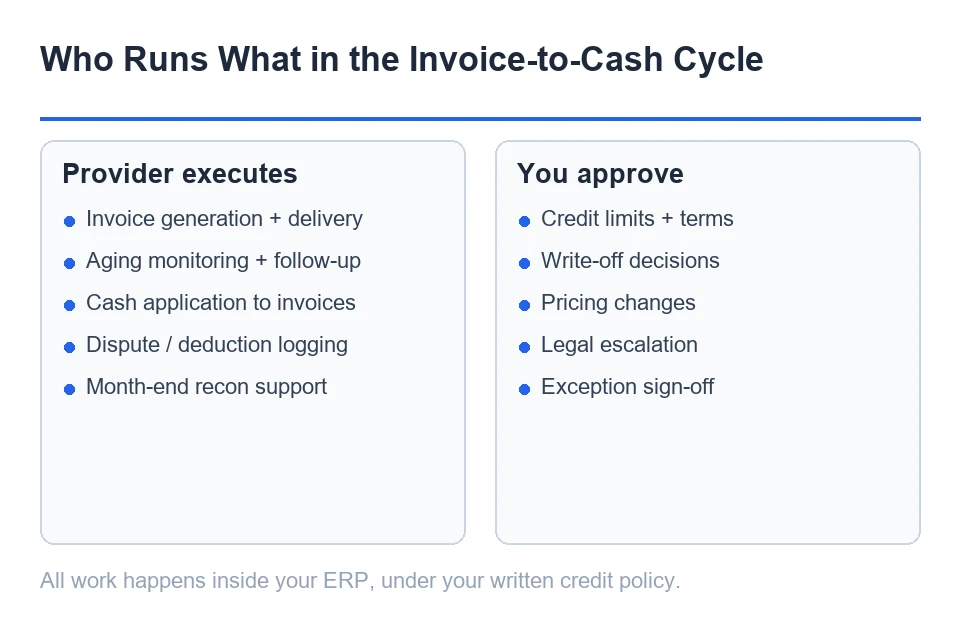
Tasks typically handed to the provider
- Invoice generation and delivery on agreed terms
- AR aging monitoring and prioritized follow-up (email, phone, portal)
- Cash application: matching incoming payments to open invoices
- Dispute and deduction logging with reason codes and escalation
- Customer payment-plan coordination within your credit policy
- Month-end reconciliation support and bad-debt flagging for your controller
What stays in-house
Credit limits, write-off approvals, pricing changes, and legal escalation decisions stay with you. A competent provider executes inside your policy and surfaces exceptions; it does not silently rewrite your terms. If a provider offers to “own” credit decisions outright, treat that as a governance red flag, not a convenience.
Why Businesses Look at It: The Receivables Problem in Numbers
The case for structured AR work is not anecdotal. Atradius, a trade credit insurer, surveys North American businesses annually in its B2B Payment Practices Barometer. Its 2026 North America findings, retrieved directly from the publisher on 2026-10-09, report that businesses in North America conduct, on average, 43 percent of their B2B sales on credit terms, with the United States at 45 percent [R1]. The same report states that delayed payments affect, on average, seven in ten firms across the region surveyed, and that these delays impact, on average, 23 percent of B2B receivables at regional level [R1].
Importantly, the same source tempers the worst-case narrative: nearly half of North American suppliers report bad debt below 1 percent of receivables, while fewer than one in four experience levels above 2 percent [R1]. The problem for most firms is not catastrophic write-offs; it is slow, unpredictable cash conversion that a dedicated, measured AR function can compress.
These are the conditions under which outsourcing tends to pay for itself: a growing invoice volume, no single owner of the collection cadence, and an aging report nobody reviews weekly. The general economics of handing such repeatable, measurable work to a specialist team are covered in our benefits of outsourcing guide.
Days Sales Outstanding: The Metric That Decides Success
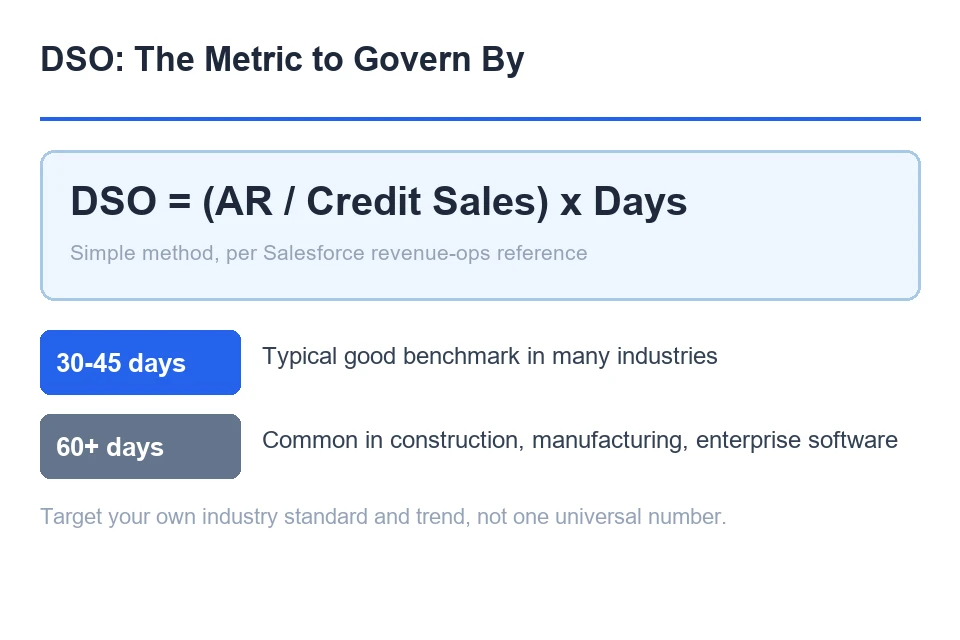
Days sales outstanding (DSO) measures the average number of days it takes to collect payment after a sale. The standard simple-method formula, verified directly on Salesforce’s revenue-operations reference on 2026-10-09, is: (Accounts Receivable divided by Total Credit Sales) multiplied by Number of Days [R4]. Worked example without currency figures: if your ending receivables equal one third of your credit sales over a 30-day period, your DSO is 10 days.
What counts as good depends on your sector. The same Salesforce reference states that in many industries, a DSO of 30 to 45 days is typically seen as a good benchmark, while sectors like construction, manufacturing, or enterprise software often run longer, sometimes 60 days or more, because projects are complex and terms are extended [R4].
For cross-industry context, a secondary source is worth citing with its provenance stated plainly: Credit Pulse, an industry roundup, reports that the Credit Research Foundation’s Q4 2025 domestic trade receivables survey found a broad median DSO of 40.5 days across industries, with a global average of 59 days [R2]. We label this as secondary because we did not access the underlying CRF report directly; treat the figures as directional, and compare your DSO to your own industry standard rather than to any single number [R4].
If you outsource AR, DSO is the metric to govern by. Our KPI and SLA governance playbook sets out how to bind a provider to measurable targets (DSO trend, collection rate, dispute aging) instead of activity counts.
In-House vs Outsourced AR: A Practical Comparison
| Dimension | In-house AR clerk | Outsourced AR team |
|---|---|---|
| Cost structure | Salary, benefits, tools, backfill | Scope-based service fee; scales with volume |
| Coverage | Single point of failure on leave or turnover | Team redundancy; continuity built into the SLA |
| Process maturity | Depends on who you hire | Documented cadences, reason codes, escalation paths from day one |
| Control | Direct, daily | Contractual: your policy, your system, your approvals |
| Best fit | Very small books, simple terms | Growing invoice volume, multi-customer aging, SLA needs |
The comparison is not about who is cheaper per hour. It is about whether the collection cadence actually happens every day, in every scenario, which is the difference between a flat aging report and a drifting one. For the wider operations context, see our guides to back office outsourcing and what a back office actually is.
How to Choose an AR Outsourcing Provider
- Insist on working inside your system. The provider should operate in your ERP or accounting platform under your roles and permissions, not maintain a shadow spreadsheet.
- Demand a written credit policy handoff. Limits, terms, escalation triggers, and discount authority must be documented before the first invoice is chased.
- Check the exception workflow. Disputes and deductions need reason codes, owners, and aging targets, not best-efforts emails.
- Verify security attestation. SOC 2 Type II or ISO 27001 evidence, role-based access, and audit trails are minimum requirements when a third party touches your customer and payment data. Receivables data is customer financial data, so treat the attestation ask as non-negotiable.
- Run a parallel cycle. One full billing-to-collection cycle run side by side with your current process before cutover.
- Bind KPIs contractually. DSO trend, collection effectiveness index, dispute aging buckets, and response SLAs, reviewed monthly.
Where you source the team matters as much as who it is. Onshore, nearshore, and offshore models trade cost against timezone overlap and compliance posture; our comparison guide breaks down the decision, and finance outsourcing in India covers the offshore delivery market in depth.
Security and Compliance Controls to Require
AR outsourcing puts a third party inside your revenue cycle. The control list mirrors what we recommend for payable-side work: segregation of duties between who sets up customers, who issues invoices, and who applies cash; callback verification on any bank-detail or remittance change; duplicate-detection at capture; and immutable audit logs. Attestation frameworks to ask for by name are SOC 2 Type II and ISO 27001; our SOC 2 and HIPAA compliance guide explains what each attestation actually proves and what it does not.
Legal Considerations: What the FDCPA Does and Does Not Cover
A common claim in outsourcing pitches is that B2B collections are “unregulated.” That is too absolute, and this section states the position conservatively.
The federal Fair Debt Collection Practices Act defines “debt” as an obligation of a consumer to pay money arising out of a transaction in which the money, property, insurance, or services are primarily for personal, family, or household purposes [R3]. On the face of the statute, ordinary business-to-business trade receivables fall outside that consumer-debt definition, and the FDCPA’s third-party-collector rules are aimed at consumer debts.
That does not make B2B collection unregulated. A provider collecting your invoices can still be constrained by: the terms of your commercial contract and its assignment or agency provisions; state collection, licensing, and unfair-practice statutes that vary by jurisdiction; privacy and data-protection requirements governing customer financial information; and, in some factoring or assignment structures, consumer-protection rules if any underlying obligation is consumer-facing. Scope, jurisdiction, and structure change the answer.
This section is general information, not legal advice. Before outsourcing collections, have counsel review your contracts, the provider’s role (agent, assignee, or factoring purchaser), and applicable state law.
What Drives the Cost of AR Outsourcing
Pricing Notice: Pricing and savings vary depending on invoice volume, dispute complexity, integration depth, service scope, and team configuration. Published dollar figures would be misleading without knowing your book, so we quote on scope. Request a scoped quote.
The factors that move price, in rough order of impact: monthly invoice count; average collection cycle length; dispute and deduction volume; integration complexity with your ERP; coverage hours and timezone requirements; and security attestation level. Benchmarks for the wider finance function, including what to expect from outsourced accounting services, are set out in our small-business cost guide.
A Realistic Transition Plan
From scoping to steady-state operation, a dedicated AR engagement typically runs four to eight weeks, with one full billing-to-collection cycle executed in parallel with your existing process before cutover. The parallel run is the step that separates a real transition from a hand-wave: it proves the provider can reproduce your cadence, your tone with customers, and your reconciliation accuracy before anyone removes the safety net.
Frequently Asked Questions
What is accounts receivable outsourcing?
Contracting an external team to run part or all of your invoice-to-cash cycle: invoicing, collection follow-up, cash application, dispute logging, and reconciliation, inside your accounting system under your credit policy and approval rules.
Is it safe to outsource accounts receivable?
Yes, when the provider contracts the controls: segregation of duties between customer setup, invoicing, and cash application; callback verification on remittance-detail changes; role-based access; audit logs; and SOC 2 Type II or ISO 27001 attestation. Without those, you are exposing customer financial data to an unmanaged process.
Does the FDCPA apply to B2B collections?
The federal FDCPA defines debt as a consumer obligation for personal, family, or household purposes, so ordinary trade receivables fall outside that definition. That does not mean unregulated: contracts, state collection and licensing laws, unfair-practice statutes, and privacy rules still apply. This is general information, not legal advice.
What is a good DSO?
Salesforce’s revenue-operations reference states that in many industries a DSO of 30 to 45 days is typically seen as a good benchmark, while construction, manufacturing, and enterprise software often run 60 days or more. The practical target is your industry standard and your own trend, not a universal number.
How is DSO calculated?
The simple method, per Salesforce: accounts receivable divided by total credit sales, multiplied by the number of days in the period. Example: receivables equal to one third of credit sales over 30 days give a DSO of 10 days.
What do outsourced AR teams cost?
It depends on invoice volume, dispute complexity, integration depth, scope, and security requirements. No responsible vendor publishes a flat figure; get a scoped quote and compare against the fully loaded cost of an in-house clerk including backfill and tooling.
How long does an AR outsourcing transition take?
Typically four to eight weeks from scoping to full operation, including one parallel billing-to-collection cycle before cutover.
Should I outsource collections or hire another clerk?
Hire in-house if your book is small, terms are simple, and one reliable owner already exists. Outsource when invoice volume outgrows a single person, when you need daily cadence with redundancy, or when you want documented reason-code discipline and SLA governance from day one.
References
| ID | Source | Type | Used for |
|---|---|---|---|
| R1 | Atradius – B2B Payment Practices Barometer, North America 2026 | Primary survey report | 43% credit-terms share; US 45%; 7 in 10 firms affected; 23% of B2B receivables delayed; bad-debt distribution |
| R2 | Credit Pulse – DSO by Industry 2026 Benchmarks | Secondary roundup (reports CRF Q4 2025 and Hackett Group figures; underlying reports not accessed directly) | Median DSO 40.5 days domestic; 59-day global average, labeled as secondary |
| R3 | 15 U.S.C. 1692a – FDCPA definitions, Cornell Legal Information Institute | Primary statute text | Statutory definition of “debt” as a consumer obligation |
| R4 | Salesforce – Days Sales Outstanding (DSO): How to Calculate and Why It Matters | Vendor explainer (directly fetched and verified 2026-10-09) | Simple-method formula; 30-45 day benchmark; 60+ day sectors; compare-to-your-industry guidance |
All sources retrieved 2026-10-09. Search volume, keyword difficulty, and traffic data were not available for this topic at publication time and are deliberately not stated anywhere in this article.
Ready to See Your Receivables Clearly?
CapStonePlanet runs dedicated offshore AR and finance teams: invoicing, collections, cash application, and reconciliation inside your systems, with SLA governance and audit-ready trails. Custom quotes on scope.
About the Author

Kishan Dangi
Founder & CEO, CapStonePlanet
12+ years in BPO and outsourcing. CapStonePlanet delivers dedicated offshore accounts receivable and finance operations teams, running invoicing, collections, cash application, and reconciliation inside client accounting systems with audit-ready trails, to US and Canadian businesses.
Conclusion
Accounts receivable outsourcing works when it is bought as a governed process, not a task list: a written credit policy handoff, daily collection cadence with reason-coded exceptions, cash application inside your system, security attestation, and DSO as the contractual metric. It fails when a business hands over the phone calls and hopes the aging report improves on its own. Start with your current DSO, benchmark it honestly against your sector, run one parallel cycle, and let the trend line decide whether the partnership earns its keep.