- Have any Questions ?
- info@capstoneplanet.com

HR Outsourcing Services in 2026: What They Typically Cover and How to Choose the Right Delivery Model
Quick answer: what HR outsourcing services are
HR outsourcing services are arrangements in which an outside provider performs some or all of your human resources work, from recruiting coordination and onboarding paperwork to payroll administration, benefits enrolment, employee records, and HR compliance filing. The provider supplies the people, process, and management for the work; your company keeps ownership of the employment relationship and the decisions that carry legal risk. The three decisions that shape every arrangement are which tasks move out, who remains the employer of record, and where the work is physically performed. For most US and Canadian small and mid-sized businesses, the starting point is not the whole department. It is the busiest repeatable tasks, proven on a narrow scope first. That is the pattern we work with as a partner building dedicated offshore HR teams, and the rest of this guide is written around it. This guide covers what the services normally include, how the four main delivery models differ, how a dedicated offshore HR team fits, which tasks to keep in-house, what changes for a Canadian business, and how to evaluate a provider before you sign.What HR outsourcing services normally cover
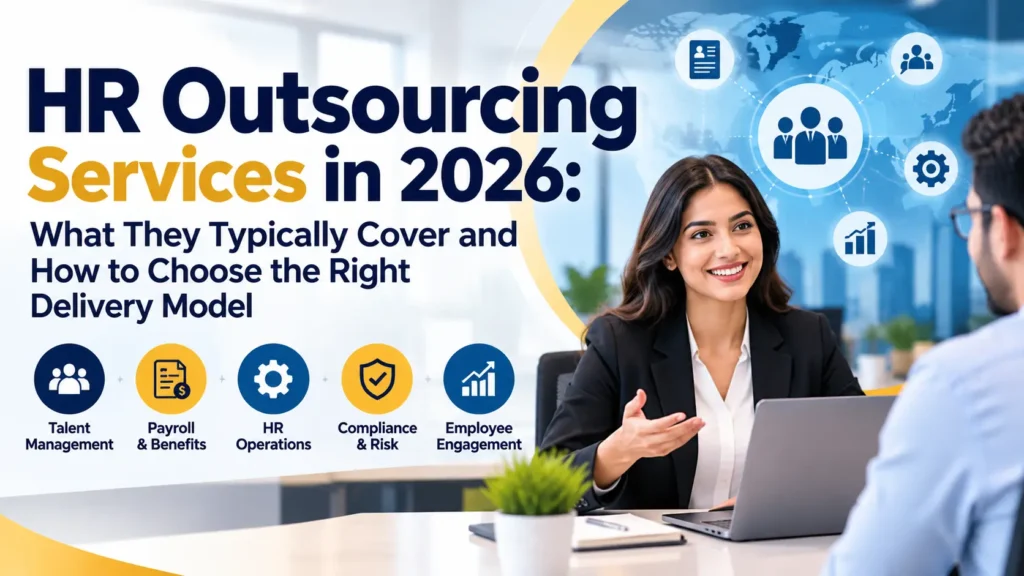
HR outsourcing is a category, not a single service. Providers package the work differently, and the package name says much less than the task list inside it. When a provider answers a request for information, ask for the task inventory rather than the label. Across the providers that rank for this topic in the United States, the work clusters into six groups: talent acquisition support, onboarding and employee records administration, payroll and time processing, benefits administration, employee relations support, and compliance and reporting. Each group contains a mix of high-volume transactional work and low-volume judgment work, and that mix is what determines whether it belongs in an outsourced arrangement at all. Some of those groups are also bought on their own, outside any HR scope: compliance and reporting preparation is close to knowledge process outsourcing, while payroll processing is usually bought as finance and payroll administration outsourcing.| Function group | Typical outsourced tasks | Judgment work that usually stays with you |
|---|---|---|
| Talent acquisition support | Job posting, sourcing, screening, interview scheduling, candidate tracking, offer paperwork | Final hiring decision, compensation negotiation, headcount approval |
| Onboarding and employee records administration | New hire paperwork, background check coordination, HRIS data entry, document filing, policy acknowledgement tracking | Role design, probation decisions, termination calls |
| Payroll and time processing | Payroll data preparation, timesheet reconciliation, leave balance updates, statutory filing support | Pay structure, exception approvals, bonus decisions |
| Benefits administration | Enrolment processing, eligibility tracking, carrier change submission, employee benefit queries | Plan design, renewal strategy, cost-sharing decisions |
| Employee relations support | Policy documentation, case logging, HR helpdesk triage, internal reporting | Investigations, disciplinary decisions, accommodation rulings |
| Compliance and reporting | Records maintenance, filing calendars, audit preparation support, register upkeep | Legal interpretation, agency responses, whistleblower handling |
The two-axis model: employer of record versus where the work is performed
Most comparisons of HR outsourcing collapse two separate questions into one, and that single mistake causes most of the confusion SMBs run into. The two-axis model separating employer of record from where the work is performed is the cleanest way to frame the decision, because the axes move independently of each other. The first question is who legally employs the worker. The second question is where the HR work is physically performed. These are independent. You can change one without changing the other, and the models behave very differently depending on which one you are changing. A US professional employer organisation changes the first axis. It becomes a co-employer for your existing staff, which is why it can bundle benefits, workers compensation, and payroll tax filing at a scale a small company cannot reach alone. An offshore dedicated team changes the second axis only. The work moves to a team in another country, and nothing about your legal position as the employer changes at all. That distinction clears up a common misunderstanding we see from buyers: they assume that outsourcing HR work offshore means giving up control of employment. It does not. It means the administrative work is performed by people who are not on your payroll, in a location you choose. The practical consequence is that the two axes carry different risks and different reversibility. Changing who employs your staff is a structural change that is difficult to unwind and touches your benefits contracts, your tax registrations, and your existing employees. Changing where a process is performed is an operational change you can pilot with two people and reverse in a quarter. Buyers who frame the decision on the two-axis model usually end up choosing a smaller first step than they originally planned, which is a good outcome.The four US delivery models compared on liability and control
When you see PEO, ASO, HRO and EOR compared on liability and control, the useful question is less about ranking the models and more about which axis each one moves. The table below sets out what each arrangement actually changes.| Model | Who employs the worker | Where the work is done | Liability position | Typical fit |
|---|---|---|---|---|
| PEO (professional employer organisation) | Provider becomes co-employer of your staff | Usually on your premises, provider administers remotely | Provider shares employer obligations, you retain day-to-day control | roughly 10 to 100 employees wanting enterprise-grade benefits and workers compensation |
| ASO (administrative services organisation) | You remain sole employer | Provider administers remotely | You retain all employer liability | Businesses that want payroll and benefits administration without co-employment |
| HRO (human resources outsourcing) | You remain sole employer | Provider staff, often their own service centre | Function-specific, defined by contract scope | Companies outsourcing defined HR functions such as recruiting or benefits processing |
| EOR (employer of record) | Provider employs the worker on your behalf | Provider’s entity in the worker’s country | Provider becomes the legal employer for that worker | Hiring employees in a country where you have no legal entity |
Where a dedicated offshore HR team fits
In a dedicated offshore HR team, the client stays the employer and the provider supplies named people who work exclusively on that client’s account. The team learns the client’s systems, policies, and approval chain rather than working from a shared script, and it operates during agreed hours that overlap the client’s business day. This is the same dedicated team structure that has been used for years in customer support and back office work, applied to HR administration. The reason this model is rarely covered in US HR outsourcing comparisons is simple: almost every ranking guide is written by a domestic PEO, ASO, or EOR provider, for whom offshore delivery is a competing model rather than a product. Unlike those guides, which compare only domestic structures, this section treats offshore delivery as its own decision with its own questions, because our own delivery model is offshore by design and the practical questions are different. What actually changes on the client side is narrower than most buyers expect. The client keeps the HRIS as the system of record, keeps the approval workflow, and keeps every decision that carries legal consequence. What moves is the execution layer: the screening calls, the data entry, the document chasing, the benefits enrolment processing, the case logging, and the reporting that has to be assembled before a decision can be made.Which HR tasks to outsource and which to keep in-house
The honest answer to which HR tasks to outsource and which to keep in-house is that the decision follows data sensitivity and decision rights, not job titles. Most guides do not separate those two tests, which is why their lists of outsourced HR functions end up as job titles rather than tasks. A senior HR manager position may contain both transferable and non-transferable work, while a junior coordinator role may be almost entirely transferable. Use three tests on every task. First, does the task produce a decision or prepare for one? Preparation is transferable, decisions are not. Second, does the task require access to data you are not willing to place outside your own systems? If yes, the task stays with your staff even if it is repetitive. Third, is the volume high enough that a dedicated person would be busy most of the day? If not, bundling is better than a dedicated headcount.| Task | Outsource | Keep in-house | Automate | Reason |
|---|---|---|---|---|
| Resume screening against a fixed scorecard | Yes | Partly | High volume, rule-based, decision sits with the hiring manager | |
| Interview scheduling across time zones | Yes | Yes | Pure coordination, no judgment | |
| New hire document collection and HRIS entry | Yes | Partly | Repetitive and high volume, low sensitivity if access is scoped | |
| Background check coordination | Yes | No | Repetitive chasing, but adjudication stays internal | |
| Offer letter preparation from approved terms | Yes | Partly | Templated, approval already given | |
| Compensation decisions and negotiations | Yes | No | Judgment with direct employment liability | |
| Employee relations investigations | Yes | No | Confidential, legally consequential | |
| Termination process | Yes | No | High-risk, timing-sensitive, jurisdiction-specific | |
| Benefits enrolment processing | Yes | Yes | Exception-driven volume work | |
| Plan design and renewal negotiation | Yes | No | Strategic, cost-bearing decision | |
| Payroll data preparation and reconciliation | Yes | Yes | Volume work with clear reconciliation rules | |
| Final payroll approval and funding | Yes | No | Financial control point | |
| Compliance register upkeep and filing calendar | Yes | Partly | Tracking is transferable, legal interpretation is not | |
| Agency correspondence and audit response | Yes | No | Legally attributable communication |
RPO and HR consulting compared with HR outsourcing
RPO and HR consulting compared with HR outsourcing is a recurring confusion, and the three overlap least when you look at who owns the outcome. Recruitment process outsourcing takes over the end-to-end recruitment process, including sourcing, screening, scheduling, offer coordination, and hiring reporting, and is measured on hiring outcomes such as time to fill and offer acceptance. HR outsourcing covers the broader administrative HR stack, of which recruiting support is one part. HR consulting sells advice and design, not execution. For a small business the practical difference is that consulting tells you what your HR function should look like, HR outsourcing runs part of it, and RPO runs recruitment specifically. Many SMBs end up with two of the three at once, usually RPO for hiring volume plus HR outsourcing for records, payroll preparation, and benefits processing. If recruitment is your dominant HR pain, read the recruitment process outsourcing guide before choosing a general HR provider, because the delivery skills are not identical.How HR outsourcing works: the process and the transition roadmap
An HR outsourcing process has five stages regardless of model or provider: scope definition, provider selection, knowledge transfer, pilot, and steady-state governance. Most failures are not selection failures. They are knowledge transfer failures, where the scope was agreed in a proposal and the actual process was never written down. Plan the first 90 days as a phased 90-day transition roadmap for moving HR work rather than a single cutover, and typically start with the least sensitive task family. Weeks 1 to 2 are typically documentation and access setup: process maps, decision rights, system access scoped by role, and a named counterpart on each side. Weeks 3 to 4 are typically a supervised pilot on one task family, commonly onboarding paperwork or recruiting coordination, with full quality review on every item. Weeks 5 to 8 widen volume and add the second task family, with sampling reduced as error rates improve. Weeks 9 to 12 typically move to regular reporting against agreed service levels, and the first formal review decides what to add next. Two details make the difference in practice. First, decide the escalation path in week 1, before the pilot starts. A dedicated team needs to know which questions are answerable on the spot and which must go back to the client’s HR lead, and leaving that undefined produces either paralysis or overreach. Second, keep a shadow period for anything financially material, such as payroll data preparation, until two full cycles have reconciled without variance.What changes for a Canadian business
Canadian provincial employment standards sit against US federal rules in a way that surprises buyers who assume North America is one market. A Canadian employer’s obligations on hours, overtime, statutory holiday pay, termination notice, and leave are set primarily by the province or territory where the employee works. In contrast, the US obligations that most HR guides describe come from federal statutes and a patchwork of state law, which is why most guides do not translate cleanly across the border. The two do not map onto each other, and a provider built for the US market will not automatically handle the Canadian side correctly. The practical implication is that your provider must work from your jurisdiction’s rules, not from a generic North American playbook. Ontario’s employment standards guide and British Columbia’s employment standards guidance are examples of the primary references that should sit behind your HR documentation (https://www.ontario.ca/document/your-guide-employment-standards-act-0 and https://www2.gov.bc.ca/gov/content/employment-business/employment-standards-advice/employment-standards). This is also where an offshore administrative team earns its place in a Canadian business, because the administrative burden of tracking province-specific leave accruals, holiday entitlements, and notice periods is high and rule-based. The rules are set locally; applying them consistently to records and calculations is work that can be performed by a dedicated team as long as the team works from your jurisdiction’s reference material and your HR lead signs off on interpretations.Data security rules for offshore employee records covering PII
Employee records are among the most sensitive data a small business holds, because a single file can contain a social insurance or social security number, bank details for payroll, health information behind a leave request, and immigration documents. Any arrangement that places HR work with an external team has to answer data security rules for offshore employee records covering PII before the first record moves, not after. Four rules do most of the work. First, minimum necessary access: scope the offshore team’s system permissions to the fields their task requires, so a recruiting coordinator cannot open payroll data and a benefits processor cannot open investigation files. Second, no uncontrolled copies: records stay in the client’s systems, with no local download stores, screenshots, or personal devices, and output travels through controlled channels. Third, logged and attributable access: every record view is traceable to a named account, which is what makes an incident investigation possible at all. Fourth, background verification and contractual confidentiality on the provider side, covering the named team rather than the company in general. Where regulated data is involved, the provider’s control environment matters as much as the contract. A provider that can evidence independent security certification and documented handling procedures for sensitive work is testable; one that answers with a general assurance is not. Our own offshore delivery governance for regulated work is documented in the SOC 2 and HIPAA compliant offshore back office guide, which sets out the access and handling pattern we apply to sensitive queues.Governance: SLAs, KPIs and a weekly reporting cadence
Governance through SLAs, KPIs and a weekly reporting cadence is what separates an outsourced service from a hopeful arrangement. The service level agreement should name the measurement, the target, and the consequence, and it should be short enough that both sides actually read it each quarter. For HR administration the measures that matter are turnaround time on defined task types, first-time-right rate on data entry and payroll preparation, backlog age, escalation resolution time, and coverage against agreed hours. Vanity measures such as total tickets closed should be avoided, because volume without accuracy is worse than no volume at all. Reporting cadence should match risk: a weekly operational report on volumes, exceptions, and open items, and a monthly or quarterly review on service levels, error trends, and scope changes. Two governance habits are worth building early. Keep one shared exception log rather than trading issues across email threads, so that recurring exceptions become visible as a pattern and can be fixed at the process level. And review the scope document at each quarterly review, because an outsourced task list that has not changed in a year is usually a sign the client stopped paying attention rather than a sign of stability.What drives HR outsourcing cost and how to read a quote
This guide does not quote rates, because a published price for HR outsourcing is close to meaningless without scope. What you can do is understand the cost drivers and pricing models, without quoting rates, so that a proposal can be read intelligently. The drivers are, in order of impact: the number and complexity of task families in scope, the volume per period, whether the work needs a dedicated person or can be bundled across accounts, the systems the team must work in and whether integrations exist, the level of oversight the client requires, and the shift and coverage pattern. The pricing models you will encounter are a fixed monthly fee per dedicated team member, a per-transaction or per-employee-per-month fee for administrative volume, a per-hour or per-minute rate for ad hoc work, and outcome-linked pricing tied to defined service levels. Three questions reveal whether a quote is comparable. Is the scope written as a task list or as a job title? Does the quoted model include the setup, integration, and management overhead, or are those separate lines? And what happens to the fee when volume doubles or halves? A provider that answers all three clearly is usually also the provider that will handle a scope change without renegotiating from scratch.Vendor evaluation questions to ask before signing a contract
Bring vendor evaluation questions to ask before signing a contract to every shortlisted provider, and score the answers in writing rather than relying on impressions from the sales call. The questions below are ordered so that the first few eliminate most of the field. Ask how the provider defines employer of record for your arrangement in one sentence, and treat an unclear answer as disqualifying for a regulated or multi-jurisdiction situation. Ask which specific tasks move in month one and which move in month six. Ask how system access is scoped and logged, and ask to see an example of the access matrix rather than a description of it. Ask who supervises the team day to day and how that supervisor is measured. Ask how errors are caught and corrected, with a real example from a comparable engagement. Ask for the service level definitions and the remedy if they are missed. Ask what the exit looks like, including how records, credentials, and documentation return to you. And ask for two client references at your size and in your jurisdiction. Once the answers hold up, the next question is what the first ninety days of that engagement would actually look like. A practical walk through of setting up an offshore back office team, from scoping to steady state, is covered in our guide to how to set up an offshore back office team and the delivery shape we use is described in our what a dedicated offshore pod includes. If you want that review run against your own task list rather than a generic example, bring your task families and volumes to our team and we will map them against the task split, the delivery model, and the governance measures in this guide.How headcount changes the right HR delivery model
Headcount thresholds that change the right HR delivery model are useful because they map to where administrative load stops being absorbable by a founder or an office manager. These thresholds are planning guidance rather than rules, and the trigger is really administrative hours per week rather than a headcount number. Below roughly 25 employees, HR is usually a part-time internal responsibility and the first external need is process coverage on a specific task, not a department. Between roughly 25 and 75 employees, payroll preparation, benefits enrolment, onboarding paperwork, and compliance tracking become a genuine weekly burden, and a bundled or dedicated administrative team usually pays for itself in released management time. Above roughly 75 to 100 employees, the work is deep enough for a dedicated offshore team with named roles and an agreed service level, and the decision shifts from whether to outsource to which parts of the function move and which stay. The wrong way to use a threshold is to treat it as a reason to move everything at once. The right way is to use it to decide what to move first, because the administrative tasks that trigger the threshold are exactly the tasks that transfer most cleanly.HR outsourcing risks and mitigation
HR outsourcing risks and mitigation deserve to be written down before the engagement starts, because every one of them is cheaper to prevent than to repair. The four risks that recur are knowledge loss, control loss, data exposure, and dependency. Knowledge loss happens when process documentation exists only in the head of the person who left the task behind. Mitigate it by requiring written process maps as a deliverable of the transition, not as a courtesy. Control loss happens when approvals drift, so an administrative team starts making judgment calls by default because it is faster than asking. Mitigate it with an explicit decision-rights list and a weekly review of exceptions rather than a monthly review of outcomes. Data exposure is mitigated by the access rules described earlier and by testing them rather than assuming them. Dependency is mitigated by keeping the client’s systems as the system of record and by documenting the reversal path, so that the knowledge gained during the engagement sits with your company rather than only with the provider.Remote and hybrid workforce alignment in an outsourced HR function
The workforce this work supports is distributed in a way it was not a few years ago, and that changes the HR administration load in specific ways. Remote hiring means onboarding paperwork arrives from more jurisdictions, equipment and access provisioning has to be tracked as an HR task rather than an IT afterthought, and the record of who works where and under which province’s or state’s rules becomes a live document rather than an annual review. For an outsourced HR service, three practical consequences follow. Provinces and states must be tracked per employee rather than assumed from the company’s head office address. Documentation habits change, because a distributed team cannot hand a paper file to the person next to them, so records have to be complete enough to stand alone. And the boundary between HR administration and IT or facilities access quietly blurs, which is exactly the kind of scope ambiguity that causes disputes later, so it belongs in the written scope rather than in an assumption. Selecting the right fraction of that work to outsource can also become the research discipline for a fractional HR partnership, helping a business identify the scope and cost drivers before it evaluates providers.Worked example: a small US company outsourcing recruiting support
As an illustrative example, consider a 40-person US company outsourcing recruiting support while keeping HR in-house. The company hires roughly 25 people a year across support and operations roles, its office manager spends about a day a week on scheduling and paperwork, and candidates wait several days between stages. Nothing here is broken; the problem is that the work sits with someone whose real job is something else. A first-phase offshore arrangement takes interview scheduling, candidate tracking updates, screening calls against a fixed scorecard, and new hire document collection. The client keeps final interviews, compensation decisions, and offers. Because these tasks are coordination and preparation rather than decisions, the client’s legal position does not change, and the only structural change is that two named team members now work in the client’s applicant tracking system with scoped permissions. Three months in, the measurable changes are candidate response time within one business day, consistent weekly hiring reporting, and roughly a day per week returned to the office manager. The second phase, added only after the first is stable, is onboarding paperwork and HRIS data entry. This sequence is deliberate: it proves the model on the least sensitive work before touching employee records.Frequently asked questions
What is an HR outsourcing company? An HR outsourcing company performs defined human resources work for other businesses under a contract, supplying the staff, process, and management for tasks such as recruiting coordination, onboarding paperwork, payroll preparation, benefits administration, and records upkeep. It differs from an HR consultant, who advises rather than executes, and from an employee leasing arrangement, which changes who employs your staff. Can you outsource an entire HR department? You can outsource most of the execution layer of an HR department, but not the parts that carry employment liability. Investigations, compensation decisions, termination, and legal interpretation normally stay with the client. What usually happens in practice is that a small business outsources the administrative majority of the function and retains one senior internal owner for the judgment work. Does outsourcing HR mean losing control of employment? No, provided you choose a model that does not change employer of record. In a dedicated offshore or administrative services arrangement, you remain the sole employer and the provider performs work on your behalf. Control of employment only changes materially in co-employment models such as a PEO, and that is a separate decision from where the administrative work is performed. How many stages of outsourcing HR functions are there? In practice there are five: scope definition, provider selection, knowledge transfer, a supervised pilot, and steady-state governance. The pilot stage is the one most often skipped, and it is the stage that reveals whether the knowledge transfer was real or only agreed in principle. How long does it take to transition HR work to a provider? A single task family can be running under supervision within two to four weeks and stable within roughly 90 days. Multi-task transitions take longer, and payroll-related work should stay under full review until two complete cycles have reconciled without variance. Complexity comes from system access and process documentation rather than from the work itself.Conclusion
HR outsourcing decisions go wrong for predictable reasons: the scope was described as a job title rather than a task list, the model was chosen before the employer-of-record question was answered, or the transition was treated as a handover instead of a documented process with a supervised pilot. Avoiding those three mistakes matters more than finding the lowest initial fee. Start with the two-axis model and be explicit about which axis you are changing. Move the repetitive, rule-based, high-volume work first. Keep the decisions that carry legal consequence. Set access rules and service levels before the first record moves, and build a reversal path so that the knowledge stays with your company. CapStonePlanet builds dedicated offshore HR, recruitment support, and back office teams for US and Canadian businesses, working as an extension of the client’s existing systems and approval chain. If you are weighing which HR tasks to move first, or want a scoped view of what a dedicated team would cover in your situation, talk to our offshore delivery team with your task list and volumes rather than a job title, and we will tell you plainly which parts transfer cleanly and which should stay with you. Related reading: what HR outsourcing is in definition form, dedicated offshore team model, and RPO for small business.About the Author

Kishan Dangi (KK Patel)
Founder and CEO, CapStonePlanet
Kishan leads CapStonePlanet, an India-based outsourcing partner that builds dedicated offshore teams for US and Canadian businesses across customer support, back-office, recruitment support, and domain BPO. The company specializes in the dedicated team model, giving SMBs their own branch office in India with trained staff, managed quality, and deployment typically within days.