- Have any Questions ?
- info@capstoneplanet.com

India vs Latin America Outsourcing for US Businesses: A Neutral Comparison of Time Zones, Language, Cost Drivers, Data Protection Law and Travel Practicalities
Key Takeaways
- Outsourcing the work does not move legal accountability, so the buyer stays answerable to its regulator and its customers.
- Read the scope and the period of a SOC 2 Type II report and the scope statement of an ISO/IEC 27001:2022 certificate, not the logo.
- Get the sub-processor register with roles and countries, plus a notice-and-objection window before any change.
- Pin the breach notification clock in the contract; statutes set a floor, the agreement sets the deadline that governs.
- Fix data return, deletion and proof of destruction at signature, when you still have leverage.
Quick Answer
Before you sign with an offshore data processing vendor, confirm the data categories and every country they reach, obtain the sub-processor register, read the SOC 2 Type II scope and period, fix the contract instrument, and set the breach notification window in writing. Disclosure box – read this before the analysis. CapstonePlanet is an outsourcing provider based in India. We sell delivery capacity from India.
How to Use This Comparison (and Our Disclosure)
Disclosure box – read this before the analysis. CapstonePlanet is an outsourcing provider based in India. We sell delivery capacity from India. That means we have a commercial interest in how this comparison lands, and you should discount our framing accordingly rather than treating this page as a neutral authority. We are publishing it anyway because the pages currently ranking for india vs latin america outsourcing are almost all provider-owned, and most of them assert cost and compliance claims without naming a primary source. Our approach here is different in one specific way: every statistic below carries a fact id, and where we could not find a verifiable primary source we say so instead of filling the gap. If you think we have got something wrong, or you want the underlying sourcing for any claim, tell us and we will correct or provide it.
This article does not recommend a region. It gives you the dimensions that actually change outcomes, the evidence behind each one, and a scoring framework you complete yourself. The honest summary is that the right answer depends on four things: whether your work needs real-time collaboration, what language your end customers and internal documents use, how much regulatory exposure your data creates, and how cost-sensitive you are.
How to read a provider-published comparison, including this one.
| What to check | Why it matters |
|---|---|
| Does the page name its sources? | A wage or savings figure with no source is a marketing number, not evidence. |
| Does it disclose its own commercial interest? | A provider comparing two regions it does not both serve is arguing a case, not analysing one. |
| Does it state a single winner? | Real comparisons produce conditional answers. A universal verdict usually tracks the author’s sales model. |
| Does it cover compliance by statute name? | Generic “robust data protection” language is untestable. Named statutes and transfer mechanisms are. |
| Does it tell you what it could not verify? | A page with no stated gaps has probably not looked hard. |
Meaning. “India vs Latin America outsourcing” is a comparison of delivery geographies, not of services. Offshoring and nearshoring describe where work happens, not what work is done, and the same support, finance or engineering function can be delivered under either model.
Purpose. The comparison exists to help a buyer decide where to place a function. It is a location question layered on top of a sourcing question you have already answered: what to outsource, and under what contract model.
Who it is for. US small and mid-sized business owners and operations and finance leads who are comparing India against Mexico, Colombia, Argentina and Brazil, and who need a decision they can defend internally rather than a slogan.
Why it matters. The two geographies differ materially in time zone overlap, language of delivery, cost composition, regulatory exposure and ease of in-person management. Picking on headline cost alone is the most common way this decision goes wrong.
Benefits of comparing properly. You stop paying a premium for overlap you do not need, or accepting a coverage gap you have not planned for. You also enter vendor conversations with the right questions, which shortens due diligence.
Limitations and risks. Published comparisons in this space are heavily provider-authored, salaries are recycled from secondary aggregators, and several legal questions require a lawyer rather than a blog. Treat this page as a structured input to a decision, not as the decision.
Practical context. If you are already reading tri-shore material, start with our onshore vs nearshore vs offshore outsourcing guide for the model-level framework, and our complete guide to outsourcing if you are still testing whether to outsource at all.
What ‘India vs Latin America Outsourcing’ Actually Means
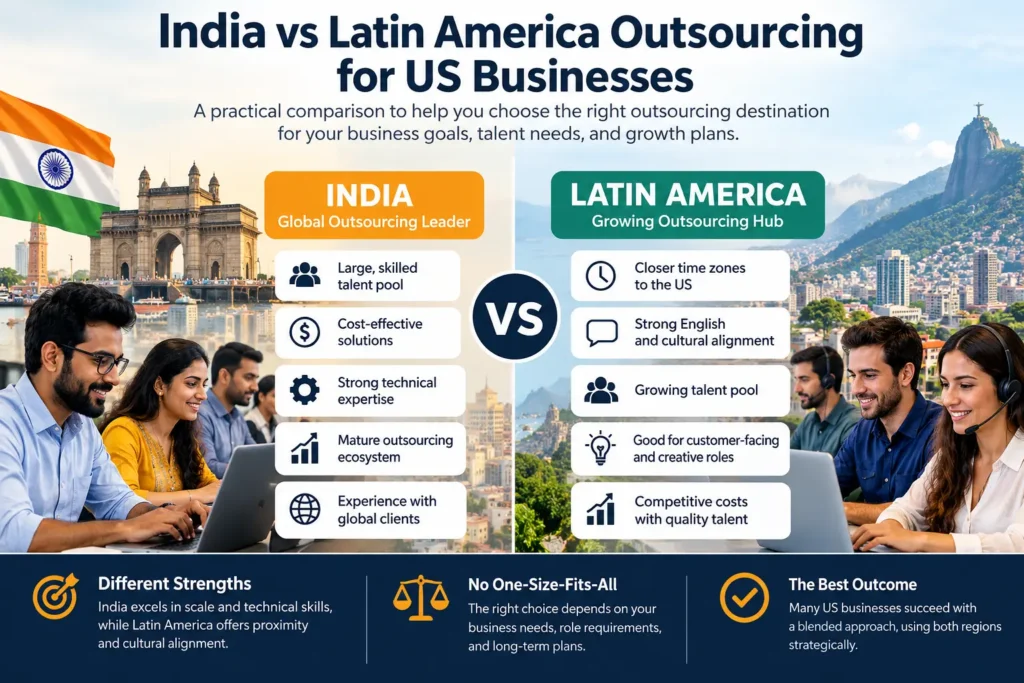
The direct answer: these are two delivery geographies for the same kinds of outsourced work. India is conventionally classified as offshore; Mexico, Colombia, Argentina and Brazil are conventionally classified as nearshore for US buyers. The classification is about distance and time zone, not about capability.
Nearshore is defined as hiring talent or building teams in a geographically close country, typically in the same or a similar time zone, while offshore involves distant markets such as India, the Philippines or Malaysia [F33, industry, https://www.robertwalters.us/insights/hiring-advice/blog/nearshore-vs-offshore-outsourcing.html]. TechTarget defines nearshore outsourcing as getting work done by people in neighbouring countries, with closer geographical proximity and shared or similar time zones easing travel and communication compared with offshoring [F34, industry, https://www.techtarget.com/it-strategy/definition/What-is-nearshore-outsourcing-and-how-does-it-work].
Note what those definitions do not say. Neither states that nearshore is better. Both define the term geographically. Any page that converts a proximity definition into a quality verdict has added a claim the definition does not carry.
Meaning. Outsourcing is the transfer of a function to an external provider. Offshoring and nearshoring describe where that provider sits relative to you. Onshoring keeps it in your own country.
Purpose. The distinction matters because proximity changes three operational facts: overlap with your working day, the ease of travelling to the team, and the number of handoff cycles a task passes through.
| Model | Definition | Typical time zone gap from US Eastern | Geographic reach |
|---|---|---|---|
| Onshore | Delivery in the buyer’s own country | Same zone | Domestic |
| Nearshore | Delivery in a geographically close country, usually same or similar time zone [F33] | 0 to 3 hours for Latin America [F31] | Mexico, Colombia, Argentina, Brazil |
| Offshore | Delivery in a distant market [F33] | 9.5 to 13.5 hours ahead for India [F31] | India, Philippines, Malaysia |
Who it is for. Any US buyer whose function involves either interaction with US-based staff or end customers, or a compliance surface that varies by jurisdiction.
Why it matters. The gap between a three-hour and a twelve-hour offset is the difference between a shared working day and a shift pattern. That is a management design question, not a quality question.
Benefits of getting the definition right. You stop comparing unlike proposals. A nearshore quote for a shared-hours team and an offshore quote for a night-shift team are not the same product.
Limitations. The nearshore label covers four countries with different labour markets, different languages and different data laws. Treating “Latin America” as one option is a simplification you will have to undo before shortlisting.
Practical context. A US SMB running tier-one phone support from 9am to 6pm Eastern is describing an offshore function if the team is in India and a nearshore function if the same team is in Mexico. Same work. Different coverage economics. For the parent explainer on what these arrangements cover, see our BPO overview.
Time Zone Overlap and Working-Model Fit
The direct answer: India is roughly 9.5 to 13.5 hours ahead of US time zones, while nearshore Latin America runs at 0 to 2 hours difference and offers full overlap with US time zones from Eastern to Pacific [F31, industry, https://www.hirewithnear.com/blog/outsourcing-to-latin-america]. India’s main outsourcing destinations sit 10 hours 30 minutes ahead of New York, requiring early-morning or late-night meetings for US clients [F1, industry, https://www.auxis.com/learn/nearshore-outsourcing/advantages-of-nearshoring/].
This matters more than most buyers expect. On the SSON/Auxis survey cited by Auxis, 60 percent of enterprise and global business services leaders ranked time zone compatibility as “very important” when evaluating outsourcing options [F2, industry, https://www.auxis.com/learn/nearshore-outsourcing/advantages-of-nearshoring/]. Separately, physical proximity ranked as the number one factor for choosing an outsourcing provider on the Computer Economics IT Outsourcing Statistics report, as reported by Auxis [F3, industry, https://www.auxis.com/learn/nearshore-outsourcing/advantages-of-nearshoring/].
| Delivery location | Offset versus US Eastern | Offset versus US Central | Daylight saving behaviour | Typical overlap with US business hours |
|---|---|---|---|---|
| India (IST) | 10 hours 30 minutes ahead of New York [F1] | Approx. 11 hours 30 minutes ahead | India does not observe daylight saving | Late evening to early morning US time; effectively a shift pattern |
| Mexico City | On Central Time, one hour behind Eastern [F32] | Same as Central Time | Mexico City operates on Central Time [F32] | Full US business day overlap |
| Colombia | Same as Eastern Time year-round [F32] | One hour behind Eastern | Colombia does not observe daylight saving [F32] | Full Eastern business day overlap |
| Argentina | 0 to 3 hours from US zones; typically 1 to 2 hours ahead of Eastern | 1 to 3 hours | Argentina does not observe daylight saving | Substantial overlap across a normal US day |
| Brazil | 0 to 3 hours from US zones; typically 1 to 2 hours ahead of Eastern | 1 to 3 hours | Brazil does not observe daylight saving | Substantial overlap across a normal US day |
Ranges for Latin America are drawn from Hire With Near’s comparison table, which records nearshore Latin America at 0 to 2 hours difference versus India at 9.5 to 13.5 hours ahead [F31, industry, https://www.hirewithnear.com/blog/outsourcing-to-latin-america]. Colombia matching Eastern Time year-round and Mexico City operating on Central Time are recorded in the same source [F32, industry, https://www.hirewithnear.com/blog/outsourcing-to-latin-america].
Meaning. Time zone overlap is the number of hours per day in which your team and your provider’s team can both be working without one side changing their normal hours.
Purpose. It determines whether a task can be resolved in a conversation or has to be queued as a handoff.
Who it is for. Anyone whose function involves live decisions, customer conversation or iterative design work.
Why it matters. Overlap is not a nice-to-have on tasks that stall when a question goes unanswered. And it is a genuine cost: securing US-hours coverage from a large offset is a staffing decision with a shift-pattern consequence.
Benefits of high overlap. Same-day resolution, joint ceremonies without accommodation, and a manager who can be reached in their own working day. Benefits of low overlap, honestly stated: an offshore team running a different clock can deliver a continuous overnight cycle of work that is ready when you start, which suits batch and backlog work well.
Limitations. A “full overlap” headline is about the location, not the contract. A nearshore provider can still staff you thinly, and an offshore provider can still cover your hours by running a shift. Verify the staffing pattern, not the time zone.
Practical context. A daily standup scheduled for 8:30am Eastern lands mid-afternoon in Argentina and Brazil, early-to-mid afternoon in Mexico City and Colombia, and in the evening in India. For further reading on delivery model trade-offs, see our benefits of outsourcing guide and the tri-shore comparison guide.
Real-Time Overlap Versus Structured Asynchronous Handoffs
The direct answer: a fractional offset is an advantage for collaborative work, and a large offset is a manageable cost for asynchronous work. Neither is automatically disqualifying.
Meaning. Synchronous work requires both parties present at the same time. Asynchronous work proceeds through a documented queue with defined turnaround.
Purpose. Classify your function before you judge a time zone. Most buyers classify their function wrongly, because they generalise from one team to the whole scope.
Who it is for. Operations leads deciding how much of a function truly needs live contact.
Why it matters. The cost of forcing synchronous work across a large offset falls on shift premiums and attrition. The cost of forcing asynchronous work between overlapping teams is the slower cycle you did not need to accept.
Benefits. A correct classification lets you take offshore cost with nearshore turnaround on the asynchronous portion, and pay for overlap only where it is genuinely required.
Limitations. Handoff-heavy models depend on documentation quality. If your processes are undocumented, an asynchronous model will fail regardless of the time zone, and that failure will be misattributed to the location.
Practical context. A US SMB running a 24/7 follow-the-sun support rota gets real value from a large offset [F1, industry, https://www.auxis.com/learn/nearshore-outsourcing/advantages-of-nearshoring/]. The same company’s engineering team, which needs live pairing, does not. See the offshore coverage discussion in our benefits of outsourcing guide.
| Workflow type | Full overlap | Verdict |
|---|---|---|
| Voice or live chat support in US hours | Essential | Nearshore overlap is the default fit; offshore requires an explicit shift pattern [F1] |
| Live engineering pairing and design review | Helpful to essential | Favours overlapping hours |
| Back-office processing with a next-day SLA | Immaterial | Offshore offset can be an advantage |
| Overnight batch and reconciliation | Immaterial | Offshore offset is an advantage |
| Incident response with a strict latency target | Essential for severity-one | Needs explicit 24/7 cover in the contract, not a time zone assumption |
Statutory Holidays, Working Calendars and Coverage Gaps
This is where we have to stop and be honest with you, because this is the section most comparison pages skip entirely.
What we could not verify. This article did not capture a primary holiday-calendar source for India, Mexico, Colombia, Argentina or Brazil. That means we are not going to tell you how many national holidays each country has, or which ones clash with US holidays, because we have not verified those numbers and inventing them would be worse than omitting them. No holiday count or date is asserted anywhere on this page.
Meaning. A statutory holiday in a delivery country can suspend a proportion of your capacity on a day your own business is fully open. The reverse also happens: your US holiday can leave a provider’s team working with nobody to escalate to.
Purpose. Calendar planning exists to prevent a coverage surprise in a month-end close, a payroll run or a regulatory filing window.
Who it is for. Finance and operations leads, and anyone running a process with a hard deadline that does not move because a holiday happened.
Why it matters. The research behind this article identified statutory holidays and calendar differences as one of the clearest gaps in the pages currently ranking for this query. That means most buyers shortlisting from those pages are not asking the question at all.
Benefits of doing this work. You discover the clash before it hits a deadline, and you can price the redundancy or the flexible-capacity buffer into the contract. This is also a dimension where a Latin American delivery location may be stronger than India for some buyers and worse for others, because it depends on which specific days your deadlines sit on.
Limitations. Holiday calendars change, and bridge days are often declared by government decree at short notice. A calendar you review once at contracting and never update is a latent risk.
Practical context. A US SMB running a month-end close should ask what happens when a delivery-country national holiday falls on the first working day of the month. The answer should be a documented continuity plan, not an assurance.
Questions to put to any provider. How many of your delivery-country public holidays fall in the first five working days of a month this year? What is your committed plan when one does? Do you operate a bridge-day policy, and is it documented in the contract? Who covers escalation when the US side is on holiday and the delivery team is working? For the HR-side view of these arrangements, see our HR outsourcing services guide.
Language Fit: English Proficiency, Spanish and Portuguese, and What It Means for Your Workflow
The direct answer: India’s delivery teams work primarily in English. Mexico, Colombia and Argentina work primarily in Spanish, and Brazil in Portuguese, with English proficiency varying substantially across countries and individuals. Which is better depends entirely on the language of your end customer and your internal documentation.
In the EF English Proficiency Index 2025, India scored 484, Brazil 482, Colombia 480 and Mexico 440 [F30, first_party, http://ef.co.uk/epi/analysis/english-and-economic-competitiveness].
Read that table with care. The Indian national score is marginally above Brazil and Colombia, and clearly above Mexico. That is a fact about national populations. It is not a measurement of the English of a hired delivery team, and this article will not use it as one. A provider’s shortlisted team can be far above or below its country average. Use the index as a country-level context signal only, and test the actual people you are hiring.
| Country | EF EPI 2025 score | EF proficiency band as published | Interpretation for a delivery team |
|---|---|---|---|
| India | 484 (global rank 74) [F30] | Low proficiency | Country average only; does not describe a hired team |
| Brazil | 482 [F30] | Not stated in the captured source | Country average only |
| Colombia | 480 [F30] | Not stated in the captured source | Country average only |
| Mexico | 440 [F30] | Very low proficiency | Country average only |
Scores are reproduced as index values from the EF English Proficiency Index 2025 source captured in this article’s research [F30, first_party, http://ef.co.uk/epi/analysis/english-and-economic-competitiveness]. Only the India and Mexico band descriptions were stated in the captured material; the Brazil and Colombia bands are marked as not stated rather than inferred.
Meaning. Language fit has two separate components. Internal language fit is whether your team can read your documentation, tickets and specifications. Customer language fit is whether the team can serve your end customer in the customer’s language.
Purpose. Separating those two components is what stops a buyer from solving the wrong problem. A US SMB serving English-speaking customers does not need Spanish capability. A US SMB serving Spanish-speaking customers may find a Spanish-native nearshore team structurally better suited than an English-first offshore team, regardless of any proficiency index.
Who it is for. Support, sales and documentation-heavy functions, and any buyer whose customer base is not English-first.
Why it matters. For customer-facing work, language is not a proficiency score, it is a service-quality variable. A team that shares the customer’s first language handles idiom, tone and escalation nuance differently from a team working in a second language, however fluent.
Benefits. Latin American delivery locations offer Spanish and Portuguese natively, which serves US Hispanic-market support without translation layers. Indian delivery locations offer deep English-language capability and mature English-documented process practice.
Limitations. Do not let a national average decide a hiring question, and do not let a shared language substitute for capability testing. Accent-neutrality requirements, regulated-script requirements and industry terminology should be tested with actual candidates on the actual call types.
Practical context. A US SMB serving Spanish-speaking customers evaluating a Mexico or Colombia team is testing a different thing from the same company evaluating an India team: native-language service versus English-language service. A US SMB serving only English-speaking customers should compare the English of its shortlisted candidates, not the EF EPI ranking of their countries. For how these choices play out in process delivery, see our BPO explainer and the ecommerce customer service pods guide.
Cost Structure: The Drivers That Move Your Invoice, Not Headline Wage Numbers
The direct answer: nobody in this article can tell you what your engagement will cost, and any page that leads with a salary figure is leading with the most recycled and least reliable number in this comparison. Our own research found that industry salary figures came from secondary aggregators with conflicting numbers, and no single authoritative wage source could be confirmed. No salary fact is asserted as verified here.
What we can give you is the published arbitrage ranges as ranges, attributed to their sources, plus the cost drivers that actually move your invoice.
| Published arbitrage claim | Range | Source class | Source |
|---|---|---|---|
| Nearshore Latin America average labour arbitrage, on SSON/Auxis survey data reported by Auxis | 30 to 50 percent | industry | https://www.auxis.com/learn/nearshore-outsourcing/advantages-of-nearshoring/ [F4] |
| Mid-level and senior Latin America professionals versus equivalent US rates, per Hire With Near’s 2026 State of LatAm Hiring Report | 30 to 70 percent below US | industry | https://www.hirewithnear.com/blog/outsourcing-to-latin-america [F5] |
| CapstonePlanet’s own tri-shore guide: nearshore Latin America savings and time zone gap | 40 to 60 percent savings, 0 to 3 hour gap | first_party | https://capstoneplanet.com/onshore-vs-nearshore-vs-offshore-outsourcing-guide/ [F35] |
| CapstonePlanet’s own tri-shore guide: offshore India and Philippines savings and time zone gap | 60 to 80 percent savings, 10 to 12 hour gap | first_party | https://capstoneplanet.com/onshore-vs-nearshore-vs-offshore-outsourcing-guide/ [F35] |
The first two rows are third-party industry sources. The third and fourth are our own published figures, and we have labelled them first_party deliberately: they are a vendor’s claim, not independent evidence, and you should treat them exactly as you would treat the same claim from a competitor. Note also that the two independent sources disagree with each other on the range limits, and Hire With Near’s upper bound of 70 percent closes most of the gap to our own offshore band. That disagreement is itself the most useful thing on this page: the arbitrage band is not a settled number.
For the US reference point, use the US Bureau of Labor Statistics Occupational Outlook Handbook, which is the primary US government reference for software developer occupation and wage data [F36, government, https://www.bls.gov/ooh/computer-and-information-technology/software-developers.htm]. Start your comparison there rather than from a vendor page.
Meaning. Total engagement cost is not the wage. It is wage plus on-costs plus every operational cost the arrangement generates.
Purpose. The cost-driver view exists so you can compare two quotes on like-for-like terms instead of comparing two headline rates, which are almost never describing the same thing.
| Cost driver | How it behaves in India | How it behaves in Latin America |
|---|---|---|
| Gross compensation | Lowest published arbitrage band [F35, first_party] | Higher than India, still below US [F4, F5, F35] |
| Employer on-costs and statutory benefits | Requires local review; not verified in this article | Requires local review; not verified in this article |
| Recruitment and replacement cost | Scales with volume; deep talent pools | Varies by country; Colombia, Argentina and Brazil held 58 percent of nearshore placements [F6] |
| Attrition and ramp | Ramp cost recurs on every replacement | Same mechanism; rate differs by market |
| Real estate and equipment | Often bundled into the rate | Often bundled into the rate |
| Management and quality overhead | Higher management overhead where overlap is low | Extra management layer still exists; overlap reduces the overhead |
| Currency movement | Creates exposure if the contract is not USD-denominated; not verified here | Creates exposure if the contract is not USD-denominated; not verified here |
| Contract model | Shifts risk by model, not by country | Shifts risk by model, not by country |
Who it is for. Finance leads and anyone signing the contract.
Why it matters. The cheaper headline loses on total cost whenever it carries higher ramp, attrition, redundancy or management overhead. That is common enough to be the default assumption until proven otherwise in your own numbers.
Benefits of modelling this way. You can see which quote is genuinely cheaper for your scope, and you stop arguing about rates.
Limitations. Attrition, ramp and overhead are rarely disclosed cleanly by providers, and this article did not verify employer on-cost or statutory benefit mechanics for any of the five countries. Treat those rows as questions, not inputs.
Practical context. Consider the shape of a comparison, without any currency amount attached: an offshore quote at a materially lower rate and a nearshore quote at a higher rate, examined across a 24-month horizon including ramp cost and attrition, can invert. The mechanism is that the lower-rate engagement carries the same ramp cost more often, and the management overhead of a twelve-hour offset is real. Run that model with your own rates. Do not take the mechanism as a claim about the size of the effect. For more on delivery model economics, see the tri-shore guide and the BPO explainer.
Why Per-Hour Rate Cards Are a Weak Basis for Comparison
The direct answer: because a per-hour rate hides utilisation, scope and attrition risk, and those are the three things that actually determine what you pay for a delivered outcome.
Meaning. A rate card prices time. A contract model allocates risk. They are different instruments and they are frequently conflated in proposals.
Purpose. Normalising quotes means converting every proposal to an all-in monthly cost per productive hour for your scope, and noting who carries which risk.
Who it is for. Buyers comparing two or more proposals, especially where the models differ between proposals.
Why it matters. Two quotes for the same role at different rates are not comparable until they are normalised. The lower rate is often attached to the model with the higher risk transfer to you.
Benefits. Normalisation exposes a quote that looks cheap only because it shifted utilisation or attrition risk onto your side.
Limitations. Normalising requires the provider to disclose utilisation and attrition, which some will not. Treat non-disclosure as an answer.
Practical context. Two quotes for the same role at different rates, converted to a normalised all-in monthly cost per productive hour, will frequently rank in the opposite order to the rate cards.
| Contract model | Who carries utilisation risk | Who carries scope risk | Who carries attrition risk |
|---|---|---|---|
| Full-time equivalent | Buyer | Buyer | Buyer |
| Dedicated team | Shared | Buyer | Shared |
| Staff augmentation | Buyer | Buyer | Buyer |
| Managed service | Provider | Provider | Provider |
| Fixed price | Provider | Provider | Provider |
This table describes how the models allocate risk. It is a structural description of contracting models, not a sourced claim about any particular provider. See the tri-shore guide for the fuller treatment.
Currency, Payment Rails and Inflation Risk
This is the second place where we have to stop and be honest.
What we could not verify. The research behind this article identified currency and payment rails as a competitor gap, which means most comparison pages skip it, and it captured no primary source for foreign exchange mechanics, invoicing conventions or repatriation procedures in any of the five countries. We are therefore not stating any currency, invoicing-currency or payment-mechanics rule for India, Mexico, Colombia, Argentina or Brazil. Every cell below is marked UNVERIFIED, and the correct source for this would be official central bank or tax authority material, which we did not obtain.
Meaning. Currency and payment mechanics determine who absorbs exchange-rate movement, what the provider’s cash cycle looks like, and how much financial-operations work your own team takes on to make a foreign payment.
Purpose. Understanding this before contracting prevents an invoice dispute and a treasury surprise.
Who it is for. Finance leads, controllers and anyone who owns the accounts-payable process.
Why it matters. A provider that invoices in its local currency and a provider that invoices in US dollars are offering materially different risk allocations, and that difference is usually invisible in a rate comparison. Historically high-inflation economies add a further question about how the nominal values in a multi-year contract behave.
Benefits of resolving this early. A clear invoicing currency, a named payment route and a stated FX-adjustment mechanism remove an entire category of later dispute.
Limitations. This is exactly the area where a blog is the wrong instrument and your own finance or tax adviser is the right one. We are flagging it as a gap because competitor pages omit it, not because we have closed it.
Practical context. The illustrative question: if the provider quotes in US dollars and pays its staff in local currency, who absorbs the movement between those two, and is that written into the contract? We are not answering that question here. We are telling you to ask it.
Questions to put to any provider. Which currency will you invoice in, and is that fixed for the contract term? If you pay staff in local currency but invoice in US dollars, who absorbs the movement between those two? What payment route and bank details will you use, and what information do you need from us to set it up? How is a price change handled in a multi-year contract? For adjacent delivery model context, see the tri-shore guide.
Data Protection Law by Country: India, Mexico, Colombia, Argentina and Brazil
The direct answer, in one line: India and Brazil both permit cross-border transfer subject to conditions and mechanisms, Colombia and Argentina both restrict transfer to countries that do not provide an adequate level of protection, and this article did not verify the Mexican federal data protection statute by number.
This section covers four jurisdictions on named statutes and one country as an explicit gap. The reason the research behind this article found it worth writing is that the pages currently ranking for this query systematically omit country-specific data protection law, and a buyer who shortlists from those pages starts legal review without the statute names.
Meaning. Data protection law determines what you must document, disclose and contractually commit to when personal data crosses a border into a delivery location.
Purpose. The statute-level view exists so your legal review begins from named laws, named regulators and named transfer mechanisms rather than from a vendor’s assurance that it is “GDPR compliant”.
Who it is for. Any buyer handling personal data about customers, employees or end users, and any regulated buyer whose own obligations follow the data.
Why it matters. Compliance obligations attach to the data and to your own status as a controller. They are not a national ranking. A location is not more or less compliant in the abstract; a specific transfer is either documented correctly or it is not.
Benefits of starting here. You arrive at vendor conversations able to ask whether a given transfer mechanism is available and what document the provider will supply, which is a testable question.
Limitations. This is a summary for orientation, not legal advice, and several of the underlying claims here rest on reputable industry legal sources rather than directly retrievable official English text. The Argentina international-transfer exceptions lean partly on a secondary compilation and should be confirmed against the official Spanish text.
| Country | Statute | Year in force | Regulator | Cross-border transfer mechanism | Adequacy status | Breach notification duty | Registration or filing requirement |
|---|---|---|---|---|---|---|---|
| India | Digital Personal Data Protection Act, 2023 [F13, F14, F15] | 2023 [F13] | Not covered here | Transfer permitted except to notified restricted countries [F13, S10A] | No EU-style adequacy framework captured | Not covered here | Not covered in this article |
| Colombia | Ley 1581 de 2012 (Habeas Data), regulated by Decree 1377 of 2013 [F22] | Enacted 17 October 2012 [F24] | Superintendencia de Industria y Comercio (SIC) [F24] | Article 26 generally prohibits transfer to countries not providing an adequate level of protection [F23] | Adequacy test applies under article 26 [F23] | Not covered here | Not covered in this article |
| Argentina | Ley 25.326, regulated by Decree 1558/2001 [F25] | Enacted 4 October 2000 [F25] | Agencia de Acceso a la Informacion Publica (AAIP) [F28] | Prohibits transfer to countries not providing an adequate level of protection, subject to listed exceptions [F25] | Holds EU adequacy decision 2003/490/EC of 30 June 2003 [F26] | Argentina’s law itself sets no breach-notification duty or deadline [F29] | Mandatory registration of databases with the AAIP, including information on international transfers [F29] |
| Brazil | Lei Geral de Protecao de Dados (LGPD) [F17] | In force since 18 September 2020 [F17] | ANPD | Permitted on adequacy, standard contractual clauses, binding corporate rules, certification or codes of conduct [F18, F19] | Adequacy evaluated by the ANPD [F19] | Breach reporting within three business days under the new transfer rules [F21] | Not covered here |
Sources for the rows above: India, India Code official text and DSCI FAQs and DLA Piper [F13, F14, F15, F16, S10A]; Brazil, DLA Piper, International Trade Administration, Linklaters and IAPP [F17, F18, F19, F20, F21]; Colombia, DLA Piper and Hunton Andrews Kurth [F22, F23, F24]; Argentina, InfoLEG official text, Microsoft Compliance, the AAIP and a secondary compilation [F25, F26, F27, F28, F29]. Cells marked as not captured are genuine gaps in this article’s sourcing, not statements that the obligation does not exist.
Practical context. A US SMB passing customer personal data to a processor in each of the five jurisdictions produces a different documentation pack for each. That is the point of this section: your compliance work scales with the number of destinations, not with a regional ranking. For adjacent process context, see the tri-shore guide and our BPO guide.
If regulatory exposure is your deciding dimension, the most useful next step is to build the documentation list before you build the shortlist. Our due diligence checklist template below is designed for exactly that, and it works against any provider in any region, including providers other than us.
India Under the DPDP Act 2023
The direct answer: the DPDP Act permits transfer of personal data outside India unless the Central Government has notified a restriction on the specific destination country, and it does not impose a general localisation mandate for most organisations.
Specifically, the Act permits transfer of personal data outside India by a Data Fiduciary unless the Central Government notifies restrictions on specific countries or territories [F13, industry, https://www.dsci.in/files/content/documents/2025/cross-border-flow-of-data.pdf]. Section 16(1) of the Act empowers the Central Government, by notification, to restrict the transfer of personal data by a Data Fiduciary for processing to such country or territory outside India as may be so notified [F14, official, https://www.indiacode.nic.in/bitstream/123456789/22037/1/a2023-22.pdf]. Under the framework, cross-border transfer is permitted to any country except those specifically restricted by the Government of India, and Data Fiduciaries may transfer personal data to another Data Fiduciary or Data Processor only under a valid contract [S10A, industry, https://www.dlapiperdataprotection.com/?c=IN&t=law].
There is a further structural detail worth knowing: the DPDP Act does not distinguish “sensitive personal data” and, for most organisations, does not impose a general data localisation requirement [F15, industry, https://www.dsci.in/files/content/documents/2025/cross-border-flow-of-data.pdf]. On the rule-making side, Rule 13 of the DPDP framework gives the government authority to restrict cross-border data transfers, especially for Significant Data Fiduciaries, and Rule 15 allows data fiduciaries to transfer personal data outside India [F16, industry, https://www.hlc.com/en/publications/indias-digital-personal-data-protection-act-2023-brought-into-force-].
Read the permission correctly. “Permitted by default” is not the same as “unrestricted forever”. The government holds a notification power, and a destination country can in principle be restricted later.
| India transfer question | Position | Source |
|---|---|---|
| Default position | Transfer permitted outside India unless the destination is notified as restricted [F13] | industry, https://www.dsci.in/files/content/documents/2025/cross-border-flow-of-data.pdf |
| Government restriction power | Section 16(1) empowers restriction by notification of specific countries or territories [F14] | official, https://www.indiacode.nic.in/bitstream/123456789/22037/1/a2023-22.pdf |
| Contract requirement | Transfers to another Data Fiduciary or Data Processor require a valid contract [S10A] | industry, https://www.dlapiperdataprotection.com/?c=IN&t=law |
| Localisation mandate | No general localisation requirement for most organisations [F15] | industry, https://www.dsci.in/files/content/documents/2025/cross-border-flow-of-data.pdf |
| Sensitive data category | The Act does not distinguish “sensitive personal data” [F15] | industry, https://www.dsci.in/files/content/documents/2025/cross-border-flow-of-data.pdf |
Meaning. The Act is India’s comprehensive data protection statute, and its cross-border rule operates by default-allow plus a government restriction power.
Purpose. It tells you that an India delivery location does not create a localisation barrier by default, and it tells you precisely what to check before you rely on that.
Who it is for. US buyers sending personal data to an India-based processor under a contract.
Why it matters. Default-allow is administratively simpler than an adequacy-application route, but it is a policy that can change by notification, so it belongs on your contract-review list rather than in a one-time assessment.
Benefits. A valid contract is the operative documentation requirement, which is a concrete deliverable you can request.
Limitations. Nothing here addresses sectoral rules that may apply to your industry, and the Act does not use a sensitive-data category, so if your own regime requires special handling of a category, that requirement comes from your side, not India’s.
Practical context. A US SMB transferring customer records to an India-based processor under a valid contract is in the default-permitted position; the condition to monitor is whether the destination country is later notified as restricted. For the model-level view, see the tri-shore guide.
Brazil Under the LGPD
The direct answer: the LGPD has been in force since 18 September 2020, permits international transfers only on specific legal bases, and applies extraterritorially to processing of data about people in Brazil even when the processing happens outside Brazil.
Brazil’s General Data Protection Law has been in force since 18 September 2020 and is Brazil’s first comprehensive data protection regulation, broadly aligning with the EU GDPR [F17, industry, https://www.dlapiperdataprotection.com/?t=law&c=BR]. Brazil’s new regulation on international data transfers permits transfers only under specific legal bases, such as adequacy decisions, standard contractual clauses and binding corporate rules [F18, government, https://www.trade.gov/market-intelligence/brazils-new-rules-international-data-transfers]. Under the LGPD, cross-border transfers are permitted where the destination has an adequate level of protection as evaluated by the ANPD, or where the controller guarantees protection through specific contractual clauses, standard contractual clauses, global corporate rules, or certificates or codes of conduct [F19, industry, https://www.linklaters.com/en/insights/data-protected/data-protected—brazil].
The extraterritorial point is the one buyers most often miss. The LGPD applies if data subjects are in Brazil at the time of processing, even if the processing takes place outside Brazil, and on that basis the transfer is considered to have taken place [F20, industry, https://iapp.org/news/a/brazil-s-new-regulation-on-international-data-transfers]. Operationally, Brazil’s new transfer rules require businesses to update contracts, map how data moves across borders, assess security practices, and prepare to report data breaches within three business days [F21, government, https://www.trade.gov/market-intelligence/brazils-new-rules-international-data-transfers].
| Brazil transfer mechanism | What it permits | What the buyer must document |
|---|---|---|
| Adequacy | Transfer to a destination the ANPD has evaluated as providing an adequate level of protection [F18, F19] | Confirm the destination’s status at the time of transfer |
| Standard contractual clauses | Transfer where the controller guarantees protection through SCCs [F18, F19] | Executed clauses, and the mapping of the data flows they cover [F21] |
| Binding corporate rules | Transfer within a corporate group under approved global rules [F18, F19] | The approved rules and the group entities they bind |
| Certification or codes of conduct | Transfer relying on a certification or an approved code [F19] | The certification or code, and its scope |
Meaning. The LGPD is Brazil’s comprehensive privacy law, and its transfer regime is permission-based rather than default-allow.
Purpose. It defines the documentation you need in place before data about people in Brazil goes anywhere.
Who it is for. Any US SMB whose customers, employees or end users are in Brazil, whether or not the company has a Brazilian entity.
Why it matters. The extraterritorial scope means a US company with no Brazilian establishment can still be in scope [F20], and the three-business-day breach reporting timeline under the new rules [F21] is a hard clock that has to be reflected in your incident response plan and your provider contract.
Benefits. Multiple recognised mechanisms give genuine flexibility, and the SCC and contractual-clause routes are familiar territory for anyone who has worked on GDPR transfers.
Limitations. The mechanisms are conditions, not formalities. A contract update and a data-flow map are deliverables, and the breach clock runs against you regardless of where the failure occurred.
Practical context. A US SMB whose Brazilian end customers’ data is processed is in scope even without a Brazilian entity [F20], which is why the LGPD is a diligence question for the buyer rather than a provider-only matter. See our BPO guide for how a processing arrangement is typically structured.
Colombia Under Ley 1581
The direct answer: Colombia’s framework centres on Statutory Law 1581 of 2012, the Habeas Data law, regulated by Decree 1377 of 2013, and article 26 generally prohibits transferring personal data to countries that do not provide an adequate level of protection.
Colombia’s data protection framework centres on Statutory Law 1581 of 2012, known as the Habeas Data law, regulated by Decree 1377 of 2013, which covers authorisation of data usage, limitations on processing, and cross-border transfer of databases [F22, industry, https://www.dlapiperdataprotection.com/index.html?t=law&c=CO]. Article 26 of the law generally prohibits transferring personal data to countries that do not provide an adequate level of protection [F23, industry, https://www.dlapiperdataprotection.com/index.html?t=law&c=CO]. Colombia enacted the law on 17 October 2012, and it is enforced by the Superintendencia de Industria y Comercio [F24, industry, https://www.hunton.com/privacy-and-cybersecurity-law-blog/colombia-enacts-data-protection-law].
Meaning. Colombia’s framework is an adequacy-based restriction on outbound transfer, not a default-allow regime.
Purpose. It defines the approval question you have to answer before a transfer out of Colombia is lawful.
Who it is for. Buyers with Colombian employees, Colombian customers, or a Colombian delivery team holding personal data.
Why it matters. An adequacy-based test can add lead time. Because the transfer is prohibited by default where adequacy is absent, the practical consequence is either an authorised mechanism or a documented reliance on an exception, and both take preparation.
Benefits. The framework is long established, which means provider-side familiarity is reasonable and the contractual instruments are well understood in the market.
Limitations. This article did not capture the available authorisation routes or their turnaround times in detail. Take the authorisation lead time into your own project plan. In this article, the number is a gap we are telling you about, not one we have verified.
Practical context. A US SMB transferring employee records of Colombian staff to a US payroll system must satisfy the adequacy test it applies to that transfer, because the US destination will not be presumed adequate [F23].
| Colombia framework element | Position | Source |
|---|---|---|
| Statute | Statutory Law 1581 of 2012 (Habeas Data) [F22] | industry, https://www.dlapiperdataprotection.com/index.html?t=law&c=CO |
| Regulating decree | Decree 1377 of 2013 [F22] | industry, https://www.dlapiperdataprotection.com/index.html?t=law&c=CO |
| Regulator | Superintendencia de Industria y Comercio (SIC) [F24] | industry, https://www.hunton.com/privacy-and-cybersecurity-law-blog/colombia-enacts-data-protection-law |
| Transfer restriction | Article 26 generally prohibits transfer to countries not providing an adequate level of protection [F23] | industry, https://www.dlapiperdataprotection.com/index.html?t=law&c=CO |
| Authorisation requirement | Not covered here | Gap |
Argentina Under Ley 25.326
The direct answer: Argentina’s Ley 25.326 prohibits transfer of personal data to countries that do not provide an adequate level of protection, subject to listed exceptions, Argentina holds an EU adequacy determination, and the United States is not on Argentina’s adequacy list, so transfers to the US need another mechanism.
Argentina’s Ley 25.326, the Ley de Proteccion de los Datos Personales, was enacted on 4 October 2000 and is regulated by Decree 1558/2001. It prohibits transferring personal data to countries or international organisations that do not provide an adequate level of protection, subject to listed exceptions [F25, official, https://servicios.infoleg.gob.ar/infolegInternet/anexos/60000-64999/64790/norma.htm]. Argentina was the first country in Latin America to achieve an EU adequacy determination, under European Commission Decision 2003/490/EC of 30 June 2003, which enables free data flows from the EU to Argentina [F26, industry, https://learn.microsoft.com/en-us/compliance/regulatory/offering-pdpa-argentina].
The practical twist for US buyers: the United States is not on Argentina’s list of countries providing an adequate level of protection, so transfers to the US require one of the article 12 exceptions or contractual safeguards such as the Ibero-American Data Protection Network model clauses [F27, secondary, https://worldprivacyatlas.com/laws/intl-transfer-AR]. Argentina’s regulator is the Agencia de Acceso a la Informacion Publica, established by Decree 746/2017 as successor to the Direccion Nacional de Proteccion de Datos Personales [F28, government, https://www.argentina.gob.ar/aaip/datospersonales]. Ley 25.326 also requires mandatory registration of databases with the AAIP, including information on international transfers, and the law itself sets no breach-notification duty or deadline [F29, secondary, https://worldprivacyatlas.com/laws/intl-transfer-AR].
Note the source classes. The article 12 exceptions and the registration point rest on a secondary compilation rather than the official text, and the underlying Spanish-language official text should be confirmed before you rely on the detail. We are flagging that rather than presenting it as settled.
Meaning. Argentina operates an adequacy-based transfer restriction with a mandatory database registration layer on top.
Purpose. The registration requirement is the piece most US buyers have not encountered, because it imposes a filing obligation rather than only a contractual one.
Who it is for. Any buyer with an Argentina delivery team or Argentine data subjects, and any buyer moving data between the US and Argentina.
Why it matters. The direction of the transfer matters. Argentina sitting on the EU adequacy list helps data flowing in from Europe, but it does not help the US-to-Argentina or Argentina-to-US leg, because the US is not adequate from Argentina’s perspective [F27].
Benefits. EU adequacy is a meaningful external validation of the framework, and the contract-clause route is available for the US leg.
Limitations. The registration obligation means a filing, and the absence of a statutory breach-notification deadline in Ley 25.326 [F29] means your notification commitments will come from your own regime and your contract rather than from the destination law. Do not read that absence as permission to stay silent.
Practical context. A US SMB moving data between an Argentina delivery team and its US headquarters is transferring to a country not on Argentina’s adequacy list, so it needs an article 12 exception or a contractual safeguard such as the RIPD model clauses [F27].
| Argentina obligation | Position | Source |
|---|---|---|
| Database registration with AAIP | Mandatory, including information on international transfers [F29] | secondary, https://worldprivacyatlas.com/laws/intl-transfer-AR |
| Transfer restriction | Prohibited to countries not providing an adequate level of protection, subject to exceptions [F25] | official, https://servicios.infoleg.gob.ar/infolegInternet/anexos/60000-64999/64790/norma.htm |
| Article 12 exceptions | Required for US transfers, or contractual safeguards such as RIPD model clauses [F27] | secondary, https://worldprivacyatlas.com/laws/intl-transfer-AR |
| Breach notification status | The law itself sets no breach-notification duty or deadline [F29] | secondary, https://worldprivacyatlas.com/laws/intl-transfer-AR |
| EU adequacy | Decision 2003/490/EC of 30 June 2003 [F26] | industry, https://learn.microsoft.com/en-us/compliance/regulatory/offering-pdpa-argentina |
Ask your counsel to confirm the article 12 detail against the Spanish InfoLEG text before relying on it. For delivery model context, see the tri-shore guide.
Mexico: Contracting Rules and the Limits of What Is Confirmed Here
The direct answer: this article is not going to tell you what REPSE requires, because the research behind it did not retrieve a verified primary-source description of REPSE, and inventing one would be exactly the failure mode this page exists to correct.
What we can say. The research identified REPSE, the Registro de Prestadoras de Servicios Especializados, as a real Mexican registry and as a gap in competitor coverage. It retrieved no primary-source page and no authoritative description, and therefore asserts no fact about it. That is the whole of what this article knows about REPSE.
What the research also could not verify. The Mexican federal data protection statute was not covered by statute number in the research supporting this article. This article does not name a Mexican data protection law and does not state its year, regulator or transfer mechanism.
Meaning. Mexico is a major nearshore destination for US buyers, and the practical consequence of these gaps is that you cannot lean on this page for Mexican compliance detail. You have to ask.
Purpose. The purpose of stating the gap explicitly is to stop you from assuming that a page covering India, Brazil, Colombia and Argentina at statute level has also covered Mexico at the same standard. It has not, and the omission is deliberate rather than accidental.
Who it is for. Any buyer considering a Mexican delivery location, and any buyer whose shortlist includes a Mexican provider.
Why it matters. Mexican contracting and registration rules sit in the middle of a nearshore engagement, and a buyer who does not ask about them is relying on the provider to have handled them correctly. That may well be the case. It is still not something this page has verified.
Benefits of treating this as questions. You get the information from the party that actually has it, in writing, as part of due diligence, which is a stronger position than relying on a secondary summary.
Limitations. The limitation is obvious and we are naming it: this section contains no verified Mexican legal fact. It is a set of questions and a coverage-status table.
Practical context. A US SMB contracting with a Mexican provider should ask the questions below and request documentation, rather than assume either that a requirement applies or that it does not.
| Mexico coverage item | Verification status | Not verified here |
|---|---|---|
| REPSE registration | Not verified here | Obtain the official registration requirement from the Mexican Secretaria del Trabajo y Prevision Social or the relevant official federal source |
| Contractor specialisation classification | UNVERIFIED | Obtain the official classification framework from an official federal source |
| Mexican federal data protection statute | Not verified here | Obtain the official statute and its transfer provisions |
Questions to put to a Mexican provider. Are you registered on the Registro de Prestadoras de Servicios Especializados, and can you evidence that registration? What does your registration cover, and does it include the classification that matches the work you would do for us? Which Mexican federal data protection statute governs the personal data you process on our behalf, and what transfer mechanism do you rely on? Which official body regulates that, and how would you notify us of a breach? We are asking you to answer these on the record rather than answering them for you.
What Data Protection Law Does and Does Not Decide
The direct answer: data protection law determines your documentation obligations. It does not determine which region is better, and treating compliance as a regional scoring contest is the single most common analytical mistake in this comparison.
Meaning. Obligations come from three different places: the destination country’s law, your own obligations as a controller in your own jurisdiction, and the contract you sign. Compliance work is the union of all three, not a ranking of the destination.
Purpose. Separating the three sources stops you from asking a vendor to solve a problem that is actually yours.
Who it is for. Anyone building a compliance pack ahead of a shortlist decision.
Why it matters. A jurisdiction with an adequacy-based restriction is not “worse” than one that permits transfer by default. It requires different documentation and possibly more lead time. A jurisdiction with a large government restriction power is not “worse” than one with a clear adequacy framework. It requires a monitoring step instead of an application step.
Benefits of this framing. You can compare the actual work involved rather than a vague sense of risk, and you can price the legal and administrative effort into the decision.
Limitations. The obligation set is not static: Brazil’s transfer rules required contract updates and data-flow mapping when they came in [F21], and India’s framework includes a government notification power that could restrict a destination [F14]. Treat the compliance position as something you review, not something you settle once.
Practical context. The same US SMB workload produces a different documentation pack in each of the five jurisdictions. The trade-off is legal and administrative effort, not a score on a leaderboard.
| Obligation source | What it produces | Illustrative example |
|---|---|---|
| Destination country law | Transfer mechanism, registration, notification duties | Argentina: mandatory database registration with the AAIP, including international transfer information [F29] |
| Destination country law | Transfer permission conditions | Brazil: adequacy, SCCs, binding corporate rules, certification or codes of conduct [F19] |
| Destination country law | Transfer default position | India: permitted unless the destination is notified as restricted [F13, S10A] |
| Destination country law | Adequacy test | Colombia: article 26 prohibits transfer to countries not providing an adequate level of protection [F23] |
| Your own obligations | Your own regime’s requirements, plus your contractual commitments to your customers | Applies regardless of destination, and is where most US buyers’ real burden sits |
| The contract | Provider commitments on breach notice, sub-processors, audits, assistance | Applies regardless of destination, and is the lever you actually control |
For how processing arrangements are typically structured, see our BPO guide.
Visas and Travel: USMCA TN, Business Travel and What the Rules Actually Allow
The direct answer: the USMCA TN classification is available only to citizens of Canada or Mexico, requires a profession listed in the USMCA and a prearranged US job offer, and does not permit self-employment. Mexican citizens must obtain a TN visa at a US embassy or consulate before seeking admission. There is no equivalent route for India, Colombia or Brazil.
The TN nonimmigrant classification under USMCA is available only to citizens of Canada or Mexico, requires a profession listed in the USMCA, and requires a prearranged full-time or part-time job for a US employer; self-employment does not qualify [F7, government, https://www.uscis.gov/working-in-the-united-states/temporary-workers/tn-usmca-professionals]. Mexican citizens residing outside the United States must obtain a TN visa directly at a US embassy or consulate in Mexico before seeking admission, while Canadian citizens generally apply at a port of entry without a visa [F8, government, https://www.uscis.gov/working-in-the-united-states/temporary-workers/tn-usmca-professionals].
Mexico and Canada citizens are the only nationalities eligible for TN status; permanent residents are not eligible, and a Mexican citizen applying for admission as a TN nonimmigrant must establish citizenship by presenting a valid passport [F12, government, https://fam.state.gov/FAM/09FAM/09FAM040217.html]. Under the USMCA, temporary entry means entry without the intent to establish permanent residence, and the applicant must satisfy the officer that the stay is temporary [F11, government, https://www.law.cornell.edu/cfr/text/22/41.59].
There is no prevailing wage requirement for TN visas, no restrictions on the number that can be issued by profession or nationality, and the visa can be renewed without limit provided the job offer remains valid [F9, authoritative, https://www.bakerinstitute.org/research/tn-visas-role-us-labor-market-and-its-uncertain-future].
Meaning. TN is a USMCA-specific nonimmigrant work classification for listed professionals from Mexico and Canada. It is not a general route for moving delivery staff to the US.
Purpose. It exists to let listed professionals in Mexican and Canadian companies and their US clients move people across the border for specific work, without the cap and wage mechanics of other work visas.
Who it is for. Buyers and providers whose team members are Mexican or Canadian citizens and who need a person on a US site.
Why it matters. A Latin American delivery team is not “relocatable to the US” as a category. Where a TN route exists, it exists for the specific nationality and profession combination. Where it does not exist, the route is a different visa entirely, and this article does not cover that.
Benefits. For an eligible person on a listed profession, the absence of a cap and of a prevailing wage requirement [F9] makes TN structurally more predictable than capped categories.
Limitations. The eligible nationalities are narrow [F7, F12], self-employment is excluded [F7], temporary intent must be established [F11], and the profession list is specific [F10]. A provider that describes “easy US relocation” without naming the nationality and the listed profession is describing something the rules do not support.
Practical context. An engineer or computer systems analyst in a Mexican delivery team being placed on a US client site under TN is a specific, rule-based scenario. The same individual in an India, Colombia or Brazil team has no equivalent route under this framework, and their US presence follows a different visa path that this article does not cover. So if on-site work in the US by a specific team member is a real requirement, treat it as a constraint to test early, and note that it is a constraint that varies by nationality within Latin America, not just by region.
| TN fact | Position | Source |
|---|---|---|
| Eligible nationalities | Canadian or Mexican citizens only; permanent residents not eligible [F7, F12] | https://www.uscis.gov/working-in-the-united-states/temporary-workers/tn-usmca-professionals |
| Profession list requirement | Must be a profession listed in the USMCA [F7, F10] | https://www.nafsa.org/regulatory-information/8cfr2146 |
| Listed professions include | Computer Systems Analyst, Engineer, Management Consultant, Accountant, Graphic Designer [F10] | https://www.nafsa.org/regulatory-information/8cfr2146 |
| Degree requirement | Generally a baccalaureate or licenciatura degree; post-secondary diploma plus three years experience for some professions [F10] | https://www.nafsa.org/regulatory-information/8cfr2146 |
| Job offer requirement | Prearranged full-time or part-time job for a US employer [F7] | https://www.uscis.gov/working-in-the-united-states/temporary-workers/tn-usmca-professionals |
| Self-employment | Does not qualify [F7] | https://www.uscis.gov/working-in-the-united-states/temporary-workers/tn-usmca-professionals |
| Prevailing wage requirement | None [F9] | https://www.bakerinstitute.org/research/tn-visas-role-us-labor-market-and-its-uncertain-future |
| Annual cap | No restrictions on the number issued by profession or nationality [F9] | https://www.bakerinstitute.org/research/tn-visas-role-us-labor-market-and-its-uncertain-future |
| Renewal | Renewable without limit provided the job offer remains valid [F9] | https://www.bakerinstitute.org/research/tn-visas-role-us-labor-market-and-its-uncertain-future |
| Application route, Mexican citizens | Must obtain the visa at a US embassy or consulate in Mexico before seeking admission [F8] | https://www.uscis.gov/working-in-the-united-states/temporary-workers/tn-usmca-professionals |
| Application route, Canadian citizens | Generally apply at a port of entry without a visa [F8] | https://www.uscis.gov/working-in-the-united-states/temporary-workers/tn-usmca-professionals |
| Temporary intent | Entry without the intent to establish permanent residence; the applicant must satisfy the officer the stay is temporary [F11] | https://www.law.cornell.edu/cfr/text/22/41.59 |
Source classes for the rows above are government for F7, F8, F10, F11 and F12, and authoritative for F9. For HR delivery model context, see our HR outsourcing services guide and the tri-shore guide.
Business Travel Practicalities for US Managers
This is the third place where we have to stop and be honest.
What we could not verify. Business travel entry requirements, visa waiver eligibility and air travel times for US managers visiting Mexico, Colombia, Argentina, Brazil and India were not sourced in the research behind this article. This article therefore states no entry rule, no documentation requirement and no travel time for any destination. Entry rules change, and a wrong answer here could get a manager turned away at a border. Every cell below is UNVERIFIED and should be checked against the relevant official government source before you travel.
Meaning. Travel practicalities cover how easily a US manager can visit a delivery site: what entry documentation applies, how long the journey takes, and therefore how realistic a given visit cadence is.
Purpose. The purpose of surfacing this is planning realism. A visit cadence that is practical between a US hub and a Latin American capital may not be practical to India, and that difference shows up as management overhead rather than as cost.
Who it is for. Operations leads and executives who intend to manage a distributed team partly in person.
Why it matters. Site visits support onboarding, escalation and relationship maintenance. If the cadence you have assumed is not actually achievable, the management plan you built on it is not achievable either.
Benefits of planning this explicitly. You set a visit cadence you can sustain for the life of the contract rather than one that works only in the first quarter.
Limitations. This is a genuine gap in this article. We are not going to estimate travel times or entry rules to fill it. Verify each of these with the relevant official source for the destination country, and re-verify before each trip.
Practical context. Express the choice as management overhead rather than as a quality judgement: a quarterly on-site review cadence in Mexico compared with a twice-yearly cadence in India is a difference in what management time the arrangement consumes. Which cadence is right for you depends on your function, not on the destination.
| Destination | Entry documentation requirement | Typical travel time from a US hub | Travel-frequency realism |
|---|---|---|---|
| India | Not verified here | UNVERIFIED | Lower visit frequency is the structural expectation; verify specifics |
Questions to resolve before any trip. What entry documentation does the destination country currently require from a US citizen travelling for business meetings, and where is that published officially? Does any visa or electronic authorisation apply, and what is the processing time? What is the actual door-to-door journey time from our hub, including connections? How many visits a year can we genuinely sustain, and who else needs to be in the room when we are there? For the HR-side view of these arrangements, see our HR outsourcing services guide.
Talent Availability, Scale and Attrition
The direct answer: this is an operational risk question, not a quality contest, and the research behind this article found no source supporting a regional quality ranking. Anyone ranking regional talent quality in the abstract is going beyond the evidence.
What is supported: nearly 90 percent of shared services and enterprise leaders ranked talent quality as a top reason to choose LATAM over Asia or Europe, on SSON/Auxis survey data reported by Auxis [F4, industry, https://www.auxis.com/learn/nearshore-outsourcing/advantages-of-nearshoring/]. That is a statement about buyer preferences, not about the talent itself, and the distinction matters.
On where nearshore placements actually went, Colombia, Argentina and Brazil accounted for 58 percent of all nearshore placements in Hire With Near’s 2026 State of LatAm Hiring Report [F6, industry, https://www.hirewithnear.com/blog/outsourcing-to-latin-america]. Our own published figure for the offshore side is a 60 to 80 percent savings band with a 10 to 12 hour gap, cited here as a first-party claim rather than independent evidence [F35, first_party, https://capstoneplanet.com/onshore-vs-nearshore-vs-offshore-outsourcing-guide/].
Meaning. Talent availability is the depth of qualified people in your specific function, and attrition is the rate at which the team you build turns over.
Purpose. These two variables determine whether you can actually staff the plan you have written, and what it costs you to keep it staffed.
Who it is for. Buyers scaling a team, and buyers whose function requires a specialised skill rather than a general one.
Why it matters. A market with deep general capability can still be thin in a specific niche. A market that can staff ten people quickly may not staff sixty. And attrition converts a staffing problem into a recurring ramp cost.
Benefits of a deep talent market. Faster hiring, more competition on quality, and a wider pool when a replacement is needed urgently. Buyer sentiment on this point is strong: talent quality was a top reason cited for choosing LATAM over Asia or Europe [F4].
Limitations and risk factors. Attrition figures are rarely disclosed by providers, and this article did not verify regional attrition rates. Depth in a general function does not imply depth in your function. A single-site delivery model concentrates exposure: one location, one labour market, one set of local risks.
Practical context. A US SMB scaling from three to fifteen support agents over six months in each region needs different contingency planning in each. The India side carries a scheduled shift or a continuous overnight model [F1] and a planning assumption about scale; the Latin American side carries three distinct labour markets that have accounted for the majority of nearshore placements [F6], which is itself a concentration worth understanding rather than assuming away.
| Region | Depth in the buyer’s function | Ability to scale quickly | Single-site dependency exposure | Confidence in this cell |
|---|---|---|---|---|
| India (offshore) | Deep in many technology and back-office functions; not verified per function in this article [F35, first_party] | Scale is a common rationale; not verified with a primary source here | Concentration risk if delivery is single-site | Low to medium; partially first-party |
| Mexico (nearshore) | Not verified in this article | Not verified in this article | Not verified in this article | UNVERIFIED |
| Colombia (nearshore) | Not verified per function in this article | Colombia, Argentina and Brazil together accounted for 58 percent of nearshore placements [F6] | Diluted by multi-country delivery | Medium, from a single industry report |
| Argentina (nearshore) | Not verified per function in this article | Same 58 percent figure applies to the three-country group [F6] | Diluted by multi-country delivery | Medium, from a single industry report |
| Brazil (nearshore) | Not verified per function in this article | Same 58 percent figure applies to the three-country group [F6] | Diluted by multi-country delivery | Medium, from a single industry report |
The 58 percent figure covers the three countries as a group [F6] and does not decompose by country, so it is not evidence about any one of them separately. Cells marked UNVERIFIED are gaps, not negative findings. For delivery model context, see our benefits of outsourcing guide and the tri-shore guide.
Decision Framework: Choosing Between India and Latin America for Your Situation
The direct answer: there is no universal winner, and this article will not declare one. What it can give you is a reproducible process that produces a defensible answer for your constraints, and a result you can take to a board or a CFO and explain.
The framework below uses seven dimensions drawn from the evidence in this article: real-time collaboration need [F1, F31], customer language [F30], regulatory exposure [F13, F17, F22, F25], budget sensitivity [F4, F5, F35], scale and speed requirement [F6], management overhead [F2, F3], and travel and site-visit need. You set the weights. The article does not set them for you, because the weights are the decision.
| Decision dimension | Your weight (1 to 5) | Score for India | Score for Latin America | Weighted India | Weighted LatAm |
|---|---|---|---|---|---|
| Real-time collaboration need | You set | You score | You score | Compute | Compute |
| Customer language | You set | You score | You score | Compute | Compute |
| Regulatory exposure | You set | You score | You score | Compute | Compute |
| Budget sensitivity | You set | You score | You score | Compute | Compute |
| Scale and speed requirement | You set | You score | You score | Compute | Compute |
| Management overhead | You set | You score | You score | Compute | Compute |
| Travel and site-visit need | You set | You score | You score | Compute | Compute |
A constraint-first shortlist is often faster than scoring, and it is the right starting point when one requirement is genuinely non-negotiable.
| Hard constraint | Which region is likely to satisfy it | Why, on this evidence |
|---|---|---|
| Voice support during US business hours | Latin America | Nearshore Latin America runs at 0 to 2 hours from US zones [F31], versus India at 9.5 to 13.5 hours ahead [F31] |
| Regulated personal data with an English-law review preference | India or Brazil both have extensively documented transfer regimes | India: default-permitted with a government restriction power [F13, F14, S10A]. Brazil: adequacy, SCCs, BCRs, certification [F18, F19]. Colombia and Argentina each require an adequacy test [F23, F25] |
| Native Spanish-language customer service | Mexico, Colombia or Argentina | Teams there operate in Spanish; English proficiency varies by country and individual [F30] |
| Native Portuguese-language customer service | Brazil | Brazilian teams operate in Portuguese [F17 references the Brazilian legal framework; language fit is country-level] |
| Need to scale past fifty people quickly | Not settled by this evidence | Buyer sentiment favours LATAM on talent quality [F4] and the three-country group took 58 percent of nearshore placements [F6], but this article did not verify scale ceilings in either region |
| Tightest-possible cost on largely asynchronous work | India on published bands | Offshore India is published at 60 to 80 percent savings on our own first-party figure, versus 40 to 60 percent for nearshore [F35, first_party], and mid-level and senior LatAm rates are reported at 30 to 70 percent below US [F5] |
| A team member on a US client site | Mexico only, for eligible Mexican citizens in a listed profession | TN is restricted to Canadian and Mexican citizens, listed professions, prearranged US employment, no self-employment [F7, F10, F12] |
| Substantial in-person management cadence | Latin America | Proximity is the definitional advantage [F33, F34] and physical proximity ranked as the top selection factor on the Computer Economics report as reported by Auxis [F3]. Travel specifics are UNVERIFIED in this article |
For adjacent delivery model context, see our tri-shore guide, the complete guide to outsourcing, our insurance BPO services guide and our HR outsourcing services guide.
Scoring Your Own Priorities
Here is a worked example. It is illustrative of the mechanism, not a recommendation. Notice that the two scenarios below reach opposite conclusions from the same evidence, which is the point: the framework is not rigged to a region.
Scenario A: a cost-led buyer with asynchronous back-office processing. Weights: budget 5, real-time collaboration 1, customer language 2, regulatory exposure 2, scale 3, management overhead 2, travel 1. On the published bands, offshore India carries the larger savings figure [F35, first_party] and the asynchronous workflow makes the offset immaterial, so India scores higher and the weighted total favours India.
Scenario B: a US SMB with Spanish-speaking end customers and live support. Weights: budget 3, real-time collaboration 5, customer language 5, regulatory exposure 3, scale 2, management overhead 3, travel 3. Overlap favours Latin America at 0 to 2 hours [F31] versus 9.5 to 13.5 hours for India [F31], Spanish-language delivery is native to Mexico, Colombia and Argentina, and the higher cost band is offset by the service requirement. Latin America scores higher.
Both scenarios use the same evidence base and reach different answers because the weights differ. That is what a working framework looks like.
| Worked sensitivity check | India | Latin America | Result |
|---|---|---|---|
| Base scoring, Scenario B | Lower | Higher | Latin America |
| Cost weight doubled | Higher | Lower | Narrows; may flip to India if cost becomes decisive |
| Cost weight halved | Lower | Higher | Latin America by a wider margin |
| Collaboration weight set to 1 | Higher | Lower | Narrows substantially; the decision moves to cost |
| Regulatory exposure weighted to 5 | Depends on your jurisdiction mix | Depends on your jurisdiction mix | No automatic winner; run the documentation exercise in the data protection section |
The single most useful thing you can do with this framework is to run it twice with different weights and see how much the answer moves. A result that flips on a small weight change is not a decision yet. It is a sign that two of your requirements are in genuine tension and need to be resolved by whoever owns the trade-off.
Meaning. Scoring converts your constraints into explicit weights and comparably scored dimensions.
Purpose. It exists to make the trade-offs visible and the conclusion defensible to people who were not in the room.
Who it is for. The person who has to justify the decision internally.
Why it matters. An undocumented decision gets re-litigated every time something goes wrong. A weighted scorecard survives that challenge, because the weights were set deliberately.
Benefits. It separates the decision about what you value from the comparison of the options, which is usually where these discussions get stuck.
Limitations. Scoring cannot manufacture evidence. Where a cell is UNVERIFIED in this article, better weighting will not fix it; you need a provider answer or your own diligence. And a scorecard is only as good as the weights, which are a judgement call.
Practical context. A 40-person US accounting firm with US-hours client contact and moderate data sensitivity will weight collaboration and regulatory exposure highly and probably land on Latin America. A US SMB with a cost-only driver and fully asynchronous back-office processing will weight budget highly and can defensibly land on India. Both outcomes are supported. Neither is a verdict this article issued.
If it would help to pressure-test your own weighting, we are happy to have a structured, no-obligation conversation about the result you reached, in either direction, including if your conclusion points away from us.
Vendor Selection and Due Diligence Checklist
The direct answer: the questions below work for any provider in either region, and they work against us as well. Most of them are the questions this article could not answer for you, which is deliberate: the page’s job is to make you able to test a provider, not to substitute for testing one.
| Due diligence item | Question to ask | Document to request |
|---|---|---|
| Data transfer mechanism | Which transfer mechanism do you rely on for personal data we send you, and under which statute? | The executed contract, the transfer mechanism documentation and the data-flow map, for example as Brazil’s rules require contract updates and mapping [F21] |
| Breach notification commitment | What is your breach notification timeline, and how does it interact with our own regime? | The breach notification clause, and the incident response procedure. Note Brazil’s three business day reporting requirement under the new transfer rules [F21], and that Argentina’s law itself sets no deadline [F29] |
| Registration or filing status | What registrations or filings do you hold that are relevant to the work we would send you? | Evidence of registration. For example, Argentina requires mandatory database registration with the AAIP including international transfer information [F29] |
| Registration status in Mexico | Are you registered on the Registro de Prestadoras de Servicios Especializados, and what does your registration cover? | Documentation of that registration. This article has not verified what the registration requires, so ask the provider and their counsel rather than assuming |
| Subcontractor chain | Who actually performs the work, and are any sub-processors involved? | A named sub-processor list, and the flow-down terms |
| Subcontracting approvals | What is your process for adding a sub-processor, and do we get notice and an objection right? | The subcontracting clause, and the change-notification procedure |
| Business continuity and site resilience | What happens to our service if your primary site is unavailable? | The business continuity plan, and the last test result |
| Attrition disclosure | What is your attrition rate for teams like ours, and how is it measured? | Attrition reporting at a defined interval, with the measurement definition |
| Management layer | How many people sit between our team and your delivery leadership, and who owns our account? | An organisation chart with the named roles |
| Staffing pattern | Will our team work our hours, a shift pattern, or a follow-the-sun rota? | A shift schedule for our specific team, not a location-level time zone claim [F1, F31] |
| Holiday coverage | Which public holidays fall in our critical periods this year, and what is the continuity plan? | A calendar mapped against our deadlines. This article has not verified holiday calendars, so treat this cell as open |
| Invoicing and FX | Which currency will you invoice in, and who absorbs movement between your invoicing currency and your staff’s local currency? | The pricing clause and the FX adjustment mechanism. This article has not verified payment or FX mechanics |
| Contract model and risk | Which contract model are you proposing, and who carries utilisation, scope and attrition risk under it? | The proposed contract model with the risk allocation written out |
| Language capability | Who will test the English, Spanish or Portuguese capability of the actual shortlisted candidates, and how? | The assessment evidence for the specific candidates. National averages such as the EF EPI are not a team-level measurement [F30] |
Meaning. This is the bridge between comparison and procurement.
Purpose. It converts a set of dimensions into a set of testable questions with named deliverables.
Who it is for. Whoever runs the shortlist process.
Why it matters. Most of the risk in this decision sits in the gap between what a provider describes and what the contract says. A checklist with document requests closes that gap.
Benefits. Uniform questions across all shortlisted providers make the proposals comparable, and the document requests give you a sense of how organised the provider actually is.
Limitations. This checklist is not a substitute for legal advice, and the items marked as unverified in this article will remain open until you get provider answers. Treat a provider that will not answer a question as having answered it.
Practical context. A shortlist of three providers, two nearshore and one offshore, scored against the same checklist will usually differentiate on the items marked UNVERIFIED here rather than on the headline ones, because the headline items are the ones every provider prepares an answer for. This checklist is a generic procurement template and works for any provider in any region, explicitly including providers other than CapstonePlanet. For delivery context, see our BPO guide, the BPO explainer and our insurance BPO services guide.
Common Mistakes US Buyers Make in This Comparison
| Common mistake | The correction, grounded in a cited fact |
|---|---|
| Comparing a national English proficiency average against a shortlisted team’s actual English | The EF EPI measures general English proficiency in a national population, not the English of a hired delivery team. India scores 484, Brazil 482, Colombia 480 and Mexico 440 on the 2025 index [F30] |
| Comparing a vendor’s headline hourly rate against a total contract value | Rates are not comparable across contract models until normalised, because the models allocate utilisation, scope and attrition risk differently |
| Comparing a lowest-rate quote against a higher-rate quote without normalising | The published arbitrage bands are wide and do not fully agree: nearshore Latin America at 30 to 50 percent on SSON/Auxis data reported by Auxis [F4], mid-level and senior LatAm rates at 30 to 70 percent below US per Hire With Near [F5], and our own first-party guide at 40 to 60 percent nearshore versus 60 to 80 percent offshore [F35] |
| Treating a large time zone gap as disqualifying for a fully asynchronous workflow | India runs 9.5 to 13.5 hours ahead of US zones [F31], which is a cost for live work and an advantage for overnight batch and backlog work |
| Treating full overlap as sufficient without checking the staffing pattern | Nearshore Latin America offers 0 to 2 hours difference from US zones [F31], but a location-level overlap claim does not describe your team’s shift schedule |
| Reading a provider-run comparison as a neutral one, including this one | CapstonePlanet is an India-based provider with a commercial interest in this comparison. Most pages ranking for this query are provider-owned. Weight accordingly |
| Assuming a compliance ranking rather than reading the statute | India permits transfer except to notified restricted destinations [F13, S10A], Brazil permits it on adequacy, SCCs, binding corporate rules, certification or codes of conduct [F19], and Colombia and Argentina each apply an adequacy test [F23, F25]. These are different obligation sets, not different grades |
| Assuming a Latin American delivery team can be relocated to the US | TN is available only to Canadian or Mexican citizens, in listed professions, with a prearranged US job offer, and not for self-employment [F7, F10, F12] |
| Assuming no compliance work is needed because the provider says it is compliant | Obligations arise from the destination law, your own obligations and the contract. Brazil required businesses to update contracts and map data flows [F21]; Argentina requires database registration including transfer information [F29] |
| Treating a provider’s “robust data protection” claim as a compliance answer | Generic assurances are untestable. Named statutes, named regulators and named transfer mechanisms are the testable version, as set out in the data protection section |
Meaning. These are the failure modes this article exists to correct.
Purpose. They are the reason the article leads on evidence class rather than on a verdict.
Who it is for. Anyone who has already read a few provider comparison pages and noticed they all reach the same convenient conclusion.
Why it matters. Most of the mistakes above are cheap to avoid and expensive to discover late.
Benefits. Avoiding them shortens the shortlist process and reduces the chance of a mid-engagement surprise.
Limitations. This list is drawn from the evidence gathered for this article. It is not an exhaustive taxonomy of procurement failure.
Practical context. Note the last row: it applies to this page as much as to any other. For further context, see the tri-shore guide and our benefits of outsourcing guide.
Frequently Asked Questions
Each answer below carries its citation, and the source-availability table at the end of this section marks which answers are fully sourced and which are not.
What is the difference between nearshore and offshore outsourcing?
Nearshore is defined as hiring talent or building teams in a geographically close country, typically in the same or a similar time zone, while offshore involves distant markets such as India, the Philippines or Malaysia [F33, industry, https://www.robertwalters.us/insights/hiring-advice/blog/nearshore-vs-offshore-outsourcing.html]. TechTarget frames nearshore outsourcing as getting work done by people in neighbouring countries, with closer proximity and shared or similar time zones easing travel and communication compared with offshoring [F34, industry, https://www.techtarget.com/it-strategy/definition/What-is-nearshore-outsourcing-and-how-does-it-work]. India is conventionally classified as offshore and Mexico, Colombia, Argentina and Brazil as nearshore. Neither definition asserts that one model is better; the classification is geographic.
Is Latin America better than India for outsourcing?
There is no universal answer, and this article declines to give one. The correct answer depends on real-time collaboration need, the language of your end customers, your regulatory exposure and your cost sensitivity. Latin American delivery locations run 0 to 2 hours from US zones while India runs 9.5 to 13.5 hours ahead [F31, industry, https://www.hirewithnear.com/blog/outsourcing-to-latin-america], which favours Latin America for live collaboration and can favour India for asynchronous work. Use the decision framework above to reach an answer for your own constraints, and note that CapstonePlanet is an India-based provider with a commercial interest in this question.
What is the time zone difference between India and the US for outsourcing?
India’s main outsourcing destinations sit 10 hours 30 minutes ahead of New York [F1, industry, https://www.auxis.com/learn/nearshore-outsourcing/advantages-of-nearshoring/], and Hire With Near records India at 9.5 to 13.5 hours ahead of US time zones depending on the specific zone [F31, industry, https://www.hirewithnear.com/blog/outsourcing-to-latin-america]. Nearshore Latin America runs at 0 to 2 hours difference with full overlap from Eastern to Pacific [F31]. Colombia matches US Eastern Time year-round and Mexico City operates on Central Time, one hour behind Eastern [F32, industry, https://www.hirewithnear.com/blog/outsourcing-to-latin-america].
Do Indian outsourcing teams work US business hours?
The large offset means US-hours coverage from India is a staffing decision with a shift-pattern and cost consequence rather than a default capability. India sits 10 hours 30 minutes ahead of New York, which requires early-morning or late-night meetings for US clients [F1, industry, https://www.auxis.com/learn/nearshore-outsourcing/advantages-of-nearshoring/]; Hire With Near puts the gap at 9.5 to 13.5 hours [F31, industry, https://www.hirewithnear.com/blog/outsourcing-to-latin-america]. Whether a specific provider covers your hours is a question to put to that provider, and the answer should be a shift schedule for your team rather than a time zone statement about the location.
What language do Latin American outsourcing teams speak?
Teams in Mexico, Colombia and Argentina typically operate in Spanish, and teams in Brazil in Portuguese. English proficiency varies by country and by individual. In the EF English Proficiency Index 2025, India scored 484, Brazil 482, Colombia 480 and Mexico 440 [F30, first_party, http://ef.co.uk/epi/analysis/english-and-economic-competitiveness]. Those are national population averages and are not a measurement of a shortlisted team, so test the specific candidates you are hiring. If your end customers are Spanish-speaking, a Spanish-native team is a structural difference, not a proficiency difference.
How much cheaper is outsourcing to Latin America than the US?
The published ranges, attributed to their sources, are as follows. SSON/Auxis survey data reported by Auxis shows nearshore Latin America delivering average labour arbitrage of 30 to 50 percent [F4, industry, https://www.auxis.com/learn/nearshore-outsourcing/advantages-of-nearshoring/]. Hire With Near’s 2026 State of LatAm Hiring Report reports mid-level and senior Latin America professionals at 30 to 70 percent below equivalent US rates [F5, industry, https://www.hirewithnear.com/blog/outsourcing-to-latin-america]. Our own tri-shore guide, cited as a first-party claim rather than independent evidence, states 40 to 60 percent for nearshore and 60 to 80 percent for offshore [F35, first_party, https://capstoneplanet.com/onshore-vs-nearshore-vs-offshore-outsourcing-guide/]. Stated plainly: no authoritative wage source was confirmed in the research behind this article, and industry salary figures came from secondary aggregators with conflicting numbers. Do not treat headline wage numbers as verified. For the US reference point, start from the BLS Occupational Outlook Handbook, the primary US government reference for software developer occupation and wage data [F36, government, https://www.bls.gov/ooh/computer-and-information-technology/software-developers.htm].
What is the LGPD in Brazil?
The LGPD is Brazil’s General Data Protection Law, in force since 18 September 2020, and Brazil’s first comprehensive data protection regulation, broadly aligning with the EU GDPR [F17, industry, https://www.dlapiperdataprotection.com/?t=law&c=BR]. It permits international transfers only on specific legal bases, such as adequacy decisions, standard contractual clauses and binding corporate rules [F18, government, https://www.trade.gov/market-intelligence/brazils-new-rules-international-data-transfers]. Transfers are permitted where the destination has an adequate level of protection as evaluated by the ANPD, or where the controller guarantees protection through specific contractual clauses, standard contractual clauses, global corporate rules, or certificates or codes of conduct [F19, industry, https://www.linklaters.com/en/insights/data-protected/data-protected—brazil]. The law is extraterritorial: it applies if data subjects are in Brazil at the time of processing, even if the processing happens outside Brazil [F20, industry, https://iapp.org/news/a/brazil-s-new-regulation-on-international-data-transfers]. The new rules require contract updates, data-flow mapping and breach reporting within three business days [F21, government, https://www.trade.gov/market-intelligence/brazils-new-rules-international-data-transfers].
How does the India DPDP Act treat cross-border data transfers?
The Act permits transfer of personal data outside India by a Data Fiduciary unless the Central Government notifies restrictions on specific countries or territories [F13, industry, https://www.dsci.in/files/content/documents/2025/cross-border-flow-of-data.pdf]. Section 16(1) empowers the Central Government, by notification, to restrict transfer to such country or territory outside India as may be so notified [F14, official, https://www.indiacode.nic.in/bitstream/123456789/22037/1/a2023-22.pdf]. Transfers to another Data Fiduciary or Data Processor require a valid contract [S10A, industry, https://www.dlapiperdataprotection.com/?c=IN&t=law], and the Act does not impose a general localisation mandate for most organisations [F15, industry, https://www.dsci.in/files/content/documents/2025/cross-border-flow-of-data.pdf].
Does Mexico have a data protection law for outsourcing?
UNVERIFIED. The research behind this article did not verify the Mexican federal data protection statute by number, so this article does not name a statute, a year, a regulator or a transfer mechanism for Mexico. Mexico does have a data protection framework, but we are not going to characterise it from memory or from assumption. The correct next step is to ask your Mexican provider and your own counsel to identify the governing statute and the transfer mechanism that applies to your data, and to request that in writing.
What is REPSE in Mexico?
UNVERIFIED. The research behind this article identified REPSE, the Registro de Prestadoras de Servicios Especializados, as a real Mexican registry and as a gap in competitor coverage, but it retrieved no verified primary-source description of it. This article therefore asserts no fact about REPSE, including no registration requirement. Present it to a Mexican provider as a question: are you registered on REPSE, and can you evidence it? Until an official source is obtained from the Mexican Secretaria del Trabajo y Prevision Social or the relevant official federal source, treat REPSE as an open item in your due diligence rather than a requirement you have confirmed.
Who can get a USMCA TN visa?
Only citizens of Canada or Mexico [F7, government, https://www.uscis.gov/working-in-the-united-states/temporary-workers/tn-usmca-professionals]. The applicant needs a profession listed in the USMCA, and a prearranged full-time or part-time job for a US employer; self-employment does not qualify [F7]. The professions list under USMCA Appendix 2 to Annex 16-A includes Computer Systems Analyst, Engineer, Management Consultant, Accountant and Graphic Designer, and generally requires a baccalaureate or licenciatura degree, or a post-secondary diploma plus three years experience for some professions [F10, government, https://www.nafsa.org/regulatory-information/8cfr2146]. Permanent residents are not eligible, and a Mexican citizen must establish citizenship by presenting a valid passport [F12, government, https://fam.state.gov/FAM/09FAM/09FAM040217.html]. There is no prevailing wage requirement and no annual cap, and the visa can be renewed without limit provided the job offer remains valid [F9, authoritative, https://www.bakerinstitute.org/research/tn-visas-role-us-labor-market-and-its-uncertain-future]. The stay must be temporary, meaning entry without the intent to establish permanent residence [F11, government, https://www.law.cornell.edu/cfr/text/22/41.59].
Can a Latin American delivery team member work on-site in the US?
The TN route exists for Mexican and Canadian citizens under the conditions above [F7, F8, F12], so a Mexican team member in a listed profession with a prearranged US job offer could in principle be placed on a US site under TN. There is no equivalent framework for India, Colombia or Brazil, so on-site presence for teams from those countries follows entirely different routes that this article does not cover. Treat “we can put someone on your site” as a question about a specific person’s nationality and profession, and get it answered before you rely on it. Note also that Mexican citizens must obtain the visa at a US embassy or consulate in Mexico before seeking admission [F8, government, https://www.uscis.gov/working-in-the-united-states/temporary-workers/tn-usmca-professionals], while Canadian citizens generally apply at a port of entry without a visa [F8].
Which Latin American country is best for nearshore outsourcing?
This article declines to crown one, and the evidence does not support a ranking. On placement volume, Colombia, Argentina and Brazil accounted for 58 percent of all nearshore placements in Hire With Near’s 2026 State of LatAm Hiring Report [F6, industry, https://www.hirewithnear.com/blog/outsourcing-to-latin-america], but that figure covers the three as a group and does not decompose by country. On timing, Colombia matches US Eastern Time year-round and Mexico City operates on Central Time [F32, industry, https://www.hirewithnear.com/blog/outsourcing-to-latin-america]. On language, Mexico, Colombia and Argentina operate in Spanish and Brazil in Portuguese, with English proficiency varying by country [F30]. On regulation, Colombia and Argentina apply an adequacy test for transfers [F23, F25], Argentina holds EU adequacy and requires database registration [F26, F29], and Brazil permits transfer on adequacy, SCCs, binding corporate rules, certification or codes of conduct [F19]. The research behind this article found no verified data supporting a country-level quality ranking, and this article does not manufacture one. Selection should follow your constraints: customer language, time zone need, and the regulatory regime you can document for.
Does CapstonePlanet provide outsourcing from India?
Yes. CapstonePlanet is an India-based outsourcing provider, and that creates a commercial interest in a comparison between India and Latin America. We have run this article against that interest in three specific ways: every statistic carries a fact id and a source class, with our own figures labelled first_party rather than presented as independent evidence [F35]; the four areas where the research could not verify a primary source are published as gaps and questions rather than filled in; and the article reaches no regional verdict, routing the decision to a weighted framework you complete. You should still weight our framing accordingly, and if you believe we have been unfair in either direction, tell us.
| FAQ | Source availability |
|---|---|
| What is the difference between nearshore and offshore outsourcing? | Fully sourced [F33, F34] |
| Is Latin America better than India for outsourcing? | Fully sourced for the underlying offsets [F31]; the answer is a judgement framework, not a sourced verdict |
| What is the time zone difference between India and the US for outsourcing? | Fully sourced [F1, F31, F32] |
| Do Indian outsourcing teams work US business hours? | Partially sourced: offsets are sourced [F1, F31]; provider staffing patterns are not |
| What language do Latin American outsourcing teams speak? | Partially sourced: EF EPI scores are sourced [F30]; per-country English proficiency detail is not verified in this article |
| How much cheaper is outsourcing to Latin America than the US? | Partially sourced: ranges are sourced [F4, F5, F35], but no authoritative wage source was confirmed. Do not treat headline wage numbers as verified |
| What is the LGPD in Brazil? | Fully sourced [F17, F18, F19, F20, F21] |
| How does the India DPDP Act treat cross-border data transfers? | Fully sourced [F13, F14, F15, F16, S10A] |
| Does Mexico have a data protection law for outsourcing? | UNVERIFIED pending a primary source |
| What is REPSE in Mexico? | UNVERIFIED pending a primary source |
| Who can get a USMCA TN visa? | Fully sourced [F7, F8, F9, F10, F11, F12] |
| Can a Latin American delivery team member work on-site in the US? | Fully sourced on TN eligibility [F7, F8, F10, F12]; the statement that no equivalent framework exists for India, Colombia or Brazil is UNVERIFIED in this article and should be confirmed |
| Which Latin American country is best for nearshore outsourcing? | Partially sourced: placement and time zone data are sourced [F6, F32, F30]; no country-level quality ranking is available |
| Does CapstonePlanet provide outsourcing from India? | Fully disclosed: first-party [F35] |
Before you leave, one note on how we would like this to be used. This article does not recommend a region, and we are not going to tell you the answer is India. If your constraints point to Latin America, or to a non-CapstonePlanet provider, or to not outsourcing at all, that is a legitimate outcome of reading this page. If it would help to talk through your specific constraints and the weighting you reached, we are glad to do that, without obligation.
Where to Go Next
This article sits inside a cluster. Each dimension above has a deeper guide, and most of them are ours, which means you should read them with the same disclosure in mind: we are an India-based provider and our guides reflect that.
| Decision dimension from this article | The deeper guide that covers it | Note on the source |
|---|---|---|
| Onshore, nearshore and offshore models, cost bands, time zone gaps | Onshore vs. Nearshore vs. Offshore Outsourcing: 2026 Cost, Compliance and Operational Comparison Guide | First-party. This is the pillar guide, and it covers the tri-shore framework this article builds on |
| Whether to outsource at all, and how the models are defined | What Is Outsourcing? Complete Guide for US Businesses (2026) | First-party. Start here if the sourcing decision itself is still open |
| BPO delivery models and offshore versus nearshore cost bands | What Is BPO? The Complete Guide to Business Process Outsourcing (2026) | First-party. Overlaps the cost structure section of this article |
| Process structure, and how a processing arrangement is defined | What Is Business Process Outsourcing (BPO)? A Complete 2026 Guide | First-party. The natural next read if the data protection section raised questions about your processing chain |
| Cost and growth case for outsourcing, including the 24/7 window | 10 Benefits of Outsourcing: Cost Savings and Growth for US Businesses (2026) | First-party. Relevant if you concluded that cost is your primary driver |
| HR delivery model selection | HR Outsourcing Services in 2026 | First-party. Relevant if you are choosing a delivery model for an HR function |
| Vertical delivery example: offshore India versus nearshore Latin America | Insurance BPO Services 2026: Claims, Policy and Underwriting | First-party. A worked vertical example of the same trade-off |
| Offshore delivery in practice, for ecommerce support | Dedicated Offshore Customer Support Pods for E-Commerce | First-party. An offshore delivery example, positioned here with the India-centric framing in mind |
If your deciding dimension turned out to be regulatory exposure, go back to the data protection section rather than to a sales page, and build the documentation list before the shortlist. That is the sequence that makes the rest of this decision easier.
Closing the disclosure loop. We opened by telling you that CapstonePlanet is an India-based provider with a commercial interest in this comparison, and we are closing the same way. Everything in this article was written against that interest: the sources are labelled by class, our own claims are marked first_party rather than presented as independent, the four areas where the research could not find a primary source are published as gaps and questions, and the decision framework is left for you to complete. If we got something wrong, or you want the sourcing behind a specific claim, tell us and we will correct it.
Ready to Fix This in Your Business?
Talk to our team about the role you want off your plate.
Sources and References
Every bracketed marker in this article maps to exactly one entry below.
- [F1] https://www.auxis.com/learn/nearshore-outsourcing/advantages-of-nearshoring/. https://www.auxis.com/learn/nearshore-outsourcing/advantages-of-nearshoring/ (industry)
- [F3] https://www.auxis.com/learn/nearshore-outsourcing/advantages-of-nearshoring/. https://www.auxis.com/learn/nearshore-outsourcing/advantages-of-nearshoring/ (industry)
- [F4] https://www.auxis.com/learn/nearshore-outsourcing/advantages-of-nearshoring/. https://www.auxis.com/learn/nearshore-outsourcing/advantages-of-nearshoring/ (industry)
- [F5] https://www.hirewithnear.com/blog/outsourcing-to-latin-america. https://www.hirewithnear.com/blog/outsourcing-to-latin-america (industry)
- [F6] https://www.hirewithnear.com/blog/outsourcing-to-latin-america. https://www.hirewithnear.com/blog/outsourcing-to-latin-america (industry)
- [F7] https://www.uscis.gov/working-in-the-united-states/temporary-workers/tn-usmca-professionals. https://www.uscis.gov/working-in-the-united-states/temporary-workers/tn-usmca-professionals (government)
- [F8] https://www.uscis.gov/working-in-the-united-states/temporary-workers/tn-usmca-professionals. https://www.uscis.gov/working-in-the-united-states/temporary-workers/tn-usmca-professionals (government)
- [F9] https://www.bakerinstitute.org/research/tn-visas-role-us-labor-market-and-its-uncertain-future. https://www.bakerinstitute.org/research/tn-visas-role-us-labor-market-and-its-uncertain-future (authoritative)
- [F10] https://www.nafsa.org/regulatory-information/8cfr2146. https://www.nafsa.org/regulatory-information/8cfr2146 (government)
- [F11] https://www.law.cornell.edu/cfr/text/22/41.59. https://www.law.cornell.edu/cfr/text/22/41.59 (government)
- [F13] https://www.dsci.in/files/content/documents/2025/cross-border-flow-of-data.pdf. https://www.dsci.in/files/content/documents/2025/cross-border-flow-of-data.pdf (industry)
- [F14] https://www.indiacode.nic.in/bitstream/123456789/22037/1/a2023-22.pdf. https://www.indiacode.nic.in/bitstream/123456789/22037/1/a2023-22.pdf (official)
- [F15] https://www.dsci.in/files/content/documents/2025/cross-border-flow-of-data.pdf. https://www.dsci.in/files/content/documents/2025/cross-border-flow-of-data.pdf (industry)
- [F17] https://www.dlapiperdataprotection.com/?t=law&c=BR. https://www.dlapiperdataprotection.com/?t=law&c=BR (industry)
- [F19] https://www.linklaters.com/en/insights/data-protected/data-protected—brazil. https://www.linklaters.com/en/insights/data-protected/data-protected—brazil (industry)
- [F20] https://iapp.org/news/a/brazil-s-new-regulation-on-international-data-transfers. https://iapp.org/news/a/brazil-s-new-regulation-on-international-data-transfers (industry)
- [F21] https://www.trade.gov/market-intelligence/brazils-new-rules-international-data-transfers. https://www.trade.gov/market-intelligence/brazils-new-rules-international-data-transfers (government)
- [F22] https://www.dlapiperdataprotection.com/index.html?t=law&c=CO. https://www.dlapiperdataprotection.com/index.html?t=law&c=CO (industry)
- [F23] https://www.dlapiperdataprotection.com/index.html?t=law&c=CO. https://www.dlapiperdataprotection.com/index.html?t=law&c=CO (industry)
- [F24] https://www.hunton.com/privacy-and-cybersecurity-law-blog/colombia-enacts-data-protection-law. https://www.hunton.com/privacy-and-cybersecurity-law-blog/colombia-enacts-data-protection-law (industry)
- [F25] https://servicios.infoleg.gob.ar/infolegInternet/anexos/60000-64999/64790/norma.htm. https://servicios.infoleg.gob.ar/infolegInternet/anexos/60000-64999/64790/norma.htm (official)
- [F26] https://learn.microsoft.com/en-us/compliance/regulatory/offering-pdpa-argentina. https://learn.microsoft.com/en-us/compliance/regulatory/offering-pdpa-argentina (industry)
- [F27] https://worldprivacyatlas.com/laws/intl-transfer-AR. https://worldprivacyatlas.com/laws/intl-transfer-AR (secondary)
- [F28] https://www.argentina.gob.ar/aaip/datospersonales. https://www.argentina.gob.ar/aaip/datospersonales (government)
- [F29] https://worldprivacyatlas.com/laws/intl-transfer-AR. https://worldprivacyatlas.com/laws/intl-transfer-AR (secondary)
- [F30] http://ef.co.uk/epi/analysis/english-and-economic-competitiveness. http://ef.co.uk/epi/analysis/english-and-economic-competitiveness (first_party)
- [F31] https://www.hirewithnear.com/blog/outsourcing-to-latin-america. https://www.hirewithnear.com/blog/outsourcing-to-latin-america (industry)
- [F32] https://www.hirewithnear.com/blog/outsourcing-to-latin-america. https://www.hirewithnear.com/blog/outsourcing-to-latin-america (industry)
- [F33] https://www.robertwalters.us/insights/hiring-advice/blog/nearshore-vs-offshore-outsourcing.html. https://www.robertwalters.us/insights/hiring-advice/blog/nearshore-vs-offshore-outsourcing.html (industry)
- [F35] https://capstoneplanet.com/onshore-vs-nearshore-vs-offshore-outsourcing-guide/. https://capstoneplanet.com/onshore-vs-nearshore-vs-offshore-outsourcing-guide/ (first_party)
About the Author

Kishan Dangi (KK Patel)
Founder and CEO, CapStonePlanet
Kishan leads CapStonePlanet, an India-based outsourcing partner that builds dedicated offshore teams for US and Canadian businesses across customer support, back-office, recruitment support, and domain BPO.
+