- Have any Questions ?
- info@capstoneplanet.com

KYC and AML Outsourcing: What You Can Delegate and What Stays In-House
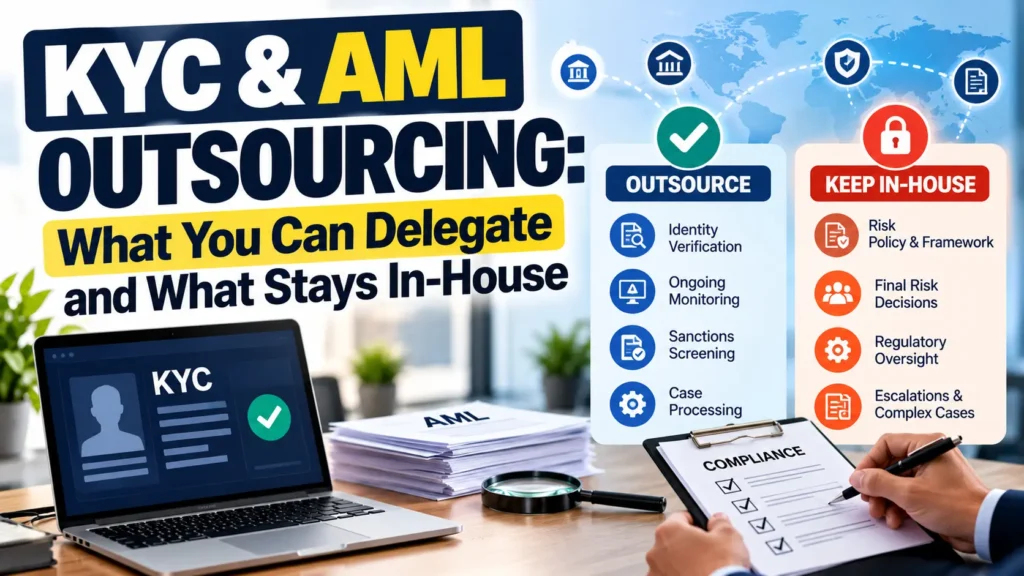
Quick answer: KYC and AML outsourcing means a third party performs the operational work of customer due diligence and anti-money-laundering checks. You can delegate verification, screening, alert triage, and documentation review. You cannot delegate your regulatory accountability. Under FFIEC examination expectations and federal interagency third-party guidance, the regulated institution remains responsible for the adequacy of every control a vendor performs on its behalf.
Key Takeaways
- Operational KYC and AML work is outsourcable; regulatory accountability is not.
- The control you must never relinquish is the decision to file or not file a report.
- Regulation (EU) 2024/1624 sets out specific tasks that cannot be fully handed to a vendor.
- AUSTRAC states plainly that an outsourcing arrangement does not change your obligations.
- Most failures are oversight failures, not execution failures.
What KYC and AML outsourcing actually covers
Customer due diligence and transaction monitoring are operational workflows. They follow written procedures, produce documented outputs, and can be measured. That makes the execution layer a natural fit for a dedicated offshore team, in the same way back office outsourcing covers other repeatable operations.
What makes this different from general business process outsourcing is the evidence trail. Every action must be reconstructable years later, for an examiner or a court.
What can be outsourced and what cannot
This is the single most important table in any KYC outsourcing decision. It is also the section most vendors leave vague.
| Activity | Outsourcable | Who remains accountable | Why |
|---|---|---|---|
| Identity document collection | Yes | Institution | Data handling, not judgement |
| Customer data entry and file assembly | Yes | Institution | Operational |
| Sanctions and PEP screening (running the check) | Yes | Institution | Tool execution |
| Screening alert triage (first level) | Yes, with rules | Institution | Interim judgement under your policy |
| Escalation and case write-up | Yes | Institution | Documentation |
| Enhanced due diligence research | Yes | Institution | Fact gathering |
| Ongoing monitoring of transaction patterns | Yes | Institution | Rule execution |
| Deciding to file a SAR | No | Institution | Legal duty, non-delegable |
| Approving a high-risk customer | No | Institution | Risk acceptance |
| Setting and owning risk appetite | No | Institution | Board-level |
| Signing off on the AML programme | No | Institution | Named officer duty |
The split is consistent across regimes: execution can move, decisions cannot.
The regulatory position, by jurisdiction
Different regulators describe outsourcing differently, but every one of them separates the work from the responsibility.
| Jurisdiction | Instrument | How outsourcing is treated |
|---|---|---|
| United States | FFIEC BSA/AML Exam Manual | Examiners assess third-party controls as if performed in-house |
| United States | Interagency Third-Party Guidance | Risk management applies to all third-party relationships |
| United States | 31 CFR 1020.320 | Reporting duty sits with the institution |
| European Union | Regulation (EU) 2024/1624 | Specifies tasks that cannot be delegated |
| United Kingdom | MLR 2017, Supervision Manual | Outsourcing permitted; oversight and named officer duties remain |
| Australia | AUSTRAC outsourcing guidance | Outsourcing does not alter your obligations |
Reading these together produces one rule: the regulator supervises you, not your vendor.
Why the oversight gap is the real risk
Enforcement does not usually target the vendor. It targets the institution that failed to supervise the vendor. FinCEN enforces against financial institutions directly, and money laundering remains a global problem precisely because oversight chains break quietly.
In practice, an oversight gap looks like this:
- A screening tool runs, but nobody tests whether the rule set matches the institution’s risk assessment.
- Alerts are triaged, but the triage rationale is not reconstructable from the file.
- A customer’s risk rating drifts, and no one owns monitoring that change.
None of these are vendor execution failures. Each is a failure of the institution’s own monitoring of the arrangement. If you have seen this pattern in other outsourced functions, it follows the same logic as KPI and SLA governance for offshore teams.
How to structure a defensible arrangement
A defensible structure has four parts, and each one is something you own:
1. Documented procedures before go-live. The vendor should be able to perform the task using your written procedure, not their interpretation of the regulation. Procedure ownership stays with you.
2. A named accountable owner internally. The vendor reports to a function inside the institution. That function reports to the compliance officer named in your jurisdiction’s requirements.
3. Reproducible evidence. For any decision, the file must show who did what, when, against which rule, and what happened next. This is what examiners actually test.
4. Independent testing. Someone other than the vendor’s own quality team samples the vendor’s output. This mirrors the structure used in SOC 2 and HIPAA compliant offshore operations, where the controls are tested rather than assumed.
For geographical delivery decisions, the analysis of onshore, nearshore, and offshore trade-offs applies here too, with one addition: data residency rules may remove some locations from consideration entirely.
How to vet a KYC and AML outsourcing provider
Ask these questions and insist on evidence, not assurances.
| Question | Good answer | Warning sign |
|---|---|---|
| How is alert triage quality measured? | Sampled QA with documented error rates | “Our analysts are experienced” |
| Can you reproduce a closed case from 3 years ago? | Full audit trail by case ID | Reliance on vendor-side tooling only |
| Who owns the screening rule set? | The client institution | Vendor keeps rules proprietary |
| How is a new regulation adopted? | Client-owned procedure change process | Vendor decides interpretations |
| How do you handle staff turnover? | Documented knowledge transfer, cross-training | Single analyst per process |
| What happens at exit? | Defined data handover and deletion | No exit plan |
If a provider cannot answer the third and sixth rows, the arrangement is not defensible regardless of price.
Common mistakes that create regulatory exposure
- Outsourcing the decision along with the task. The most common and most serious.
- Treating the vendor’s quality report as independent testing. It is not.
- No documentation of the rule set version. You cannot demonstrate control over a moving target.
- Failing to monitor after go-live. Many programmes are strong at inception and weak at month twelve.
- Assuming a certification transfers responsibility. Certifications support your oversight; they do not replace it.
The pattern behind every one of these is the same: execution was delegated, and oversight was not built to match.
Frequently asked questions
Is KYC and AML outsourcing allowed?
Yes, in all major jurisdictions, provided accountability, oversight, and decision-making remain with the regulated institution. Regulators supervise the institution, not the vendor.
Can we outsource SAR filing?
You can outsource the preparation and evidence assembly. The decision to file and the filing itself remain the institution’s legal duty under 31 CFR 1020.320.
Does a vendor’s SOC 2 report satisfy our obligations?
No. It is one input into your oversight. It does not transfer accountability.
What is the biggest risk in outsourcing KYC?
The oversight gap: the arrangement operates but nobody at the institution is testing whether it actually controls the risk it was designed to control.
Where to go next
If you are weighing whether to keep this function in-house or move it to a dedicated offshore team, the deciding factor is usually not cost but whether you can build the oversight layer described above. Teams handling regulated work for lenders and insurers typically combine the workflow guidance in our outsourced underwriting services material with a formal governance model. For related regulated operations, see mortgage underwriting, insurance fraud detection, and healthcare BPO. A structured outsourcing checklist is a practical starting point before any vendor conversation.
About the Author

Kishan Dangi (KK Patel)
Founder and CEO, CapStonePlanet
Kishan leads CapStonePlanet, an India-based outsourcing partner that builds dedicated
offshore teams for US and Canadian businesses across customer support, back-office,
recruitment support, and domain BPO.