Inside This Guide
Short answer: Property management outsourcing means handing recurring rental operations to an external trained team. Those operations include tenant screening support, lease administration, rent collection follow-up, maintenance coordination and property accounting. The owner or manager keeps leasing decisions, money authority and legal accountability. This model is moving up the agenda for two reasons. Administrative and payroll costs are rising faster than income, and screening and delinquency risk now sit inside a strict federal compliance frame.
Key takeaways
- Administrative and payroll expenses in benchmarked multifamily portfolios grew 3.81 percent year over year in 2024. They now sit nearly 20 percent above 2021 levels. Total income per unit grew only 1.5 percent over the same period (National Apartment Association, 2024 data).
- Three quarters of property management companies reported that labor costs, property insurance, property taxes and materials costs rose over the past year. In response, 63 percent planned to cover the increased costs by raising rents or resident-paid fees (Buildium industry survey).
- Tenant quality was the most commonly named foremost challenge for property management professionals heading into 2025, which pushes screening quality ahead of raw leasing volume.
- The rent collection service segment is forecast to grow at a 5.8 percent CAGR from 2026 to 2033. Repair and maintenance held the largest revenue share, at 33.7 percent in 2025 (Grand View Research).
- Tenant screening that uses consumer reports sits inside the Fair Credit Reporting Act. Permissible purpose, adverse action notices and user duties are statutory obligations that do not disappear because a third party performs the work.
- A safe transition runs 60 to 90 days: scope and document, parallel run on one full cycle, then cutover with a defined exception path.
- The governance set that matters is collection rate, days to fill, turnover rate, first-time fix rate, work-order closure time, arrears aging and owner report on-time rate.
What is property management outsourcing?
Property management outsourcing is the practice of assigning repeatable rental-operations work to a trained external team that works inside your systems and under your decision rights. The owner or the licensed manager still owns the portfolio, sets policy, approves expenditures and holds the legal relationship with residents. The outsourced team executes the administrative, financial and coordination work behind those decisions.
The distinction that matters in practice is between delegation of execution and transfer of authority. Outsourcing moves execution. It should not move authority. A provider that quietly starts approving credits, signing lease amendments, selecting tenants or releasing deposits has crossed a line. That creates compliance and fiduciary exposure for the owner, not just for the provider.
In the United States the demand for this kind of support is not speculative. Professional management of rental stock is a large and expanding services industry. The published analysis attributes part of that growth to owners delegating daily tasks. Those tasks include tenant communication, rent collection, leasing support, maintenance coordination and compliance administration, all done to reduce time commitment and operational complexity [R1].
Why property management outsourcing is climbing the agenda in 2026
Three pressures are converging, and each one on its own would justify a look at operating structure.
Cost growth is outrunning income growth
Benchmark data for 2024 shows total annual operating expenses per unit rising 2.2 percent year over year. Administrative and payroll expenses rose 3.81 percent and now sit nearly 20 percent higher than in 2021. Payroll alone increased 3.6 percent. Repairs and maintenance expenses increased 3.7 percent year over year and 28.2 percent. Against that, total annual income per unit increased only 1.5 percent [R3].
The arithmetic consequence is simple. When the administrative layer grows faster than the revenue layer, the administrative layer is where structure has to change. Hiring more onsite staff is the most expensive possible answer to a staffing-cost problem.
Owners are being pushed toward fee and rent increases they cannot fully control
Three quarters of companies reported that labor costs, property insurance, property taxes and materials and supply costs rose over the past year. In response, 63 percent of third-party property management companies planned to cover increased costs in 2025 by raising rents or resident-paid fees. The same survey notes a limit. Rents can only be raised so far when rental supply is growing relative to demand, and when renter wage growth is not keeping pace [R2].
For an owner, that means the price lever is partly exhausted. The remaining levers are process efficiency, staffing structure and error reduction, which is precisely what a well-scoped outsourcing engagement targets.
Screening quality has become the primary operational risk
Tenant quality was the most popular response when property management professionals were asked about their foremost challenge heading into 2025. The published guidance is explicit about robust screening procedures to avert fraud and avoid evictions down the line. It also speaks about balancing screening rigor with competitive rent levels [R2].
Market analysis adds the fraud dimension. Digital leasing has streamlined tenant acquisition. It has also made it easier for applicants to submit falsified income documents, manipulate credit information or misrepresent identity details. Fraudulent applications undermine traditional screening methods. That raises the risk of rent delinquency, lease defaults and eviction proceedings [R1].
A tired onsite coordinator reviewing applications at 6 pm is the wrong control for that risk. A dedicated screening desk with checklists, second review and audit trails is the right one.
How to read the frameworks in this guide: the readiness gates, keep-versus-outsource split, governance and SLA frame, quality-control ladder, KPI set, vendor evaluation checklist and 90-day transition sequence are CapStonePlanet operating methodology, drawn from how we run offshore back office, finance and accounting, and real estate operations teams for US businesses. They are company practice, not external research findings. External data points are cited to the references table at the end, and every numeric claim is traced to a named source in our evidence ledger.
CapStonePlanet outsourcing readiness framework
Before choosing which functions to delegate, we run a five-gate readiness check with owners. A portfolio that fails a gate can still outsource, but the failed gate becomes the first remediation item in the transition plan rather than a surprise after go-live. All five gates are company methodology, not industry standards.
- Procedure gate. Can the current process be written on one page by the person who does it today? If the answer lives only in someone’s head, delegation amplifies the gap. Write the procedure first; delegate second.
- Decision-rights gate. Are the decisions that stay with the principal named explicitly: tenant approval, rent and concession pricing, eviction filing, trust-account authority, habitability judgments? Unnamed decisions get delegated by accident.
- Access-design gate. Can the team be given least-privilege access with logging and a clean offboarding path? If the property software cannot scope permissions, fix that before any external team touches it.
- Measurement gate. Do you know your current baseline: administrative hours per unit, defect and rework rate, and cycle times for leasing, collections and maintenance? Without a baseline you cannot prove the engagement worked or failed.
- Exit gate. Could you hand the work to a different provider in 30 days? Procedures, templates and logs must live in your repository, not only the vendor’s. Passing this gate keeps negotiating power on your side for the life of the contract.
Score each gate as ready, partial or not ready. Partial scores are normal and are remediated during the first phase of the transition described below. A not-ready decision-rights or trust-account gate should stop the delegation of those functions entirely.
Which property management functions to outsource and which to keep
The honest answer is not “everything except the signatory authority.” Functions differ in how well they travel. Work that is rules-based, high-volume, document-heavy and reversible travels well. Work that requires judgment under legal penalty, discretionary negotiation, or physical presence travels badly.
Functions that outsource well
- Lease administration and abstraction. Extracting terms, dates, escalations, options and renewal windows from lease documents into a structured register. Rules-based, high-volume, and verifiable against the source document.
- Rent collection follow-up and arrears chasing. Scheduled reminders, payment posting reconciliation, delinquency aging and escalation to a defined human decision point. The forecast growth of the rent collection segment reflects real owner appetite for this [R1].
- Maintenance coordination and dispatch. Intake, triage, vendor scheduling, follow-up and closure documentation. Market analysis identifies maintenance coordination and scheduling as among the tasks owners most often delegate [R1].
- Tenant communication and service desk. First-line response, ticket routing, status updates and escalation. Published analysis notes AI-driven tooling already automating routine tenant inquiries, rent reminders, lease processing and maintenance scheduling [R1].
- Property accounting and owner reporting. Ledger posting, bank and rent reconciliation, owner statements, vendor invoice processing and 1099 support data preparation.
- Screening operations support. Order placement, document collection, identity verification checks, adverse action notice generation and file completeness review, under your written criteria.
- Turnover and make-ready administration. Move-out inspection documentation, vendor coordination, budget preparation and approval packaging.
Functions to keep in house
- Tenant selection decisions. The approve or deny call must remain with a named person accountable under your screening criteria. Adverse action obligations attach to the user of the report.
- Rent pricing and concession approval. Judgment calls on pricing against local demand belong with the owner or the manager of record.
- Eviction filings and legal correspondence. Notice preparation support can be delegated; filing decisions and lawyer communication cannot.
- Trust account signatory authority. Movement of resident funds stays with principal-side controls.
- Physical inspections and habitability judgments. Onsite observation is not a remote function.
- Vendor contracting and insurance verification sign-off.
Illustrative example (hypothetical, not a client result). Consider a single-family portfolio operator who runs leasing support, bookkeeping and maintenance intake through one in-house coordinator. On the readiness framework, the operator passes the procedure gate for rent posting. The operator fails it for maintenance intake, where triage lives in the coordinator’s judgment. The keep-versus-outsource split above says to delegate rent posting, statement preparation and intake documentation now. It says to keep dispatch judgment, vendor sign-off and resident hardship decisions in house until procedures exist for them. The transition plan then starts with the failed gate. Document the intake triage rules during the first phase, run them in parallel for one full cycle, and only then move the documentation work offsite. This scenario is constructed to show how the framework applies. It is not a description of any CapStonePlanet client, and no outcome, saving or result is claimed.
Tenant screening and the legal floor you cannot outsource
This section is general information about federal requirements, not legal advice. Screening rules also vary by state and municipality, and several jurisdictions impose additional source-of-income, criminal-record and fee restrictions. Confirm your criteria with counsel before you operationalize them with any team, internal or external.
When a landlord obtains a consumer report on an applicant to decide whether to grant a tenancy, the Fair Credit Reporting framework applies. Congress stated the purpose of the subchapter in clear terms. It requires consumer reporting agencies to adopt reasonable procedures for meeting the needs of commerce, for consumer credit, personnel, insurance and other information. Those procedures must also handle the data in a manner that is fair and equitable to the consumer. That covers confidentiality, accuracy, relevancy and proper utilization of the information [R4].
Three statutory points drive how an outsourced screening desk must be built.
First, the report has to be obtained for a permissible purpose. A consumer report may be furnished only under the circumstances set out in the statute, which includes a person who intends to use the information in connection with a determination of eligibility for a credit or business transaction involving the consumer, and for employment purposes [R4]. Operationally, that means the provider orders reports only against a real, documented application, never speculatively and never on a consumer who has not applied.
Second, tenant history is expressly inside the regulated perimeter. The statute recognizes a category of consumer reporting agency that compiles and maintains files on consumers on a nationwide basis relating to, among other things, residential or tenant history [R4]. Eviction-filing data and rental-history products are not informal background checks; they are regulated consumer reports.
Third, adverse action duties fall on the user. If a person takes adverse action with respect to a consumer that is based in whole or in part on information contained in a consumer report, that person must provide notice of the adverse action and the required disclosures [R4]. Where an outsourced team prepares the notice, the obligation is still yours. Delegation of the drafting does not delegate the duty.
What a compliant outsourced screening desk looks like
- Written, uniformly applied screening criteria approved by the owner and reviewed by counsel, with no ad hoc exceptions granted by the provider.
- Order placed only on a completed application, with the permissible purpose recorded against the file.
- Identity and data-match checks before any report is relied on, given the documented rise in falsified income documents and manipulated identity details [R1].
- Two-person review: preparer and approver, with the approver on the principal side for any denial.
- Adverse action notice generated from a controlled template, with the consumer reporting agency identification, the dispute statement and the retention of the report as required.
- Access segregation so the provider team can see only the files it is working, with full audit logging.
- No storage of raw consumer report data in provider-owned tools beyond the retention period your policy allows.
The reason to be strict here is not caution for its own sake. Screening is the highest-leverage control in the whole operating model, and the published evidence ties weak screening directly to delinquency, lease defaults and eviction cost [R1][R2].
Lease administration: the quiet function that pays for the engagement
Lease administration is the least glamorous and most reliably recoverable function in the portfolio. It covers the register of leases, the abstraction of material terms, critical-date tracking, escalation calculation, option management, amendment control, renewal notices and estoppel support.
Where it fails, it fails expensively. A missed renewal option, an unindexed escalation, a lapsed insurance certificate or an unissued notice converts directly into lost revenue or uncovered risk. None of those failures are visible in a monthly P and L until the quarter in which they cost you something.
What good lease abstraction contains
- Parties, premises, term dates, commencement and expiration, and any holdover terms.
- Rent schedule including base rent, escalation mechanics, percentage or variable components and rounding rules.
- Security deposit or letter of credit details, with release conditions.
- Renewal and termination options with notice windows counted backwards from the option date.
- Assignment and subletting consent rights and conditions.
- Maintenance, tax, insurance and utility allocation between the parties.
- Alterations, signage and use restrictions.
- Default triggers, cure periods and remedies.
- Compliance obligations, including accessibility and licensing conditions.
Control that makes delegated abstraction trustworthy
Require a two-pass model: one analyst abstracts, a second reviewer verifies every extracted value against the source document, and the verifier initials the field. Then sample-audit 10 percent of the register each month against originals. Abstraction is verifiable work, which is exactly why it outsources well. The verification is what stops it from becoming a source of silent error.
For residential portfolios the same discipline applies to lease files, move-in condition documentation, notice service records and renewal offer tracking. For commercial and mixed-use portfolios it extends to CAM and reconciliation support. That is a natural companion to the accounts payable outsourcing function, because vendor invoice validation depends on the same contract terms.
Rent collection, posting and arrears management
Rent collection is the function owners most consistently report wanting off their plate. The market data supports that. The rent collection segment is projected to expand at a significant CAGR from 2026 to 2033. Owners delegate it to professional providers to ensure timely payments, reduce administrative burden and improve cash flow outcomes [R1]. The same analysis describes a shift toward online and automated payment systems, including mobile applications, tenant portals and recurring payment options. Those tools simplify rent transactions while minimizing payment delays and errors [R1].
The collection cycle as a governed process
- Statement generation and distribution on a fixed calendar, with delivery method logged per resident.
- Payment posting and reconciliation against bank and portal exports daily, not monthly, so unmatched items surface within 24 hours.
- Automated reminder sequence with defined touch points, tone and quiet hours, approved in writing by the owner.
- Manual arrears contact by a trained coordinator for accounts crossing the first threshold, with a documented conversation log.
- Escalation to decision at a pre-agreed day count, where a named person on the principal side decides between payment plan, notice or filing.
- Ageing review weekly by portfolio, with movement explained line by line.
The benchmark context matters when you set thresholds. Vacancy and rent loss rose again in 2024, marking a fourth consecutive annual increase. Concessions climbed sharply over the same period. Bad debt improved by 30.2 percent year over year, yet it remained elevated relative to pre-surge levels [R3]. In plain terms, fewer residents are paying late than at the worst point. But the cost of a late payment is higher, because it lands against thinner income growth. Collection discipline therefore earns more per hour spent than it did three years ago.
What must never be delegated
Credit decisions, waiver of late fees outside policy, acceptance of partial payment in settlement of arrears, and any movement of funds from a trust account. These are authority acts, and they need a principal-side signature with an audit trail.
Maintenance coordination and vendor management support
Repair and maintenance held the largest revenue share of the U.S. property management services market in 2025, at 33.7 percent. It is also expected to grow at the fastest rate through the forecast period. That growth is driven by expanding rental housing stock and an increasing focus on property upkeep and tenant satisfaction. The same analysis notes that regular maintenance helps preserve property value, reduce long-term repair costs and improve tenant retention [R1].
Cost data reinforces the urgency. Repairs and maintenance expenses increased 3.7 percent year over year in 2024 and 28.2 percent. Sustained inflation drove those costs, in maintenance repairs, security, appliances and unit-turn work [R3].
The coordination layer that controls spend
- Intake standardization. Every request captured in one system with category, priority, unit, photos and resident statement. No verbal work orders.
- Triage rules. Emergency, urgent, routine and preventive defined in writing with response-time targets, including habitability-triggering categories.
- Dispatch logic. Preferred vendor by trade, property and geography, with SLA and insurance status visible at dispatch.
- Spend gates. Pre-agreed authority thresholds per work order and per month per property, above which principal approval is required before dispatch.
- Closure discipline. Invoice matched to work order and to purchase order where used, warranty logged, first-time-fix recorded, resident confirmation captured.
- Preventive scheduling. Filter cycles, inspection cycles, backflow and life-safety testing tracked as calendar obligations, not memory.
This is where a delegated team typically produces the clearest measurable gain. The loss is not in the repair itself. It sits in the unmanaged middle: the untracked request, the double-dispatch, the invoice paid twice, the warranty expired unused. Those are administrative failures, and administrative failures are what outsourcing fixes.
Property accounting, owner reporting and the trust-account boundary
Delegated accounting covers ledger posting, bank and rent reconciliation, accounts payable and receivable processing, owner statement preparation, vendor invoice validation, lease commission accrual support and year-end data packs. It should not cover signatory authority, reserve decisions, tax elections or the auditor relationship.
Reporting cadence that makes the delegation visible
- Daily: cash and receipts posting, unmatched item queue.
- Weekly: arrears ageing, work-order backlog, exception log.
- Monthly: owner statement with rent roll, income and expense variance against budget, delinquency schedule, capital items, and a KPI scorecard.
- Quarterly: service review against SLA, process defect log, capacity and scope reforecast.
Owner reporting quality is usually the first thing an owner notices after transition. So tie it to the back office outsourcing standards rather than treating it as a property-specific exception. The reconciliation discipline described in the accounts receivable outsourcing guide applies almost unchanged to rent ledgers.
Service models compared: dedicated pod, traditional BPO, or freelance support
Choosing the function is only half the decision. Choosing the delivery model determines whether the function actually gets performed to standard.
Dedicated offshore pod
A named, stable team working only your portfolio, inside your systems, on your procedures, with overlap hours. Best when volume is meaningful, when procedures need to accumulate in one place, and when you want continuity of knowledge on specific properties. The trade-off is that you own process documentation and management rhythm more than with a managed-service contract. Compare the structural differences in dedicated pods versus traditional BPO.
Traditional BPO or managed service
Contracted by output with a defined SLA, staffed from a bench, and usually stronger on standardized high-volume work such as lease abstraction, invoice processing and first-line tenant response. Weaker on portfolio-specific judgment and on relationships with local vendors. Governance needs to be sharper because the team composition can change; the SLA and KPI framework in the KPI and SLA governance playbook is the control.
Freelance or marketplace support
Cheapest to start, hardest to secure. Suitable for narrow, low-risk, non-sensitive tasks. Poor fit for anything touching consumer reports, trust accounts or resident data, because access control, background screening, business continuity and auditability are usually absent. The risk comparison is set out in dedicated teams versus freelance marketplaces.
Virtual assistant support
A single generalized assistant can absorb calendar, inbox and light coordination work, but it does not give you segregation of duties, second review or escalation depth. For screening-adjacent or accounting-adjacent tasks that is a control weakness, not a cost saving. See virtual assistant outsourcing and BPO versus virtual assistant for the boundary.
Location strategy
Onshore, nearshore and offshore each carry different cost, overlap and data-control profiles. The decision should follow the sensitivity of the data and the need for real-time resident contact, not headline labor arbitrage. The comparison framework is in onshore versus nearshore versus offshore.
Model fit summary
- Lease abstraction and document registration: traditional BPO or pod, high volume, verifiable output.
- Rent posting and arrears admin: pod, because reconciliation continuity and property-specific knowledge matter.
- Maintenance intake and dispatch support: pod with overlap hours, because resident contact is time-sensitive.
- Screening operations support: pod or managed service with documented FCRA handling, background-screened staff and access segregation.
- Owner reporting and accounting: pod, with principal-side review of statements before release.
- Overflow document processing: traditional BPO.
- Anything touching trust funds or legal decisions: keep in house under all models.
Governance, SLA and quality-control framework
Delegation without governance decays. The frame below is CapStonePlanet methodology for property operations engagements; it is what the 90-day transition and the KPI set are built to feed.
Service levels that match how rental operations actually fail
- Turnaround levels on the clock-driven items. Lease abstraction is delivered within a set number of business days of signature. Arrears reminders go out on the schedule your notices require. Maintenance intake is acknowledged the same day it lands.
- Accuracy levels on the verifiable items: abstraction field accuracy, posting accuracy against the bank feed, statement arithmetic. Accuracy is measured by sampling audit, not by the provider grading its own work.
- Availability levels on overlap hours with your resident contact windows, plus a named-deputy rule so a single absence never stalls a notice deadline.
- Response clocks on escalations: what gets answered in hours versus days, and who is notified.
Three lines of quality control
- First line: maker-checker inside the team. Every outbound artifact (notice draft, statement, abstracted lease) is reviewed by a second pair of eyes on the pod before it reaches you.
- Second line: client-side sampling. You audit a fixed monthly share of output against the procedure, and the defect rate is published, not summarized.
- Third line: periodic independent review. A quarterly review of the full control set: access logs, notice compliance, trust-account boundaries, and the root-cause entries in the defect log.
Escalation ladder
Defects are tiered by consequence, and each tier has a fixed path and clock. A typo in an internal note is a level-one fix at team-lead level. A wrong abstraction figure that could affect a renewal decision is level two: account manager same business day, with a root-cause entry in the defect log. Anything touching resident funds, legal notices or fair-housing exposure is level three: engagement sponsor notified immediately, the affected work frozen, and the procedure updated before the work resumes. Resident complaints always carry a path that bypasses the provider entirely.
Cadence completes the frame. Hold a weekly operations call on the KPI dashboard. Add a monthly business review on defect trends and team retention. Finish with a quarterly strategic review on scope and the governance set itself.
How to transition property management operations in 90 days
Most failed property outsourcing transitions fail for the same reason: cutover happened before the procedure existed. A transition is not a training event, it is a documentation event followed by a supervised duplicate run.
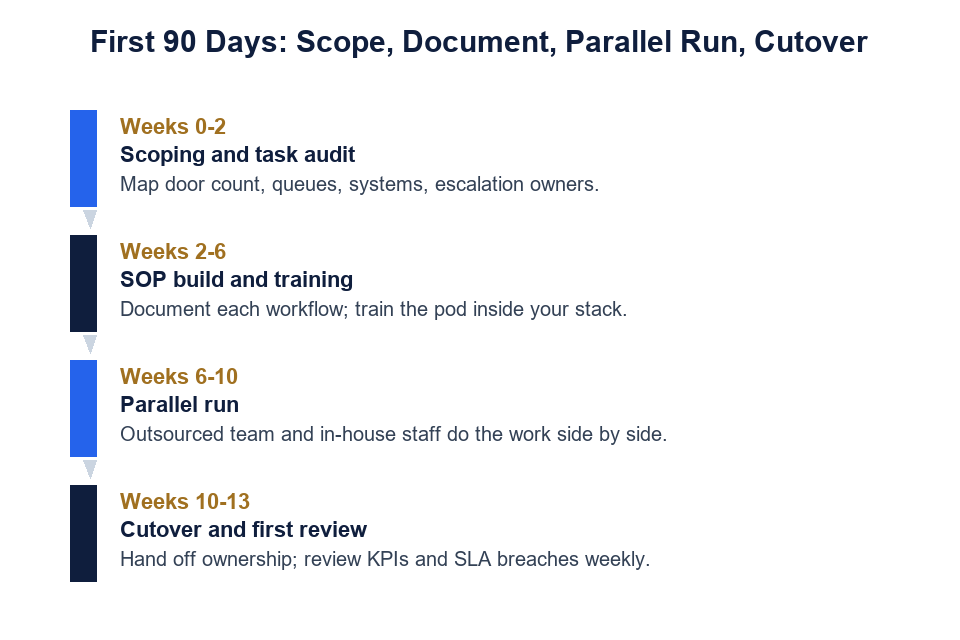
Days 1 to 20: scope, document and instrument
- Inventory every recurring task, its frequency, its owner, its system and its failure mode.
- Classify each task keep, outsource or conditional using the criteria in this guide.
- Write the procedure for every outsourced task, including the exception path and the named approver.
- Define authority thresholds: spend gates, credit limits, notice approvals, escalation triggers.
- Set the measurement baseline from your own last three months of data, not from vendor estimates.
- Complete access design: least privilege, separate identities, logging, no shared credentials, data-loss controls on resident files.
- Confirm insurance, licensing and, for screening-adjacent roles, FCRA-aware handling and staff background screening in writing.
Days 21 to 55: parallel run on one full cycle
- Run the delegated team alongside the existing team on one complete monthly cycle, including one full rent cycle and one full maintenance cycle.
- Duplicate output comparison: same invoices, same postings, same dispatch decisions, same notices drafted.
- Defect log every divergence with root cause, and fix the procedure rather than the person.
- Verify reconciliation to zero variance before any live posting authority is granted.
- Test the escalation path with deliberate seeded exceptions, including a habitability call and a suspected fraudulent application.
Days 56 to 90: cutover, stabilize and govern
- Cutover by function, not by portfolio, and never cut over screening and collections in the same week.
- Hold daily standups for the first two weeks, then weekly, then move to the standing service-review rhythm.
- Publish the first governed monthly scorecard at day 90 against the baseline you set in phase one.
- Retain the right to reverse any single function without terminating the engagement.
Scoping to full operation typically takes four to eight weeks. That includes a parallel run of one to two full cycles. It is the same transition envelope applied to accounts payable outsourcing. It holds for property operations too, where resident contact is heavier.
KPIs that tell you whether the outsourcing is working
Measure the function, not the vendor’s effort. The following set is drawn from the operating logic in the KPI tracking and SLA governance playbook and mapped to property management.
- Collection rate on time by cycle, with the ageing curve of the remainder.
- Days to fill vacancy from notice to signed lease, split by marketing lag and screening lag.
- Tenant turnover rate and renewal rate, since retention is the offset to rising acquisition cost.
- Screening turnaround time and file completeness rate on first submission.
- Adverse action notice accuracy as a sampled audit pass rate, treated as a control metric, not a speed metric.
- First-time fix rate and repeat-visit rate per work order category.
- Work-order closure time by priority band against the published target.
- Maintenance spend per unit trend against the benchmark direction, with variance explained.
- Administrative cost per unit trend, which is the metric the engagement exists to move.
- Reconciliation exceptions per thousand transactions and average age of open items.
- Owner statement on-time and error-free rate after principal review.
- Lease register accuracy from monthly 10 percent sample audit.
- Escalation rate to principal side, with a target of falling trend at constant volume.
- Staff continuity on the account, measured as named-team retention.
Set thresholds from your own baseline. A vendor-supplied industry average is not a target. Where no reliable public figure exists for a metric, record it as unavailable rather than importing a number from a sales deck.
Risks, and the controls that actually contain them
Compliance risk in screening and notices
Control: written uniform criteria approved by counsel, permissible-purpose logging, two-person review, sampled adverse action audit, and no provider-side denial authority. The statutory duties on users of consumer reports do not transfer with the task [R4].
Data security and resident privacy
Control: least-privilege access, no bulk export, encryption in transit and at rest, background-screened staff, incident notification clauses with defined hours, and periodic access recertification. Compliance posture should be verified the way it is in the SOC 2 and HIPAA compliant back office guide, with report and remediation evidence rather than attestations.
Quality drift after go-live
Control: monthly sampled audit with published defect rates, procedure version control, and a defect log that names root cause. Drift is a governance failure, and it is fixed by measurement frequency, not by escalation volume.
Vendor concentration and key-person dependence
Control: procedures documented in your repository rather than the vendor’s, named deputies, portability clause, and escrow of configuration and documentation.
Fair housing exposure from delegated decisions
Control: uniform criteria, no unwritten exceptions, complete interaction logs, and mandatory principal-side approval for any departure from criteria. Fair housing rules are state and locality specific; treat delegated discretion as the highest-risk artifact in the whole model.
Reputational exposure from resident-facing tone
Control: approved scripts, tone calibration in the parallel run, quiet-hour rules, and a resident complaint path that bypasses the provider.
How to choose a property management outsourcing partner
Buy evidence, not assurances. The sequence below is the CapStonePlanet vendor evaluation checklist for property operations. It is the same qualification process we apply to financial-operations providers, adapted for property work. Treat it as company methodology rather than an industry standard.
- Ask for a worked sample on your own documents. Send five redacted leases and three anonymized arrears cases. Score abstraction accuracy, notice drafting quality and reconciliation logic.
- Test FCRA literacy specifically. Ask how permissible purpose is recorded, who may place an order, how adverse action notices are produced, and what happens when a consumer disputes. Vague answers disqualify.
- Inspect access design. Request the actual role matrix, logging approach and offboarding procedure.
- Demand a parallel-run commitment. A provider unwilling to duplicate a full cycle before cutover is asking you to be the test environment.
- Check overlap hours against your resident contact windows. Morning and early evening coverage is where maintenance and arrears calls actually land.
- Verify continuity planning. Named deputies, illness cover, disaster recovery and attrition rate on the account.
- Insist on your own procedure repository. If the documentation lives only with the vendor, exit cost rises every month you stay.
- Clarify insurance, licensing and indemnity for delegated acts, and confirm who holds the resident-facing legal relationship.
- Set the pricing conversation on scope and outcomes. Rate cards alone obscure the real question, which is administrative cost per unit and defect cost. Ask for a scope-based structure with a measured pilot.
For owners evaluating whether to build the capability internally instead, the make-or-buy comparison in what is outsourcing and the cost-structure discussion in benefits of outsourcing apply directly. Real estate owners who want a lighter first step often begin with role-scoped support. That support is described in real estate virtual assistants and real estate operations. From there, they graduate to a pod as volume justifies it.
Frequently asked questions
Is tenant screening legal to outsource?
The administrative work can be delegated, but the legal duties cannot. Under the Fair Credit Reporting Act, a consumer report may be furnished only for a permissible purpose. A person who takes adverse action based in whole or in part on a consumer report must also give the required notice. Keep the approve or deny decision and the notice approval on the principal side. Hold the provider to documented criteria [R4][R4].
Which property management tasks are best suited to outsourcing first?
Start with lease administration and abstraction, rent posting and reconciliation support, maintenance intake and dispatch documentation, and owner statement preparation. These are rules-based, high-volume and independently verifiable. Leave tenant selection decisions, trust account authority, eviction filings and physical inspections in house.
Does outsourcing reduce administrative cost per unit?
It can, and the pressure that makes it worth examining is documented. Administrative and payroll expenses rose 3.81 percent year over year in 2024 and sit nearly 20 percent above 2021. Total income per unit rose only 1.5 percent over the same period [R3]. The saving comes from removing duplicated and error-driven work, not from rate arbitrage alone. So measure administrative cost per unit against your own baseline.
How long does a property management outsourcing transition take?
Plan for 60 to 90 days. Allow roughly 20 days to scope, document and design access. Set aside 35 days for a parallel run covering one full rent cycle and one full maintenance cycle. Use the final 30 days for staged cutover and stabilization. Never cut over screening and collections in the same week.
What should never be handed to an external team?
Signatory authority over resident funds, the tenant approve or deny decision, rent pricing and concession approval, eviction filing decisions, habitability judgments from physical inspections, and vendor contracting sign-off.
How do I stop quality from drifting after go-live?
Sample-audit monthly and publish the defect rates. Keep procedures under version control in your own repository. Require a root-cause entry in the defect log for every divergence. Review named-team retention as a metric in its own right.
Is a dedicated team better than a managed BPO service?
A dedicated pod suits portfolios where property-specific knowledge compounds and resident contact is time sensitive. A managed BPO service suits standardized, high-volume document work where output can be contracted by SLA. Many owners run both: a pod for reconciliation, arrears and coordination, and a managed service for abstraction overflow and invoice processing pod versus BPO comparison.
Do I lose control of resident relationships?
Not if the model is designed correctly. Delegated teams handle intake, status communication and documentation; discretionary and sensitive conversations stay with you. Approved scripts, quiet-hour rules and a complaint path that bypasses the provider keep the relationship intact.
About this guide: research method, limitations and updates
- Research dates. Sources were retrieved on 2026-10-09 and re-verified on 2026-10-10. Market data moves; figures should be re-checked before being reused in a decision.
- Source types. One market research report (Grand View Research), one industry association benchmark study (National Apartment Association), one software vendor trend survey (Buildium), and primary federal statute text (Fair Credit Reporting Act via Cornell Law School Legal Information Institute). Sources that returned errors or blocked access during research were excluded and are not cited.
- Claim tagging. Every factual and numeric claim in this guide is tagged in our evidence ledger as a direct quote, a paraphrase, or an inference. Inferences are never presented as sourced facts. Where a source gives a figure without naming its comparison window, the figure is quoted without a window.
- Limitations. This review had no access to backlink indexes, rank trackers, keyword-volume tools or Search Console data, so authority and ranking-position claims are not made anywhere in this guide. Competitive metrics are marked unavailable rather than estimated.
- Legal content. The FCRA and fair-housing passages summarize public statutory text for orientation. They are not legal advice, and no external expert reviewer is claimed; confirm compliance steps with qualified legal counsel for your jurisdictions.
- Company methodology. The frameworks in this guide are CapStonePlanet practice, labelled as such at each use. No client names, client results, case studies or savings figures are presented; the one worked scenario is explicitly hypothetical.
- Update notes. 2026-10-10: maintenance-cost claim wording corrected to match the source exactly; readiness framework, governance and quality-control framework, methodology labelling and this transparency block added. 2026-10-09: initial publication.
- Corrections and contacts. To report an error in this guide, use the contact page; substantive corrections are applied and dated in the update notes above. Site policies: privacy policy and terms and conditions. Author profile: our team.
References
- [R1] Grand View Research, U.S. Property Management Services Market Report, 2026 to 2033. https://www.grandviewresearch.com/industry-analysis/us-property-management-services-market-report (retrieved 2026-10-09)
- [R2] Buildium, 2025 Property Management Industry Trends. https://www.buildium.com/blog/2025-property-management-industry-trends/ (retrieved 2026-10-09)
- [R3] National Apartment Association, Momentum Management: Navigating Elevated Costs in a Constrained Operating Environment. https://www.naahq.org/news/momentum-management-navigating-elevated-costs-constrained-operating-environment (retrieved 2026-10-09)
- [R4] Cornell Law School Legal Information Institute, 15 U.S. Code sections 1681, 1681a, 1681b and 1681m (Fair Credit Reporting Act). https://www.law.cornell.edu/uscode/text/15/1681, https://www.law.cornell.edu/uscode/text/15/1681a, https://www.law.cornell.edu/uscode/text/15/1681b, https://www.law.cornell.edu/uscode/text/15/1681m (retrieved 2026-10-09)
General information only, not legal or investment advice. Screening, fair housing and landlord-tenant requirements vary by state and municipality; confirm criteria with counsel before operationalizing them.
About the Author

Kishan Dangi
Founder & CEO, CapStonePlanet
12+ years in BPO and outsourcing. CapStonePlanet delivers dedicated offshore back office, finance and accounting, and real estate operations teams serving US businesses. This guide covers property management outsourcing: tenant screening support, lease administration, rent collection follow-up, maintenance coordination and property accounting, executed inside client systems with audit-ready trails.
Want a scoped opinion for your portfolio?
Tell us the property count, the systems you run and the functions that are consuming the most administrative hours. We will map which tasks suit delegation, what a 90 day transition looks like for your setup, and what the governance frame should be.