- Have any Questions ?
- info@capstoneplanet.com

How Long Does Underwriting Take? Complete Timeline by Type (2026)
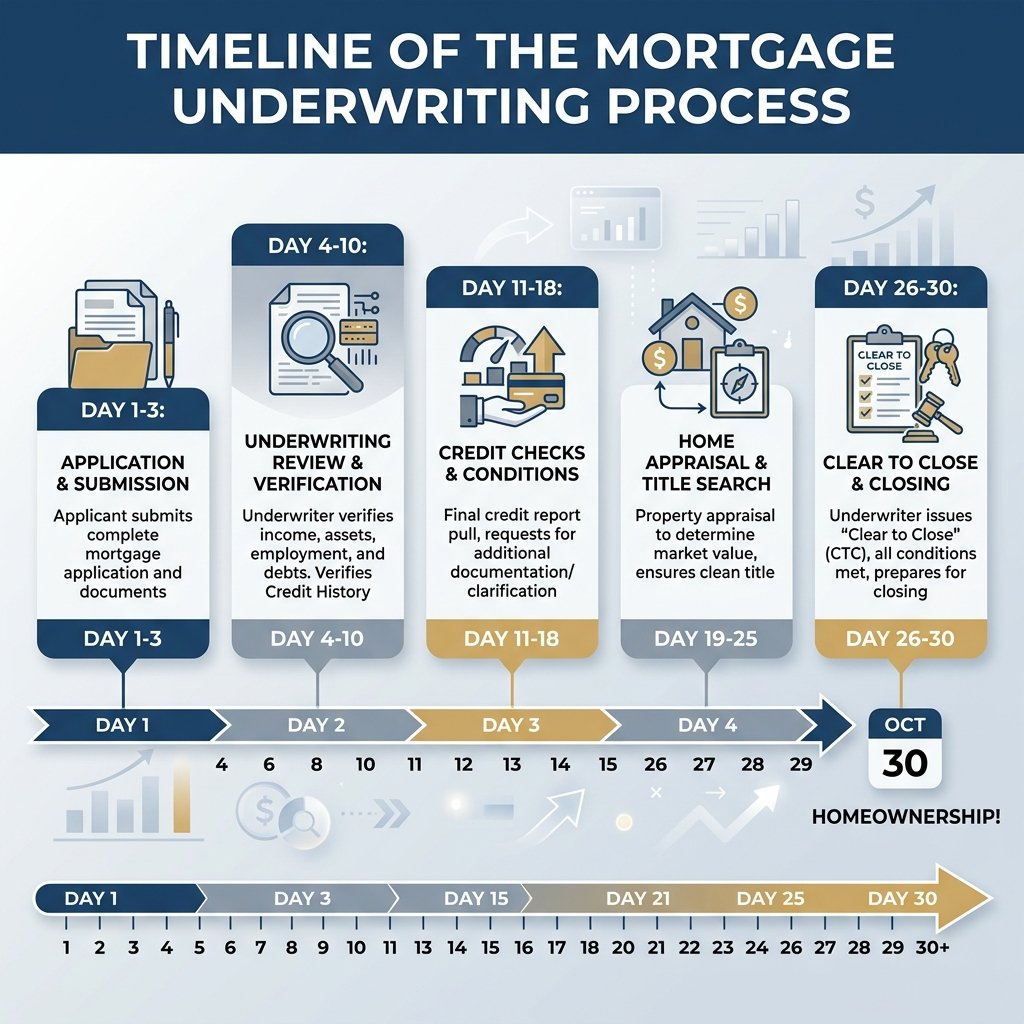
Underwriting timelines vary significantly by type. Mortgage underwriting takes 1–6 weeks (42–45 days average to close). MCA underwriting is fastest at 24–72 hours. Insurance underwriting for life policies takes 2–8 weeks. Personal loan underwriting takes 1–7 days. Commercial loan underwriting takes 2–12 weeks. Auto loan underwriting is fastest at 1–24 hours. The single biggest factor determining speed across ALL types is documentation completeness — files with all documents ready upfront close 40–60% faster.
If you’ve ever asked “How long does underwriting take?” — you already know the frustration of not getting a straight answer. The truth is, underwriting timelines range from 24 hours to 12+ weeks depending entirely on what you’re applying for, who the lender is, and how prepared your file is.
Mortgage underwriting typically takes 1 to 6 weeks with the average closing timeline sitting around 42 to 45 days from application to keys in hand. MCA underwriting — the fastest type — can return decisions in minutes and fund within 24 hours. But these are textbook answers. The real answer depends almost entirely on your lender, the loan type, and a handful of factors that most guides completely ignore.
This guide breaks down exactly what’s happening behind the scenes during underwriting across every major type in 2026 — mortgage, MCA (merchant cash advance), insurance, personal loans, commercial loans, SBA loans, and auto loans. You’ll get real timelines, the specific factors that affect each type, and actionable strategies to get your approval faster.
Key Takeaways
- Fastest: Auto loan underwriting (1–24 hours) — MCA underwriting (24–72 hours)
- Slowest: Commercial loan underwriting (2–12 weeks) — complex financial analysis required
- Most Searched: Mortgage underwriting (1–6 weeks) — 42–45 day average close time
- #1 Delay Factor: Incomplete documentation across ALL underwriting types
- 2026 Trend: AI-powered Intelligent Document Processing is cutting timelines 30–60% at tech-forward lenders
- Your Control: Borrowers who respond to conditions within 24 hours close an average of 10–14 days faster
What Exactly Happens During Underwriting?
Before we talk timelines, you need to understand what an underwriter actually does with your file. An underwriter isn’t just “approving” your loan — they’re conducting a deep forensic analysis of your financial life to answer one question: Is this person or business a safe bet?
The industry breaks this down into the “Three C’s” of underwriting:
- Credit: Your credit history, score, and repayment behavior — they’re looking at credit scores, outstanding debts, late payments, collections, and credit utilization ratio.
- Capacity: Can you actually afford this? They verify your income, employment stability, and debt-to-income (DTI) ratio to ensure payments won’t stretch you too thin.
- Collateral: Is the asset worth the loan amount? This is where appraisal comes in — if the collateral appraises below the loan amount, approval could hit a wall.
Every piece of paper you submit — pay stubs, tax returns, bank statements — gets cross-referenced, verified, and scrutinized. It’s thorough by design: your lender is putting significant money on the line, and the underwriter is the last line of defense.
Quick Reference: Underwriting Timelines by Type (2026)
| Underwriting Type | Typical Timeline | Automated Portion | Key Delay Factors | 2026 Trend |
|---|---|---|---|---|
| Mortgage | 1–6 weeks (avg 42–45 days to close) | Minutes (AUS) | Appraisal, title issues, complex income verification | AI document processing, IDP systems |
| MCA (Merchant Cash Advance) | 24–72 hours | 5–15 minutes | NSF frequency, stacking detection, Fintech bank restrictions | Bank API integration, specialized outsourcing |
| Life Insurance | 2–8 weeks | Minutes (simplified issue) | Medical exams, APS requests, lab results | Accelerated underwriting, algorithm-based approval |
| Personal Loan | 1–7 days | Minutes (instant approval) | Income verification, DTI ratio | Real-time bank data APIs (Plaid, Yodlee) |
| Commercial Loan | 2–12 weeks | Limited (mostly manual) | Business financials, collateral valuation, legal docs | KPO-based financial analysis |
| SBA Loan | 4–12 weeks | SBA CAFS system | SBA review queue, 7(a) eligibility documentation | Digital SBA submission portals |
| Auto Loan | 1–24 hours | Minutes (dealer financing) | Credit score, LTV ratio, vehicle valuation | Digital verification tools |
1. Mortgage Underwriting Timeline (1–6 Weeks)
Mortgage underwriting is the most commonly searched underwriting type — and the one with the widest timeline variance. The full process from application to closing averages 42–45 days in 2026, with underwriting consuming the largest and most variable chunk of that timeline.
The Step-by-Step Mortgage Underwriting Timeline
Step 1: File Submission and Queue (Days 1–3)
Your loan processor compiles your complete file and submits it to the underwriting department. Depending on the lender’s current volume, your file may sit in a queue for 1–3 business days before an underwriter even opens it. During peak seasons (spring and summer buying), this wait can stretch to 5–7 days.
Step 2: Initial Review and AUS Decision (Days 3–5)
The underwriter runs your file through an Automated Underwriting System (AUS) — typically Fannie Mae’s Desktop Underwriter (DU) or Freddie Mac’s Loan Product Advisor (LPA). This system returns one of three results:
- Approve/Eligible: Your file meets automated guidelines — great news, this speeds things up significantly.
- Refer/Eligible: Your file needs a closer human look — not a denial but it adds time.
- Refer with Caution: Red flags exist — expect a deep manual review.
Step 3: Document Verification (Days 5–15)
This is where the clock really starts ticking — or stalling. The underwriter verifies every claim in your application:
- Employment verification (calling your employer or using automated services)
- Income documentation cross-referencing (pay stubs vs tax returns vs bank deposits)
- Asset verification (checking that your down payment funds are “seasoned” and sourced properly)
- Reviewing your debt obligations and calculating your final DTI ratio
Step 4: Appraisal and Title (Concurrent — Days 5–20)
While the underwriter reviews your financials, two critical third-party processes run simultaneously:
- Home Appraisal: A licensed appraiser visits the property to determine its fair market value. This typically takes 1–2 weeks to schedule and complete. If the appraisal comes in low, you’ll need to renegotiate the purchase price or bring additional funds to close.
- Title Search: A title company investigates the property’s legal history to ensure there are no liens, unpaid taxes, ownership disputes, or easement issues that could block the sale.
Step 5: Conditional Approval (Days 15–25)
Here’s something most borrowers don’t expect: getting “conditionally approved” is the norm, not the exception. About 80–90% of all mortgage applications receive a conditional approval rather than a clean outright approval. Common conditions include:
- An updated pay stub or bank statement
- A letter of explanation (LOE) for a large deposit or credit inquiry
- Proof of homeowner’s insurance
- A signed gift letter if your down payment includes family funds
Your response speed here is everything. Borrowers who return conditions within 24 hours can shave a full week off the process. Those who drag their feet for 5–7 days? They’re the ones complaining that underwriting took forever.
Step 6: Clear to Close (Days 25–35)
Once all conditions are satisfied, the underwriter issues the golden ticket: “Clear to Close” (CTC). At least three business days before closing, you’ll receive a Closing Disclosure (CD) outlining your final loan terms, interest rate, monthly payment, and total closing costs. This mandatory 3-day waiting period is required by federal law (TRID rule).
Step 7: Closing Day
You sign the final documents, wire your down payment and closing costs, and the property is legally yours. The entire journey from application to closing averages 42–45 days, with underwriting consuming the largest and most variable chunk of that timeline.
Mortgage Underwriting Timelines by Loan Type
| Loan Type | Underwriting Time | Key Reason |
|---|---|---|
| Conventional | 2–4 weeks | Streamlined AUS process; fastest for clean W-2 files |
| FHA | 3–5 weeks | Additional property requirements and MIP calculations |
| VA | 3–6 weeks | VA appraisal process and Certificate of Eligibility verification |
| USDA | 4–6 weeks | Two rounds of underwriting (lender + USDA office) |
| Jumbo Loan | 3–6 weeks | Higher scrutiny on income/assets above conforming limits |
| Refinance | 2–5 weeks | No purchase agreement, but appraisal and loan payoff add steps |
For a complete mortgage underwriting walkthrough, see our Mortgage Underwriting Process 2026 Guide.
2. MCA Underwriting Timeline (24–72 Hours)
MCA underwriting is the fastest of all major underwriting types. Merchant cash advance funders evaluate businesses based on daily cash flow, bank statement history, and credit card processing volume — not FICO scores or collateral. This streamlined approach enables decisions in 24–72 hours, with automated pre-screening returning results in 5–15 minutes.
MCA Underwriting Step-by-Step
Minutes 0–15: Automated Pre-Screening
Bank account data is pulled via API (Plaid, Finicity). The system checks for obvious deal-breakers: open bankruptcies, unresolved judgments, bank account type (Fintech banks are often rejected), and restricted industries.
Hours 1–24: Manual Underwriting Review
An underwriter examines the complete bank statement PDF: deposit sources, revenue trends, average daily balances, NSF occurrences, and stacking evidence (existing MCAs from other funders).
Hours 24–72: Paper Grade Assignment & Funding
Based on the review, the file receives a paper grade (A through D) determining the factor rate and advance amount. Standard files process in under 24 hours.
MCA Underwriting Paper Grades & Their Impact on Timeline
| Paper Grade | Processing Time | Key Criteria | Factor Rate |
|---|---|---|---|
| A-Paper | 12–24 hours | 30K+ CC sales, under 2 NSF/90 days, stable revenue | 1.10–1.25 |
| B-Paper | 24–48 hours | 15–30K CC sales, 2–5 NSF/90 days | 1.25–1.35 |
| C-Paper | 24–72 hours | 5–15K CC sales, 5–10 NSF/90 days | 1.35–1.50 |
| D-Paper | 48–72+ hours | Under 5K CC sales, 10+ NSF/90 days, stacking risk | 1.50–1.80+ |
Industry data shows that 91% of MCA deals are lost when decision time exceeds 48 hours. This is why top funders are investing in automation and specialized MCA underwriting teams that process files around the clock.
3. Insurance Underwriting Timeline (2–8 Weeks)
Insurance underwriting — particularly for life insurance — takes the longest of any consumer underwriting type because it involves medical risk assessment. The timeline depends heavily on the policy type and the amount of coverage being sought.
Life Insurance Underwriting Timelines by Policy Type
| Policy Type | Underwriting Time | Requirements |
|---|---|---|
| Simplified Issue | 24–72 hours | Health questionnaire only, no medical exam |
| Guaranteed Issue | Instant–24 hours | No medical questions — graded benefits apply |
| Fully Underwritten | 4–8 weeks | Medical exam, blood/urine tests, APS, MIB report |
| Accelerated Underwriting | 1–2 weeks | Algorithm-based, uses prescription DB + MVR, no exam |
The biggest bottleneck in life insurance underwriting is the Attending Physician’s Statement (APS) — waiting for your doctor to send medical records. This single step can add 2–4 weeks to the timeline. Insurance underwriting in 2026 is being transformed by accelerated underwriting programs that use predictive algorithms to waive exams for low-risk applicants, cutting timelines by up to 70% for eligible applicants.
For health insurance underwriting (individual plans), timelines are typically 2–4 weeks, though group health plans underwrite faster at 1–3 weeks.
4. Personal Loan Underwriting Timeline (1–7 Days)
Personal loan underwriting has become the most streamlined consumer lending process thanks to fintech innovation. Leading online lenders now offer same-day or next-day funding for qualified borrowers.
| Lender Type | Underwriting Time | Key Factors |
|---|---|---|
| Online Fintech | Minutes–24 hours | AI-based risk models, bank data API, instant verification |
| Traditional Bank | 3–7 business days | Manual review, more documentation required |
| Credit Union | 2–5 business days | Membership verification, more personalized review |
Personal loan underwriting evaluates three primary factors: credit score (typically 600+ minimum), debt-to-income ratio (under 43% preferred), and income stability (6+ months in current job). The fastest approvals come from fintech lenders that use real-time bank data APIs (Plaid, Yodlee) to verify income and spending patterns — eliminating the need for manual document upload.
5. Commercial Loan Underwriting Timeline (2–12 Weeks)
Commercial loan underwriting is the most complex and time-intensive. Underwriters analyze business financial statements, tax returns, cash flow projections, collateral valuations, and management team backgrounds. This is not a process that can be meaningfully accelerated by automation in most cases.
| Loan Type | Underwriting Time | Complexity Factors |
|---|---|---|
| SBA 7(a) Loan | 4–12 weeks | Lender + SBA review, eligibility documentation |
| Commercial Real Estate | 4–10 weeks | Property appraisal, environmental reports, lease reviews |
| Equipment Financing | 1–4 weeks | Equipment valuation, UCC filings |
| Business Line of Credit | 1–4 weeks | Revenue analysis, collateral assessment |
| Commercial Bridge Loan | 2–6 weeks | Exit strategy, property analysis, expedited process |
Many commercial lenders are now using financial KPO services to handle the document-intensive portions of commercial underwriting — spreading the workload across specialized teams that work in different time zones.
6. Auto Loan Underwriting Timeline (1–24 Hours)
Auto loan underwriting is among the fastest due to the secured nature of the loan (the vehicle serves as collateral) and standardized credit scoring models. Most dealer-arranged financing returns a decision within minutes to hours. The underwriting process is simpler than mortgages because the loan-to-value ratio is based on published vehicle valuations (Kelley Blue Book, NADA Guides), loan amounts are smaller ($20,000–$50,000 typical), and the collateral is standardized and easy to liquidate.
Automated vs Manual Underwriting: Why It Matters for Your Timeline
Not all underwriting is created equal. The method your lender uses has a massive impact on how long you’ll wait.
| Factor | Automated Underwriting (AUS) | Manual Underwriting |
|---|---|---|
| Speed | Minutes to hours for initial decision | Days to weeks |
| Best For | Standard W-2 borrowers, clean credit | Self-employed, thin credit, unique situations |
| Flexibility | Rigid — follows preset guidelines | High — allows case-by-case exceptions |
| Consistency | Highly consistent, no human bias | Subject to individual judgment |
| 2026 Trend | AI-augmented with IDP and NLP | Human-in-the-Loop (HITL) hybrid models |
[UNIQUE INSIGHT] The AI-Augmented Underwriter: 2026’s Game Changer
Here’s what most guides won’t tell you: the underwriter reviewing your file in 2026 is likely working alongside AI tools that didn’t exist two years ago. Modern lenders are deploying Intelligent Document Processing (IDP) systems that use OCR and Natural Language Processing to read, extract, and validate data from your bank statements and tax returns automatically. What used to take an underwriter 3–4 hours of manual document review now takes minutes.
But here’s the catch: this doesn’t eliminate the human underwriter. It amplifies them. The AI handles the data extraction “grunt work,” freeing the certified mortgage underwriter to focus on the nuanced judgment calls that algorithms still can’t make — evaluating compensating factors, assessing the “story” behind an unusual financial pattern, or deciding whether a borderline DTI ratio is actually acceptable given the borrower’s overall profile.
The result? Lenders with modern tech stacks are closing loans 30–60% faster than those still running on legacy systems. If speed matters to you, ask your lender directly: “Do you use automated document processing in your underwriting pipeline?”
7 Factors That Affect Every Underwriting Timeline
While each underwriting type has its own process, these seven factors consistently affect speed across ALL types:
- Documentation Completeness: Incomplete files are the #1 cause of delays. Borrowers who submit everything upfront close 40–60% faster.
- Lender Technology: Lenders with modern tech stacks (AI document processing, bank data APIs) process files 30–60% faster than legacy lenders.
- Lender Volume: Underwriters at peak-capacity lenders create longer queues. Ask about current pipeline volume before applying.
- Application Complexity: Self-employed, multiple income streams, non-standard property types — all add review time.
- Third-Party Dependencies: Appraisals, title searches, medical exams, and verification services are all outside the lender’s direct control.
- Response Speed: Borrowers who respond to conditions within 24 hours close an average of 10–14 days faster across all loan types.
- Financial Stability: Any mid-process financial change (new credit, job change, large deposit) triggers re-verification that can add 1–3 weeks.
What Causes Underwriting Delays? (And How to Avoid Them)
You can’t control everything, but you can control the biggest delay triggers. Here are the top reasons files get stuck and exactly what to do about each one:
1. Incomplete or Inaccurate Documentation
This is the number one cause of underwriting delays, period. Missing signatures, outdated bank statements, or tax returns that don’t match your W-2 income will trigger a suspension of your file until the issue is resolved.
Fix: Before you even apply, gather your last 2 years of tax returns, last 30 days of pay stubs, last 2 months of bank statements, and any documentation for additional income sources. Have it all in a digital folder ready to submit instantly.
2. Complex Financial Profiles
Self-employed? Multiple income streams? Own rental properties? Your file will take longer because the underwriter needs to manually verify and calculate income that doesn’t fit a neat W-2 box. Self-employed borrowers in particular should expect to provide 2 full years of business tax returns, a year-to-date profit and loss statement, and potentially a CPA letter confirming business viability.
Fix: Work with a loan officer who specializes in self-employed borrowers — they’ll know exactly what the underwriter needs upfront, saving you multiple rounds of back and forth.
3. Low Appraisal
If the appraised value comes in below the purchase price, the lender won’t fund the full loan amount. This can derail or delay the entire process while you renegotiate with the seller or come up with additional cash.
Fix: Research comparable sales in the area before making an offer. If you’re in a hot market, build an appraisal gap clause into your contract so you’re prepared.
4. Title Issues
Liens, unpaid property taxes, boundary disputes, or errors in the chain of ownership can surface during the title search and require legal resolution before closing can proceed.
Fix: This one is largely out of your hands, but choosing a reputable title company and starting the search early helps. Ask your lender to order the title search the same day your application is submitted.
5. Mid-Process Financial Changes
Opening a new credit card, financing a car, making a large cash deposit, or changing jobs during underwriting is the equivalent of throwing a wrench into a running engine. Any of these changes will trigger a re-verification of your entire financial profile.
Fix: Treat the underwriting period like a financial freeze — don’t change anything. No new credit, no big purchases, no job changes until you have the keys in your hand.
What Happens If You Get Denied During Underwriting?
Let’s address the elephant in the room: not every underwriting story ends with a “Clear to Close.” Denial happens, and it’s more common than you might think.
The most frequent reasons for underwriting denial include:
- DTI ratio too high: Most lenders cap DTI at 43–50%. If your debts consume too much of your income, you won’t qualify.
- Credit score drop: If your score falls below the minimum threshold during the process (often due to a new credit inquiry or late payment), the loan can be denied.
- Employment change: Switching jobs — especially from salaried to commission-based — during underwriting is a red flag that can result in denial.
- Appraisal shortfall: If the property doesn’t appraise at the purchase price and you can’t bridge the gap, the loan falls through.
- Undisclosed debt: If the underwriter discovers liabilities you didn’t report, it damages your credibility and can result in immediate denial.
If you’re denied, your lender is legally required to send you an Adverse Action Notice explaining the specific reasons. Use that information to fix the issues before reapplying. In many cases, a denial today can become an approval in 3–6 months with targeted credit repair and debt reduction.
How to Speed Up Your Underwriting: Universal Checklist
You’ve seen the delays. Now here’s how to beat them — follow this checklist and you’ll put yourself in the fastest lane possible, regardless of underwriting type:
- Pre-organize All Documents: Before applying, compile tax returns (2 years), pay stubs (30 days), bank statements (2 months), and government-issued ID in a single digital folder.
- Disclose Everything Upfront: Past bankruptcies, judgments, or gaps in employment? Tell your loan officer on Day 1. Surprises during underwriting cause the worst delays.
- Respond to Conditions Within 24 Hours: When the underwriter asks for something, drop everything and provide it. Every day you delay adds 1–3 days to your closing.
- Freeze Your Finances: No new credit applications, no large purchases, no job changes, and no large unexplained deposits until after closing.
- Choose Your Lender Wisely: Ask about their current pipeline volume and average closing time. A lender with a 30-day average will serve you better than one averaging 55 days.
- Ask About Technology: Lenders using desktop underwriting platforms and AI document processing close faster. It’s a legitimate question to ask before committing.
- Ask About Outsourcing: Lenders using specialized underwriting support teams process files faster because they work around the clock across time zones.
The Outsourcing Factor: Why Lender Efficiency Varies So Much
Here’s something borrowers rarely consider: the speed of your underwriting depends heavily on how your lender has structured its operations behind the scenes.
Many mid-sized lenders and brokers in the US now outsource portions of their underwriting workflow to specialized firms that handle document processing, income verification, and preliminary file review. This isn’t a shortcut — it’s a strategic move. By leveraging dedicated home loan underwriting teams that operate across time zones, lenders can process files around the clock instead of being limited to a single shift.
The result? A file that might sit untouched for 3 days at an overloaded in-house operation gets reviewed within hours by a specialized team. If you’re comparing lenders, ask about their operational model — the ones who’ve invested in efficient underwriting operations will consistently deliver faster timelines without cutting corners on quality.
Frequently Asked Questions
How long does mortgage underwriting take?
Mortgage underwriting takes 1–6 weeks, with the full application-to-closing process averaging 42–45 days. Clean conventional loan files with W-2 income can clear in 2–3 weeks, while complex self-employed files may take the full six weeks.
How long does MCA underwriting take?
MCA underwriting is the fastest at 24–72 hours. Automated pre-screening returns a decision in 5–15 minutes, with full manual review and funding completing within 24–72 hours for most files. A-Paper files can fund in under 12 hours.
How long does life insurance underwriting take?
Fully underwritten life insurance takes 4–8 weeks due to medical exams, blood work, and attending physician statements. Accelerated underwriting programs can reduce this to 1–2 weeks for eligible applicants. Simplified issue policies take 24–72 hours.
How long does personal loan underwriting take?
Online fintech lenders can approve and fund personal loans in minutes to 24 hours. Traditional banks take 3–7 business days. Credit unions take 2–5 business days.
How long does commercial loan underwriting take?
Commercial loan underwriting takes 2–12 weeks depending on the type. SBA 7(a) loans take 4–12 weeks, equipment financing takes 1–4 weeks, and business lines of credit take 1–4 weeks.
What is the longest part of the underwriting process?
Document verification is the longest phase across all types — but the specific bottleneck varies. For mortgages, it’s the appraisal and third-party verifications. For insurance, it’s the APS (medical records request). For commercial loans, it’s the business financial analysis.
Can underwriting be done in one day?
For some types, yes. MCA automated pre-screening returns results in minutes. Personal loans from fintech lenders can approve and fund on the same day. Simplified issue insurance can approve in 24 hours. Auto loans from dealerships can approve in minutes. Full mortgage or commercial loan underwriting in one day is not realistic.
What causes the most underwriting delays?
Incomplete or missing documentation is the #1 cause across ALL underwriting types. The second most common cause is complex income verification (self-employment, multiple income streams). Third is mid-process financial changes like opening new credit or making large purchases.
How has AI changed underwriting timelines in 2026?
AI-powered Intelligent Document Processing (IDP) systems can extract and validate data from bank statements and tax returns in minutes instead of hours. Lenders with full AI stacks are closing loans 30–60% faster than legacy lenders. However, human underwriters remain essential for complex judgment calls and evaluating compensating factors.
Does underwriting take longer for self-employed borrowers?
Yes — 1–3 weeks longer on average. Self-employed borrowers need 2 years of business tax returns, year-to-date P&L statements, and potentially a CPA letter. This manual income calculation is the primary reason for extended timelines. Working with a lender who specializes in self-employed borrowers can help.
References
[R1] ICE Mortgage Technology. “2026 Mortgage Origination Insight Report.” https://www.icemortgagetechnology.com/
[R2] Ellie Mae. “Origination Insight Report: Underwriting Turn Times.” https://elliemae.com/
[R3] Deloitte. “Global Outsourcing Analysis 2026: Financial Services Processing.” https://www2.deloitte.com/
[R4] Liftoff Platform. “MCA Funding Strategies 2026.” https://liftoffplatform.com/blogs/news/mca-funding-strategies-2026
[R5] SBA. “SBA 7(a) Loan Program Overview.” https://www.sba.gov/partners/lenders/7a-loan-program
Need Underwriting That Doesn’t Slow You Down?
Whether you’re a lender looking to scale or a borrower trying to understand the process, having the right underwriting team makes all the difference. CapStonePlanet provides specialized underwriting support — including MCA bank statement scrubbing, mortgage underwriting assistance, financial analysis for commercial loans, and KPO-based risk assessment — that helps US lenders close faster with zero compromises on accuracy.
24-hour turnaround on standard files. Documented 99%+ accuracy rates. Dedicated teams operating across time zones.
About the Author

Kishan Dangi (KK Patel)
Founder & CEO, CapStonePlanet
12+ years in BPO and outsourcing. Founded CapStonePlanet in 2018 to help US and Canadian businesses scale through dedicated offshore teams specializing in ecommerce support, virtual assistants, customer service operations, and underwriting process support.
Pricing Notice: Pricing and savings vary depending on volume, scope, workflow requirements, and service configuration. Contact our team for detailed pricing and a customized estimate.